First attempt at sourdough bread: D-

a-sourdough-2010-03-20-1.JPG
So flat! Big mistake…

I couldn’t wait to try out my 7-day-old home-cultured sourdough starter. It’s probably a miracle that I even got bread that rose, and was edible. I ate it, for sure, with spinach salad, Stilton, and a slosh of chardonnay. But I have two big criticisms of my first effort.

1. The dough was too wet. I’ve been working on making breads with wetter dough that are less kneaded and more coarse and bubbly. But I think I took that too far. The dough needs to be dry and stiff enough to hold a proper boule shape. My dough did double, though, within a couple of hours. Something is growing in there.

2. Though the bread did not taste at all yeasty, it also didn’t have much of a sourdough taste. My guess is that the problem primarily is the youth of my starter. I’m hoping that, as the starter matures, the lactobacillus bacteria will get a stronger foothold against the yeast, producing more lactic acid in the dough and hence a sourer taste. There may also be tricks I need to learn about how long to let the dough rise, when to feed the starter before I make the dough, and so on. This is something I don’t fully understand yet.

This is clear: Making sourdough bread is a fairly different set of skills than making bread with commercial dry yeast. I think I’ve also learned already that making sourdough bread requires more judgment and a greater understanding of the biology and techniques of breadmaking. Sourdough bread takes longer and rises slower. There are more variables, more things that might go wrong and that the experienced baker must work around or compensate for.

Oh well. One’s gotta start somewhere. But ultimately I want to learn to bake a smart but peasanty sourdough loaf that will be the signature bread of Acorn Abbey. The bread contains nothing but King Arthur whole wheat flour and water. There is no oil, except to coat the pan. Some time ago, I stopped even putting salt in bread, unless company is coming.

My previous posts on sourdough: Day 1 ; Day 4.

a-sourdough-2010-03-20-2.JPG
The fed starter

a-sourdough-2010-03-20-3.JPG
Ready for the oven, flat or not

The woods and the sea — close cousins

a-woods-2010-03-20-1.JPG
The woods, from the deck at the back of my house

This time of year especially, I miss the California coast. It’s wildflower time at Point Reyes, the best time of year to hike along those grassy promontories above the sea. When I had to move inland, away from the sea, I knew somehow that life would be tolerable only if I was near the woods. The woods are a compensation for the sea.

Metaphorically, they are similar. If we were analyzing dreams, or the symbolism of woods and sea in a novel, we would encounter the same symbols: mystery, depth, danger, fear, the unknown. Does there live an adult who isn’t at least a little afraid to go into the woods alone at night?

What I find surprising, though, is the appeal of woods in winter. It is as though the water is clear. You can see into the depths. When the leaves come, as they will within the next few weeks, that clarity and silence are lost. The woods will be teeming with life. The sound of the wind in the leaves is not unlike the sound of the surf. And when there is a storm, the thrashing in the woods is not unlike the waves crashing against the rocks. The symbolism of that thrashing and crashing are the same: foreboding, the power and volatility of nature, the inevitability of change.

These are real woods here. If you look at these woods from above in Google Earth, you can see that the woods go on almost continuously to the north and west, into the Appalachians. No wonder we get bears here from time to time.

I am always frustrated at how hard it is to photograph the woods. I think this is because a two-dimensional photograph cannot capture the depth of the woods. A 3D photo of the woods might do the trick.

a-woods-2010-03-20-2.JPG
The Pacific from the Marin Headlands across the water from San Francisco

At last!

a-daffodils-2010-03-19-1.JPG

The daffodils are blooming at last. In the fall of 2008, I planted 55 pounds of daffodil bulbs. Every spring hereafter, they’ll pay me back. Notice how they all turn their little faces to the south.

The day lily shoots are growing fast. The deer don’t mess with daffodils, but they love to eat day lily shoots. I’ve been peppering the day lily shoots with dried blood (a fertilizer) in hopes that it will keep the deer away. So far so good. In the summer of 2008, I planted 300 day lily sets on the bank up the hill from my driveway, which is too steep to mow. I hated the work, but I love the payback.

a-daffodils-2010-03-19-2.JPG

Sourdough starter, Day 4

a-sourdough-2010-03-17-1.JPG

For the first three days, there was no apparent activity in the sourdough starter. But on the morning of Day 4, the starter was nice and bubbly. It smells good — nice and fruity. On the fourth day, the directions I’m using call for switching to water to feed the starter, rather than pineapple juice. I hope I’ll be able to start baking with the starter in a few more days. Here’s a link to my post on Day 1.

The methods of 100 years ago

henleys-title-page.jpg

Here is a link to a scanned copy of Henley’s Twentieth Century Formulas, Recipes and Processes. The book, which is in PDF format, is more than 800 pages long and covers just about everything a self-sufficient American in 1914 might need to know — farming, shelter, tools, homemade cosmetics and medicines, preserving food, and so on. The PDF file is more than 100 megabytes. Everything is arranged in alphabetical order.

Stilton

a-stilton-2010-03-15-2.JPG
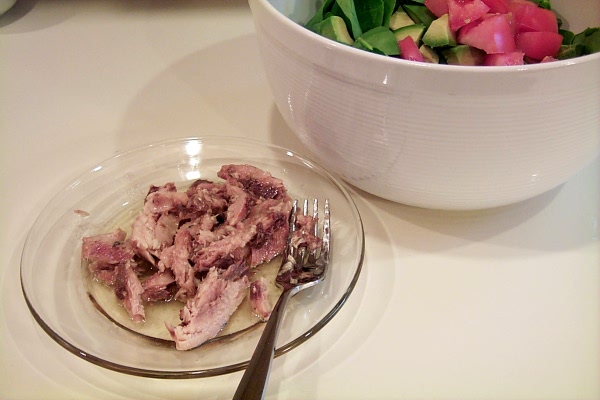
Note to myself: Those glass plates don’t photograph very well. I need to go to some junk shops and find some photogenic dishes.

Blue cheese and garlic are the best of friends. Though I love a good Roquefort, I prefer a good Stilton. I suspect this is because the Roquefort (sheep’s milk) is richer than Stilton (cow’s milk). Blue cheese loves onions, too. The Fat Ladies, every ounce of them English, in one of their cooking shows, made a Stilton and onion soup that I made at home a couple of times, and it was good. The dressing on the salad in the photo contains a whole head of garlic. What a great peasant supper — a garlicky salad, Stilton, and a loaf of homemade peasant bread.

Rural England is a dairy culture, and they make great cheeses. Last time I was there, they still home-delivered fresh milk in bottles. Friends in Wales once served me for dinner a whole array of English and Welsh cheeses, including the Welsh Caerphilly, which you can sometimes find in American stores.

As for the Fat Ladies, one of them (Jennifer Paterson) is dead now. Netflix has the DVDs of their cooking show. Their show is extremely entertaining and rich with ideas for those of us who respect peasant food.

fat-ladies-2010-1.jpg
The Fat Ladies (YouTube)

Le Cordon Bleu in Paris

cordon-bleu-1.JPG
Serving English cooking. The photo is about 10 years old.

If you saw Julie and Julia, in which Meryl Streep plays Julia Child, you saw the film version of what Le Cordon Bleu cooking school in Paris was like in the 1940s. It’s been 10 years since I was in Paris, but I came across these photos recently while pulling files off an old computer.

The event in the photos is an international buffet cooked by the students at Le Cordon Bleu. They make foods from their native cultures. A friend of mine was a student at Le Cordon Bleu at the time, and he took me to this event. I was not surprised to see that the Asian students’ tables were mobbed, while there was only a small group around the English students’ table. That kind of snobbery is a shame, because the English students had cooked an amazing example of an English Christmas dinner.

cordon-bleu-2.JPG
Le Cordon Bleu does these international buffets several times a year, I believe. They are mobbed.

cordon-bleu-3.JPG
Serving Asian cooking…

cordon-bleu-4.JPG

I’ve eaten in lots of places — Bangkok, New Delhi, London, Ireland, Denmark, and all over Mexico and the United States. Paris is not my favorite food city. Parisian food is just too rich and meaty to appeal to me, so I found myself going to Asian restaurants or to this vegetarian restaurant near Notre Dame, Le Grenier de Notre-Dame. The vegetarian food there is only so-so. Americans do vegetarian food much better. The cities with the best vegetarian food, in my opinion, are New York and Los Angeles. The food in Ireland is about a million times better than the food in England, especially outside of London.

I don’t aspire to, or fawn over, haute cuisine or trendy food. To me, it’s all about honest foods skillfully prepared. I’ve been asked a few times to name the restaurant that I’ve most enjoyed. That’s pretty easy: Chez Panisse in Berkeley, Alice Waters‘ restaurant.

A virtual supper for James-Michael

b-cabbage-in-red-sauce-7.JPG
Cabbage in sweet and sour sauce

A friend in California has been asking for my recipe for cabbage in red sweet and sour sauce. Rather than typing something into an email, I thought I’d take some photos and blog it. James-Michael used to frequently request this dish back in San Francisco. For years, we never lived far apart, and we kept up the tradition of Sunday night supper. Many is the time I rode my scooter in a cold fog over Twin Peaks to cook at his apartment. More often I cooked at my apartment, and James-Michael had the more important task of selecting the after-supper DVDs.

Those of you who are more experienced cooks, please excuse the detail. This is a tutorial for James-Michael, who is still a novice cook. As I’ve mentioned before, I rarely follow recipes exactly. Rather, I read recipes for the concept and then run with it.

This concept came from a recipe that was included with my Aeternum pressure cooker, made in Italy, which I bought in the 1970s. The original recipe was for a whole cabbage, with the stalk excavated, stuffed with Italian sausage. Though I used to make the stuffed version, with vegetarian stuffings, for years I’ve mostly just used plain cabbage, cut in half and with the stalk removed. You can make it in a pressure cooker (especially if the cabbage is whole and stuffed), but you can also use a covered pot.

b-cabbage-in-red-sauce-1.JPG

1. I’d suggest starting with a smallish head of cabbage. Remove the outer leaves and wash it. You also need a nice, strong onion. By the way, I bought this cabbage at Whole Foods. It’s organic and was grown in Watauga County, a mountain county not too far to the west of here.

b-cabbage-in-red-sauce-2.JPG

2. Cut the cabbage in halves. Cut out the stalk. Chop the onion coarsely.

b-cabbage-in-red-sauce-3.JPG

3. Cook the onion gently in a tablespoon or so of olive oil. No need to brown it. Just cook it until it’s soft and translucent.

b-cabbage-in-red-sauce-4.JPG

4. Add about one and a half cups of water. Bring the water to a boil. Add about a tablespoon of sugar. I use raw sugar. Also add about three tablespoons of vinegar, some salt, and some pepper. Add two or three tablespoons of tomato paste or ketchup, enough to give the sauce a nice red color. Optional: add a small handful of raisins.

b-cabbage-in-red-sauce-5.JPG

5. I don’t think this dish would come out right without the celery seed. Use about half a teaspoon, or a little more if you like.

b-cabbage-in-red-sauce-6.JPG

6. When all these ingredients have been added to the sauce, boil the sauce gently for a few minutes. Then put in the cabbage. Ladle the sauce over the cabbage. Cover the pot and let it simmer gently for about an hour. Every 10 minutes or so, lift the lid and ladle more sauce over the cabbage. Test the cabbage with a fork to see if it is becoming tender. When the cabbage is tender, consider how much sauce you have. If there’s too much sauce, and it’s watery, then after the cabbage is tender remove the lid, turn up the heat, and boil off some of the water. If at any point while the cabbage is cooking the amount of sauce gets too low, add a little water. Half the art of cooking is getting the sauce right. You want it to be concentrated and savory, never watery.

b-cabbage-in-red-sauce-8.JPG

Here’s your virtual supper! I served the cabbage with pinto beans and rice. To make the rice, I chopped some raw nuts in a blender, then browned the nuts lightly in a pan. When the nuts were browned, I added the rice and stirred in a spoonful of the cabbage sauce to moisten it. Then, at the table, I spooned some cabbage sauce over the rice.

Sourdough starter: no harm in trying

sourdough-2010-03-13-1.JPG
I bought the crock at a junk shop in Madison for 99 cents.

I’m sure I would have experimented with sourdough years ago, were it not for the fact that, while I was working, I didn’t have much time for baking. Plus, I lived in San Francisco for 17 years. Baking sourdough bread at home in San Francisco would seem a bit odd, since the city is full of good sourdough bread.

As a nerd, I could never be content to just blindly follow some directions and end up (hopefully) with sourdough bread. I need to understand what’s going on. As usual, Wikipedia supplies the fundamentals. Because I’ve made homemade sauerkraut, all the concepts are familiar to me. Even experienced sourdough makers often seem to think that what makes sourdough is just yeast. But it’s more complicated than that. Wikipedia explains that sourdough is a symbiotic combination of yeast and lactobacillus. Now we’re getting somewhere…

Yeast is a fungus. It eats sugar, and the useful byproducts of this metabolism are carbon dioxide and alcohol. When we bake with yeast, the carbon dioxide bubbles cause the bread to rise, and the alcohol is baked off.

Lactobacillus is an anaerobic bacteria. It eats sugar and produces lactic acid. Lactic acid is a food preservative. It’s what makes sauerkraut.

In sourdough, the lactobacillus feed mostly on the metabolic byproducts of the yeast. The lactic acid produced by the lactobacillus gives sourdough bread its sour taste. It’s the same process that makes sauerkraut sour. The lactic acid has another important effect in the sourdough starter, which can sit at room temperature for weeks without rotting. The lactic acid lowers the pH of the concoction. This acidity prevents unwanted bacteria from growing. This is the same principle that makes vinegar a preservative, and it’s what keeps bad bacteria out of sauerkraut.

And now we can see why most recipes for making your own sourdough starter start with pineapple juice. The acidity of the pineapple juice keeps the bad bacteria from growing until the starter is mature enough to produce enough lactic acid to do the job. Then we can use water.

So where do the yeast and lactobacillus come from to inoculate the starter? They’re all around us, especially on the grains of wheat.

If you’d like to make a sourdough starter, I’d suggest Googling around for recipes. Read several recipes. I’m using this one, more or less.

I’ll post more photos as the process continues. It may take up to two weeks before I’m ready to make sourdough bread.

sourdough-2010-03-13-2.JPG
Not much to see yet