

The lost word?

crepuscular-1.jpg
Wikipedia photos

crepuscular-2.jpg

Once upon a time many years ago, while looking up a word in an unabridged dictionary, I came across a word on a nearby page that jumped out at me, because it was a beautiful word that described a picturesque phenomenon. I resolved to remember the word, and I promptly forgot it. I do recall the definition. It was a word (or words?) describing something very particular: a beam of light, through an aperture, falling on mist.

For years and year I tried to refind this word, and I failed. Once upon a time, research tools were incredibly primitive — things such as Thesauruses and indexes in the backs of books. Now we have the Internet.

My frustrated attempts to photograph my gothic window, using only a camera with a bad lens that refuses to let its exposure be manually adjusted, made me realize that I’d never gone looking for this word on the Internet.

It was a quick and easy search. There is a scientific name for the phenomenon, the Tyndall Effect, used to describe the scattering of light when it falls on colloidal particles in suspension. A more common description is the two-word term “crepuscular rays,” which even has a Wikipedia entry.

It is possible that, at that early age, I had never encountered the word “crepuscular” before and so was impressed by the word. It is, certainly, a beautiful word. It comes from the Latin word for twilight, crepusculum.

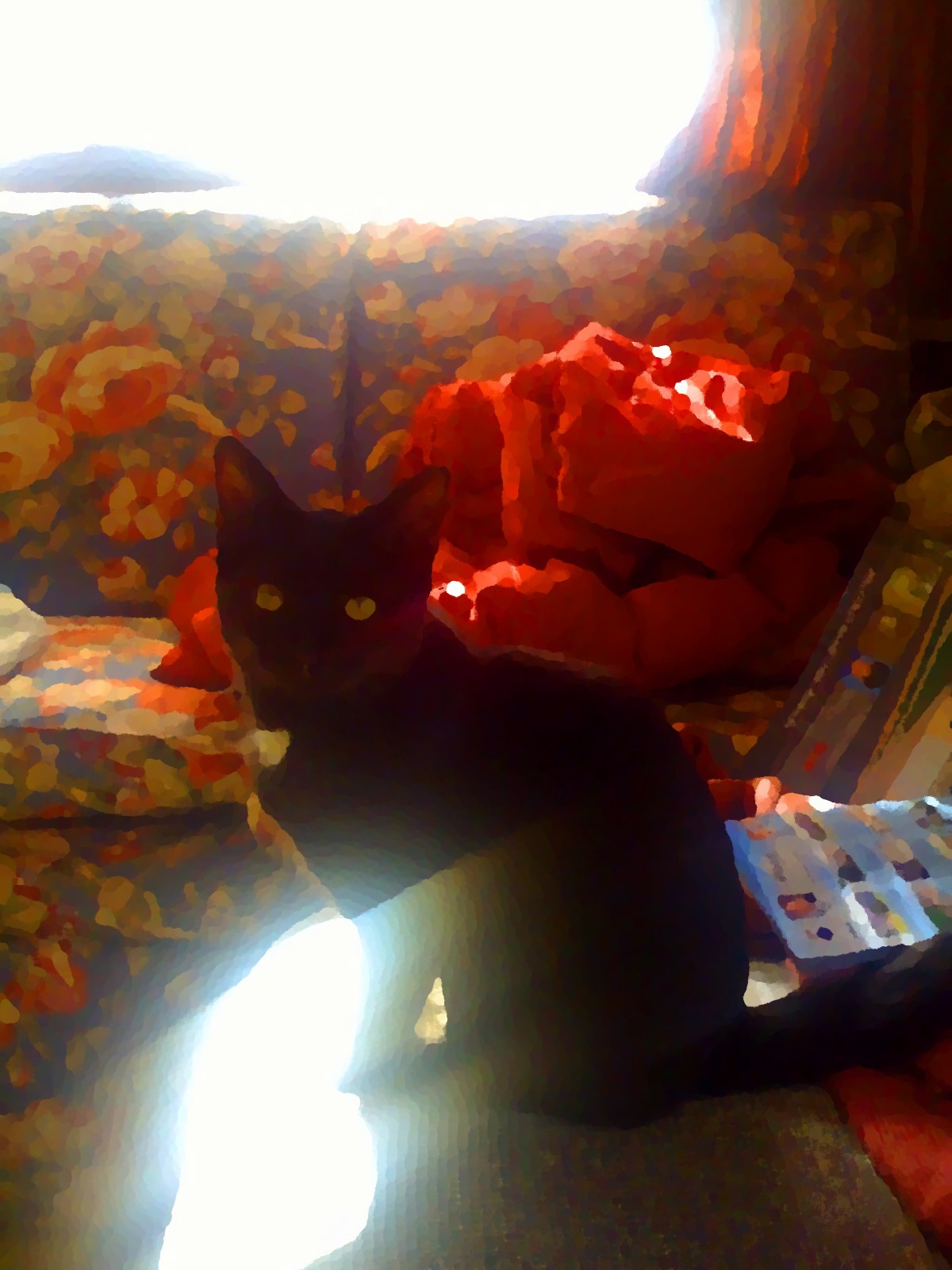
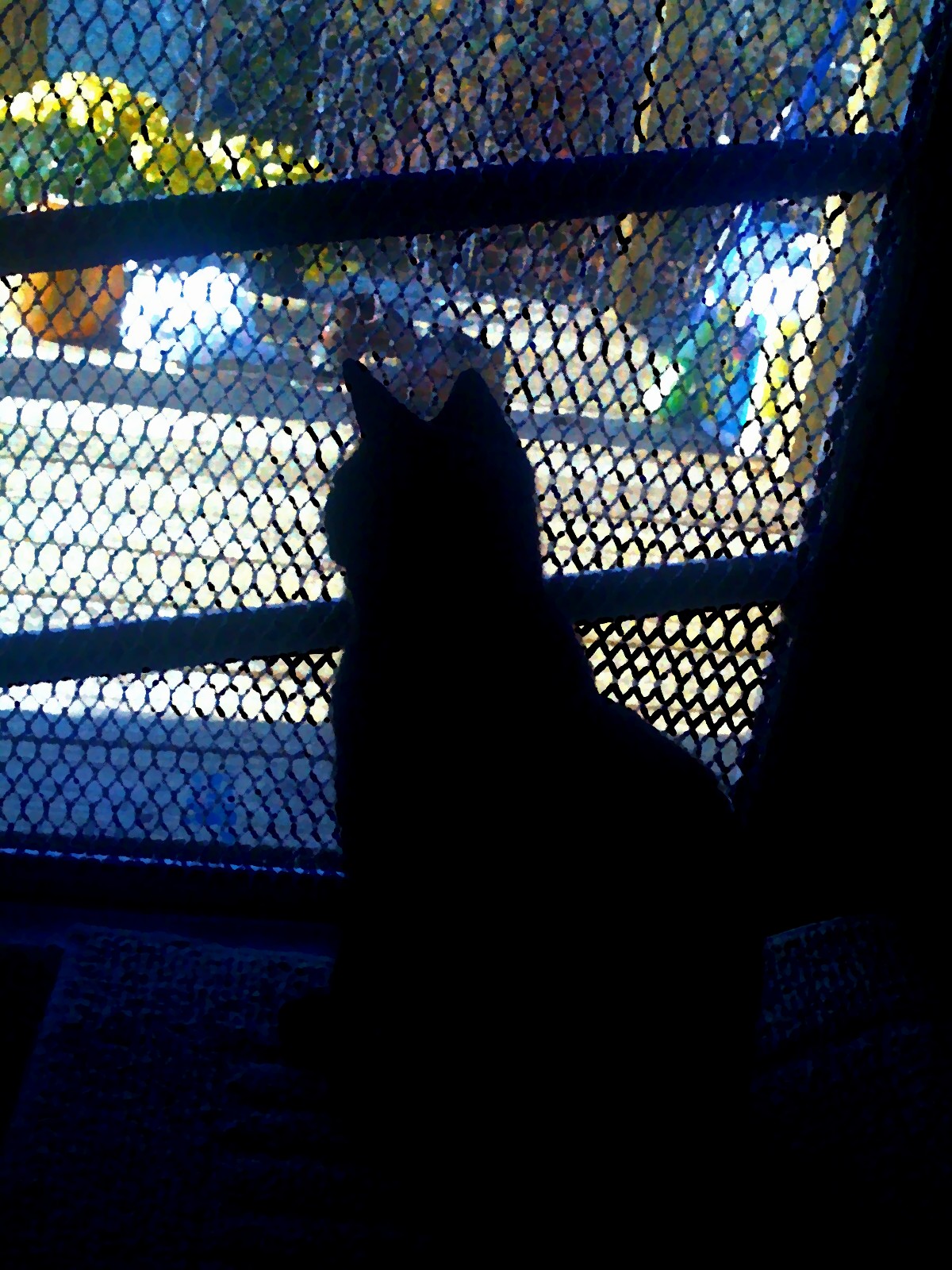
People generally say that cats are nocturnal. I think it is more accurate to say that cats are crepuscular. My cat sleeps at night. But she goes wild at crepusculum, both morning and evening.

What would we do without the Internet? I plan a post soon on yet another unbelievable Internet resource: Google Books.

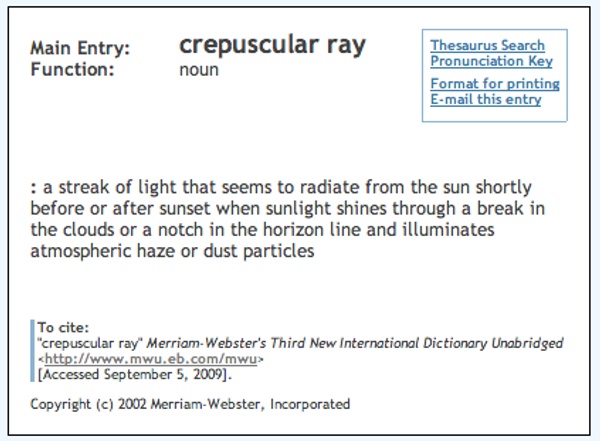
If “crepuscular ray” is the lost word(s), then here is what I would have seen that day long ago in the Miriam-Webster unabridged dictionary:

crepuscular-3.jpg

How you used to get your news…

ap-teletype.jpg

My previous post about the death of Fred Fragler, who hired me for my first job, got me all sentimental about analog communications technology. I mentioned the Associated Press Teletype machines and how it was the job of a newspaper copy boy to look after them. The Winston-Salem Journal had about, oh, eight of them. They made a lot of noise and were kept in their own room adjoining the newsroom.

Here’s a Google video that shows one running, and you can hear how it sounds.

The old Associated Press teletype network used a nationwide network of telephone lines leased from AT&T. Since this technology used telephone lines, it follows that its signal was something that could be carried over the telephone — sound. Sound, of course, can also be carried by radio. Ham radio operators still use this type of signal for communication. It’s radio teletype, which hams call RTTY. It, too, is sound. It sounds like this on the radio. Hams now use computers and computer sound cards to generate and decode this sound.

I’m still working on setting up my radio room here in the new house, and I don’t yet have a radio teletype system set up. When I was in San Francisco, though, I had confirmed (meaning the other side of the communication later sent an acknowledgement) radio teletype contacts with other RTTY operators New Zealand, Japan, the Galapagos, Spain, and Hawaii. Radio teletype actually is a very efficient mode of radio communications, almost as efficient as Morse code.

I’m amused by young’uns these days with their iPhones. “I can call New Zealand with my iPhone,” they might say. Sure they can. But the signal from their iPhone can carry at most for a few miles, then a corporate communication system picks up the data and hauls it to New Zealand. Whereas, in a radio teletype message from San Francisco to New Zealand, there is nothing between the two radios but the ionosphere.

What's up with the sun?

800px-pieter_bruegel_d_a_093.jpg
Pieter Bruegel, 1565, during the Little Ice Age

800px-grassodenhauser.jpg
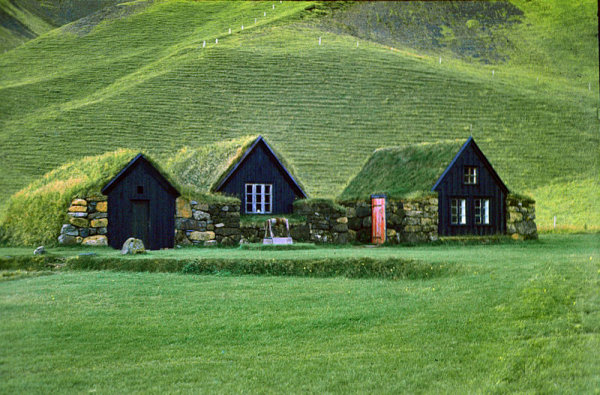
Turf houses in Iceland

It is not commonly understood that the output of the sun goes through cycles. I, nerd that I am, didn’t appreciate this until I got my ham radio license and learned about the 11-year solar cycles that affect the propagation of high-frequency (1.8 Mhz – 30 Mhz) radio signals around the planet. But there are other cycles of the sun, maybe periodic, maybe more random, that have had a huge effect on human history.

The history of northern Europe, not to mention Iceland and Greenland, was greatly affected by climate changes thought to be related to changes in the sun’s output.

A new 11-year solar cycle should have begun by now, but it’s late. There have been 670 days without sunspots through June 2009.

A recent paper by scientists from the National Solar Observatory observes that there have been changes in the sun’s behavior that go back farther than the 11 years of the solar sunspot cycle, at least back to 1992. This is troubling, because if the trend continues, the solar situation would look more and more like the Maunder Minimum, which is blamed for the Little Ice Age in Europe, which lasted for hundreds of years, starting as early as the 13th century.

This is all very complicated, and the data is sketchy, but if you’re a weather watcher, and a climate watcher, as I am, then this is something you’ll want to read up on and keep an eye on.

No town halls, Virginia?

virginia-foxx-2up.jpg

If you do a Google search for “Virginia Foxx,” you’ll see that every time she has spoken on the House floor recently, she has embarrassed North Carolina’s Fifth District. It’s not just that she is ignorant and therefore almost always wrong. Or even that she repeats the vilest and most thoroughly debunked right-wing propaganda. It’s that she’s mean.

While GOP operatives and hate-radio hosts are dispatching mobs to shout down home-district town halls by Democratic representatives, Rep. Virginia Foxx isn’t even having a town hall. I called her Clemmons office to check her schedule. Sorry, nothing but a “telephone town hall,” which is of course a one-way affair. She talks, we listen. Watauga Watch reports that she’s only got fund-raisers on her summer schedule.

A booger from the woods comes to get Lily

s-treed-2009-03-13-2.JPG

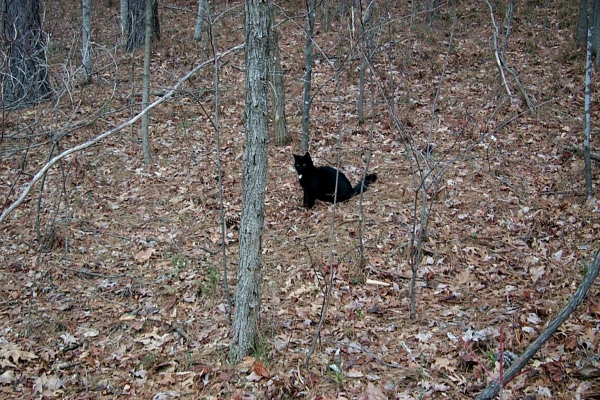
Lily, who is about nine months old now, has played outside and practiced her tree-climbing since she was a kitten. Her practice paid off this morning. A dog got her up a tree. I heard barking and ran outside with the broom. A nondescript dog I’d never seen before was bouncing around the tree, and Lily was about 20 feet up a slender, bent pine tree, holding on for dear life. I chased the dog off and made poor Lily wait while I got the camera to record her humiliation. I was afraid she’d be afraid to climb down, but she made a very well-controlled descent, first head-first, then tail first, and came to me with her fur ruffled to be petted.

I’ve always told her that there are boogers in the woods, but she doesn’t need to be told. She hears the boogers all the time, though this is the first time one ever came to get her.

Now I’m rethinking letting my chickens roam free. My new chicken house will be ready as early as next week, and I was hoping to get biddies in early April.

s-treed-2009-03-13-1.JPG
Safely down

I call, she comes. What a concept!

aab-lily-reposes-001.JPG
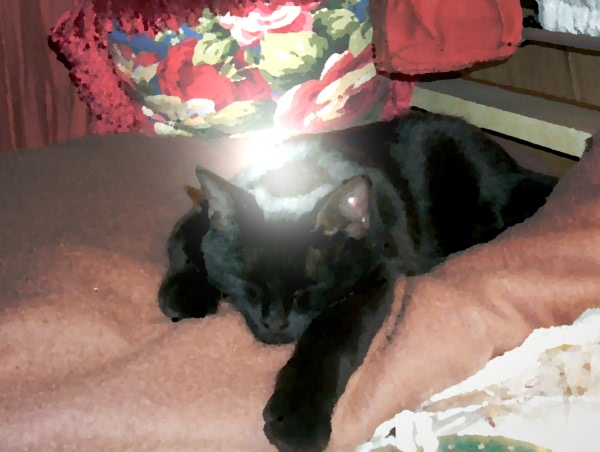
Lily reposes. Digital effects applied in Gimp photo editor.

I have raised several dogs from puppyhood, and so I have pretty well-developed theories about how to raise puppies. Lily, who is now about nine months old, was about eight weeks old when she came to me. I had to play kitten-raising by ear.

Dogs, of course, need training. Train a cat? Ha! They can learn basic rules fairly well: Don’t scratch, don’t bite, don’t get on the table, don’t scratch the furniture. Lily, I think, has turned out just fine. The guidelines for kitten raising, it seems to me, boil down to: Give them a lot of affection and attention, and always respond to them in a consistent, predictable way that they can understand.

I thought that Lily would never be motivated to come when I call. But these past few evenings, she has been doing that. She knows that one of the unbreakable rules is that she can’t go out until the sun is up, and she must be in before dark. She likes to stay out all day when the sun is shining and it’s not too cold. An hour before sunset, she’s probably sleepy and hungry. So when I go out and call her, I soon hear a meowing in response, far off in the woods. And before I know it, she’s at the door.

I’m pretty sure she’s aware that the woods are dangerous after dark if you’re a kitty cat.

Cat portraits

oil-img_0612.JPG
Lily in the morning light — James-Michael Gregg

A friend was visiting from California a couple of weeks ago, and he took hundreds of photos of Lily with his iPhone. Two photos, in particular, caught light and color in a wonderful way. I used Gimp to apply an “oilify” effect.

oil-img_0653.JPG
Lily in the morning shadow