
The (distant) future of eggs
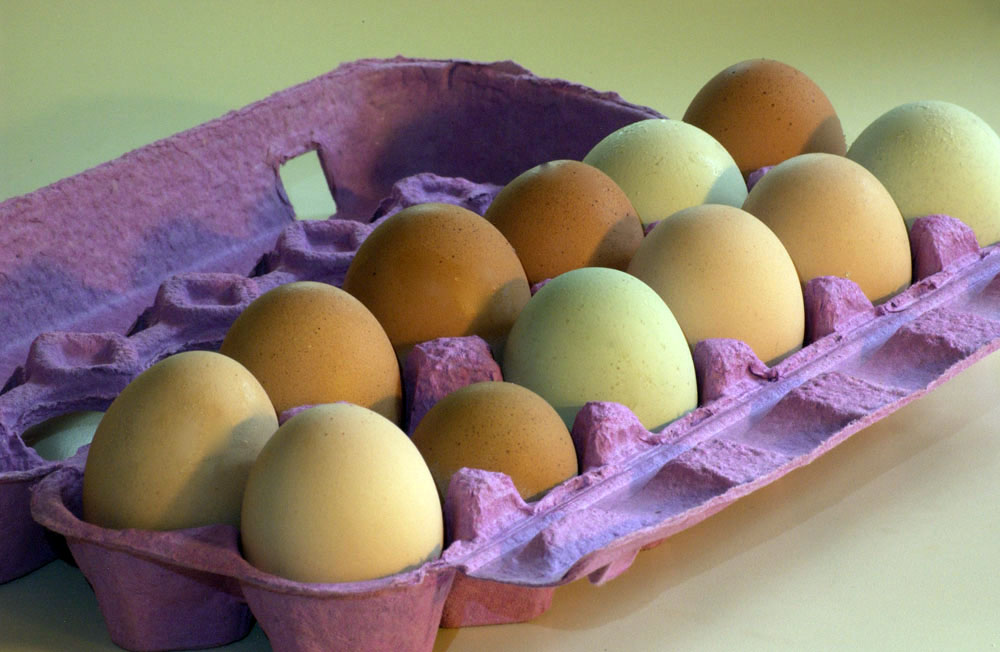
Home-laid abbey eggs
It has been nice to see a number of stories in the past month about major restaurant chains switching to cage-free eggs. But it’s a slow process. There’s an awful lot of industrial chicken infrastructure that has to be changed. And even hens that aren’t in cages are not exactly living in chicken heaven. The majority of cage-free hens will still be packed into big, crowded barns with no access to the outdoors.
Wendy’s restaurants announced yesterday that they will go cage-free by 2020. Starbucks and Panera also have promised to go cage-free by 2020. McDonald’s and Subway will take 10 years to go cage-free — 2025.
This is a start. Surely it was the market, or “consumer sentiment,” that demanded this change. People are becoming increasingly aware of our cruelty to animals kept on industrial farms. However, I suspect that, for psychological reasons, most people have less denial in thinking about chickens raised for eggs, because laying hens aren’t slaughtered (not, at least, when they’re still young). It’s easier to think about the lives of laying hens than about the short lives of broiler chickens.
Here’s a link to a nice Chicago Tribune story on cage-free egg farming. A farmer is quoted as saying that he keeps his hens for over seven years before they’re sent off to be made into soup. I’m a bit skeptical that hens are kept that long.
Though I love knowing that all my eggs are laid just up the hill, I’m very aware that having chickens is not for everybody. If I were buying eggs, I’d just pay extra for the most hen-friendly eggs I could find.

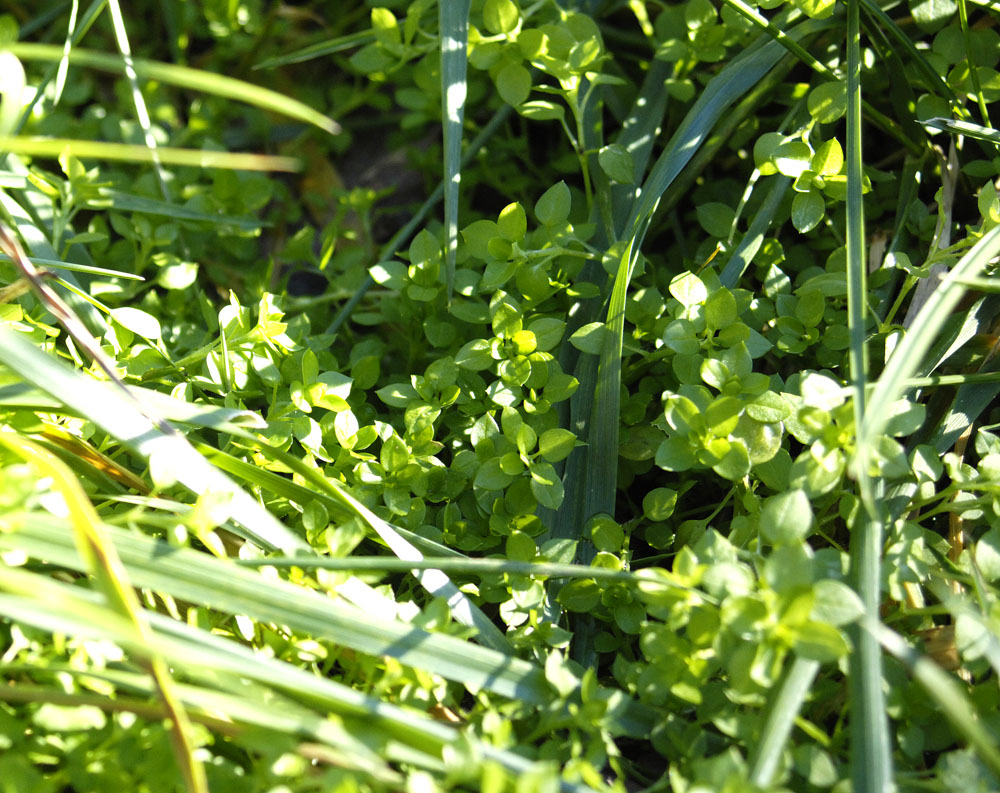
Given a choice on a January day between a grassy orchard and the woods, the girls prefer the woods, though they also spend time in the orchard to get the clover and chickweed.
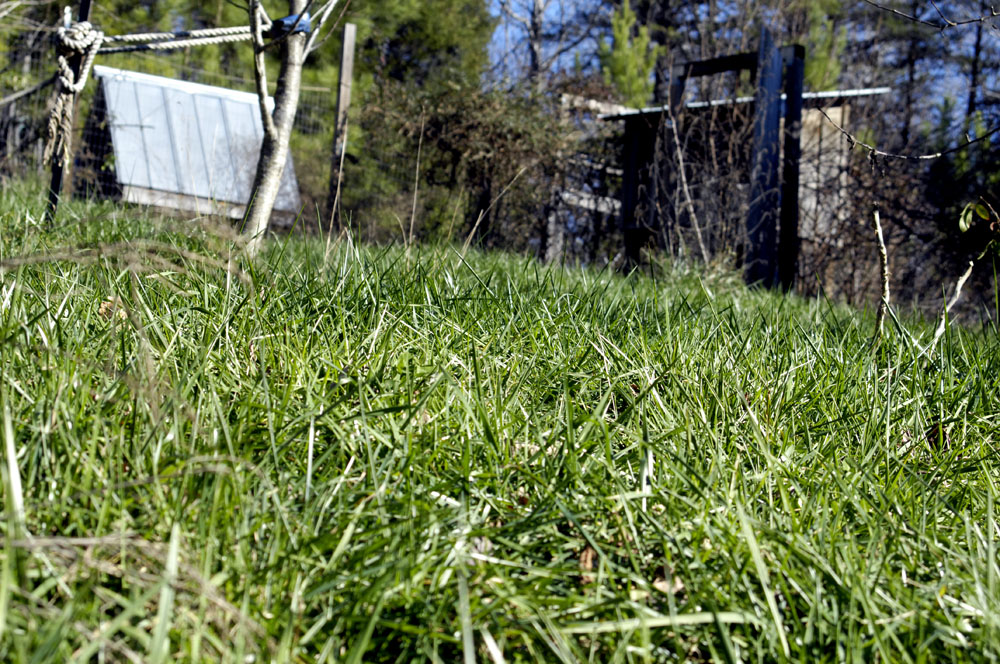
Green grass and chickweed from a warm and wet December
Blue-filtering eyeglasses

My eye doctor urged me to wear blue-filtering glasses while I’m in front of a computer screen or an iPad screen. Though I love the Retina display on my new 27-inch iMac, the screen does seem to be — at least subjectively — more intensely blue than the screen on my old iMac. So I’ve started wearing my blue-filtering reading glasses when sitting in front of the iMac.
The concern for ophthalmologists is high-energy visible light. There is evidence that it is a factor in age-related macular degeneration. Too much blue light also may affect the brain in a way that interferes with sleep.
Adding the blue-filtering feature to a pair of new glasses doesn’t add all that much to the cost of the glasses. Notice in the photo above that the computer screen looks slightly more orange when seen through the glasses, because the blue light is reduced.
If you’re in front of computer screens a lot, and especially if you’re older, this is something worth discussing with your eye doctor.
And, of course, keeping the brightness of the screen as low as is comfortable will help preserve the computer screen, use less energy, and reduce the strain on your eyes.
The ability (and inability) to judge character

You would think that after hundreds of thousands of years of evolution as social beings, we humans would be pretty good at judging the character and intentions of other humans. The sociobiologist E.O. Wilson has written, for example, that we humans constantly study other humans and that this explains our insatiable demand for stories, or why we love to gossip. Even our pets are very good at perceiving our intentions.
And yet a sizable chunk of the American population is dangerously bad at judging character. Not only that, this sizable chunk of the population all too often sees deranged and narcissistic people as political and religious leaders and sends them money by the millions and hundreds of millions of dollars. This is one of the most frightening and unpredictable facts of American politics. I am not terribly concerned about sexual peccadillos, except for the extreme hypocrisy of all-too-many preachers. Private sexual peccadillos don’t get us into wars or prey on the poor so that preachers and millionaires can ride around in jets and avoid paying taxes.
Can the ability to judge character be tested? Are there ways of impartially establishing who is good at judging character and who is not?
As early as 1929, MacMillan published Studies in the Nature of Character: General methods and Results by some academics from Columbia University. Since then, a good bit of research has been published on how good we are (or are not) at judging the character of others. How is this research done?
The basic method, as far as I can tell from my own admittedly limited research, is to go to a group of people who know each other and to ask those people to predict how others will perform on “personal inventory” tests. There are many such personality tests that clinicians use, for example the Minnesota Multiphasic Personality Inventory. Then you compare people’s predictions with other people’s actual performance on the tests and look for statistically significant correlations.
What are some of the factors that correlate with being a good judge, or a poor judge, of character? Here are some of the candidates, with a rough description of what researchers have found:
• Age: Though children improve in their ability to judge character between the ages of 3 and 14, there is no evidence that older people get better at judging character.
• Sex: There no convincing evidence that men or women are better at judging character.
• Family background: This area has not been well studied, but so far there is no evidence that family background matters much.
• Intelligence: Now we’re getting somewhere. Smart people are indeed better at judging the character of others. Smart people also, unsurprisingly, are better at judging the intelligence of others.
• Training in psychology: This is murky, but it may well be true that trained psychologists are no better than the rest of us at judging character.
• Sensitivity and artistic ability: There is pretty good evidence that artistic and sensitive people are better judges of character. People with literary abilities may be particularly good at judging character.
• Emotional stability: The evidence here is scant, though it is pretty clear that people who are excessively anxious, troubled by obsessions, etc., are poorer judges of character.
• Social skill and popularity: Though good social skills seem to help people judge character, those who are the best judges of character tend to be capable of a kind of scientific social detachment. For example, physicists may be better judges of character than psychologists. Poor judges of character are more socially oriented than better judges. It may follow (though I did not find any specific research) that introverts are better judges of character than extraverts.
And finally:
• Good character: People of good character are probably better equipped to judge the character of others. It’s important to keep in mind a famous statement by Gordon Allport:
As a rule, people cannot comprehend others who are more complex and subtle than they. The single-track mind has little feeling for the conflicts of a versatile mind. People who prefer simplicity of design and have no taste for the complex in their aesthetic judgments are not as good judges as those with a more complex cognitive style and tastes.
Unfortunately I could not easily find any research that looked for correlations between religiosity and the ability to judge character. But insofar as I myself am able to judge the character of others (feel free to judge me!), I would have to say that evangelical, salvation-oriented religious types are among the very worst judges of character. As for why people send millions of dollars to preachers like Jim Bakker or Jimmy Swaggart, it helps to remember that half the population have IQs of under 100 and live pretty hard lives. Getting money and votes out of people who are not so smart and not doing very well is now a think-tank science — the smart studying the not-so-smart so as to take political and economic advantage of them. Unfortunately, that may be the No. 1 key to American politics at present.








Pancakes: Problems and solutions
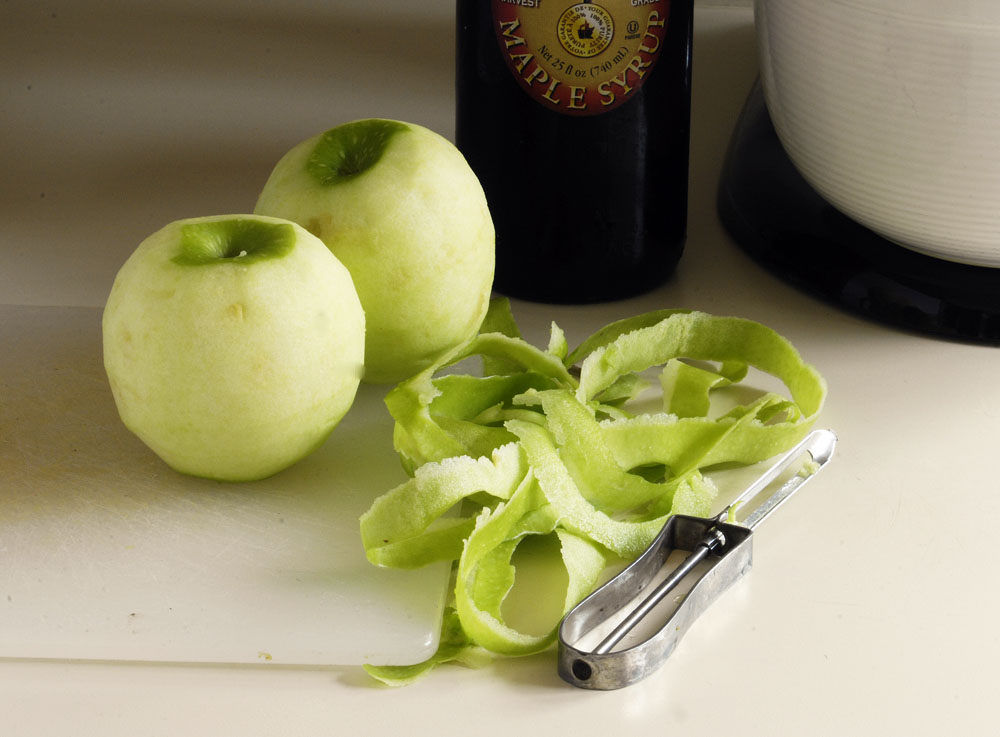
There is no way to make pancakes into a truly healthy breakfast. But, sooner or later, we’re all going to give in to the temptation of eating them. I’m always looking for ways to make eating comfort foods more of a misdemeanor rather than a felony.
To be sure, it has been decades since I’ve eaten a pancake made of white flour. Yuck. My flour of choice at present is sprouted whole wheat flour. But it’s still just flour. How might we get the carb load down and the fiber and nutrition load up?
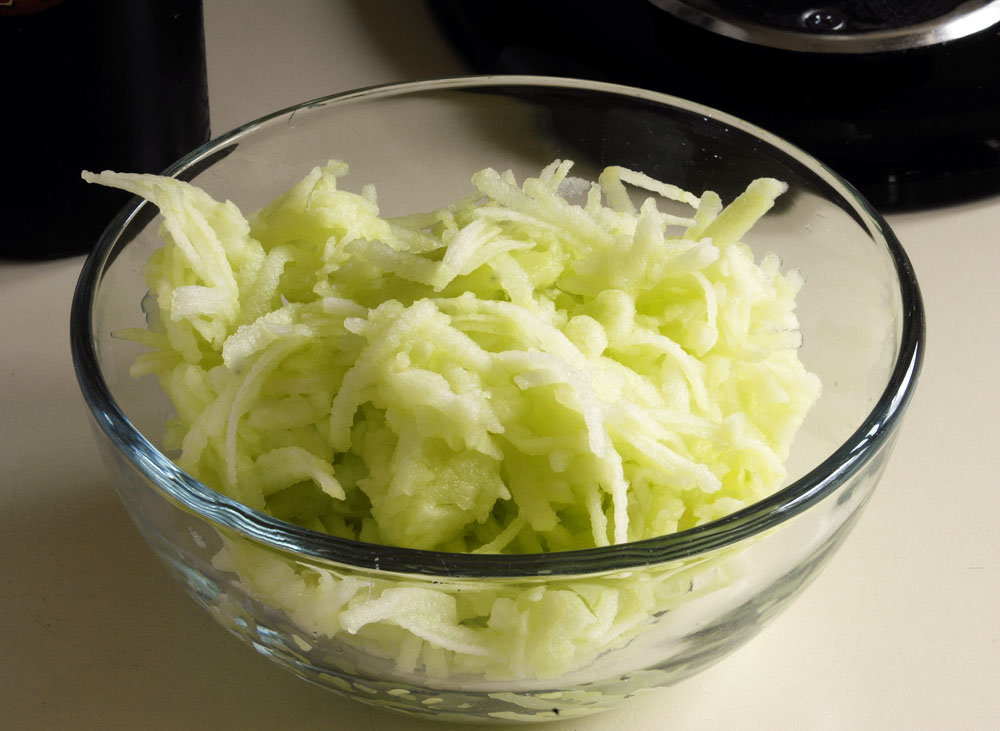
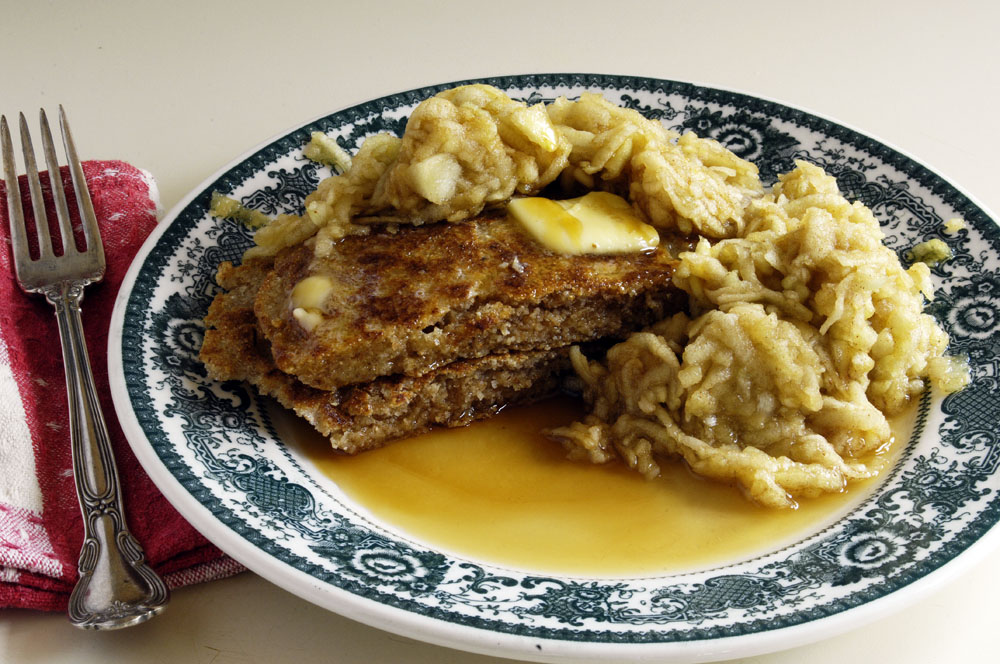
I’ve often used cooked apples as a topping for pancakes, but how might we do that with raw apples? This morning I grated two Granny Smith apples (the KitchenAid shredder made quick and easy work of it). I tossed the apples in maple syrup with some cinnamon.
That meant one pancake for breakfast instead of two, plus two fewer apples waiting in the refrigerator for me to figure out what to do with them. The apples were yummy prepared that way. There are worse crimes.
Farms and farmland: What are the trends?
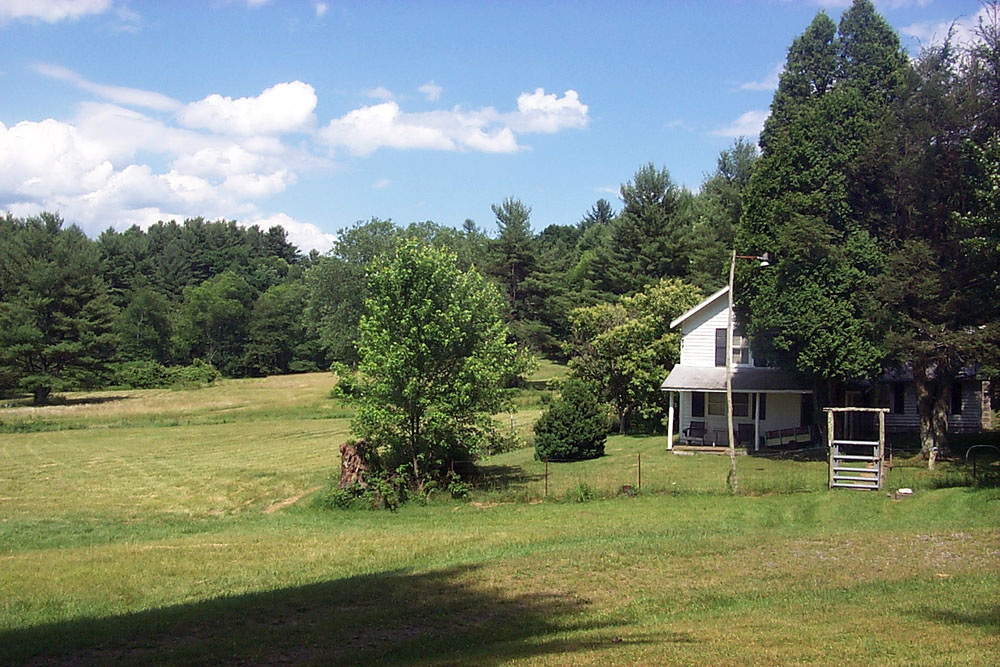
This is the farm of my great uncle Barney Dalton in Laurel Fork, Virginia. Barney was born in 1876 and died in 1972, but his farm is still owned by his heirs, who work hard to keep it looking like it looked 75 years ago.
A story in this morning’s Winston-Salem Journal (by my friend Meghann Evans) reports that Forsyth County, North Carolina, is working on a plan to preserve farmland. I’m all for it, though for Forsyth County it would seem that the plan is a little late. Though Winston-Salem and Forsyth County have not grown as fast as Raleigh and Charlotte, developers have been buying up farmland and turning it into suburbs for decades. It has been more than 25 years since I lived in Forsyth County, but decades of uncontrolled suburbanization is one reason why I would never be able to live in such a place anymore.
Meghann’s story about Forsyth County got me wondering about the trends in farmland.
Just a couple of weeks ago, actually, I was at a Stokes County Arts Council event and saw a friend who is co-owner of Stokes County’s largest real estate company. “How’s business?” I asked her. “Have property values gotten back up to the pre-crash peak?”
She said that farms are selling very well but that homes are still a bit of a drag.
I’m going to guess that one of the reasons that Forsyth County can even afford to talk about preserving farmland is that farmland is more valuable than it used to be. Developers can no longer buy up farmland dirt cheap and turn it into suburban gold. Driving through a place like Forsyth County, evidence of this change is easy to see. Suburban housing is still being built, but the housing is much more dense than it used to be. That is, new suburbs don’t sprawl as much as they used to because the land is not as cheap. Houses are much closer together. Much of the new housing consists of multi-story, multi-family units.
Worldwide, farmland is increasingly seen as a good longterm investment. Much of the investment in farmland is coming from corporations. In fact, here in Stokes County, one of the biggest land transactions in the past couple of years involved 1,000 acres of farmland in the Dan River bottomlands. The buyer was a corporate outfit from Greensboro. I still don’t know what they plan to do with the land.
One surprising new trend is that agricultural degrees are in great demand, and there aren’t enough graduates to fill the available jobs. Just this year, the U.S. Department of Agriculture reported that 60,000 high-skilled jobs in agriculture are expected each year but that there are only about 35,000 graduates available to fill the jobs.
In a news release earlier this year, Agriculture Secretary Tom Vilsack said, “There is incredible opportunity for highly-skilled jobs in agriculture. Those receiving degrees can expect to have ample career opportunities. Not only will they be likely to get well-paying jobs upon graduation, they will also have the satisfaction of working in a field that addresses some of the world’s most pressing challenges. These jobs will only become more important as we continue to develop solutions to feed more than 9 billion people by 2050.”
Though the corporatization of farmland ownership is disturbing, I nevertheless see it as an encouraging trend that farmland is becoming too valuable to be trashed by housing developers out to make a quick buck. For a young person trying to figure out what to do in college these days, I’d suggest horticulture with a minor in English. Wouldn’t that improve the world?
Lily (the abbey cat) gets nervous if her food bowl gets low and she can see the bottom of the bowl. She nags me until I fill it, and then she feels secure again. I feel the same way when I’m in places that are too densely populated, too dry, or otherwise too dead to support an exuberant population of living things. I need trees, rain, streams, good dirt, my own water from a well, an orchard, a garden spot, and some chickens. If the deer, voles, raccoons, possums, rabbits and even snakes rush in to live off my spot of land, then I’m flattered. At least I’ve got something for them to take.
Normally I’m at odds with trends. But the trend toward valuing and wanting to be near farmland is a trend I’m glad to see.
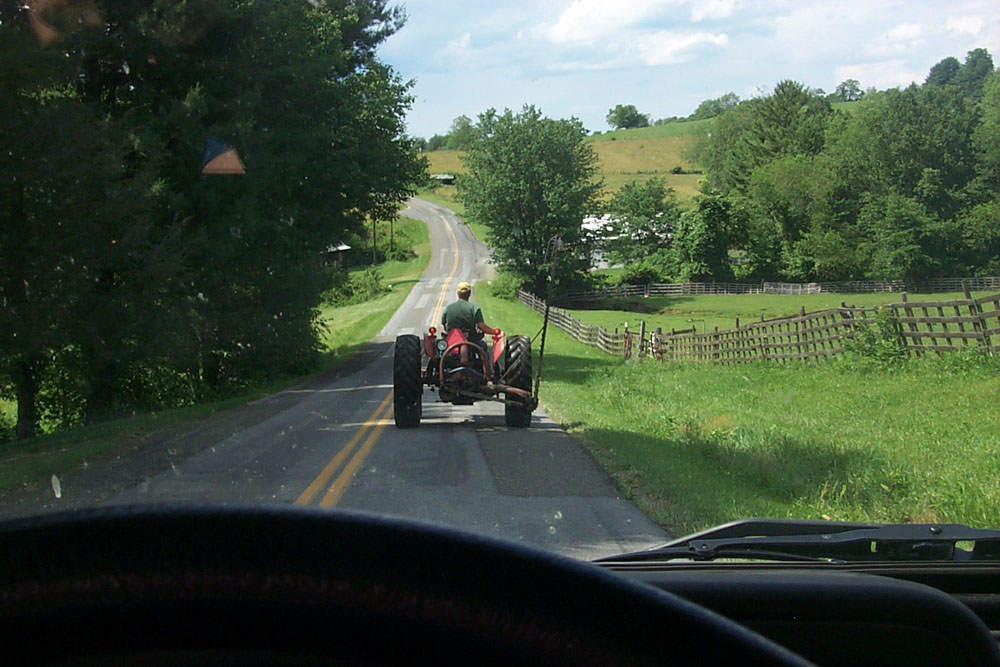
Nearby farmland
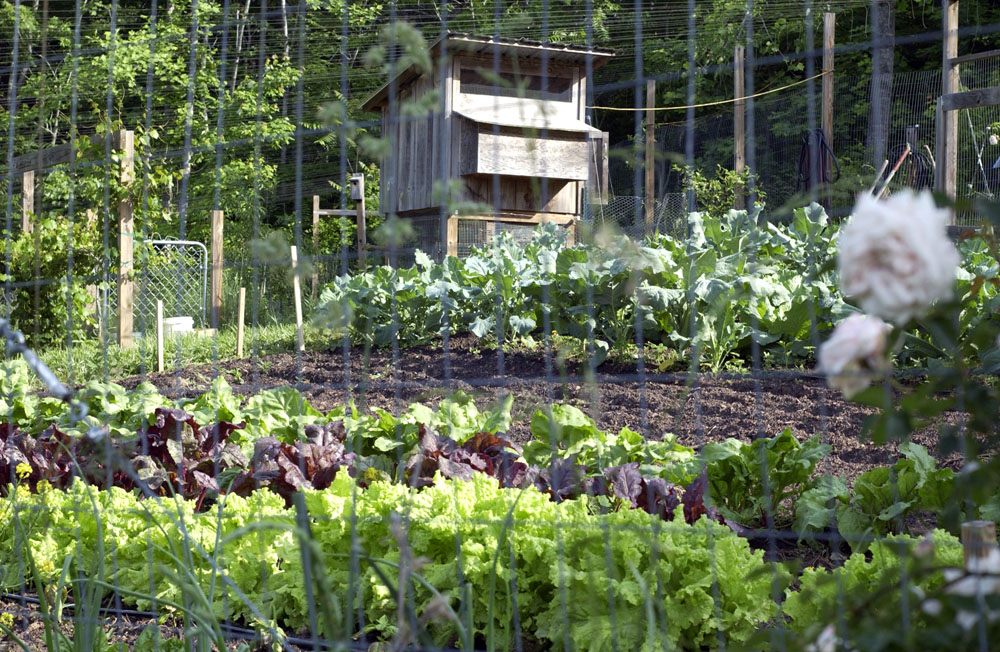
The abbey garden in a good year
Someone wants a water bowl

But if I put out a water bowl for the squirrels, then the possums would be wanting one, too.
Nipped in the bud, or nearly so

Unseasonably warm weather teased my spring-blooming camellia into unwisely blooming too early. Some buds survived the weekend freeze, and this partly opened flower survived, but the other blooms turned brown.

It was the same story with the Carolina jasmine.

The late roses are all gone.
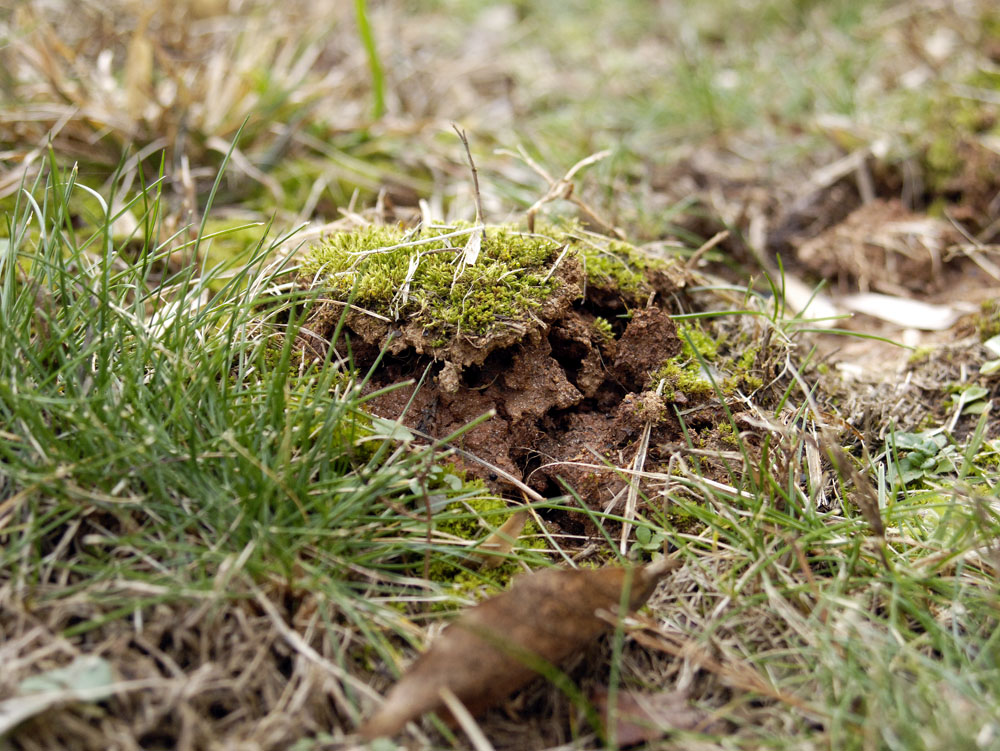
For several years, I’ve been observing the work of the moles in the yard. Sometimes they’ll work an area so thoroughly that the ground feels weakened and soft. But ultimately, if they do any harm, I can’t detect it. In fact, I think they improve the soil and the growth of the grass by aerating the soil. They particularly seem to work areas where the grass is not growing well and needs aeration, so that’s a good thing.
A new iMac at the abbey — and three Mac reviews

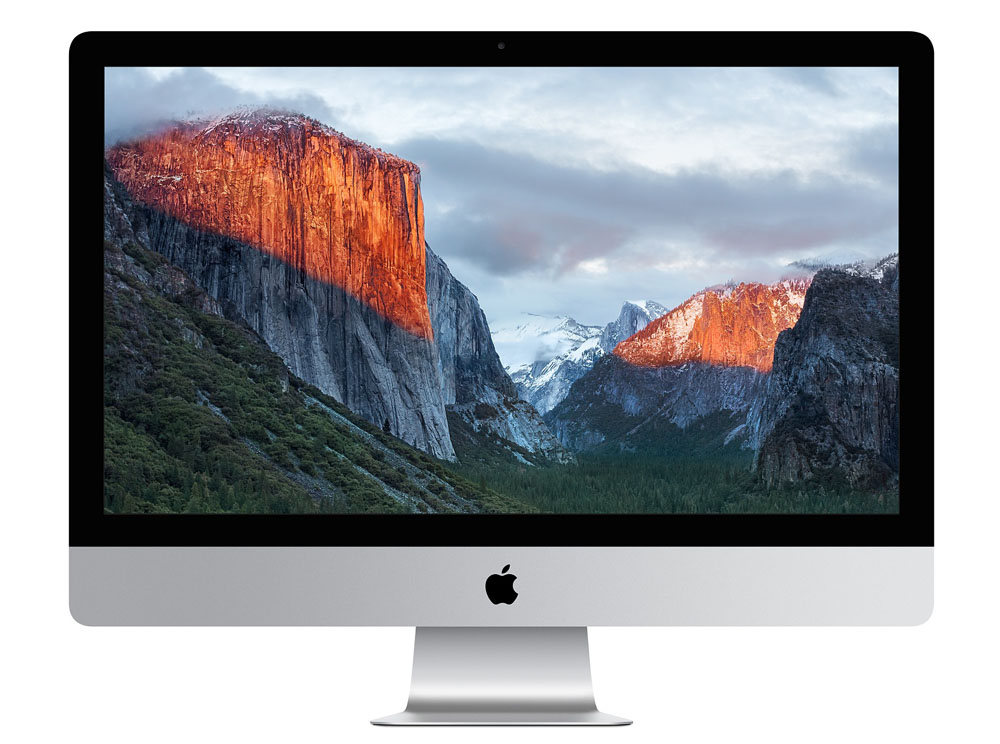
My old iMac was dying. It was eight years old and had served me well — no glitches, no grief, no fuss, no drama. But hard disks can’t last forever, and its hard disk was dying. The old Mac had started to limp — freezing and making racheting noises as the hard disk tried to read bad sectors. The old Mac is fine except for the dead disk. Sometime soon I will open it up, replace its hard disk, and it will live again as a backup computer. iMacs are not cheap, but in the long run they’re a bargain. I got my money’s worth, and then some, out of that Mac.
The new iMac is a 27-inch model with the Retina 5K screen, built in late 2015. It has eight gigabytes of memory and a 1 terabyte fusion drive.
I had considered buying one of the new 21-inch iMacs with the Retina screen, but the high-end reviews recommended against the 21-inch iMac in favor of the 27-inch iMac. For one, the price difference isn’t all that great. For two, the 21-inch models are a generation behind with the Intel processors. For three, the 21-inch models are not expandable. Their memory is soldered in, so you can’t change or add memory chips. For four, the 21-inch model has a slower and inferior graphics controller. So, for the few extra hundreds of dollars, you get not only a much bigger screen with the 27-inch models, you also get better internal hardware.
What I like:
• The screen is enormous! The clarity of it is incredible. At 227 pixels per inch, it’s impossible to see individual pixels. Black type on a white screen looks like fine printing on glossy paper, nicely lit. This monitor also has a larger color gamut than earlier LCD monitors, meaning that it can display a wider range of colors.
• It’s fast. My old iMac was pretty slow by comparison, especially when starting up applications or while paging through a lot of photographs. The fusion drive in the new Mac is probably a major factor in permitting most apps to start up in less than a second.
• Migration was easy. I used Apple’s Migration Assistant application. I had made regular backups of my old iMac onto an external hard disk, so Migration Assistant pulled all my files in from the backup disk. That took about 45 minutes. Then, when I first logged into the new iMac, all my stuff was there — mail, photos, bookmarks, and documents.
• The sound quality is remarkable. They seem to have made the whole computer into a speaker cabinet. There’s a little too much resonance (a little like the acoustics of a bucket), but the bass response and overall sound quality are much better than my old iMac.
What I don’t like:
• The keyboard that comes with the new iMacs is small and hard to use. The keyboard does not have page up/page down keys (which I use all the time). Even worse, to save space, the up-arrow and down-arrow keys are actually merged into a single key — half a key each. I have no idea who designs Apple keyboards. They seem to think that laptops now set the standard for keyboards. I despise laptops, not least for the keyboards. The keyboard that comes with new Macs, a Bluetooth keyboard, has no USB ports on the sides. So I went back to my nice, wide extended keyboard.
All in all, the new 27-inch iMac is a magnificent piece of hardware. I hope it will last eight years like its predecessor.

El Capitan looks and behaves pretty much just the same as the previous version of OS X, Yosemite. In the previous couple of OS X updates including Yosemite, Apple concentrated on getting OS X to interact smoothly with iOS (iPads and iPhones). In El Capitan, like it or not, Apple seems to be concentrating on internal changes in the operating system to make it more difficult for rogue software (and dumb users) to screw things up. In iPads and iPhones, iOS prevents you from getting under the hood at all. In OS X for iMacs and laptops, you can still get under the hood. But, increasingly, Apple is limiting what you can do (unless you really, really know what you’re doing).
It’s easy to understand why Apple is doing that. They have millions of devices in the field. Apple’s reputation depends upon those devices working properly. But users are highly inclined to do stupid things, and there are criminals and predators all over the Internet trying to hijack every device they can and install their malware on it. When Apple makes these kinds of changes that shut you out of your own computer, they always talk about security. But I suspect that a bigger issue than Internet security is keeping owners of Apple devices from monkeying with things, and making it harder to install crapware.
Before I went to the Apple Store to buy the new iMac, I looked up the address and hours on line. Google also showed me customer reviews and customer ratings for the Greensboro Apple store. There were lots of angry, one-star reviews. A typical one-star review might come from an iPhone user whose iPhone was giving trouble. This user would go to the Apple Store irate, blame Apple for whatever was wrong, and demand that the problem be fixed right there on the spot, right this instant. If that didn’t happen, they wrote a one-star review.
Over the years, the advice I’ve always given to people about keeping their computers running smoothly is not to install a bunch of crap on it. Most of the time, when something goes wrong, it’s because of a crap app. In El Capitan, Apple has new safeguards to keep crap apps out. For one, Apple wants signed certificates in software now that identify the software developer and the develop’s good standing with Apple. For two, it used to be that with the “root” password, or system password, you could tinker with any part of the system on an iMac or laptop. In El Capitan, “root” no longer has absolute privilege. There’s another layer of protection that keeps owners — and software — sandboxed to limit the damage that can be done. I have mixed feelings about this. On the one hand, as a veteran Mac user (since the 1980s!), I want to be able to do whatever I want to a system that belongs to me. On the other hand, less experienced users, when they (or a crap app) screw things up, they think it’s Apple’s fault and expect Apple to fix it for them.
It’s sad, in a way, to see an Apple store getting so many bad reviews for customer service. But is there a Microsoft store in your town? Can you walk into a Microsoft store, step up to a bar, and get a Microsoft “genius” to work on your device? Can you even call Microsoft on the phone? Of course not. Even if the Apple stores are packed, and even if you have to wait for someone in a red shirt to help you, at least Apple is there. When you buy a new iMac, you get 90 days of free “Apple Care” in addition to the one-year warranty. A lot of one-star reviews from angry iPhone users does not necessarily mean that Apple is bad at customer service.
My big concern is about how quickly these restrictive updates in Apple’s OS X cause older software to stop working. I absolutely depend on the Adobe Creative Suite, which includes Photoshop and, for publishing work, InDesign. I have version 5.5 of this Adobe software, which is one of the last versions that you can actually own outright. These days, Adobe sells this software in “cloud” versions for which you buy a “subscription” and pay for the software monthly or annually. You don’t own the software; you just rent it and keep on paying. Sooner or later, because Adobe no longer supports or updates Creative Suite 5.5, a new OS release from Apple will break the Adobe software, and I’ll be up the creek. But, so far, Photoshop and InDesign seem to work OK with El Capitan.
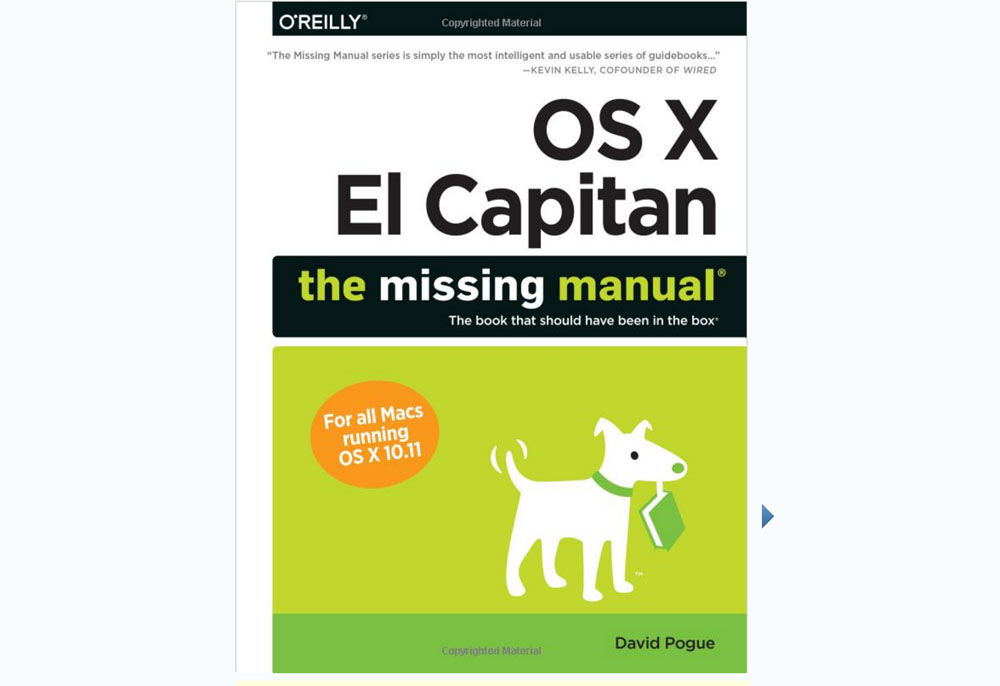
OS X El Capitan: The Missing Manual, by David Pogue. O’Reilly Media, 846 pages, November 2015.
Do you need this book? Probably not, not unless you’re at least a bit of a nerd, and if you have limited experience with Macintoshes, and if you’d like to do more with your Mac. At 846 pages, I wanted this book to get more under the hood and describe the mysterious inner workings of Apple’s OS X operating system. But that’s not really what the book is about. It’s about the kind of stuff that regular Mac users might want to do. If you’ve been using Macs for years, then much of what’s contained in this book is stuff that experienced Mac users “just know.”
Personally, I’m curious about the inner workings of Macintoshes. OS X has changed significantly in the past few years. I have been a Unix user since 1984. Unix, for years, has been my preferred operating system and the operating system that I’m most comfortable with. That’s one reason I use Macintoshes — they’re Unix boxes, under the hood. Apple, however, has taken Unix in a direction very unlike where Linux (now in many flavors) or Sun’s (now Oracle’s) Solaris has gone. Without some documentation, it would be pretty near impossible to see what changes Apple is making in the Unix system that lies under the graphical user interface.
To really know what’s going on under the hood, you’d need to see documentation of the type that software developers use. You’d have to get it from Apple, and I assume you’d have to sign a nondisclosure agreement. But for a technical overview of what’s under the hood in El Capitan, here’s a link to a 40-page “white paper” from Apple.
On the other hand, if you’re a person who can learn from books, and if you’re a little afraid of your Macintosh and would like to become better acquainted with it, then Pogue’s book is probably the best book that you can get on the subject. There are lots of illustrations to show you what you should see on the screen. There’s a good index. The book is nicely organized. And there’s an appendix on troubleshooting.
With books like this, you just might be able to solve some of your own Mac problems without standing in line at the Apple store.
Sesame sauce — a vegan option for noodles
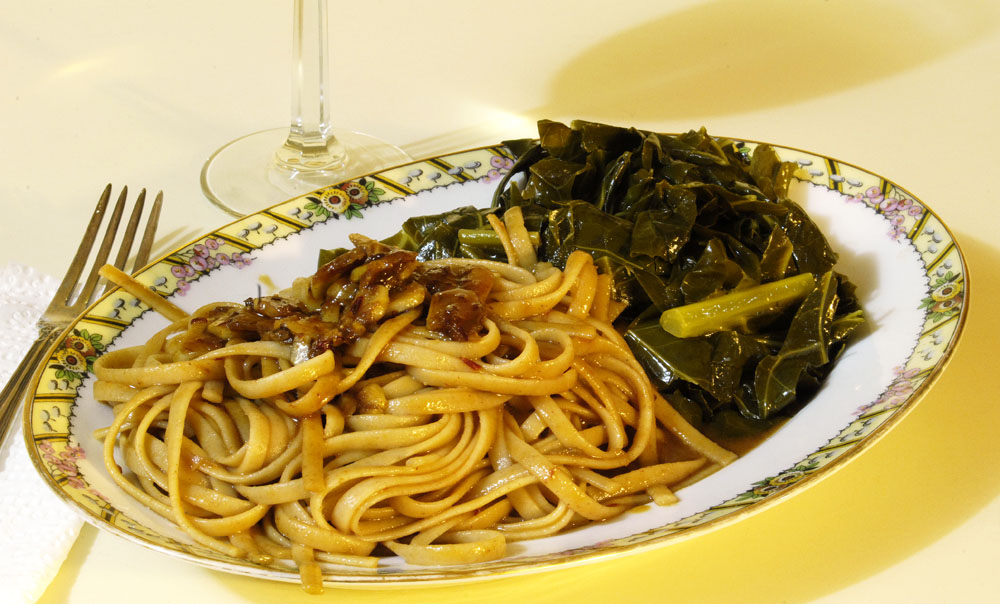
A common supper at the abbey is pasta and vegetables. The default pasta sauce probably (I’m ashamed to say) is parmesan and cream. But variety is nice, and parmesan and cream make a pretty heavy sauce.
I’m still working on refining this recipe, but here’s a working version with some ideas for improvement.
Toasted sesame sauce
2 tablespoons sugar
2 tablespoons rice vinegar

2 tablespoons toasted sesame oil
1 tablespoon soy sauce

1 teaspoon pepper sauce (such as harissa sauce)
4 cloves of garlic

1 to 2 tablespoons peanut butter
Combine the sugar and vinegar in a small skillet. Simmer it until it starts to thicken. Pour it into a small bowl and set it aside.
Sautée the garlic lightly in the sesame oil. Add the soy sauce and harissa sauce and let it simmer for a few minutes.
Add the peanut butter to the vinegar mixture. Stir it until it thickens.
Add the peanut butter and vinegar mixture to the contents of the skillet. Stir and simmer. It doesn’t have to mix perfectly. A sauce that’s slightly broken is just fine.
Peanut butter makes a great thickener for sauces — soups, too, for that matter. Vary the amount of peanut butter to get the thickness that you want. If 2 tablespoons of toasted sesame oil is a little strong on the sesame for you, then substitute olive oil for some of the sesame oil. Any vinegar will do. Obviously rice vinegar gives it a bit more of an Asian flair. Harissa sauce is available at some grocery stores, including Whole Foods. In a pinch, use ketchup and a dash of hot sauce! Don’t hesitate to use more than a mere teaspoon if it suits your taste.
This recipe makes a modest amount of sauce. Double it or triple it as needed. Top it with nuts, if you like. Crushed roasted peanuts work great.
By the way, I use whole wheat linguini.