R-r-r-r rumbledethumps


Rumbledethumps. Click here for high-resolution version.

Just as I was thinking about what to cook on a bleak midwinter day, a friend who lives in the south of France (who is Danish but shares my appreciation for British cultures) sent me a link to a YouTube video about making rumbledethumps. So I made rumbledethumps.

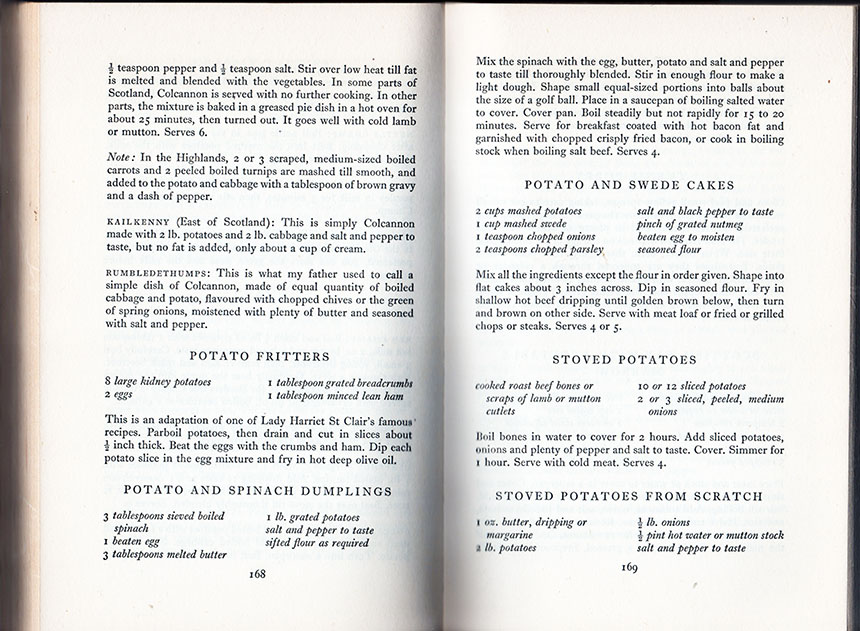
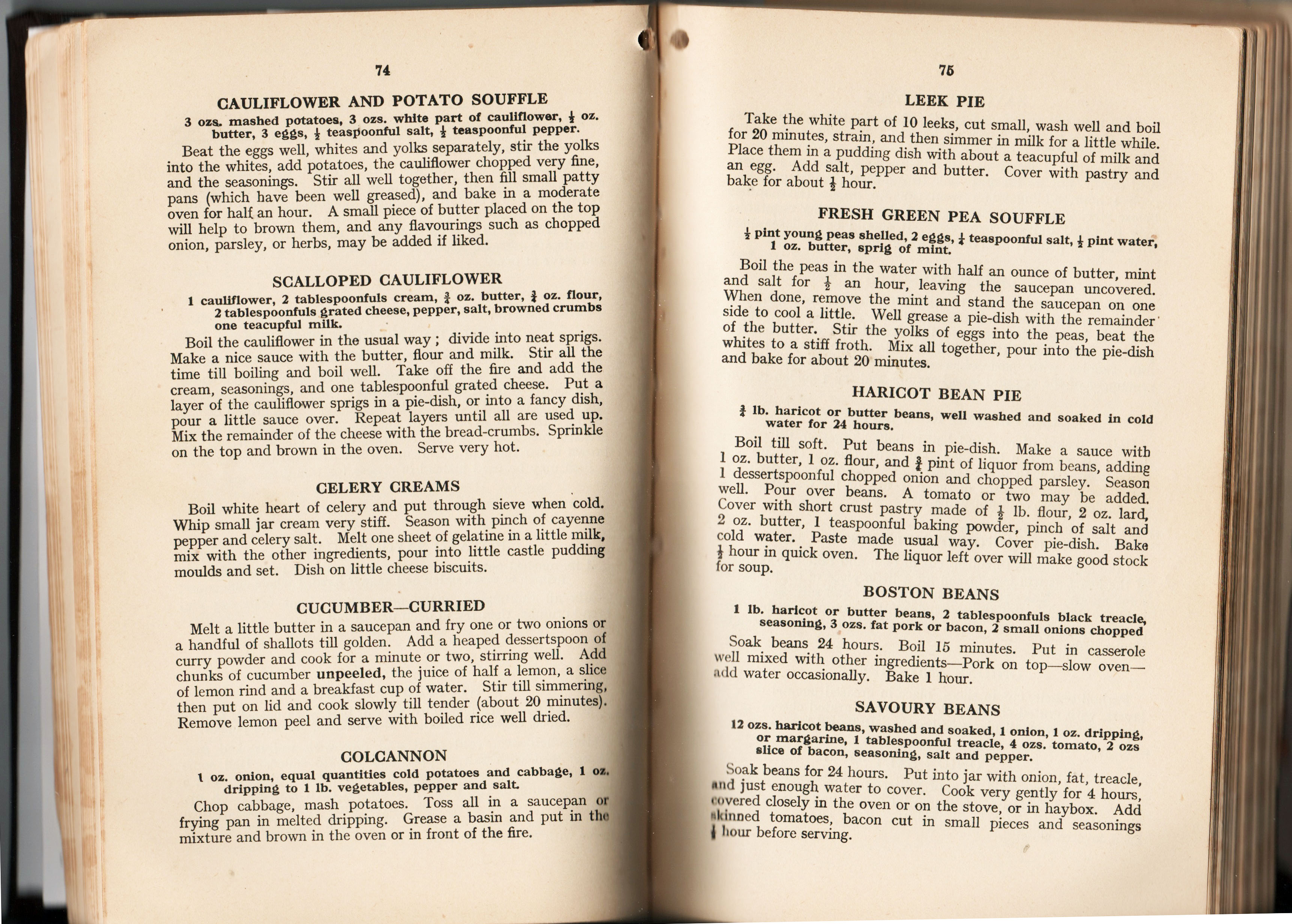
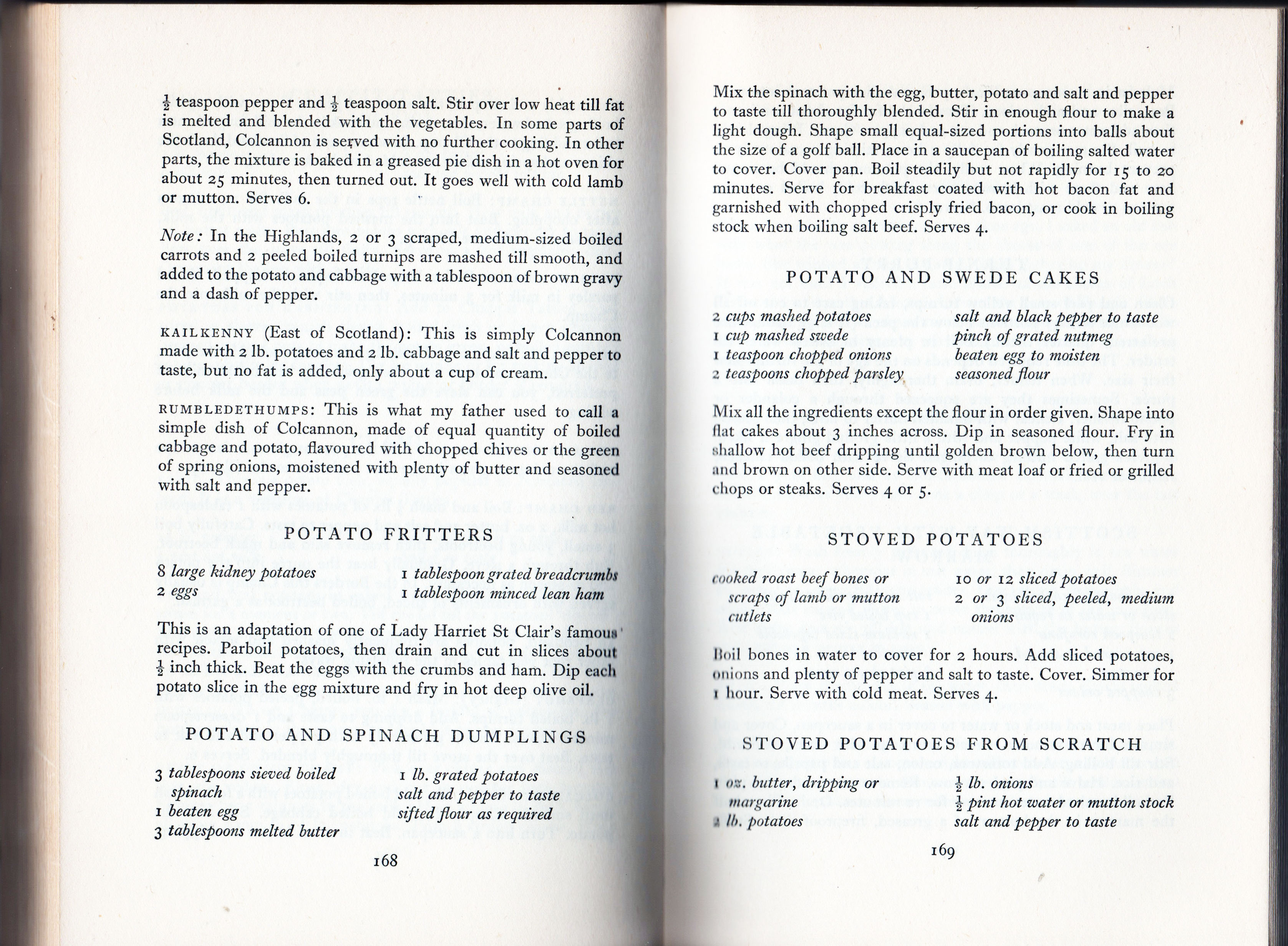
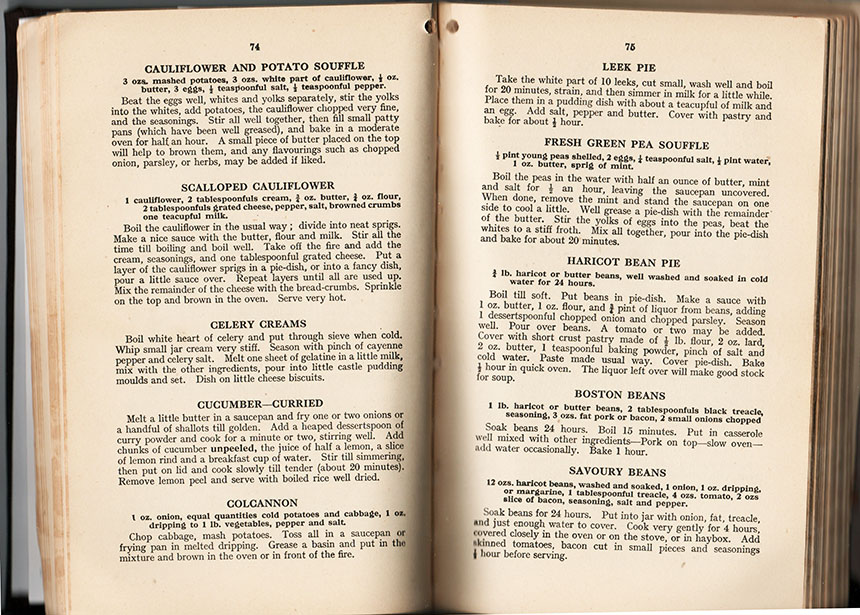
I have only two Scottish cookbooks. One, The Scottish Women’s Rural Institutes Cookery Book, sixth edition, 1948, does not mention rumbledethumps, but it does include a short recipe for making colcannon, which I believe is considered to be the Irish version of rumbledethumps. My other Scottish cookbook, The Scottish Cookery Book, 1956, includes a short reference to rumbledethumps among the potato recipes My guess is that rumbledethumps is so simple and so basic that no one really needs a recipe.


⬆︎ The Scottish Women’s Rural Institutes Cookery Book. Click here for high resolution version.


⬆︎ The Scottish Cookery Book. Click here for high resolution version.

I looked at a number of online recipes for rumbledethumps. Some sauté the cabbage along with the onions to precook it. Other recipes boil the cabbage. I boiled my cabbage to cut down on calories. But I suspect that much of the savoriness of rumbledethumps comes from lots of butter (or drippings) and salt. I used only a little butter and made up for it with olive oil. But in these old recipes, there really is just no substitute for butter (and lots of it), or drippings (and lots of it).

⬇︎ In the video, the cook pronounces the th in rumbledethumps as though it is a t. This puzzles me. ChatGPT says that TH-stopping is a normal feature of Scots. If so, I’ve never noticed it. Notice that he also rolls his r’s sometimes.

I wonder if I could make bubble and squeak from the leftover rumbledethumps.


Ink forever!


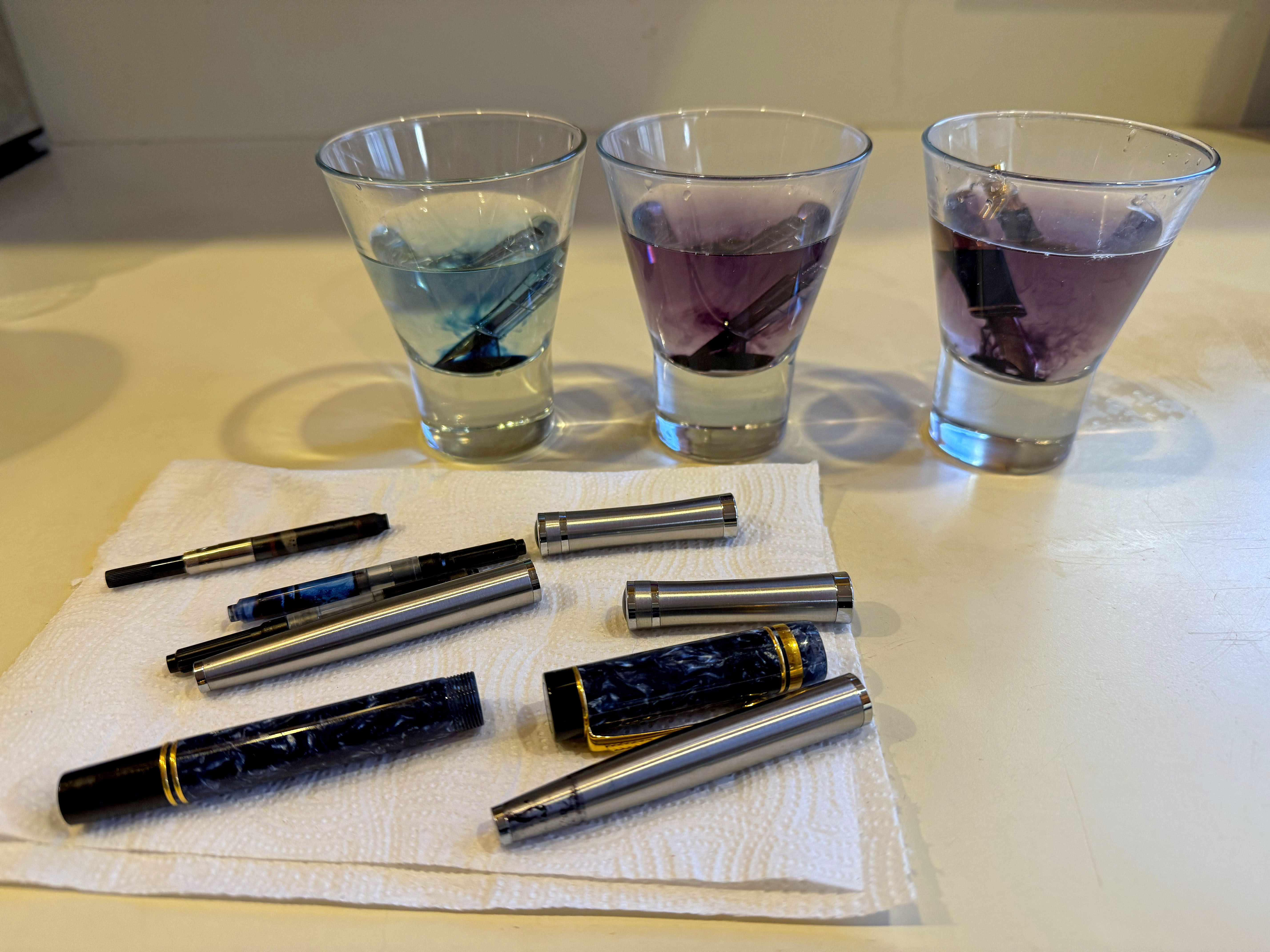
Click here for high-resolution version.

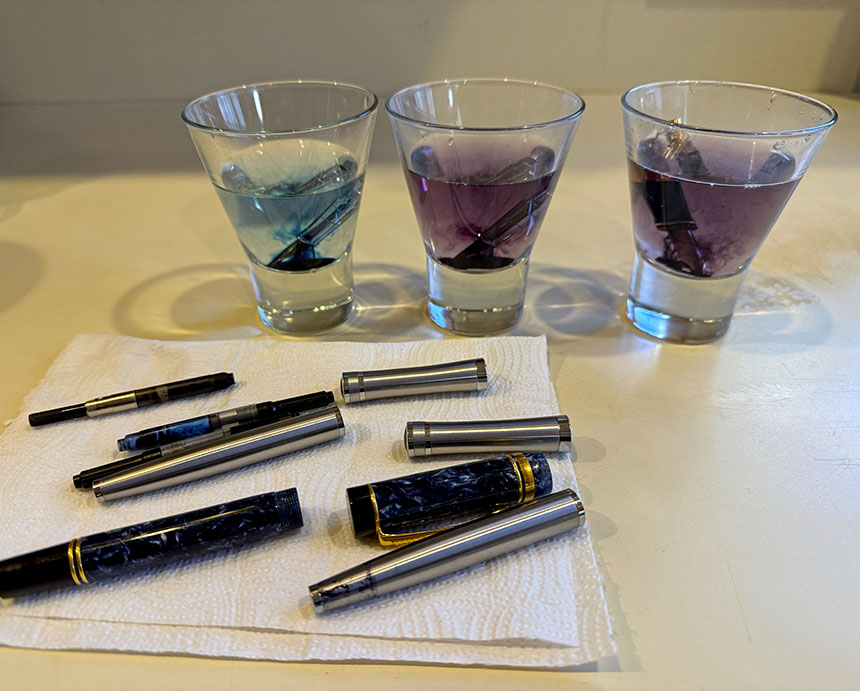
Keeping fountain pens in working order makes me realize how much time our ancestors must have spent maintaining their writing instruments. Monks, I believe, used pens made of feathers, reed, or bone. Fountain pens came along in the 1700s. But keeping them in working order still would have been a regular chore.

Eventually just rinsing the fountain pen’s parts aren’t enough to get the ink to flow again. The pen needs to be soaked to get the dried ink out.

The Epstein files

If you try to zoom out and consider the Epstein files from the planetary level, what do you see?

What I see is a global ultra-rich ruling class like nothing the world has ever seen before. The French Revolution was just a tempest in a teapot by comparison — one small country, with power so fragile that they all lost their heads in a few short years.

Oxfam says that the global top 1 percent possess more wealth than 95 percent of the world’s population. How did that happen? And it’s not just money and property that they own — it’s power, and entire governments. It’s probably safe to say that the top 1 percent also own more power than 95 percent of the world’s population.

No doubt they get away with 95 percent of their crimes. They’re used to that. They count on it. The Epstein files are a test of whether they can get away with crimes (and the cover-up of those crimes) that are so abominable that even the deplorables — who normally admire right-wing power — aren’t willing to ignore it.

The other thing is that, for all their money and power, they are pathetic, greasy, ugly little worms who buy young bodies to help enable their denial that they’re old and utterly undesirable, and that, without their money and power, they have less going for them than most of the homeless people living on the streets of San Francisco.

This is the story of our times, and the ball is in our court. How long will 1 percent of the global population be able to treat the rest of us like property? No guillotines would be needed. Just tax them to death.

The right-wing rage machine is sputtering


Trump rally, Manchester, New Hampshire, January 2024. Source: Wikimedia Commons.


The fuel that sustains MAGA is right-wing rage. When right-wing propaganda can’t deliver enough rage, Trump’s popularity and approval ratings drop. Fox News viewers in the age 25 to 54 bracket were down 61 percent in November 2025 versus November 2024.

The job of the right-wing media is to constantly fuel the rage and demonization that it directs at anyone who stands in the way of the right-wing agenda. No ugliness is too ugly, and no lie is too great, if it generates rage. The corrupt moral nature of right-wing rage is such that it now even teaches that empathy is morally dangerous. That is, empathy for friends and family is virtuous. But empathy toward the wider world, because it leads to concerns about equality, fairness, and equal justice, is the very moral snare that liberals fall into. And liberals, of course, are evil.

But liberals are now out of power. Generating right-wing rage was easy when there were liberals with power who could be demonized — Barack Obama, Hillary Clinton, Joe Biden. But a movement built on manufactured partisan rage runs out of fuel when the enemy disappears from view.

Some blame “outrage fatigue.” I don’t think that’s it. MAGA types are energized by rage rather than tired by it. Rather, this is a serious propaganda problem. If Democrats are powerless, then whom is the movement fighting? If Republicans control government, then why is life not magically improving? If Trump is president again, then why aren’t we great again? Without Democrats to blame, the rage machine becomes an ouroboros — a snake eating its own tail in search of the emotional intensity that its propaganda can no longer produce. The movement is starting to fragment as leaders who are addicted to rage and the politics of rage inevitably turn on each other.

Trump’s decline in approval ratings is partly emotional. Trump no longer provides the catharsis that MAGA types felt during the fuck-your-feelings and liberal-tears days. Trump is yesterday’s rage, warmed over, feeble, and increasingly unappealing.

None of this bodes well for MAGA’s future. But Republicans continue to have an enormous amount of power, and they will not hesitate to use it. They have two kinds of options. They can try to stay in power illegally with most of the country against them. Or they can smash a lot of furniture in an attempt to generate new themes of hysteria, rage, and fear that they hope will help them. They probably will do both.

Siegfried Sassoon


Jack Lowden as Siegfried Sassoon in “Benediction,” 2022


From Oscar Wilde to the present, there has been a continuous line of gay writers, all of them considered to be degenerate criminals until relatively recently, and all of them now vindicated as bravely many years ahead of their times — impeccably civilized in their subversiveness. Siegfried Sassoon (1886-1967) was one of the lesser known of these writers. The 2022 film “Benediction” has given Sassoon some of the attention he deserves.

The Scottish actor Jack Lowden, of course, is River Cartwright in the brilliant and ever-so-entertaining series “Slow Horses,” now streaming on Apple TV+.

Many of these writers knew each other. Gay writers living today are only a few degrees of separation from Oscar Wilde. These early 20th Century gay writers lived in dangerous times. Wilde’s trial started a dark cultural shift that lasted for sixty years. Scholars estimate that between 50,000 and 100,000 men were charged with crimes up until decriminalization in 1967. There was surveillance, entrapment, trials, prison, exile, and suicide. Alan Turing, who was charged with “gross indecency,” the same charge that was used against Oscar Wilde, was only one of these. E.M. Forster’s novel Maurice was not published until 1979, nine years after his death.

Armistead Maupin and poet Gavin Geoffrey Dillard knew Christopher Isherwood. Isherwood and W.H. Auden were lifelong friends. Isherwood knew E.M. Forster. Siegfried Sassoon knew Robbie Ross (who was a loyal friend to Oscar Wilde until the very end). Siegfried Sassoon never met Isherwood, but he certainly knew of him. As a war poet during World War I, Sassoon was critical of Isherwood because he thought Isherwood was avoiding military service by remaining in the United States. Isherwood knew Gore Vidal and Tennessee Williams.

Though almost all them were born to great privilege, they were not all of equal character. Lord Alfred Douglas, who betrayed Oscar Wilde, became an even greater jerk after Wilde’s death. E.M. Forster, on the other hand, would qualify as a saint, were it not for the Catholic church’s clock running about six thousand years slow. Christopher Isherwood was no saint — as is clear if you read Christopher and His Kind or watch the film “Cabaret” — though Isherwood lived a very different life after he came to the U.S. in 1939.


Christopher Isherwood (left) and W.H. Auden, 1939. Source: Wikimedia Commons.

After watching “Benediction,” I bought a copy of a 2003 biography of Sasson, Siegfried Sassoon: The Journey from the Trenches. I doubt that I will read the entire book; it’s a very detailed 526 pages. But it’s an excellent reference with a valuable index and large set of notes. “Benediction” doesn’t flinch at the gloom and embarrassing failures of Sassoon’s later years. I found it interesting, by the way, that my copy of the book, which I ordered from the U.K., had a previous life in the Hobson Library of the Joint Services Command and Staff College, which trains members of the British military.

I have known poet Gavin Geoffrey Dillard for more than fifty years. He is my oldest friend. Gavin lived in Hollywood for a good many years. Isherwood lived in Santa Monica. Isherwood was diagnosed with prostate cancer in 1981 and died of it in 1986. Below are two photos that Gavin took while visiting Isherwood during Isherwood’s last years.


⬆︎ Christopher Isherwood, Santa Monica, California, c. 1984. Photo by Gavin Geoffrey Dillard.


⬆︎ Christopher Isherwood and Don Bacardi, Santa Monica, California, c. 1984. Photo by Gavin Geoffrey Dillard.
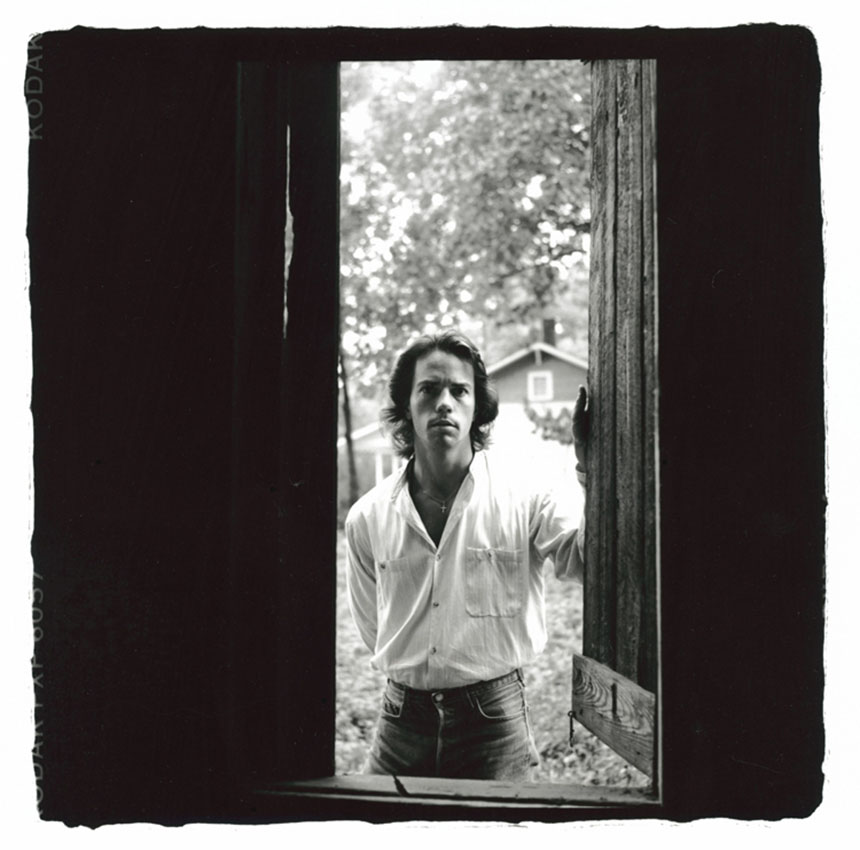

⬆︎ Gavin Geoffrey Dillard, Bethania, North Carolina, c. 1979. Photo by David Dalton. (For years, Gavin and I preferred twin-lens reflex cameras such as Yashicas and the Mamiya C330, which use square 620 film.)


For Gabriel

When you were an angel and I was a god,
Earthly-fair were the paths that we trod;
You, from your heaven of Saints at the Throne,
Banished, to wander, gold-haired and alone;
And I, from my pagan Paradise hurled,
Thro’ sun-shot cities of cloud to the world.

Humble you came, with your calm, clear eyes,
And parted lips; but your spirit was wise
With raptures of music and light that you’d lost …
So we loved and were happy, nor counted the cost.
For the gates were barred, and the way was hard
Up to the bastions of Heaven proud-starred;
And I was a god no more. But you sprang
To the peace of my arms … and an angel sang.

Unpublished poem by Siegfried Sassoon, dated 20 November 1918, included in Siegfried Sassoon: The Journey from the Trenches, 2003.

An obstinate ostinato in a time of oligarchy


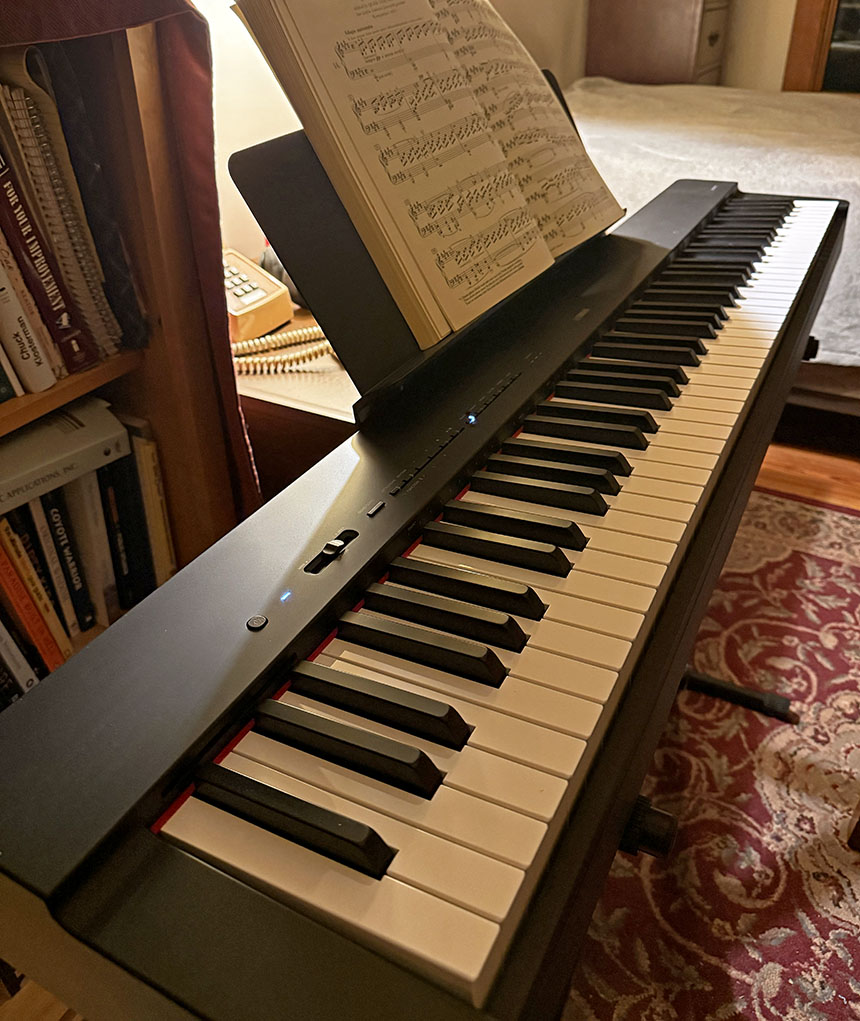
Yamaha P-225 digital piano

Though in my younger days I had a piano for many years, it had been 20 years since I owned a piano. A rather large organ console now occupies all the musical space downstairs (not to mention the ten speaker cabinets upstairs). To have a real piano again was out of the question for lack of space. But I finally acquired the next best thing to a real piano — a pretty good digital piano. I put it in my bedroom, the warmest and best-lit part of the house during the winter because of the big gothic windows.

Even when I was well practiced and at my best, I was a humble intermediate-level musician. My limit was in technique, not so much my musicality. That is, I can hear better than I can play. Many times in the past I’ve gone several years hardly playing at all, and my keyboard skills fall apart. Still, there is something to playing an instrument that is like riding a bicycle. The skills never completely go away. A few months of diligent daily practice will bring it back. Recovering rusted technique is much quicker than developing that technique for the first time. I went up to the attic and found my piano music. After a few weeks of playing scales, over and over, for at least an hour a day, I should be able to once again relearn the pieces that I learned years ago.

Computer nerd that I am, I’m very interested in letting a computer (or just an iPhone) play the piano, using the magic of MIDI. MIDI files are easy to find on the internet. However, most of those MIDI files are computer-generated. They sound mechanical and lifeless. They hurt the ears. There are MIDI files played by human beings, though, if you can find them. The MIDI files are created on special pianos that record what the pianist does with great precision. When played back on an instrument such as the Yamaha P-225, it does indeed sound like a real person is playing the piano.

Between 2002 and 2018, Yamaha had annual piano competitions in which the players’ performances were recorded on a special Yamaha grand piano. Those competitions produced thousands of human-played MIDI files. The MIDI files disappeared off the internet, though. But with some digging I found that the files still exist in an internet archive. Also, a few dedicated souls retrieved all the files and organized them. I was able to find them, and I now have the entire library on my computer. Those who might be looking for those files can start here, at the internet archive.

I made another very useful discoverty. ChatGPT can read, edit, and write MIDI files. For example, in the Yamaha archive is a performance of Schubert’s Impromptu No. 3 in G-flat Major, Op. 90, D. 899. The pianist — probably a young one — pretty much murdered the piece by playing it too fast and much too heavy with the hands, particularly the left hand. That’s the kind of thing that can happen when a pianist has great technique but mediocre musicality. I had a fascinating discussion with ChatGPT about improving this performance. ChatGPT and I went through about ten iterations, in which ChatGPT made the MIDI changes I requested, and we ended up with a performance that is at least 75 percent as good as this performance by Khatia Buniatishvilli:

Many people have written about how to try to stay sane while the world is spiraling downward into fascism. Pretty much all agree that keeping civilization alive — even in small ways in our own homes — is an act of resistance.

Trump

Every day, the horrors seem to get worse. The Trump administration is trying to sell out Ukraine to Russia, with scum such as Jared Kushner in the middle of it, with plans to get rich off of looting Ukraine. Apparently Pete Hegseth gave a war-crime order to kill the survivors of a ship that had been blasted out of the water. Now they’re denying that Hegseth gave such an order, and they’re trying to throw an admiral under the bus for it. The new outrages have been so outragous that the media have temporarily forgotten Epstein.

There may be an upside. Republicans are starting to think about their political survival after Trump is gone. Trump has more than a year for more atrocities before a third impeachment becomes an option. Republicans seem to be learning that the political gains from ignoring Trump’s atrocities are starting to diminish. If Republicans have a brain, they’d support impeachment as soon as a new Congress convenes in 2027, and get rid of Trump for good. I’m not holding my breath.

Meanwhile, how about a sonata or two.


A musical note: The words ostinato (Italian) and obstinate (English) come from the Latin obstinātus. The Italian word dropped the “B” as Latin consonant clusters were simplified. In music, ostinato refers to a musical pattern that keeps repeating, obstinately, even though the rest of the piece may have moved on — for example, an ostinato bass note or bass line.

One of the best known examples of ostinato pattern is the bass line that repeats over and over all the way through Pachelbell’s Canon in D. Listen to the cello:

And here you can see these notes in the score:

And here is something from Philip Glass, the patron saint of ostinato, in this case obstinately repeating arpeggios: