‘One of ours, all of yours’


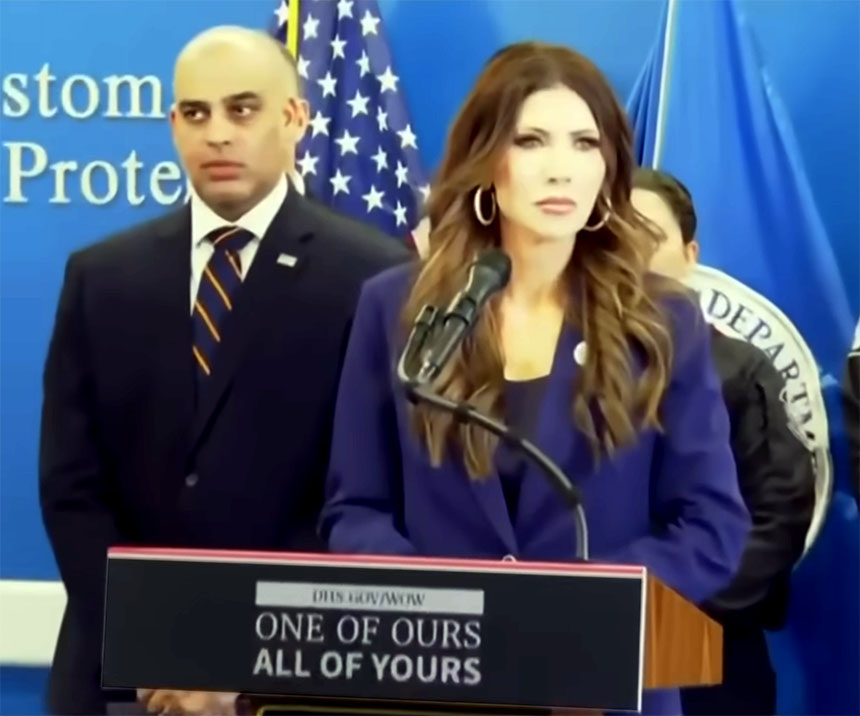
Social media, I understand, is buzzing with interpretations of just what it was Kristi Noem meant by the words “One of ours, all of yours” on the podium during a news conference in New York on January 8, after Renee Nicole Good was killed by ICE agents in Minneapolis.

Some social media posts say it’s a Nazi phrase related to the Lidice massacre. Some say the phrase has something to do with the Spanish Civil War, and some say the phrase originated with Q-Anon. Neither I nor ChatGPT can find any good evidence for any of those citations.

Still, there are two important questions: Just what did Noem mean? And why did the mainstream media ignore it?

I think I can guess why the media ignored it. It was just another act of sanewashing. That such a phrase was actually used by an American cabinet secretary who commands thousands of men armed to the teeth should have provoked dozens of op-eds asking what it means, especially since pretty much everybody took it as a threat. Instead, crickets.

Noem, you’ll remember, is the person who wrote in a memoir about killing a puppy and a goat.

The phrase is intentionally vague. That’s to provide deniability. Is there a way to interpret it other than as a veiled threat of disproportionate retaliation?

Let’s try to game out the consequences


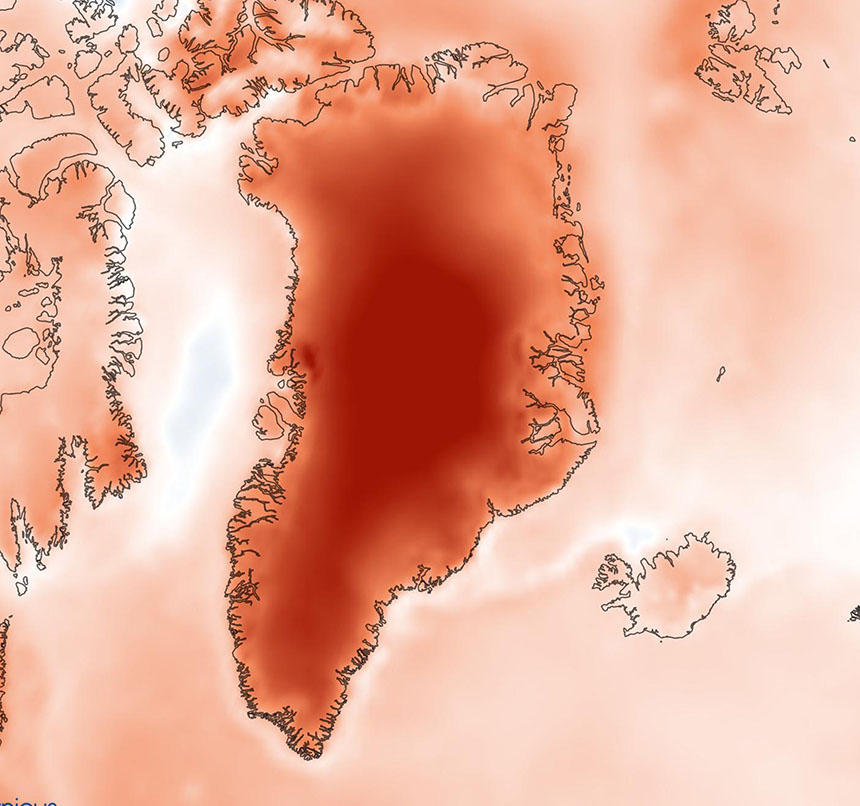
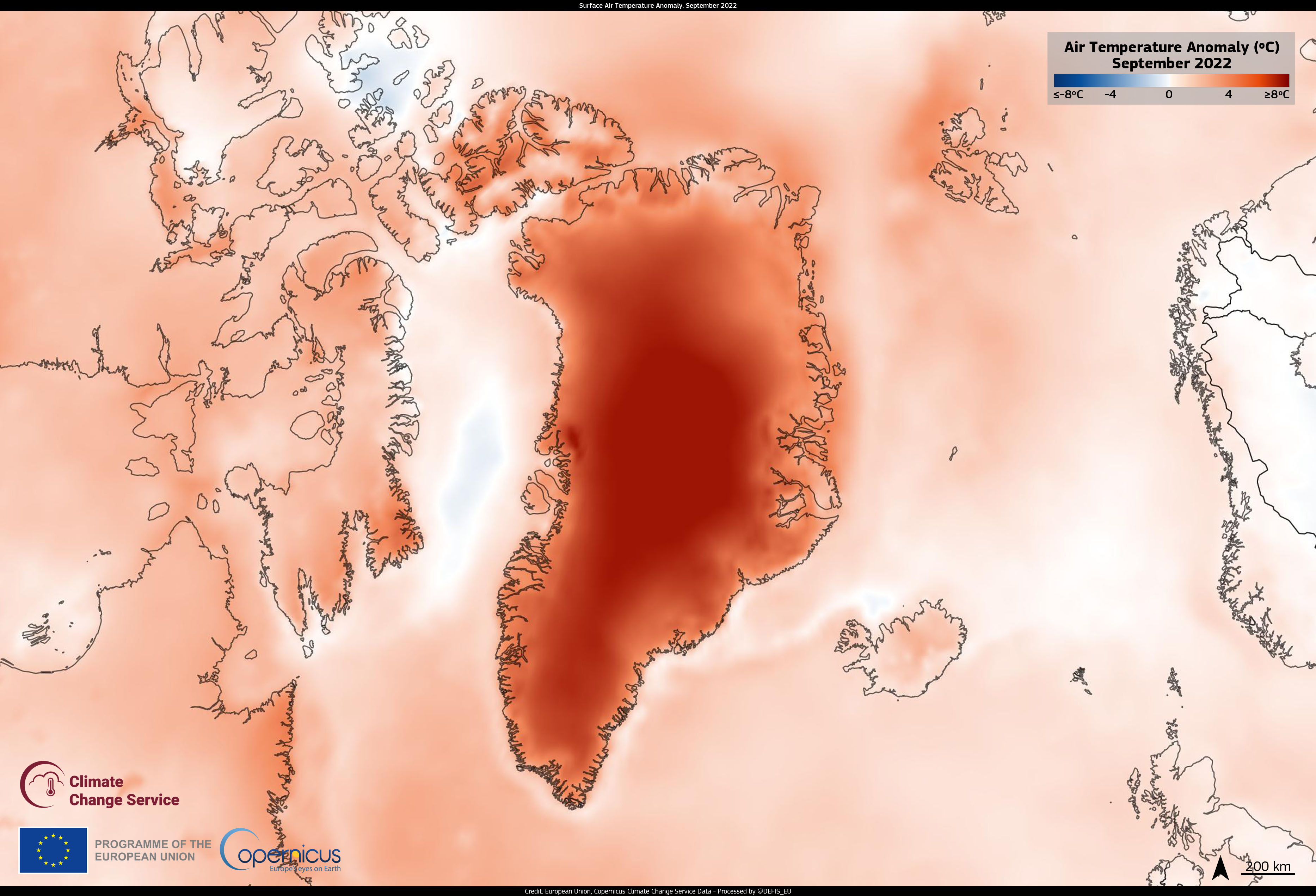
Greenland is getting warmer, in more ways than one. Source: Wikimedia Commons. Click here for high-resolution version.


After what Trump just did in Venezuela, and after the unspeakably vile and repulsive Stephen Miller said that the U.S. has the right to take Greenland, it suddenly appears that the Trump White House might actually do something as stupid as to try and seize Greenland.

Politico has an interesting piece this morning: How Trump gets Greenland in 4 easy steps. It starts with a political move: propagandizing the 57,000 people who live in Greenland to declare independence from Denmark. That could be doable, because the people of Greenland like the idea of independence. But the second step would be much more difficult: getting the people who live in Greenland to become part of the United States. That’s not what they want. They want independence. Step 4 in the Politico scenario is a military invasion of Greenland.

Politico says that step 1, Trump’s propaganda campaign aimed at the population of Greenland, started as soon as Trump got back into the White House.

The Politico scenario looks all too plausible, almost as though Politico based the piece on sources inside the White House.

I have not seen a single story so far on what would happen next if the U.S. actually does seize Greenland. That there would be retaliation is obvious. Members of the NATO countries would immediately impose sanctions on the U.S.

I asked ChatGPT 5.2 to help me game out how the world would retaliate and who would join the opposition.

We should expect: Coordinated tariffs on U.S. exports, suspension of existing trade agreements, deliberate exclusion of U.S. corporations from trade negotiations, licensing delays or export controls on high-end products that the U.S. sells abroad, regulatory retaliation against U.S. banks and corporations doing business abroad, restrictions on investments in the U.S., non-renewal of existing contracts, suspension of intelligence sharing.

Who would join Europe in retaliation: Canada, Japan, South Korea, New Zealand, Australia. Other countries might retaliate in milder or more cautious ways: India, Brazil, Mexico, other Latin American democracies.

Russia and China are wild cards.

This economic retaliation would cause an immediate financial shock. The market would sell off. Investment would be frozen. Interest rates would rise. Unemployment would rise.

The longer the sanctions continued, the worse the damage would become as the world economy builds supply lines that work around the U.S. The damage would start immediately, but readjustment inside the U.S. would be slow. Eventually a point of irreversibility would be reached.

To quote ChatGPT: The world can pull away from the U.S. almost overnight; the U.S. can only rebuild trust and integration slowly, if at all.

Suddenly we are describing a world in which the economic chaos and hostilities set the stage for the kind of counter-retaliations and miscalculations that would set the stage for World War III.

We can cling to such hopes as the idea that Trump is only trying to distract from the Epstein files. I have no idea. We might hope that Congress would see the danger and do something. But until there is a new Congress on January 3, 2027, that seems unlikely.

Wherever we are and whatever our circumstances, we’re all exposed to the folly of a Trump move against Greenland. We Americans would not be the first foolish population in history to be brought to ruin by madmen. We’ve always thought that it can’t happen here. I think we instantly knew after the November 2024 election that things would get worse before they get better. But now it seems that things could get much, much worse, and that unless these madmen can be stopped it will be a long, long time before things will ever get better.

There’s another very important thing that we will need to game out if things break bad around Greenland. That’s the American domestic situation. If the American economy goes into a tailspin, who will Trump blame? Scapegoats will be required, and those scapegoats must always be people who are within reach so that they can be slapped around. Would the Trump White House try to soothe the turmoil? Of course not. They’d do everything possible to inflame it. We don’t need to ask ChatGPT where that would lead.

Privilege (and the lack of it)


Virginia Woolf. Portrait by George Charles Beresford, 1902. Source: Wikimedia Commons. Click here for high-resolution version.


We live in an era in which privilege and wealth are squandered on obscene levels of consumption and on domination and destruction — of institutions, of norms of justice and fairness, of ecosystems, of all the fragile things that we all hold in common. Things have not always been that way. Once upon a time, privilege could be used to build and sustain a shared culture, not to strip-mine it or to burn it all down, to strengthen institutions rather than to reduce them to instruments of profit and power.

What happened?

Watching the 2022 film “Benediction” left me very curious about the life of English poet Siegfried Sassoon (1886-1967). That curiosity led me to a long biography of Sassoon (526 pages) by Jean Moorcroft Wilson published in 2003. I had expected that this book would become more a reference than something to read cover to cover, because the biography is a who’s who of an important period in English literature.

That’s the period of the Bloomsbury Group — Virginia Woolf, E.M. Forster, John Maynard Keynes. Even more important (to me) than the Bloomsbury Group were the Inklings, of which J.R.R. Tolkien and C.S. Lewis were core members.

I find that I have continued to work my way through this biography of Siegfried Sassoon because so much of what’s intriguing is how these privileged people, who didn’t have to work, used their time. It was very different from how privileged people use their time today. Back then, privilege could be used to buy time, learning, and the freedom to take intellectual and moral risks.

Yes, much of that time was used for a constant, and sometimes exhausting, stream of socializing, some of it superficial. But it also meant that they met a great many people, and sometimes lasting friendships developed — Virginia Woolf and Lytton Strachey, E.M. Forster and Roger Fry, Siegfried Sassoon and Robert Graves, T.S. Eliot and Ezra Pound, Ernest Hemingway and F. Scott Fitzgerald, Gertrude Stein and Alice B. Toklas, William Faulkner and Sherwood Anderson, J.R.R. Tolkien and C.S. Lewis. That kind of time and friendship did not exist in a vacuum. It was protected and made possible by institutions, especially the universities.

Another factor that stands out is how the privileged today and the privileged then used the great universities. Today the privileged use the universities to leverage their privilege to gain more money and more power — finance, law, and tech. Back then, two universities in particular — Oxford and Cambridge — were like engines that converted privilege into culture. Today, degrees in the humanities are at risk of going extinct, while universities are increasingly pushed toward creating wealth.

These failures amplify one another.

At the same time as the privileged few have become cultural toxins rather than cultural creators, the gap between the haves and the have-nots has grown ever greater. Back then, a D.H. Lawrence, who was the son of a coal miner, could find a path to recognition through hard-won education and patronage. Today, millions of families can’t afford to feed their children, let alone educate them or give them the time and the tools to develop their human potential. While the privileged run wild, the unprivileged never have much chance of coming to understand the causes of their condition or learning how to work together to do something about it. Nor do the privileged want them to understand the causes of their condition or to learn how to work together to do something about it.

For all their anger and discontent, the writers and artists of the early twentieth century still imagined better worlds, whereas our own moment seems preoccupied with just avoiding catastrophe. Dystopias make good literature (and movies) today, and for good reason.

I ask myself where the connections are between privilege (and the lack of it) and creating dystopias versus creating a better world. The only idea I can come up with is that the wrong people are running the world to suit themselves, while the rest of us are just trying to get by.

Yes, the writers of the early 20th century were privileged. But they also were builders, and they were on the top layer of their society. They foreshadowed and helped shape the precious few decades of human progress after World War II. Today’s elites are not cultural builders because the systems that reward them no longer value the things that an E.M. Forster, a John Maynard Keynes, or a J.R.R. Tolkien valued.

Privilege once made world-building possible. It was possible to very much like those privileged, world-building artists. Today, the privileged are all about owning the world and making the world better only for themselves. And they don’t have to care whether we like them.