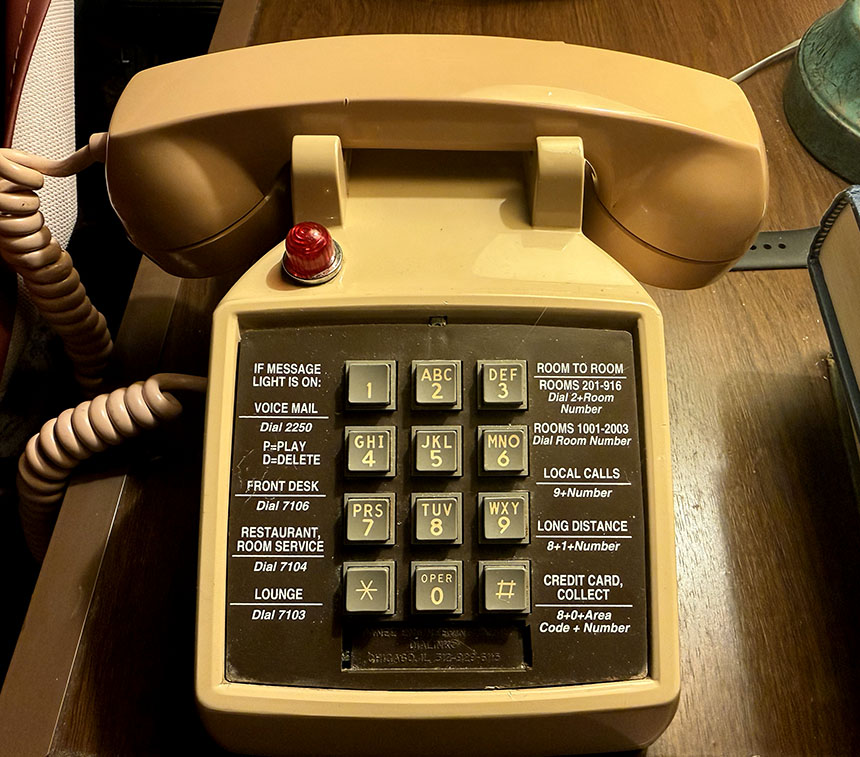
I bought this old hotel phone on eBay. The light flashes when it rings. When it was still a hotel phone, the light was on when there was a message waiting. It’s an ITT phone made in the 1970s, but it has the classic AT&T / Bell Labs handset.
Some technologies are beautiful. Some are god-awful ugly. One god-awful ugly technology is the cell phone. As a small and portable computer screen, it certainly has its purposes. But as a device for handling voice calls, it would be difficult to imagine an uglier design. It’s like talking to a brick.
The perfect design for a telephone handset has existed for almost 100 years. It’s the E1A handset, which was introduced by AT&T in 1927. Bell Laboratories continued to refine the design, and it was perfected by the 1950s. Weight, balance, acoustics, and ergonomics were all part of the design factors.
One of the stunningly elegant parts of the design, which we all took for granted because it was so natural, is called the sidetone. This meant that one could hear one’s own voice in the earpiece, at a carefully engineered reduced level. This feedback allowed you to unconconsiously adjust how loud you talked into the phone. If the sidetone was too soft, you’d be inclined to talk too loud. If the sidetone was too loud, you’d be inclined to talk too softly. An ingenious circuit inside the telephone, involving a transformer and capacitor, controlled the sidetone. The capacitor served two purposes. It allowed the alternating ringing current to pass to the bell, while blocking direct current, so the central office would not see the phone as having gone off-hook.
In short, the telephone, as an instrument of communication, was perfected by the 1950s. As instruments of communication, today’s cell phones are monstrosities. Have you ever wondered why people are inclined to talk into a cell phone too loud? Now you know. Some cell phones, maybe most, do produce sidetones, but it is not nearly as elegantly done.
This is why I have said for many years that I would rather be beaten senseless than talk to someone on a cell phone.
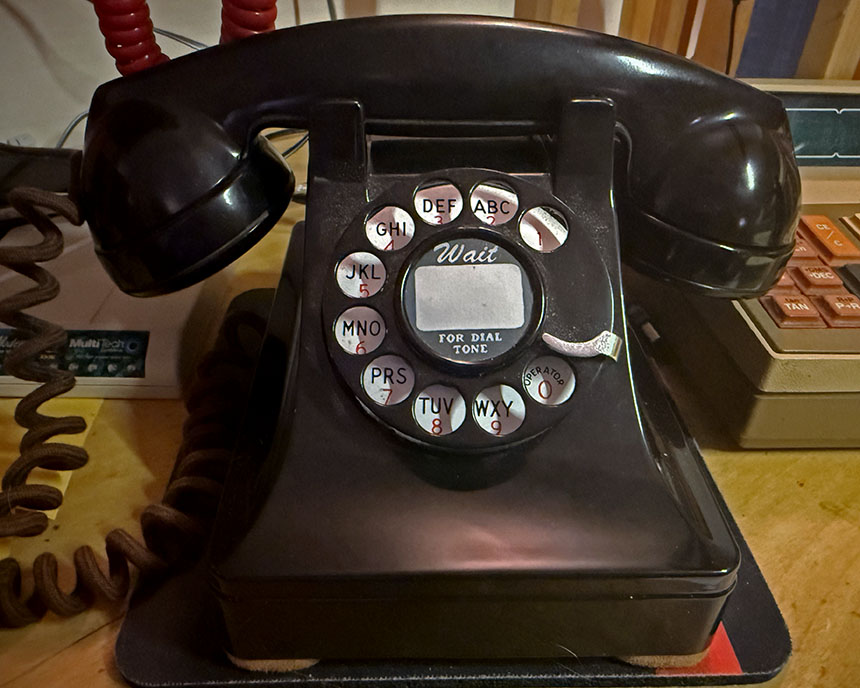
This is my Western Electric 302, the best telephone ever made. It’s a very heavy telephone, for a reason. Inside are two brass bells, two very heavy ringing coils, a voice coil, a huge capacitor, electrical relays, and an elegant mechanical dialing mechanism.
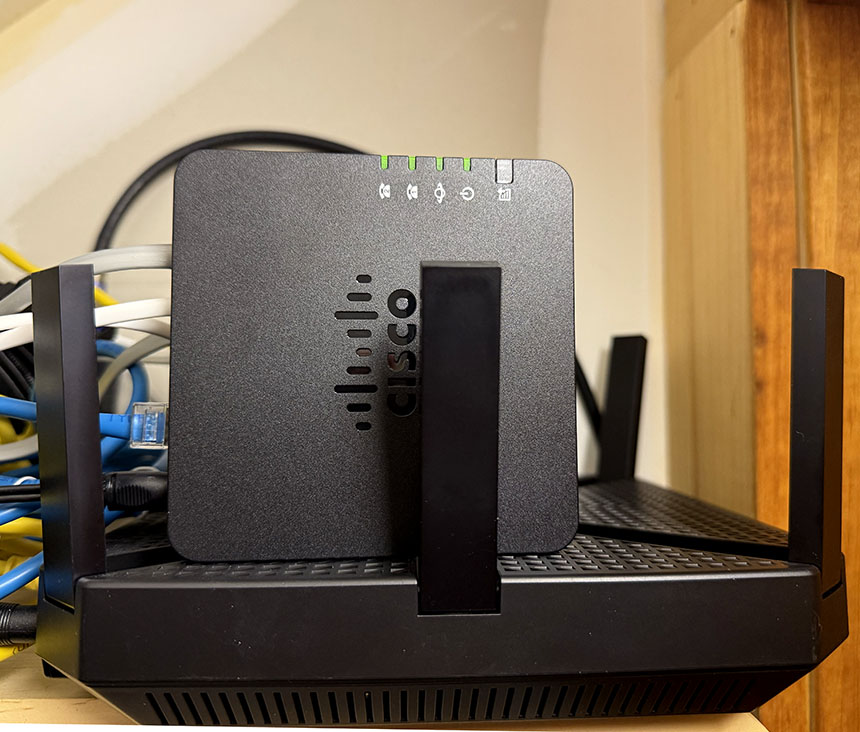
The device on top of the WIFI router is a Cisco ATA191 analog telephone adapter.
How can other technologies help?
I actually had a 36-minute telephone call yesterday, on the old hotel phone in the photo above. Josh, who succeeded me as editorial systems director at the San Francisco Chronicle, called with some updates on San Francisco news. He was on a cell phone. Did it sound as good as a call might have sounded in 1970, on the Bell System copper-wire network? No, but it’s as good as it can get these days.
One can read that land lines are coming back. Parents are finding that it’s the safest way for teenagers and pre-teens to talk with their friends. The “Tin Can” telephone for kids has been selling so fast that they often are out of stock.
For those who want to go back to the best thing since land lines, VOIP (voice over internet protocol) is the only possibility. You need an adapter like the Cisco device in the photo, an internet connection, and a VOIP provider. I use CallCentric as my VOIP provider. I found CallCentric to be not only the cheapest option, but also the option with the nerdiest features, such as full fax support.
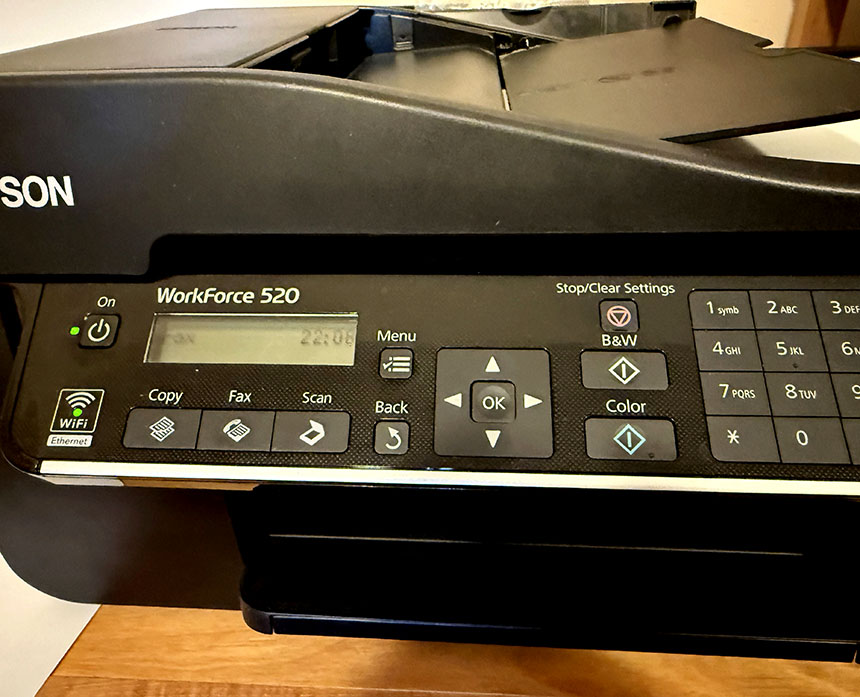
Yes, it can still send faxes, if there was anybody to send them to.
Using AI defensively
I am rapidly coming around to the conclusion that AI technology is the most magnificent — but also the most disruptive — technology of my lifetime (and I’m not young). Its potential for evil and its potential for good are probably roughly balanced. One of the things that Josh told me yesterday on the phone is that the Hearst Corporation, which owns the Chronicle, is aggressively looking at ways to use AI to cut costs. Cutting costs, of course, means eliminating jobs. Josh thinks it won’t be long before AI is editing newspaper stories, writing headlines, and even writing stories. That isn’t happening yet at responsible publications. But industries that generate propaganda, scams, and clickbait are already flooding us with AI slop.
To resist AI, I’m afraid, is futile. The best we can do, as decent human beings rather than corporate sharks or propaganda mongers, is to master AI ourselves and use it constructively, even defensively. AI is already being used to lie to us ever more efficiently. We can use it right back at them (as long as we know how) as a research tool to grapple for the truth. I have often said that having AI is like having a friend who has a Ph.D. in everything.

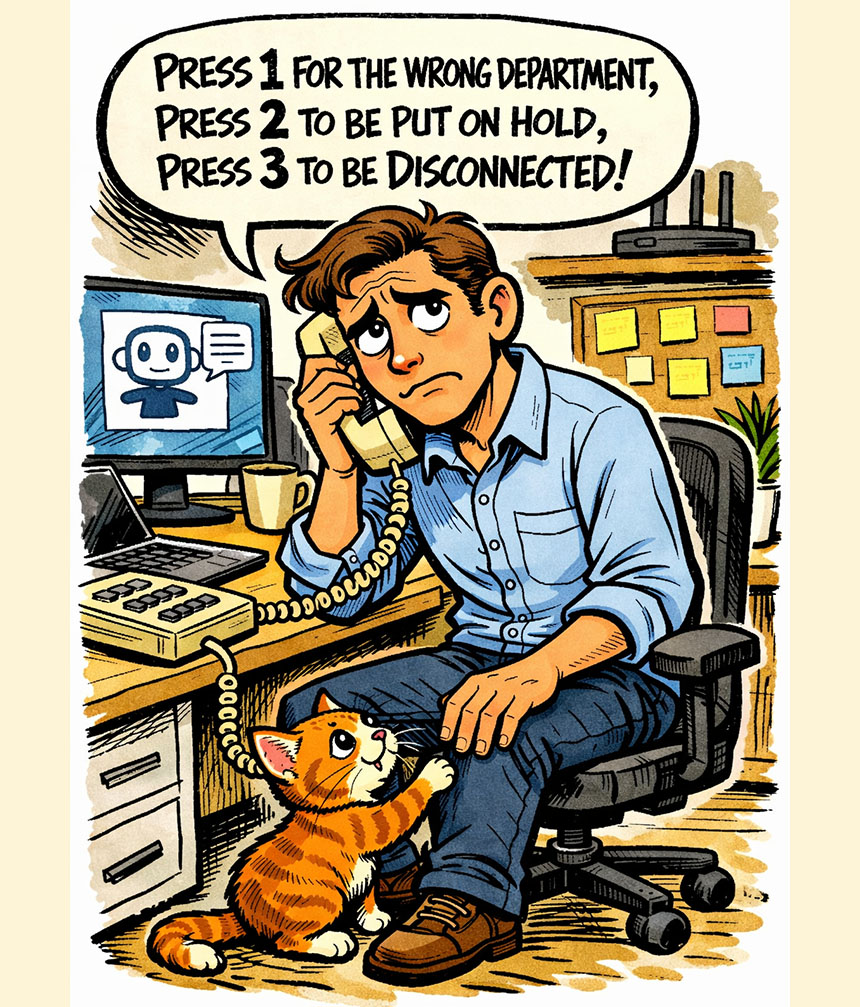
An 1823 novel that deserves a new edition. The cover of the new edition will look something like this. AI, of course, generated the cover image and helped recover the novel’s text.
Fighting slop by preserving excellence
My micro press, Acorn Abbey Books, has six books in print at present. Two of those are new editions of fairly recent books that had gone out of print (The Outnation and Denial by Jonathan Rauch). I have long wanted to republish a deserving 19th Century novel, but not until a year ago did I come across just the right novel. That’s Reginald Dalton, by John Gibson Lockhart, first published, in Edinburgh, in 1823.
Lockhart was Sir Walter Scott’s son-in-law. Lockhart wrote a vast seven-volume biography of Scott. Lockhart also wrote several novels, including Reginald Dalton. There are some facsimile versions of Reginald Dalton of very poor quality, but there has never been a true new edition. It’s certainly worth being done, which is why the Edinburgh University Press has an ongoing project to bring out academic versions of Lockhart’s work. I understand that that project will eventually include a new edition of Reginald Dalton, but it will be an annotated academic version that probably will cost two or three hundred dollars.
What I want to do is produce a reasonably affordable book meant for readers. I can already see that it will be about 550 pages as a 6×9 hardback — a lot of work to produce. A hardback book of that length, printed on demand by Ingram, probably will have to sell for between $40 and $50.
I own a copy of the 1823 first edition, which is in three volumes. But that gets me nowhere. Recovering old books means doing optical character recognition on scans of old books. Google Books has done this for Reginald Dalton, working from a copy of the book in the British Museum. Working from the Google scans, a year ago I use my nerd skills to extract the individual pages from Google’s PDF’s, do the OCR with a program named tesseract, and create a text file. But that text file, like all raw OCR, had many errors and a lot of extraneous material that has to be removed, such as the page number and titles at the top of each page. I started that process manually before I gave up after getting about a tenth of the way into the job. It was just too tedious and time consuming — editing a text file on one side of the screen while looking at an image of the 1823 page on the other side. There are about 1,000 pages in the three volumes of the first edition.
Recently I realized that AI could do this for me. Claude Code did the job. Even Claude Code worked on the job for at least six hours, and I had to buy extra time from Anthropic to get the job done. But I ended up with a text file that is about 99 percent clean. Google’s scans were imperfect. Some pages were missing in the scans, but I recovered those pages from my first edition. I have yet to give the text a full human read, but I won’t undertake to proof the text until I’ve gotten AI to do as much work on the text as an AI can do.
Some time within the next few months I expect to release a new edition of Reginald Dalton.

A Facebook meme
Day after day of pig circus
Even in times in which a bunch of medieval ayatollahs in Iran are far more real-world truthful and less corrupt than our own American government, we have no choice but to continue to read the news and continue to be appalled and exhausted and exasperated. When the tide turns, there must be payback, so we need to keep score. We also have to figure what can be done, collectively, to reverse the damage in the world than has been done by American stupidity.
The tragedy is that the pig circus distracts from so many things that actually matter. It also has set us back for years. Victor Orbán’s defeat in Hungary — or so we can hope — was a turning point. Deplorables have to learn the hard way, and some of them seem to be learning. I’m optimistic that American voters — enough of them, anyway — will exert their abundance of meanness in the right direction in the November election, though I doubt they’ll ever understand why it is that fascism requires scapegoats and how fascism exploited and inflamed their meanness, and even now is laughing all the way to the bank.