
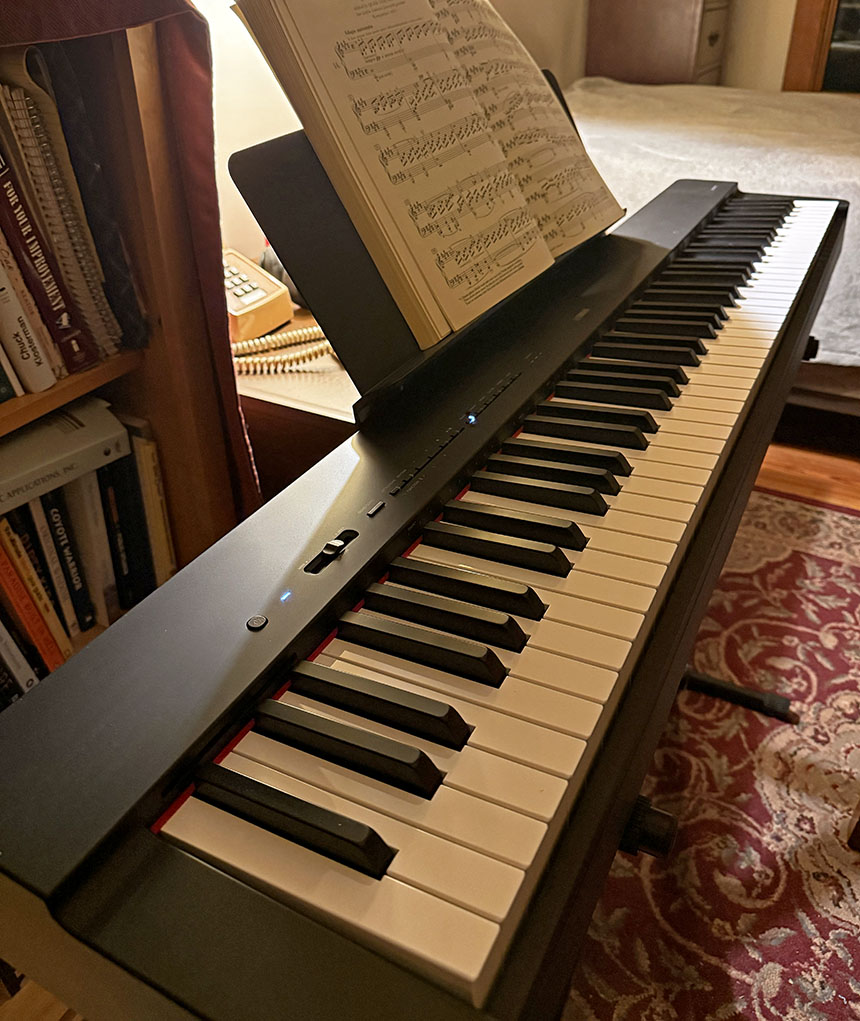
Yamaha P-225 digital piano
Though in my younger days I had a piano for many years, it had been 20 years since I owned a piano. A rather large organ console now occupies all the musical space downstairs (not to mention the ten speaker cabinets upstairs). To have a real piano again was out of the question for lack of space. But I finally acquired the next best thing to a real piano — a pretty good digital piano. I put it in my bedroom, the warmest and best-lit part of the house during the winter because of the big gothic windows.
Even when I was well practiced and at my best, I was a humble intermediate-level musician. My limit was in technique, not so much my musicality. That is, I can hear better than I can play. Many times in the past I’ve gone several years hardly playing at all, and my keyboard skills fall apart. Still, there is something to playing an instrument that is like riding a bicycle. The skills never completely go away. A few months of diligent daily practice will bring it back. Recovering rusted technique is much quicker than developing that technique for the first time. I went up to the attic and found my piano music. After a few weeks of playing scales, over and over, for at least an hour a day, I should be able to once again relearn the pieces that I learned years ago.
Computer nerd that I am, I’m very interested in letting a computer (or just an iPhone) play the piano, using the magic of MIDI. MIDI files are easy to find on the internet. However, most of those MIDI files are computer-generated. They sound mechanical and lifeless. They hurt the ears. There are MIDI files played by human beings, though, if you can find them. The MIDI files are created on special pianos that record what the pianist does with great precision. When played back on an instrument such as the Yamaha P-225, it does indeed sound like a real person is playing the piano.
Between 2002 and 2018, Yamaha had annual piano competitions in which the players’ performances were recorded on a special Yamaha grand piano. Those competitions produced thousands of human-played MIDI files. The MIDI files disappeared off the internet, though. But with some digging I found that the files still exist in an internet archive. Also, a few dedicated souls retrieved all the files and organized them. I was able to find them, and I now have the entire library on my computer. Those who might be looking for those files can start here, at the internet archive.
I made another very useful discoverty. ChatGPT can read, edit, and write MIDI files. For example, in the Yamaha archive is a performance of Schubert’s Impromptu No. 3 in G-flat Major, Op. 90, D. 899. The pianist — probably a young one — pretty much murdered the piece by playing it too fast and much too heavy with the hands, particularly the left hand. That’s the kind of thing that can happen when a pianist has great technique but mediocre musicality. I had a fascinating discussion with ChatGPT about improving this performance. ChatGPT and I went through about ten iterations, in which ChatGPT made the MIDI changes I requested, and we ended up with a performance that is at least 75 percent as good as this performance by Khatia Buniatishvilli:
Many people have written about how to try to stay sane while the world is spiraling downward into fascism. Pretty much all agree that keeping civilization alive — even in small ways in our own homes — is an act of resistance.
Trump
Every day, the horrors seem to get worse. The Trump administration is trying to sell out Ukraine to Russia, with scum such as Jared Kushner in the middle of it, with plans to get rich off of looting Ukraine. Apparently Pete Hegseth gave a war-crime order to kill the survivors of a ship that had been blasted out of the water. Now they’re denying that Hegseth gave such an order, and they’re trying to throw an admiral under the bus for it. The new outrages have been so outragous that the media have temporarily forgotten Epstein.
There may be an upside. Republicans are starting to think about their political survival after Trump is gone. Trump has more than a year for more atrocities before a third impeachment becomes an option. Republicans seem to be learning that the political gains from ignoring Trump’s atrocities are starting to diminish. If Republicans have a brain, they’d support impeachment as soon as a new Congress convenes in 2027, and get rid of Trump for good. I’m not holding my breath.
Meanwhile, how about a sonata or two.
A musical note: The words ostinato (Italian) and obstinate (English) come from the Latin obstinātus. The Italian word dropped the “B” as Latin consonant clusters were simplified. In music, ostinato refers to a musical pattern that keeps repeating, obstinately, even though the rest of the piece may have moved on — for example, an ostinato bass note or bass line.
One of the best known examples of ostinato pattern is the bass line that repeats over and over all the way through Pachelbell’s Canon in D. Listen to the cello:
And here you can see these notes in the score:
And here is something from Philip Glass, the patron saint of ostinato, in this case obstinately repeating arpeggios:
Trump seems to be fading fast, there might become a point soon when his cognitive decline becomes impossible to conceal and he’ll have to be removed from office.
Hi Chenda: Yes … sooner or later surely a smoking gun will get caught on video.