
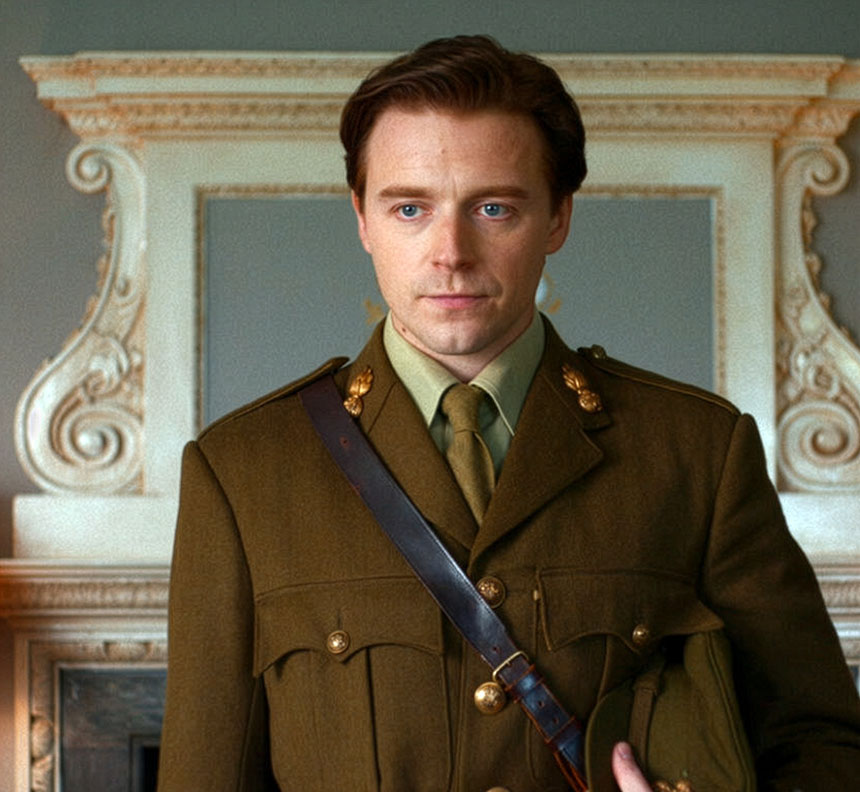
Jack Lowden as Siegfried Sassoon in “Benediction,” 2022
From Oscar Wilde to the present, there has been a continuous line of gay writers, all of them considered to be degenerate criminals until relatively recently, and all of them now vindicated as bravely many years ahead of their times — impeccably civilized in their subversiveness. Siegfried Sassoon (1886-1967) was one of the lesser known of these writers. The 2022 film “Benediction” has given Sassoon some of the attention he deserves.
The Scottish actor Jack Lowden, of course, is River Cartwright in the brilliant and ever-so-entertaining series “Slow Horses,” now streaming on Apple TV+.
Many of these writers knew each other. Gay writers living today are only a few degrees of separation from Oscar Wilde. These early 20th Century gay writers lived in dangerous times. Wilde’s trial started a dark cultural shift that lasted for sixty years. Scholars estimate that between 50,000 and 100,000 men were charged with crimes up until decriminalization in 1967. There was surveillance, entrapment, trials, prison, exile, and suicide. Alan Turing, who was charged with “gross indecency,” the same charge that was used against Oscar Wilde, was only one of these. E.M. Forster’s novel Maurice was not published until 1979, nine years after his death.
Armistead Maupin and poet Gavin Geoffrey Dillard knew Christopher Isherwood. Isherwood and W.H. Auden were lifelong friends. Isherwood knew E.M. Forster. Siegfried Sassoon knew Robbie Ross (who was a loyal friend to Oscar Wilde until the very end). Siegfried Sassoon never met Isherwood, but he certainly knew of him. As a war poet during World War I, Sassoon was critical of Isherwood because he thought Isherwood was avoiding military service by remaining in the United States. Isherwood knew Gore Vidal and Tennessee Williams.
Though almost all them were born to great privilege, they were not all of equal character. Lord Alfred Douglas, who betrayed Oscar Wilde, became an even greater jerk after Wilde’s death. E.M. Forster, on the other hand, would qualify as a saint, were it not for the Catholic church’s clock running about six thousand years slow. Christopher Isherwood was no saint — as is clear if you read Christopher and His Kind or watch the film “Cabaret” — though Isherwood lived a very different life after he came to the U.S. in 1939.

Christopher Isherwood (left) and W.H. Auden, 1939. Source: Wikimedia Commons.
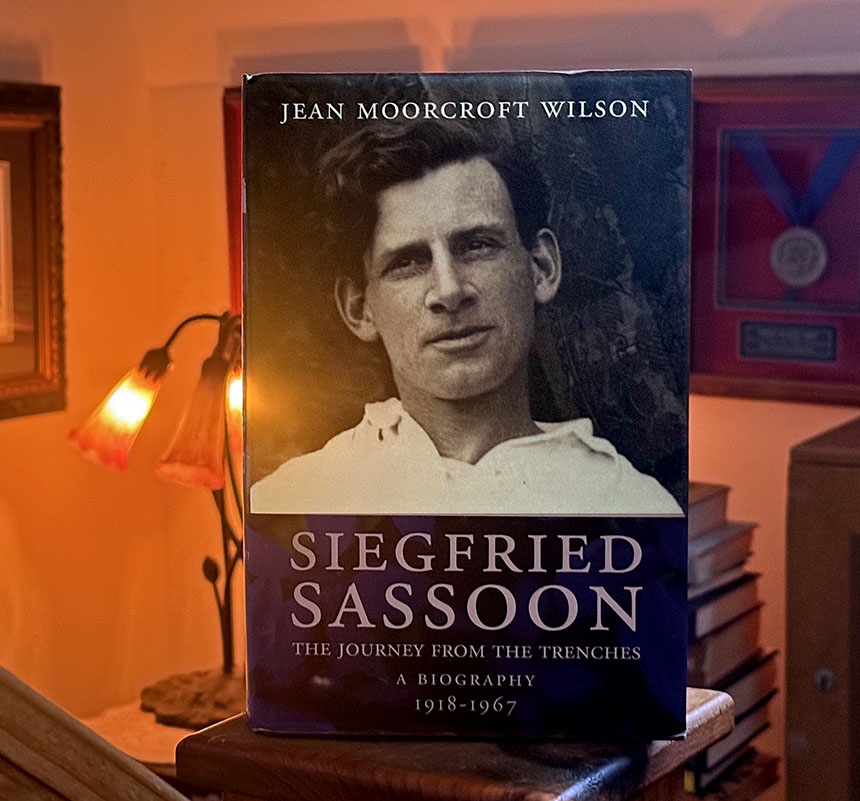
After watching “Benediction,” I bought a copy of a 2003 biography of Sasson, Siegfried Sassoon: The Journey from the Trenches. I doubt that I will read the entire book; it’s a very detailed 526 pages. But it’s an excellent reference with a valuable index and large set of notes. “Benediction” doesn’t flinch at the gloom and embarrassing failures of Sassoon’s later years. I found it interesting, by the way, that my copy of the book, which I ordered from the U.K., had a previous life in the Hobson Library of the Joint Services Command and Staff College, which trains members of the British military.
I have known poet Gavin Geoffrey Dillard for more than fifty years. He is my oldest friend. Gavin lived in Hollywood for a good many years. Isherwood lived in Santa Monica. Isherwood was diagnosed with prostate cancer in 1981 and died of it in 1986. Below are two photos that Gavin took while visiting Isherwood during Isherwood’s last years.
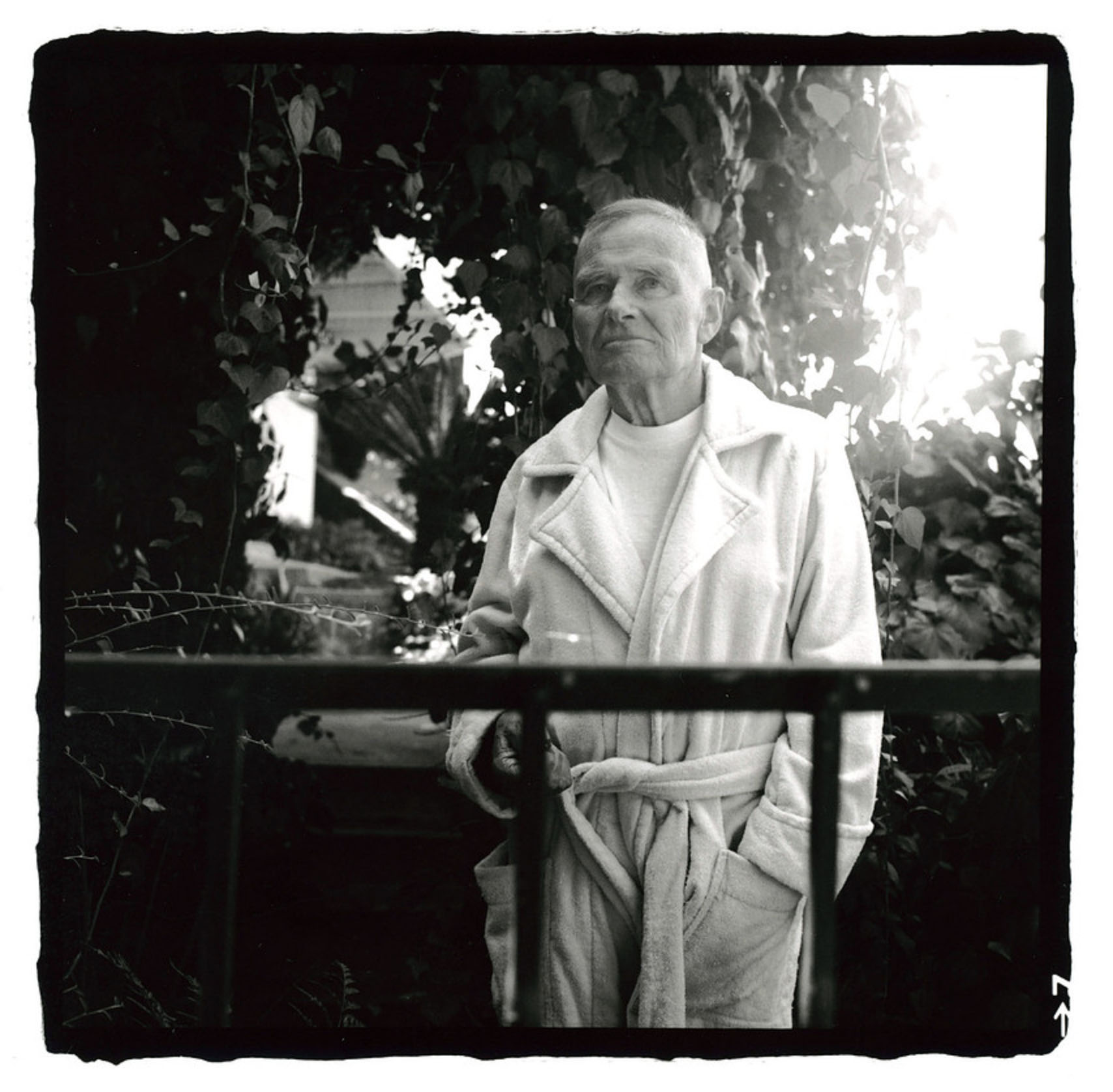
⬆︎ Christopher Isherwood, Santa Monica, California, c. 1984. Photo by Gavin Geoffrey Dillard.

⬆︎ Christopher Isherwood and Don Bacardi, Santa Monica, California, c. 1984. Photo by Gavin Geoffrey Dillard.
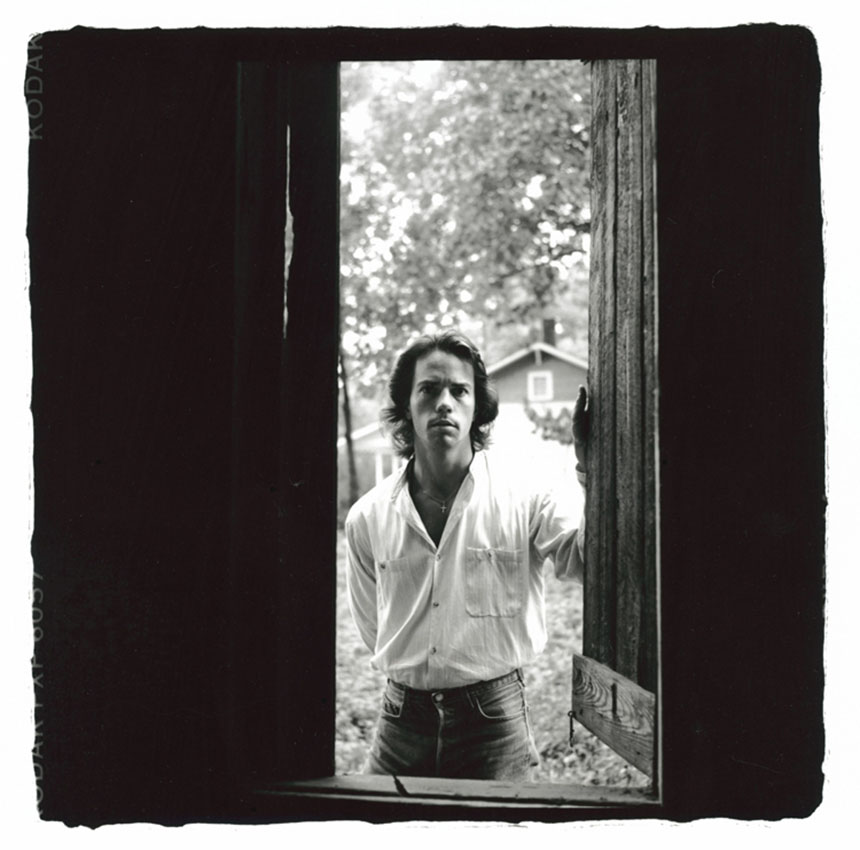
⬆︎ Gavin Geoffrey Dillard, Bethania, North Carolina, c. 1979. Photo by David Dalton. (For years, Gavin and I preferred twin-lens reflex cameras such as Yashicas and the Mamiya C330, which use square 620 film.)
For Gabriel
When you were an angel and I was a god,
Earthly-fair were the paths that we trod;
You, from your heaven of Saints at the Throne,
Banished, to wander, gold-haired and alone;
And I, from my pagan Paradise hurled,
Thro’ sun-shot cities of cloud to the world.
Humble you came, with your calm, clear eyes,
And parted lips; but your spirit was wise
With raptures of music and light that you’d lost …
So we loved and were happy, nor counted the cost.
For the gates were barred, and the way was hard
Up to the bastions of Heaven proud-starred;
And I was a god no more. But you sprang
To the peace of my arms … and an angel sang.
Unpublished poem by Siegfried Sassoon, dated 20 November 1918, included in Siegfried Sassoon: The Journey from the Trenches, 2003.
I discovered Isherwood when studying Indian philosophy. He was a member of the Vedanta Society of Southern California, and became a devout follower of Ramakrishna, the 19th century Bengali mystic. Its funny because I always associated Isherwood with the 1960s/70s counter culture, but of course he lived a long life before any of that.
Isherwood also knew Aldous Huxley, through their shared interest in Vedic philosophy. Huxley died the same day as CS Lewis and Kennedy, after getting his wife to shoot him up with some LSD on his death bed. A nice way to go perhaps.
Hi Chenda: One might wonder if Huxley even noticed the transition. 🙂
Haha, indeed!