
For several months now, I have been at work on the sequel to Fugue in Ursa Major, which for now I just call Fugue II. I’ll give it a real title later. Fugue II is a much more demanding novel involving much more science fiction. There also is a historical element that is critical to the plot. It has required a great deal of research, most of it in thick tomes published by university presses. I sometimes think that I should include notes and a bibliography with Fugue II, just to show that my radical ideas don’t always come out of thin air.
There will be time travel in Fugue II. This technology belongs to aliens, who will allow earthlings to use it to help get earth out of the nasty predicament that I left earth in at the end of Fugue in Ursa Major. I think I’ll not say just yet where (and to what time) Jake and a few other earthlings will be going. But, when they get there, a deep stack of scholarly tomes will discipline my imagination in describing what they find and what they do. I am completely out of bookshelves, and there are many stacks of books in my room, some of them three feet high.
With our current understanding of physics, is time travel possible? How about faster-than-light travel? The opinions of physicists differ. But, if time travel or warp jumps are possible, then we can say a great deal about the conditions necessary to do it. To try to understand the physics of these conditions, I have relied heavily on Roger Penrose, a mathematician and physicist who is now an emeritus professor at Oxford. I have read a number of Penrose’s books. His mind is simply magnificent. I don’t have the math to truly follow him everywhere he goes, but I get the gist of it. A 10-year-old tome of his (1,100 pages long) has been my guide for the physics involved in the plot of Fugue II. The book is The Road to Reality: A Complete Guide to the Laws of the Universe.
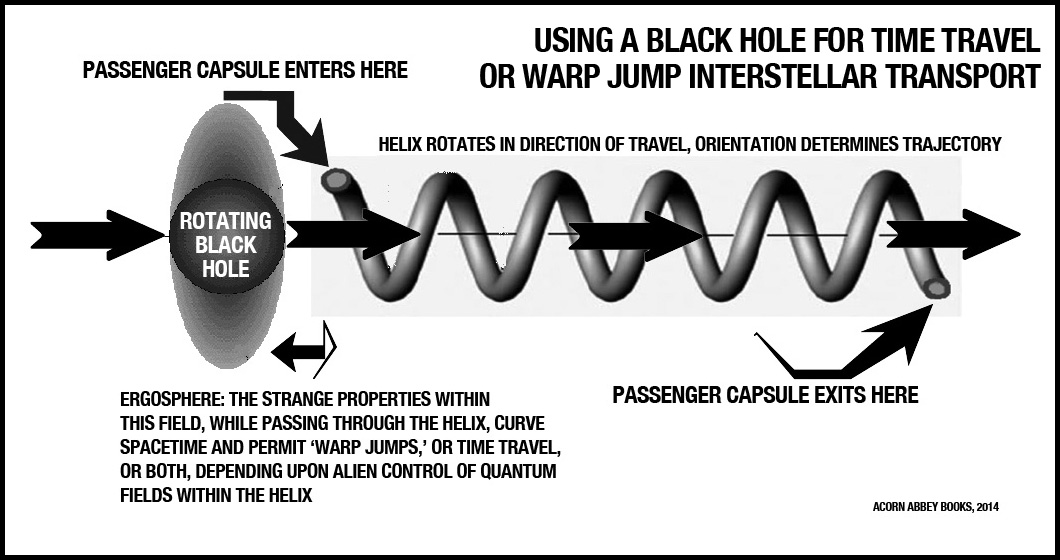
But back to time travel and warp jumps. As I see it, to travel in time you’d have to be able to control a seriously powerful source of gravity. OK. A black hole could provide that. You’d also have to be able to control a source of negative energy density. Never mind what negative energy density might be. It’s enough to know that you won’t find it in many places. But one place where you will find it (we think) is in the ergosphere of a rotating black hole. If you read the Wikipedia article, you’ll find that it was Penrose himself who first described this, back in 1969. But again, you don’t have to worry too much about the physics. The key point is that rotating black holes generate the forces we need, if time travel and warp jumping are possible.
I’ve left it to the aliens to do the necessary engineering. It involves an enormous piece of machinery — a tubular helix (or spiral) big enough to allow a rotating black hole to pass through it. The travelers go winding through the hollow helix tube while the rotating black hole is passing through the helix. You enter one end of the tube in the here and now, and you come out the other end somewhere or sometime else. The machine can take you back in time, except that it can’t take you back to a time earlier than the time the machine was built. Alas, it cannot take you to the future, because of some complications related to the Second Law of Thermodynamics. It can, however, return you to the present after you’ve traveled to the past. The same device can be used for interstellar travel with no time tweaking, depending on how you manipulate quantum fields inside the helix. (Don’t ask — it’s an alien proprietary secret.) As a travel machine, it can fling you across space faster than light, depending on how fast the helix is rotating. The axis of the rotating helix (the direction in which it’s pointing) determines the direction in which you jump. And sure, you can jump through the middle of a star or a galaxy if you want, because you went straight from point A to point B in an instant, and you were never at any points in between. But if you fling yourself to some far-off galaxy, take care that you know how you’re going to get back, because you were traveling in an ordinary spaceship, and the jump machinery was left behind.
How did the aliens solve this problem? They made multiple jumps to the same location (always near a suitable black hole), sending along the necessary materials, and built new jump machines at points of interest all over the galaxy and beyond. So space travel involves slower-than-light transport for relatively short distances and a network of those enormous jump machines for faster-than-light interstellar travel.
As I understand the science, I cannot imagine a warp engine that could be built into a space ship. Far too much mass (and therefore gravity) is required, and the gravitational and tidal forces involved are exceedingly dangerous. These forces would rip human beings and machines apart. Therefore, as I see it, a warp engine would be more like a catapult. The catapult would remain where it is, but it would push you and your space ship through a worm hole as long as the travelers and their space ship were far enough away from the tremendous gravitational and tidal forces involved in opening a worm hole.
Faster-than-light travel is a minor element of Fugue II‘s story. It’s a story about people, really. But where the plot involves science (or history), I want all the i’s dotted and all the t’s crossed. I’m a radical and a heretic, but I rarely just make stuff up. What really drives my imagination is dreaming about how we might get out of the awful times we live in, and what we might do about the fact that the wrong people are running the world and have run the world for a long time.