WYSIWYG with old daisy wheel printers


A 1985 IBM Wheelwriter 5 with the printer option. Click here for high-resolution version


I apologize to regular readers for this nerd post of limited interest. Many of the hits on this blog come from Google, from people who have run a search on one of the many subjects I’ve written about over the past 17 years. This post is meant as a service to “the typewriter community,” since I am a typewriter collector and my career was in computers and publishing.


Today I am shocked, and ashamed, at how quickly we nerds gave up our typewriters back in the 1980s and quickly adopted the new phenomenon of “word processing.” Now I’m sentimental about what we had back then. We need not only to keep the old machines alive, but also to preserve the knowledge of how to use the old machines.

A few typewriters were made that bridged the world between typewriters and computers. They had a keyboard, of course, and could be used as typewriters. But they also had a computer interface (generally a Centronics parallel port) so that they could be connected to a computer and used as a printer. Most IBM Wheelwriters did not have the printer interface. They are said to be rare. But if you can get your hands on one, they are marvelous machines. Mine is a Wheelwriter 5 made in 1985. The “printer option” for the Wheelwriter 5 consisted of two computer boards that connected to the typewriter’s main board with a ribbon cable. To house the two extra boards, an extension for the case was provided that clipped onto the back of the typewriter. Other versions of the printer option on later models of the Wheelwriter had the printer option more or less built in. Some even came with LCD displays or hardware for connecting the typewriter to an external keyboard and monitor.

The first thing to know about these beasts in that they are (rather obviously) ASCII printers. When Postscript and laser printers came along, ASCII printers including ASCII dot-matrix printers were quickly displaced. These days, printers have drivers that explain the printer’s capabilities to the computers they’re attached to. For ASCII printers, you won’t find any drivers, because: You don’t need a driver! The goal is a simple one — to send ASCII down the wire to the printer. But most computers these days have forgotten how to do that.

I am not a Microsoft Windows person. There are ways to make the old ASCII printers work with Windows, but I’m afraid I can’t help with Windows. However, the job is easy with Linux computers and Macintoshes, because Linux computers and Macintoshes are Unix boxes that still come with all the old text-handling utilities such as “vi,” “nroff,” and “lpr.” Other classic text-handling utilities, such as the Emacs editor, are easily available.

To get an old ASCII printer to work on a Linux computer or Macintosh, you need some basic knowledge that I can’t get into here. You’ll need to do some Googling and learning if the tools and concepts are new to you. For example, to attach an ASCII printer to a Linux computer or Macintosh, you’ll need a USB to Centronics parallel adapter cable. You’ll use Cups, the built-in print spooler, to set up the printer as a “raw” printer. “Raw” means that Cups sends plain ASCII down the wire without using a driver. You need to know your way around in terminal windows.

I’m an old hand at “vi” and “nroff,” because once upon a time that’s what we used for writing, editing, and formatting text. Another popular editor was Emacs. Emacs has a learning curve even steeper than that of “vi.” But to use Emacs with a daisywheel printer, you don’t have to know everything about Emacs. You only need to know enough to use Emacs for writing and editing English text.

Some of the early text utilities with graphical interfaces are still around and no doubt can still provide a WYSIWIG experience with a daisywheel printer. (WYSIWIG means “what you see is what you get.”) For example, George R.R. Martin is notorious for continuing to use WordStar on DOS! But you’ll have a harder time finding WordStar, or a working DOS computer, than you’ll have finding an IBM Wheelwriter with the printer option. So Emacs is the easiest way to go.

I’m sorry that I can’t get into the how-to’s here. It’s all pretty complicated, and Googling will lead you to articles on how to use Emacs, how to use Cups, etc. My purpose is only to show that it can be done and to encourage you to do it if you have a daisywheel printer, an ASCII dot-matrix printer, or a hybrid typewriter-printer such as a Wheelwriter in your collection.

About the IBM Wheelwriters

Typewriter collectors disdain machines such as the IBM Wheelwriters because Wheelwriters are not purely mechanical machines. Rather, there is a computer inside the typewriter that controls the typewriter’s moving parts. So-called electronic typewriters are far simpler — mechanically, anyway — than mechanical typewriters. Just as the IBM Selectric was the ultimate in mechanical typewriters, the IBM Wheelwriter is the ultimate in electronic typewriters. The Wheelwriters are heavy beasts, made for commercial use. The Wheelwriter keyboards are superb. The keyboards are identical to the IBM Model M keyboards, which IBM made for IBM computers starting in 1985. People cherish these keyboards today and pay high prices for them. If you are a good typist, then the best keyboards ever made are the keyboards on the IBM Selectric typewriters, the Model M keyboards for IBM computers, and the keyboards on the Wheelwriter typewriters. Like most of the Selectric typewriters, the Wheelwriters have a correcting function — a sticky tape that lifts letters off the paper if you made a mistake. The Wheelwriters (depending on the model) also have memories (for such things as form letters) and spell check. The daisy wheel itself lifts out, and an assortment of type styles and font sizes were available, as well as support for dozens of languages.

I love my IBM Selectrics, but the Wheelwriters also are lovable machines. They have a kind of robot personality, because, unlike typewriters, they have a brain inside.


⬆︎ This is Emacs running in a terminal window in Mac OS.


⬆︎ A letter from John Steinbeck to Robert Wallsten reproduced on a Wheelwriter using a proportional typeface. Wallsten was a screenwriter for “Alfred Hitchcock Presents.”
A personal AI road map for the present


Chat GPT: Please make a lifelike image of a stray cat walking along a street in Edinburgh, near Waverley station and the Walter Scott monument.


Ready or not, artificial intelligence is going to become a part of your life. Where we are now with AI reminds me of where we were in the 1980s with the internet. There were early adopters (like me), but eventually everybody was going to have it.

First, a disclaimer. I have been an Apple groupie for 35 going on 40 years. Thus I lean toward Apple products and discount (and even disdain) competing offerings from, say, Microsoft or Google. I also know next to nothing about Android devices, though I do have a Android phone that I keep as a kind of emergency backup for my Apple iPhone. So, Apple.

In the months since AI became the next big thing, I have been in exploratory mode — not spending much money but trying out AI’s to try to get a feel for what they’re good for and where they’re going. With the release last week of Apple’s new versions of Mac OS (version 15, Sequoia) and iOS (version 18), we have a pretty good idea of what Apple is going to do. Apple is going to have its own AI called Apple Intelligence, and Apple is going to partner with Chat GPT. Thus, for me, the course into AI adoption for the present is pretty clear — use the AI features built into Apple’s new operating systems, and combine that with a subscription to Chat GPT (which has a free version as well as a more advanced version for individuals that costs $20 a month).

Making images with an AI is a lot of fun. But, to me, it’s texts that really matter. The $20-a-month version of Chat GPT allows you to upload and analyze texts, though it’s not clear to me how long Chat GPT retains those texts. We won’t know until next month, when Apple releases new versions of its OS’s, what Apple’s capabilities with texts will be. However, it seems to be that Apple’s AI will read everything on your computer, including all your emails, and will know about you everything that can be learned about you from what’s on your Apple computer and your iPhone. I’m good with that, because Apple is making firm promises about privacy.

To be ready for what’s coming with Apple AI, you may need to upgrade your hardware. But that gets complicated, because sometimes AI’s run “on device,” and sometimes they run “in the cloud,” with queries uploaded to servers somewhere over the internet, and the responses downloaded to you, which means that you can use AI’s without having the newest Apple hardware.

Given that AI is in your future, your decisions really are about what you want to use it for and how much you’ll have to pay for it.

Low tech to the rescue


My heat pump (which also is a cooling system) had been working perfectly for fifteen years. It chose to stop running on a hot Saturday afternoon when the outdoor temperature was 88F. The temperature inside the house slowly rose to a miserable 89F.

When critical systems in a house fail, the perversity principle requires that they fail on a weekend, when the kind of businesses you need are closed (though they might make an emergency call for a hefty additional fee). Lucky for me, my nearest neighbor is retired from the heating and cooling business, and he came to take a look.

His diagnosis, in which he says he is 90 percent confident, is that an electrical relay on the air handler has failed. That’s a relatively minor thing, and if we can acquire a new relay on Monday then the fix won’t take long.

Two rooms in the house have ceiling fans, which help. But my upstairs office does not. I went up into the attic and fetched an oscillating fan that had been used in the downstairs bedroom before I had a ceiling fan installed in that room. I had forgotten how amazing fans can be!

I well remember what it was like growing up in the South in the 1950s, when some businesses had air conditioning but pretty much nobody had it in their homes or cars. It was fans that made life in the South bearable before the age of air conditioning. Architecture and landscaping were important, too. It’s why houses of that era had big front porches and shade trees.

Here in the American South, heat pumps have been common for decades. Almost everyone has a heat pump and has some understanding of how they work. In a climate that doesn’t get too cold, heat pumps are an efficient source of heat. The heat pump’s true magic, though, is that it’s reversible. It can pump heat into the house from outdoors, or it can pump heat out of the house. There is a limit to a heat pump’s efficiency, though. When heating, a heat pump can raise the temperature of the outside air only about 50 degrees F. So, if it’s 20F outdoors, a heat pump will have to rely on assistance from electrical heating coils, which are not efficient.

I have seen a good many stories lately about how efforts to introduce heat pumps in the U.K. aren’t going very well. A friend recently returned from a visit to a Scottish island, where a local had complained about the cost of operating a newly installed heat pump — £2,000 for one winter’s worth of heat. My guess would be that the problem is not so much the heat pump as a drafty and poorly insulated house. Here in American South, people who live in older houses often use heat pumps for cooling but still use gas or oil for heating.

The sound of the fan, and the start of the Democratic National Convention tomorrow, have stirred up clear memories of the summer of 1960, sitting in my grandmother’s living room with the sound of her large floor-model oscillating fan and watching the party conventions on television. In 1960, John F. Kennedy was running against Richard Nixon.


Correction: Upon reflection, I realized that my summer memory had to have been from 1960 rather than 1956, and I have edited the paragraph above accordingly.

I’m also remembering the importance of ice for living in the South before the days of air conditioning. My grandmother was fond of Pepsi. Pepsi over ice was regular thing with my grandmother, especially in summer. At home we drank far less Pepsi and far more iced tea. There was always iced tea in the refrigerator, and there was always ice in the freezer.

Normally, now, I don’t use much ice, even in the summer. But one of the first things I did after the air conditioning stopped yesterday was to turn on the icemaker.

No. 1 pencils, now and always


Click for high-resolution version.

One of the finest writing instruments ever made is the No. 1 pencil. Whenever I have bought No. 2’s, because No. 1’s are often hard to find, I have regretted it. Pencils with harder lead don’t produce good contrast. And one has to bear down harder.

The first twelve or so years of my career were as a newspaper copy editor. (In the mid-1980s, when newspapers started using publishing systems built on computers, I became a systems guy, because I was good with computers, and it paid better.) In those pre-computer days, the type was set in the composing room with hot-lead Linotype machines. The newsroom was full of typewriters, always heavy office machines, usually Royals made between 1945 and 1958. The copy paper actually was cut from the same huge rolls of newsprint that went onto the presses. A big hydraulic knife in the pressroom was used to cut the copy paper 8.5 inches wide by about 20 inches long. When you loaded a typewriter with paper, you always used two sheets of copy paper, with carbon paper in the middle. The top sheet, of course, went into the production process. The carbon copies from the entire newsroom were collected each evening (by a copy boy) and filed away, in case there were ever any questions about whether errors originated with reporters or whether the errors were made during the editing and production process.

Copy editors made their marks with, and only with, No. 1 pencils. This was not so much because the marks ever needed to be erased. It was because No. 1 pencils make clear and readable marks, and the need for less pressure meant much less fatique for the copy editors’ hands. To have edited with hard-lead pencils would have been miserable work.

So, when a copy editor’s evening started (usually around 4 p.m. for morning papers), he or she would sharpen a handful of pencils. During the evening, there would be multiple returns to the pencil trimmer. We wore out a lot of pencils.

In those days, everyone recognized everyone else’s handwriting. By the time a piece of copy was ready to go to the composing room through the pneumatic tube, there would be many pencil marks on it. Every editor would know quite well who had done all the edits, all the way back to the reporter.

Years before I entered the newspaper business, one of the jobs of copy boys would have been to carry copy from the newsroom to the composing room. By the 1930s, pneumatic tubes were the rule, larger versions of the pneumatic systems that large department stores used to use for making change from a single room somewhere where all the cash was kept.

While I’m on the subject, one of the nicest things that ever happened to me was getting a weekend job as a newspaper copy boy when I was in high school. There was no job in the world that I would have been better suited for. One of my favorite parts was looking after a room full of Teletype machines — loading paper, changing their ribbons, tearing off copy, sorting it, and distributing the copy to the right editors in the newsroom. I also typed stories going out to the Associated Press onto a Teletype system that had a keyboard and a tape punch. Punching paper tape before sending the stories allowed typing errors to be corrected, and sending stories out with punched tape meant that the Teletype machine could operate at full speed (about 60 words a minute), reducing the time used on the Teletype’s telephone circuit. Typing directly onto the wire was possible, but it was frowned upon.

Maybe someday I’ll write about the machines that were used to transfer photos over telephone lines, from coast to coast as well as transatlantic. One of those machines (in Nuremberg) actually appears briefly in the Netflix series on the Third Reich (now streaming on Netflix). The machine involved a rotating cylinder to which the photo is attached. Anyone who noticed it in the documentary is unlikely to have figured out what it was. A few of them must still exist in museums.

A few years ago, Ken saw the copy tube (below) in my attic and said, “What is that.” Oh how things have changed, that someone as deeply immersed in writing and publishing as Ken didn’t recognize it.


⬆︎ This copy tube used to belong to the San Francisco Examiner. The typewriter is a Royal HH from around 1952. I have about a dozen typewriters in my collection. Click here for high-resolution version.


⬆︎ This recipe for quiche was typed on a Royal KMM typewriter on newsroom copy paper. You can see some of the pencil marks over pâte brisée and the scratched-out typos. As for pâte brisée, you can be very sure that copy editors were as careful with French punctuation as with English. Whereas the uncaught typo “parpare” embarrasses me now, 45 years later. I have used this recipe for 45 years. Click here for high-resolution version.

(The Royal KMM typewriters were made from the late 1930s into the 1940s. It’s one of the models of typewriter that helped fight World War II. It has been said that World War II could not have been won without typewriters. The logistics of war are formidable. But consider also how the Nazis managed logistics and kept records, and what the evidence at the Nuremberg trial might have looked like had it not been neatly typed.)

The magical threads from nowhere to somewhere


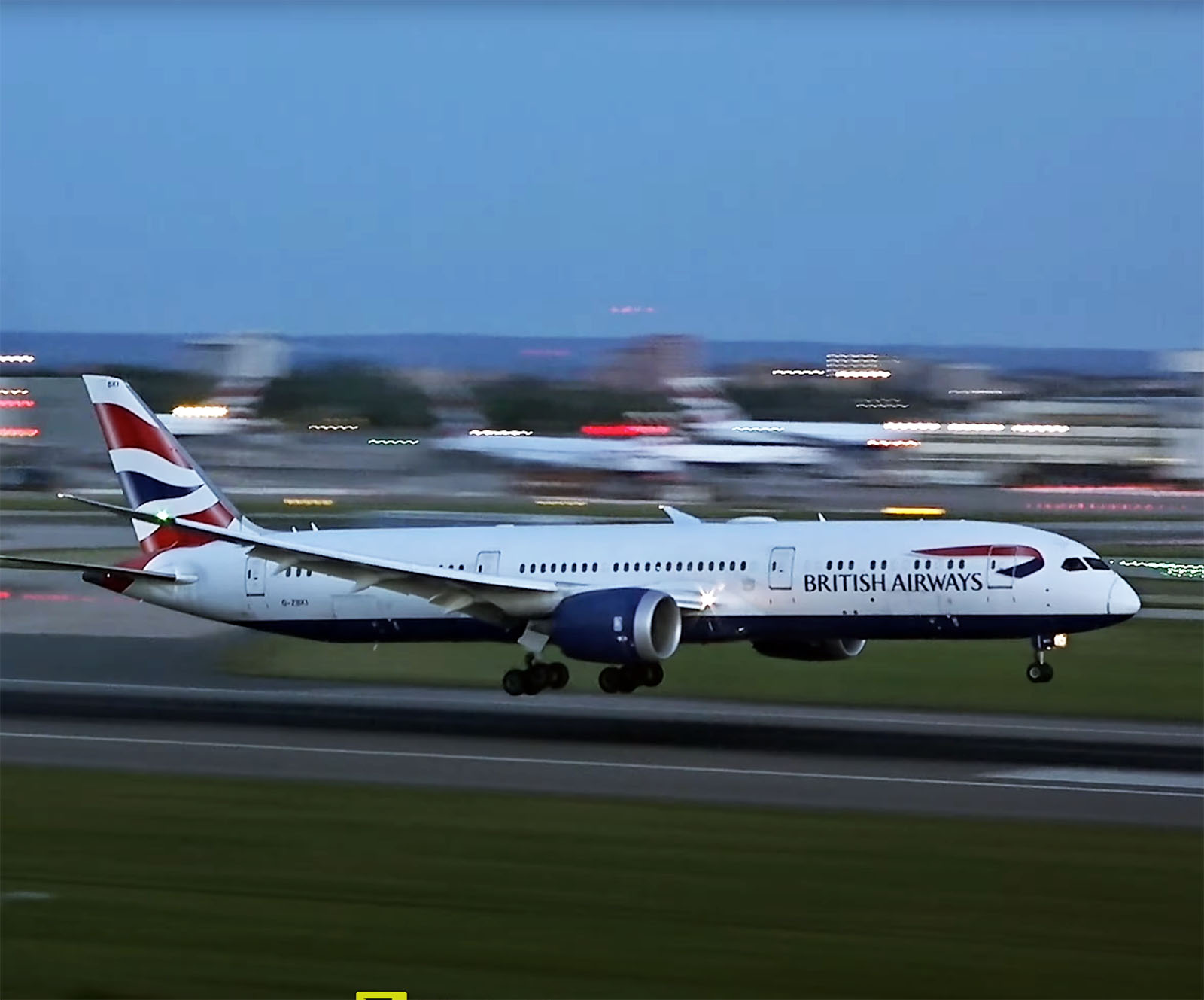
From a live stream from Heathrow Airport, Monday, April 29, 2024

When Charles Dickens was a young man, he would sit on London Bridge and watch the traffic — the people on the bridge, the ships on the river. Though London was a somewhere rather than a nowhere, it’s easy to imagine that Dickens thought of the faraway places to which the ships were bound, or from which they were coming. In David Copperfield, Dickens’ young hero does the same thing:

“[B]ut I know that I was often up at six o’clock, and that my favourite lounging-place in the interval was old London Bridge, where I was wont to sit in one of the stone recesses, watching the people going by, or to look over the balustrades at the sun shining in the water, and lighting up the golden flame on the top of the Monument. The Orfling met me here sometimes, to be told some astonishing fictions respecting the wharves and the Tower; of which I can say no more than that I hope I believed them myself.”

A common theme in literature is stories that start nowhere but take the reader somewhere as the plot unfolds. Often the stories return to nowhere at the end (because there’s no place like home). One of the reasons we read is to escape the nowhere in which most of us live for a vicarious look at somewhere.

Through the miracle of the global network that we call the Internet, there are new ways of sitting in the stone recesses of London Bridge and watching the world go by. When I discovered the YouTube live stream from London’s Heathrow Airport, I spent an embarrassing amount of time, as though mesmerized, just watching the planes land, one after another, about a minute apart. The chat window identifies the plane and says where it came from — Buenos Aires, maybe, after a long flight, or Edinburgh after a short one — sometimes places I have never been, sometimes places I remember, and sometimes places that I still would like to go.

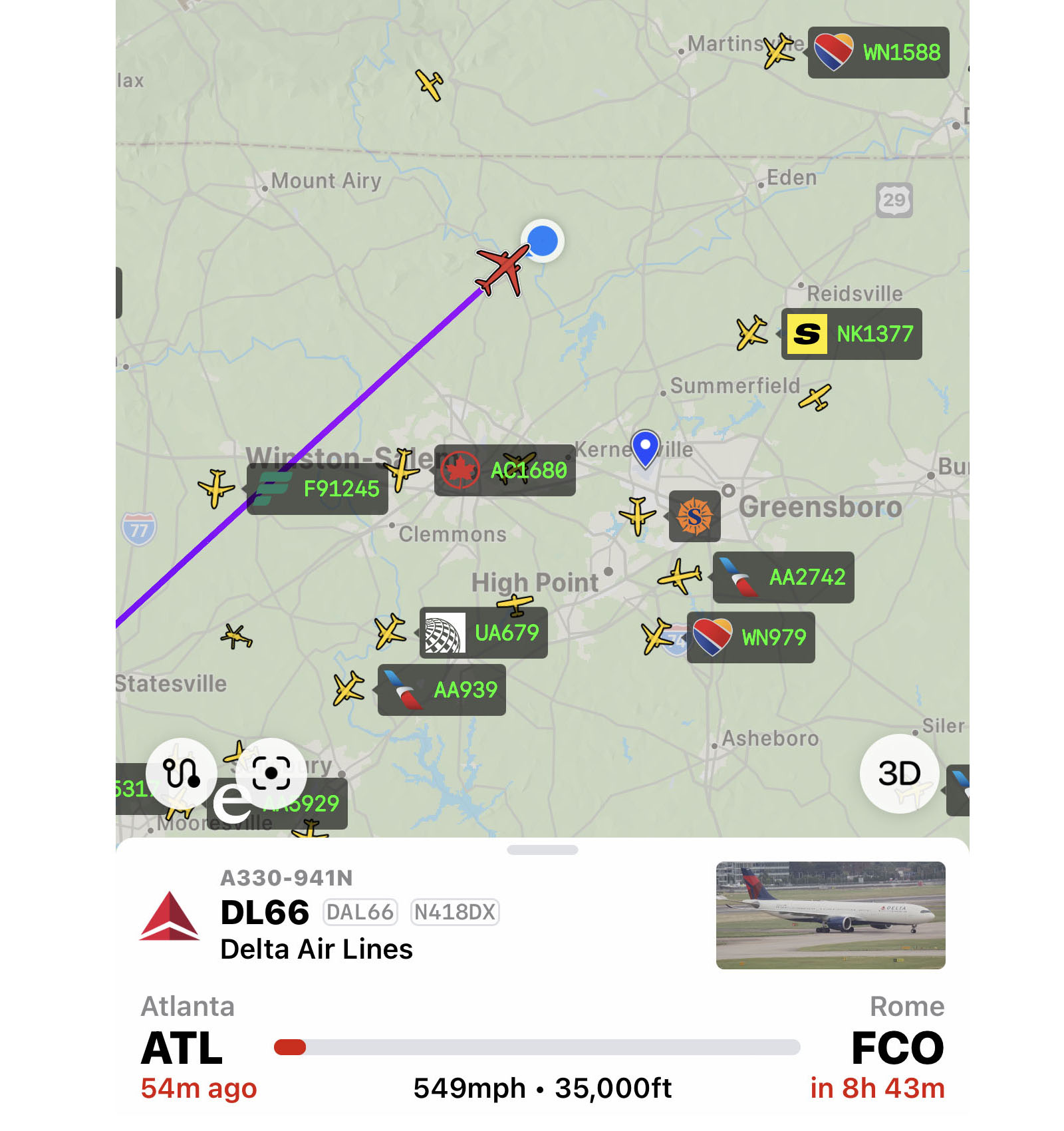
Then I realized that planes fly over my little piece of nowhere all the time. I also realized that there are apps that can identify those planes as they fly over and reveal where they came from and where they are going. It happens that a great many planes in and out of Atlanta fly right over me on the way to Europe and beyond. In no time at all, I saw (in the app) a plane on its way to Paris that was headed my way. I went out to see if I could see it. My eyes never found it, but I heard it pass over. Paris! Until Notre Dame caught fire, I had not planned to ever go to Paris again. Now I want to see Notre Dame after it has been repaired. Then there was a flight to Rome, a big Airbus that made so much noise that I could hear it through my bedroom window.

The YouTube streaming service from Heathrow is Flight Focus 365. The URL changes a couple of times a day, so you’ll need to select the live stream from the list of videos.

The app, for iPhone and Android, is Plane Finder.


⬆︎ Source: Wikimedia Commons. A square-rigged ship is to previous centuries as an Airbus 380 is today. They’re equally romantic and beautiful, if you think about it in a certain way.


⬇︎ The red airplane icon is Delta flight 66 from Atlanta to Rome. The blue dot is my location.


Update:

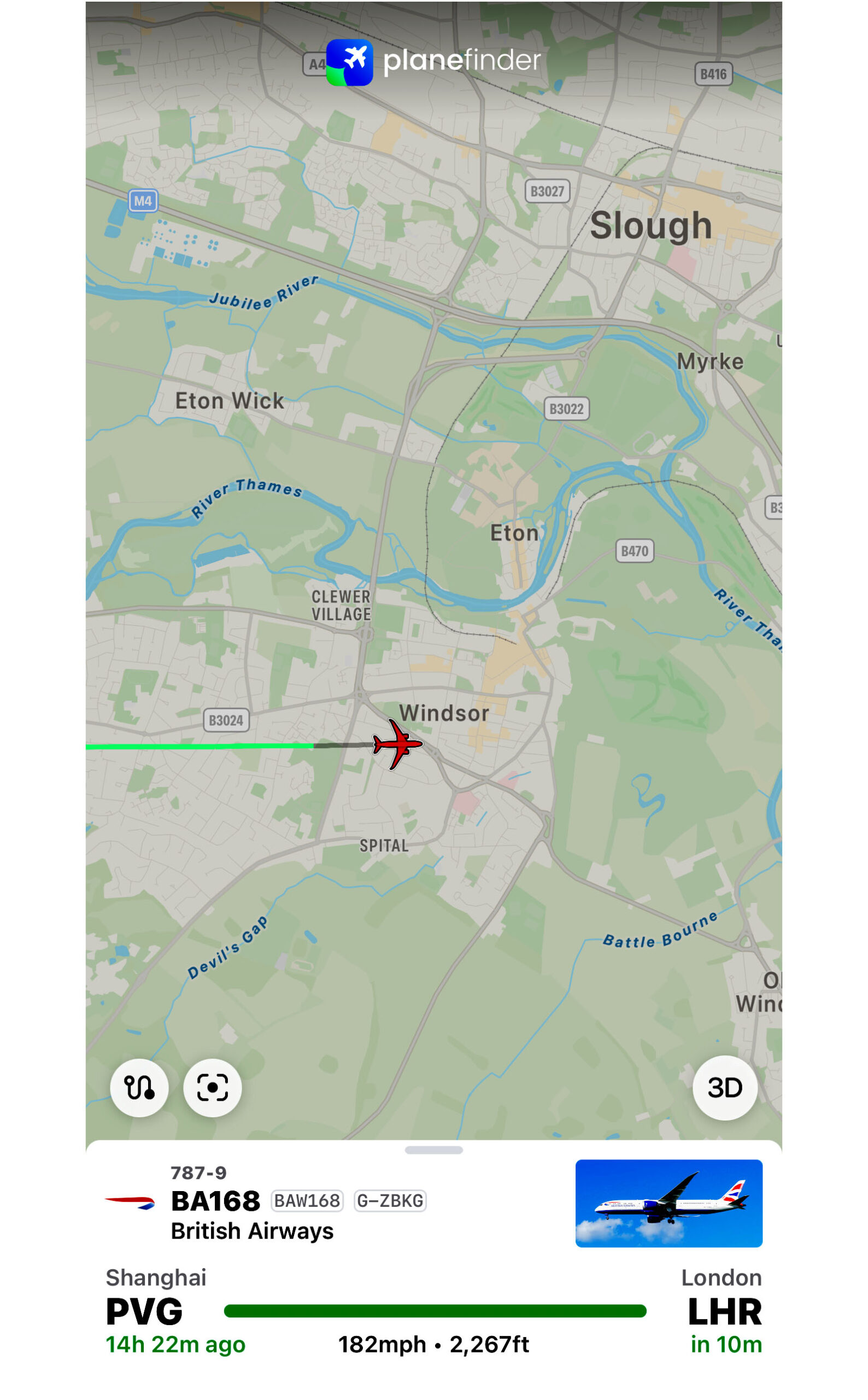
As long as we’re talking about Heathrow Airport, I should mention Windsor Castle. Planes approaching Heathrow from the east pass right over Windsor when they’re about six miles from Heathrow. The altitude is low, a little more than 2,000 feet, so if you’ve got a window seat you’ll get a very good look at Windsor Castle. There are stories that Queen Elizabeth II was so accustomed to the sound of airplanes overhead that she could identify airplanes from their sound.

I should also mention Slough, which is visible in the map below. I had wondered how “Slough” is pronounced. The train toward Paddington Station stops at Slough about 25 minutes before Paddington Station. According to the automated voice that calls out the stops, “Slough” rhymes with “how.”


I’m counting on Apple to do AI right


An article yesterday at MacRumors.com asks “Should Apple Kill Siri and Start Over?” My answer to that would be yes. Siri was (and is) terrible. Siri fell far short of the vision that Apple described in 1987 in the video above, which gets the vision right. Siri was a huge embarrassment for Apple.

I remember watching this video in 1987 at an Apple promotional event, and I’ve never forgotten it. Almost 40 years later, Apple at last is in a position to make the “Knowledge Navigator” a reality.

There’s an important hardware angle here. AI’s need a lot of computing power. AI’s run better on graphics processors than on CPUs. Apple’s M1, M2, and M3 chips are generously supplied with graphics processors. I’m writing this on a 2023 M2 Mac Mini Pro. It has ten CPU cores and sixteen (!) GPU cores. AI’s run very well on Apple’s high-end M2 chips, but it seems that Apple is not going to release M3 models of some of its computers and will skip straight to M4 chips, which are engineered specifically to optimize AI’s.

As for software, we still don’t know much about what Apple is planning. We should hear a lot more at Apple’s annual developers conference, which starts June 10.

It’s interesting that, in its 1987 visionary video, Apple showed its “Knowledge Navigator” being used by a Berkeley professor. Sure, there are plenty of people who would use an AI for sports statistics or investment research. But to really advance human knowledge, we need an AI that has read everything. The best material is behind paywalls — all the daily newspapers, academic papers new and old, new books plus all the older books that have been digitized, and even much of the daily chatter on the web. That’s going to cost a lot of money, but if anyone can figure out how to ethically acquire all that material and pay for it, Apple can.

A major failing of current AI’s is that they don’t attribute anything. My guess is that that’s because the people who are building the currently available AI’s don’t want us to know where they are stealing their training material. But if an AI is to be trusted, and if an AI’s answers are to be suitably weighed for reliability, then the AI must tell us where it got its information with citations and footnotes.

AI development is moving very fast. Acquiring, licensing, and figuring out the economics of the training material is a huge undertaking. Google, my guess is, will try to gouge and steal. Apple, I think, will do a more trustworthy job. In a few years, I expect to have a truly useful Apple AI running on Apple hardware.

AI image generators


AI image created by DALL-E-3. Click here for larger version.

When I started this blog sixteen years ago, one of my rules was that every post would include a photo. That hasn’t always been easy, especially when writing about current events. Free online image generators driven by AI create a whole new range of options. I’ll try not to overuse it!

You can try out Bing’s free image generator here: Bing AI image creator.


Click here for larger version.

Yep … I’m in the woods


A drone 235 feet directly above the abbey. Click here for high resolution version.

I’ve been interested in photography drones for a long time. But only recently did drones become halfway affordable. Smaller and smaller computer chips, improvements in battery technology, and smaller and better cameras have made it possible to build drones that weigh less than half a pound but which can shoot excellent 4K video. The drone I bought is a DJI Mini 3.

I took the photo above by putting the drone on its landing mat in the driveway in front of my house. There are trees all around me, so the driveway is the safest area for avoiding trees. I flew the drone straight up to an altitude of about 235 feet, then pointed it southwest to shoot this picture. The low mountains are the Sauratown Mountain chain, a small chain of mountains in Stokes and Surry counties (of North Carolina) about forty miles south of the Blue Ridge Mountains in Virginia. The three bumps to the right include Hanging Rock State Park, and the bump to the left is Sauratown Mountain.

It will certainly be a while before I have the skill to shoot any dramatic video with the drone. Learning to fly drones takes a lot of practice. Some of the YouTube videos shot with drones are amazing. There are lots of people who have been flying drones for years and who are very good pilots as well as good photographers and video editors. And it seems that a great many of them live in picturesque places such as the coasts of the U.K. (including Scotland) and Ireland. I have a lot to learn. But I’ll certainly have drone videos, and more drone photos in the future.

Why so much chatter about UFOs of late?


Source: Syracuse NewTimes, 2015

There has been so much media buzz about UFOs lately that even conservative pundits such as the New York Times’ Ross Douthat have written columns such as “Does the U.S. Government Want You to Believe in U.F.O.’s?” Ezra Klein, also at the New York Times, recently had a podcast with the title “What the Heck Is Going On With These U.F.O. Stories?” A big part of the recent buzz has been because of a whistle-blower who has claimed that the U.S. government possesses crashed UFOs, or at least pieces of them.

Back in 2019, I wrote a post here about the UFO that I saw in the early 1970s in eastern North Carolina. I included the sketch below to try to help describe what I saw, especially to make the point that it was no mere “light in the sky.” Lights in the sky don’t impress me (or any UFO watchers). Images from military radar don’t impress me either. My reasoning is this: If little old me has seen what I’ve seen, then the U.S. military has seen much, much, much more.

So what might be going on?

One theory, as Douthat suggests, is that the government is using some sort of procedure to gradually disclose UFOs to us, to condition us to the existence of UFOs so that some Big Announcement won’t freak us out too much. That’s an interesting and maybe even plausible idea, but those of us who have been interested in UFOs for a long time recall that, back in the 1980s, the same idea was prevalent because of films such as Close Encounters, E.T., Enemy Mine, and even the Star Wars films. But nothing ever came of it. The government is just as secretive as ever, really. As I see it, the purpose of the release of military radar video is to deceive us into thinking that the government is still mystified about what’s going on. I cannot believe that.

Recently I sent a copy of my UFO sketch to a friend who lives in France. She replied with a link to the sketch above, which looks very much like the sketch I made in 2019. The sketch above comes from a story in the Syracuse NewTimes from January 2015, “15 Years of Cylinder UFOs Over New York State”. Never before had I seen a UFO sketch that looked so much like what I saw.

I’ve made this standard disclaimer countless times, as many times as I’ve told my UFO story. That’s that my anecdote is just another anecdote among many thousands of anecdotes. The epistemological value of an anecdote is pretty much zero. So there is no reason why anyone should take seriously what I say, and no reason why anyone should take any UFO anecdote seriously. But the epistemological calculus for me personally is very different. I know what I saw, I saw it clearly, I remember it clearly, and I have no more reason to doubt what I saw than I have reason to doubt that I saw Donald Trump’s Boeing 757 parked and mothballed at La Guardia airport when I was last there in 2019. Thus my question is not “Do UFO’s exist?” but “What is the full story of what is going on?” I can only speculate, though some possibilities are more probable than others.

For one, I have zero doubt (or doubt that is as close to zero as is ever possible in a human mind) that, because I’ve seen these things, the U.S. military has seen them too — no doubt lots and lots of them. The idea that the U.S. military has collected the remains of crashed UFOs seems entirely plausible.

It would be a wonderful thing if humanity gets the Big Announcement soon. I can’t express how much I’d like to see that in my lifetime.

But people sort roughly into two categories — people such as religious people whose worlds and minds would completely fall apart because they can’t handle it; and people like me who are eager to get on with a huge expansion of human knowledge and heavy revisions in human philosophy. I’ll admit here that there is a whiff of vindictiveness in my point of view. Primitive minds — closed minds, religious minds, ugly minds — have held all of us back for far too long. If such minds were unable to deal with the Big Announcement, their defeat would be total, and there’d be nothing in the world (or in the galaxy!) that they could do about it other than go home, load their guns, and lock their doors. Then the rest of us could participate in a renaissance like nothing humanity has ever seen before.

Primitive minds will ask, “What if they’re here to eat us or to enslave us?” In fact, the primitive mind of Ronald Reagan thought that a war with aliens would be just the thing to unite humanity. Such nonsense. If E.T. visitors were here to enslave us or eat us, and if they have the power to do that, they’d already have done it.

Though I’d have a thousand questions for them, three questions stand out. First: How does their propulsion work? Second: Are they capable of faster-than-light interstellar travel, or did they get here much more slowly and do they therefore have some sort of outpost near earth? And, third: Is there a galactic federation with laws, a capital, and libraries? I’d imagine that if such a place exists, it must be a lot like the Star Wars planet Coruscant.

Maybe I’ll never find out. But future generations of earthlings surely will, and I envy them.


My sketch of the UFO I saw in the early 1970s