
Today’s Sunday drive went past RagApple Lassie Vineyards near Rockford in Yadkin County. The vines were looking really good…
Watching a bewildering world from the middle of nowhere

Today’s Sunday drive went past RagApple Lassie Vineyards near Rockford in Yadkin County. The vines were looking really good…
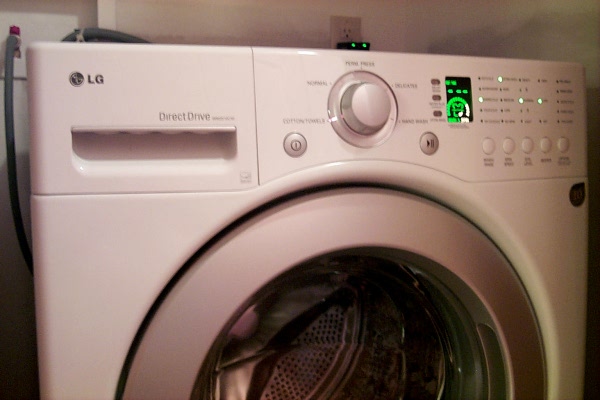
My new washer
—————————————–
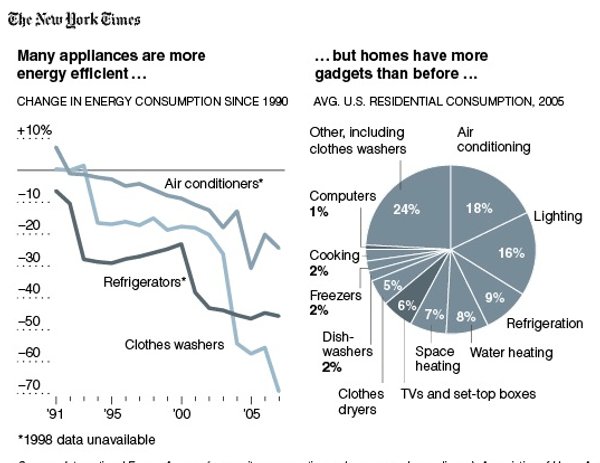
One of the nice things about new construction is that, largely because of tighter and smarter regulations, new homes and new appliances are more efficient and more frugal. My windows, with a U-factor of .31, are pretty darn snug, though no window is as efficient as a well-insulated wall. Local builders complain that Stokes County’s requirement for ceiling insulation is R-38, the same as in much of Canada, even though surrounding counties require only R-30. My Trane heat pump is far more efficient than heat pumps from the 1980s. Refrigerators have gotten much more efficient. Even my big iMac consumes far less energy than the computer it replaced.
For the month of July, with my cooling system running as needed all day and all night all month with thermostats set to 77 or 78, I used 604 kilowatt hours at a cost of $71.80. For September, with no heating and cooling needed, I’m expecting an electric bill of $35 to $40. My house is not a MacMansion. It’s 1250 square feet. [My electric company, Energy United, which is a rural electric cooperative, charges .0802 cents per kilowatt hour during the summer, meaning that my per-kilowatt charges were $48.44 for July. The rest of the bill is from taxes, fees, and fixed monthly charges.]
It has been fascinating to watch my new LG front-loading washing machine, which is Energy Star compliant. It’s astonishing how little water it uses. It’s very quiet. It spins at a very high speed to reduce dryer costs. Its behavior is very complex, controlled by a computer. Older washers with mechanical controllers were much more limited in how their wash cycles were set up.
The New York Times has a piece today on the patterns of energy consumption in the home and how they are changing.
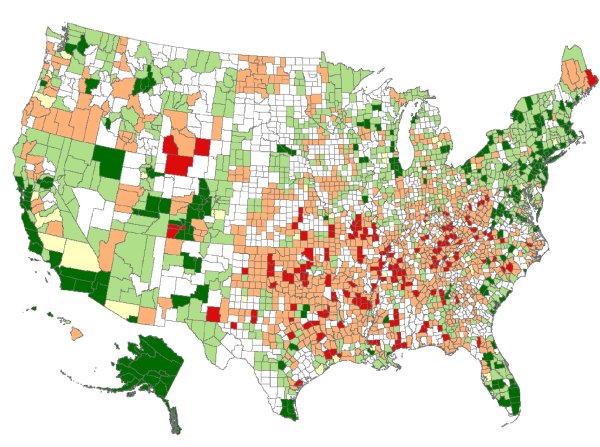
Life expectancy in the United States is at an all-time high. But like the stock market, it’s starting to look a little toppy. Life expectancy has started to decline in some parts of the United States, particularly rural areas and parts of the South.
According to LifeScience:
“Though the United States has by far the highest level of health care spending per capita in the world, we have one of the lowest life expectancies among developed nations — lower than Italy, Spain and Cuba and just a smidgeon ahead of Chile, Costa Rica and Slovenia, according to the United Nations. China does almost as well as we do. Japan tops the list at 83 years.”
This online medical journal has charts showing how life expectancy is changing area by area. (It’s uncanny how a county-by-county chart of life expectancy looks like a voting-patterns chart.)
This is all very sad, because life expectancy would continue to rise if people took advantage of what we now know about diseases caused by diet and lifestyle.

On July 8, 1932, the Dow Jones Industrial Average hit its lowest point of the Great Depression — 41.22
The media, as far as I can tell, almost completely ignored yesterday this story from the Associated Press about federal tax receipts, which have dropped in 2009 at a rate not seen since 1932. For the first six months of the year, individual income tax receipts were down 22 percent from a year ago. Corporate income tax receipts were down 57 percent.
For the month of April, the biggest month for collecting taxes, individual income taxes were down 44 percent, and corporate taxes were down 64 percent.
I wish someone could explain to me how individual income taxes can be down 22 percent if the unemployment rate is 9.5 percent. I also would like to understand how the earnings news can be good on Wall Street if corporate income taxes are down 57 percent.

Time magazine has a lame piece today on why there is more obesity in the South than in the rest of the country. They’re right about some things, for example the correlation of health and weight to income. But they trot out all the old stereotypes about biscuits, fried chicken, and pie. Southerners have always been poor, but they have not always been fat, as an examination of any collection of old photos will show you.
As a Southerner, a foodie, and a person who takes careful note of what people have in their carts in the grocery store line, I claim the standing to comment knowledgeably on this question.
1. Southerners have stopped cooking from scratch. This is clear from the contents of their grocery carts.
2. Southerners have too little color in their diets. Pretty much everything in their grocery cart will be meat or something white.
3. Southerners consume astonishing quantities of canned and bottled sweet drinks. By weight, sweet drinks are probably the main items in their grocery carts. Few even seem to make fresh iced tea at home anymore.
4. Southerners eat too much meat. They seem to have cut way back on pinto beans, which, in my childhood, you were guaranteed to get at least twice a week.
5. Southerners eat too much cheap white bread and too many chips.
6. Southerners buy very few fresh foods, not even fresh potatoes. It took me a while to realize that people aren’t interested in starting gardens because they aren’t interested in what comes out of gardens.
7. When Southerners eat out, whether at fast food places or not, they eat even more calories than they eat at home. Restaurants compete on price and the size of the portions.
If Southerners could go back to the era of homemade biscuits, all would be well. People made biscuits because it was hard to get white bread, or the white bread cost more. Biscuits come from an era in which everything came from the kitchen, from scratch.
Michael Pollen’s rule of thumb is the best I’ve ever heard: It’s about remembering and honoring what our great-grandmothers cooked. Many Southerners seem to have forgotten.
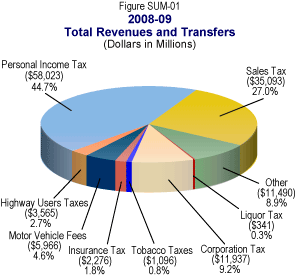
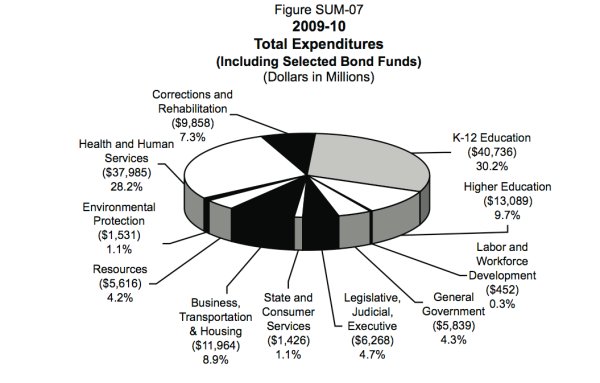
Those who like to bash California have been tsk-tsk’ing at California’s budget problems, trying to blame California’s “public sector.” California’s budget shortfall, at present, is estimated to be about $22 billion.
For comparison, the bailout of one bank alone — Citicorp — means that American taxpayers have now given $60 billion in direct assistance to Citicorp, plus $340 billion in guarantees. That comes to $400 billion, to one private bank! So far, the United States government has made about $12.7 trillion in guarantees and other financial commitments to private interests — Wall Street.
Another bit of perspective: During the California “energy crisis” of 2000 to 2001, Enron and other private interests ripped off Californians for between $30 billion and $70 billion, depending upon where one gets the numbers. Enron, by the way, paid no federal income taxes in most years and even used gimmicks to get tax rebates.
The reason California has a budget problem is that its revenue has fallen off a cliff because of the economic catastrophe brought to us by Wall Street. Last month, sales tax revenue in California was down 51% compared with last year, and personal income taxes were down 44% compared with last year. Californians are not making much money, and they aren’t spending much money.
If you look at the pie chart for California’s revenue, it’s pretty obvious which sector of the economy is not paying its fair share. California could easily fix its budget problem by increasing corporate taxes.
All the noise about public spending and the public sector is propaganda, distortion, and distraction. It’s unregulated greed and a corrupt Congress that we need to focus on.
Corporations and their propagandists are always complaining, with great shrillness, that the United States has one of the highest tax rates in the developed world (35%). To which advocates for tax fairness always reply: Nominal tax rates are one thing, but actual taxes paid, because of loopholes and shelters, is something else again. To figure out just how much in taxes big corporations (and rich people) pay is very, very difficult. It’s one of the things that they very, very much don’t want working people to know.
Here’s a number in the Washington Post story on Obama’s plan to put an end to offshore tax havens:
“The tax havens allow major U.S. corporations to pay taxes on only a fraction of their profits. According to 2004 numbers, the most recent the administration has on hand, U.S. multinational corporations paid an effective tax rate of 2.3 percent on $700 billion in profits.”
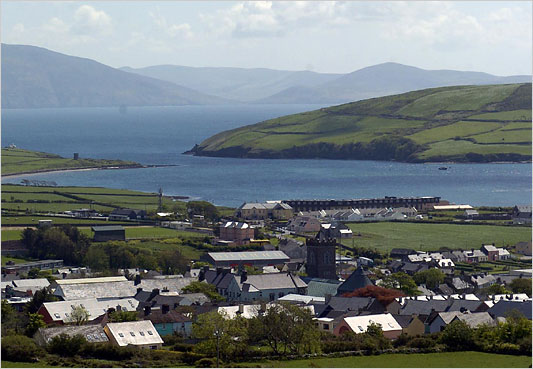
New York Times: Dingle town and Dingle harbor
The New York Times on-line edition has a little essay this morning on what the boom did to Ireland. It left the countryside littered with tacky little houses that no one wants. There is a hidden cost in that, because it cost Ireland, and least in many places, its old Irish look.
Whatever the next boom turns out to be, let’s hope it isn’t something that eats land and lays down pavement.
Dingle town, by the way, is fairly unchanged by the boom, as is the awesome stretch of road over Mount Brandon.
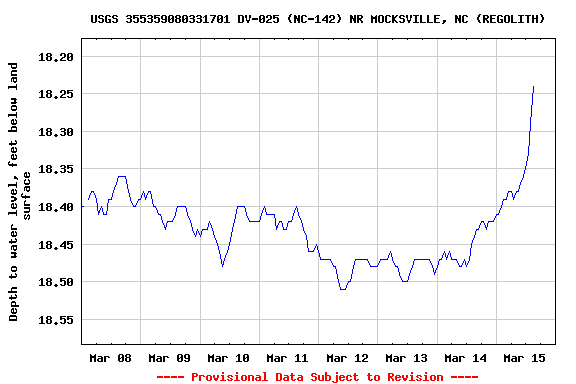
It goes without saying that sustainable living is not, um, sustainable without water. Farmers obsess about the weather, as well they should. Their livelihood depends upon the weather. Here in the Southeast, in the foothills of the Blue Ridge, we’ve been in a drought. There is no shortage of surface water at present. We’ve had around 2.5 inches of rain in the past few days. But groundwater, the aquifers that feed our wells and keep our springs and streams flowing, still has not recovered from the drought years early this decade.
The United States Geological Survey maintains wells around the country to monitor groundwater levels. The two nearest me are at East Bend, North Carolina; and Mocksville, North Carolina.
The chart above shows the groundwater level at Mocksville for the past seven days. The soaking rain we’ve had for the past few days is definitely bringing up the groundwater.
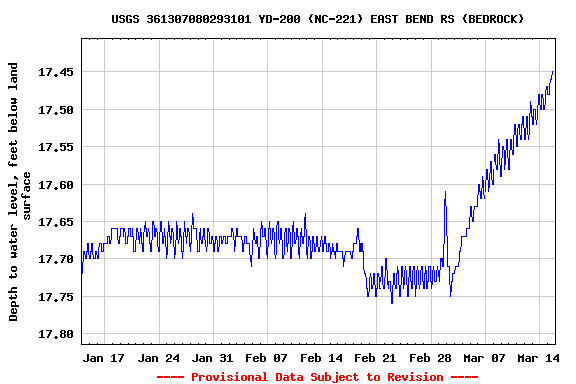
The chart above shows the groundwater level at East Bend for the past 60 days. That chart, too, looks good.
Nerd note: The daily data in the chart above shows a saw-tooth periodicity that made me curious. Some quick research suggests that barometric pressure causes fluctuation in the groundwater level. But solar and lunar tides also seem to affect groundwater levels.
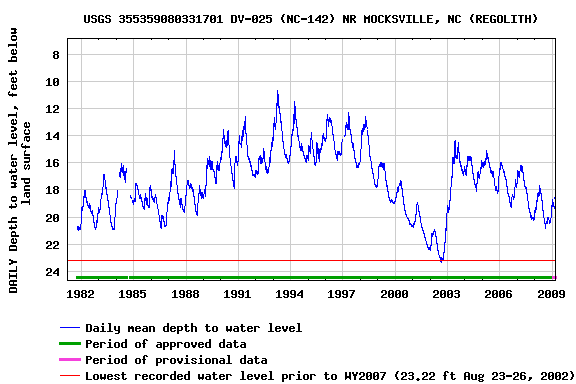
But if you look at the long-term Mocksville data, which is available only as far back as 1981, you can see that, long term, groundwater level is still below the mean, and we are still in a drought with an unfavorable long-term trend.
Speaking of periodicity, the groundwater level here normally falls during the warm seasons of the year and rises during the cool seasons of the year.
There was quite an outburst at the prospect of raising taxes for incomes over $250,000 a year. That’s radical, many said. “We’re running out of rich people,” said Michele Bachmann. “How Obama Will Bleed the Rich Dry” is the headline on Michael Gerson’s column this morning in the Washington Post.
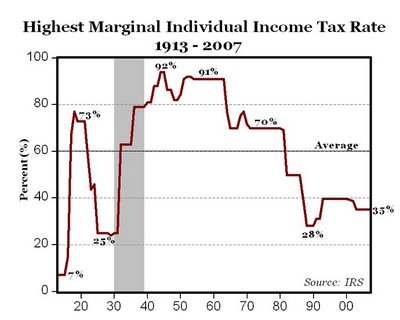
The key point of fact is this: the Obama budget raises the tax rate on income over $250,000 a year from 35 percent to 39.6 percent.
Historically, that’s hardly radical. The top rate was over 90 percent during the 1940s, 1950s, and 1960s, and 70 percent during the 1970s. We never ran out of rich people.
Historically, what’s radical was Reagan’s reducing the top tax rate to 28 percent in 1986. Though there were tax cuts on high incomes, wage earners actually paid higher taxes under Reagan. Part of this project of lower taxes for the rich and higher taxes for wage earners was to teach wage earners to hate government by convincing people that higher taxes always hurt the little guy. That is just not true.