
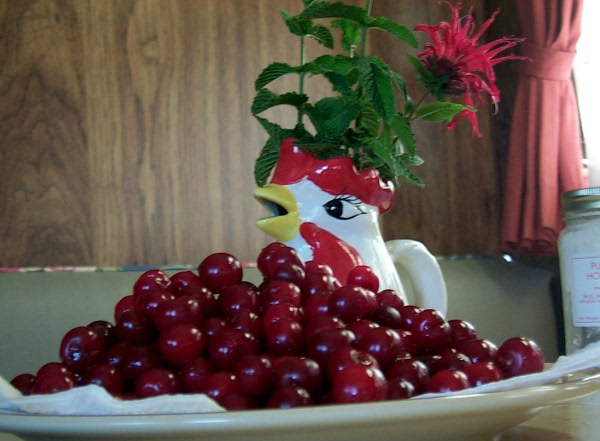
The cherries that I bought yesterday at Levering Orchard have been washed and are out to dry while I try to figure out the best way to make a cherry pie in a little travel trailer kitchen, which isn’t well equipped for pie-making.
Category: Food
Road trip: Mayberry and beyond
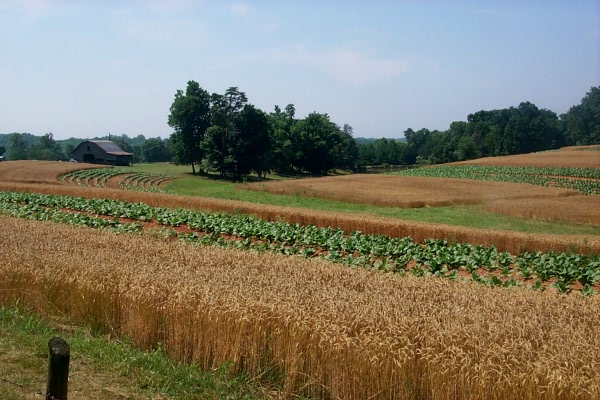
Good farming: here swaths of tobacco are alternated with swaths of rye, a nitrogen-fixing crop. This is near Sauratown Mountain in Stokes County.
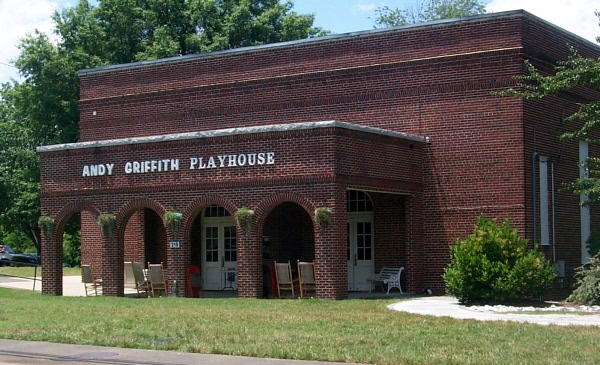
By Mayberry, I mean, of course, Mount Airy, North Carolina. Mount Airy is Andy Griffith’s hometown, and they are mighty proud of that. On the other hand, they’re constantly ticked with Andy Griffith because he lives in Los Angeles and apparently doesn’t much like visiting Mount Airy. But that doesn’t seem to diminish Mount Airy’s pride. [Correction: Someone who knows more about this than I do tells me that Andy Griffith now lives in Manteo, North Carolina, on the coast.]
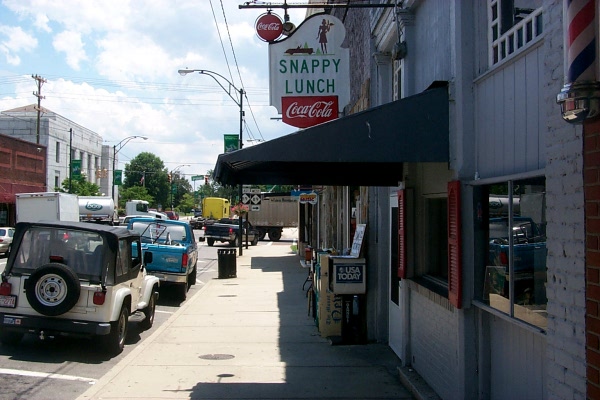
Mount Airy does a booming business in “Andy of Mayberry” tourism. Ground Zero for that tourism is Snappy Lunch on Main Street, because it was mentioned from time to time on the television show. Don’t even think of going to Mount Airy without stopping at Snappy Lunch for a pork chop sandwich. Bring some anti-acid. Californians, can you believe my San Francisco Jeep now has a North Carolina license plate and is parked in front of Snappy Lunch?
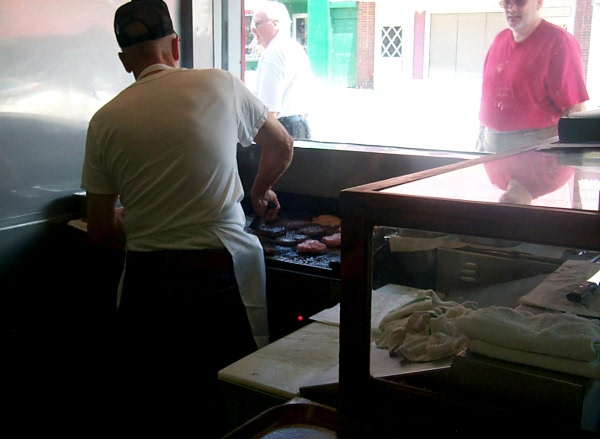
Behind the grill at Snappy Lunch — burgers and pork chops.
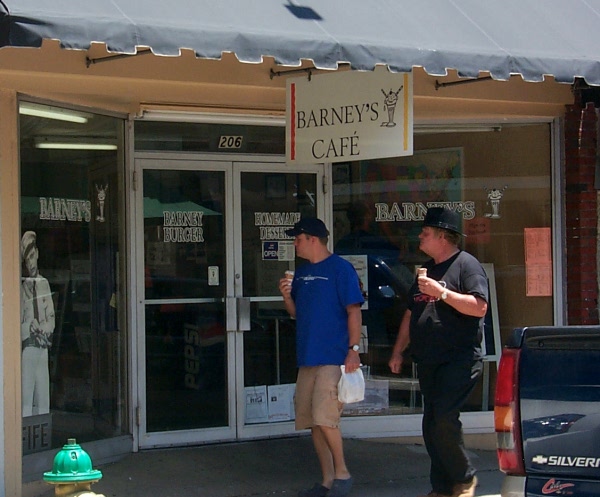
Barney also gets his due. I think Aunt Bee actually moved to Mount Airy after she retired and no doubt zipped straight to the top of the Mount Airy social ladder. This is nextdoor to Snappy Lunch. [Correction: I understand that Aunt Bee actually moved to Siler City, North Carolina, not Mount Airy.]


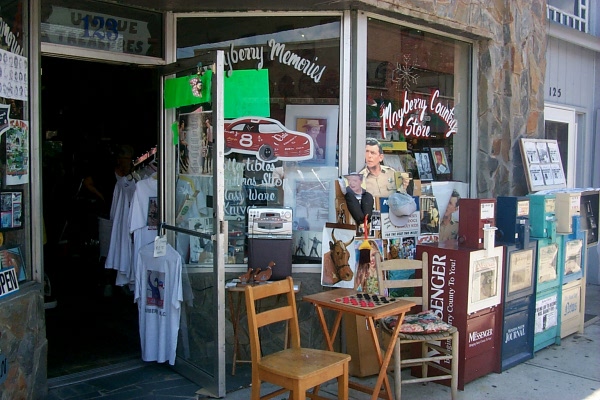
Checkers and souvenirs nextdoor to Snappy Lunch.
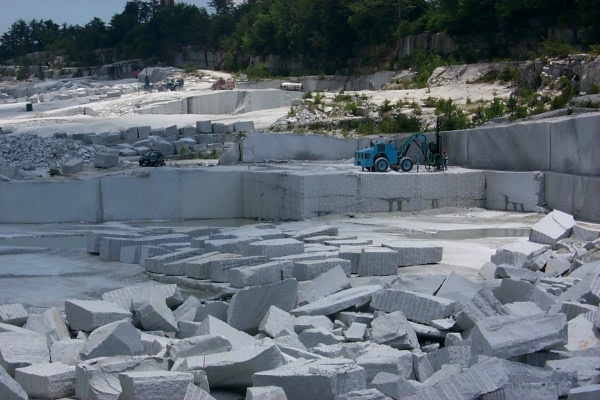
Mount Airy is truly blessed, because it is famous for not one but two things — Andy Griffith, and granite. Here’s a view of Mount Airy’s enormous granite quarry. Yes I go out of my way to take these pictures for you. I’ve seen all this stuff before!
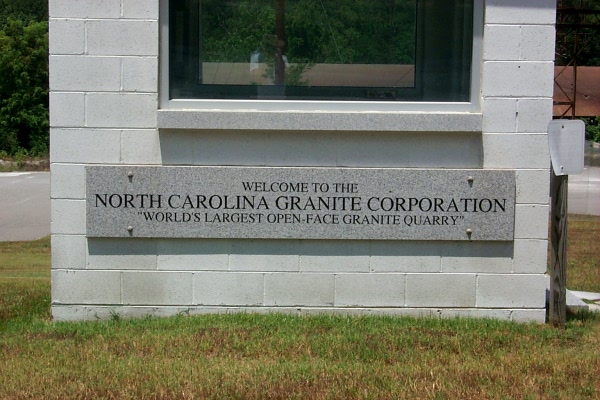
You can even go for a tour, if you like. So that it gets indexed for Google search, the sign says “North Carolina Granite Corporation, World’s Largest Open-Face Granite Quarry.”

This cottage has seen better days, but once upon a time the granite was so inexpensive that Mount Airy cottages could be built from it.
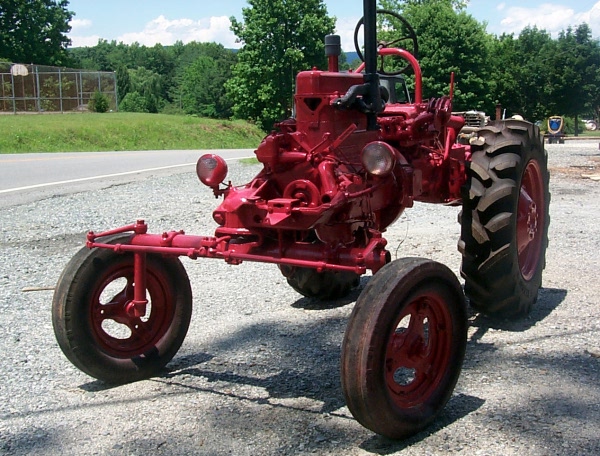
A mighty cool bug-eyed tractor near Cana, Virginia. Cana is just north of Mount Airy, North Carolina.
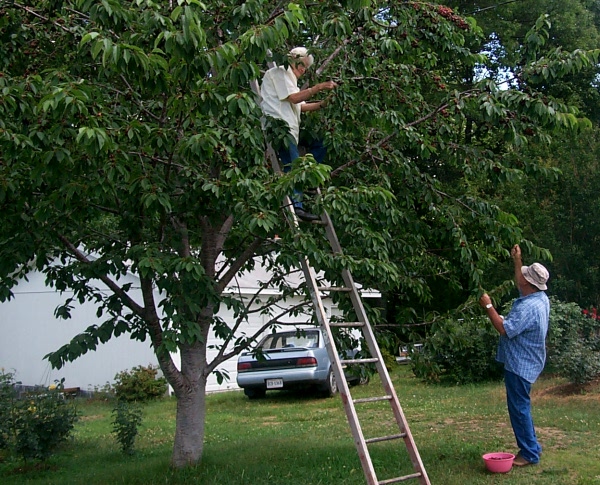
Cherry-picking time near Cana, Virginia
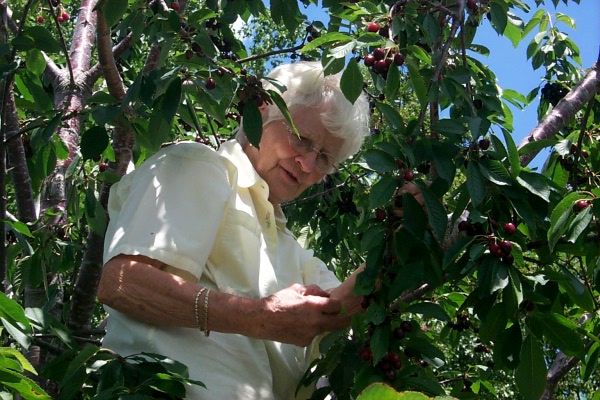
Up a cherry tree. I asked if I could take her picture, and she said yes. Then she asked, do you know who I am? And I said no. She said good. So this must be the principal of the school, or a preacher’s wife — someone important in Cana, Virginia, who ought not to be photographed up a tree.
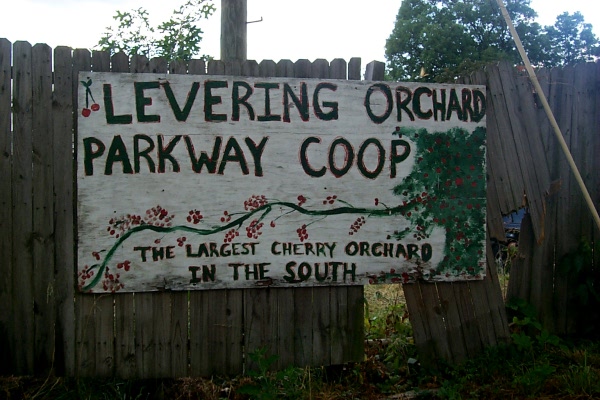
The Levering Orchard has been in business for three generations. It’s operated by the couple who do the Simple Living series for PBS. I stopped to buy cherries.
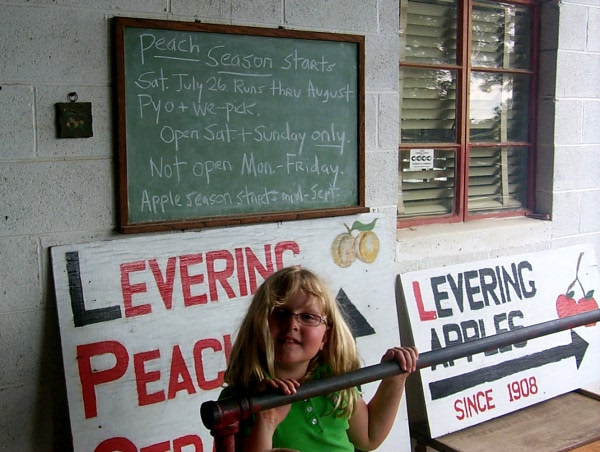
Inside the Levering Orchard shed
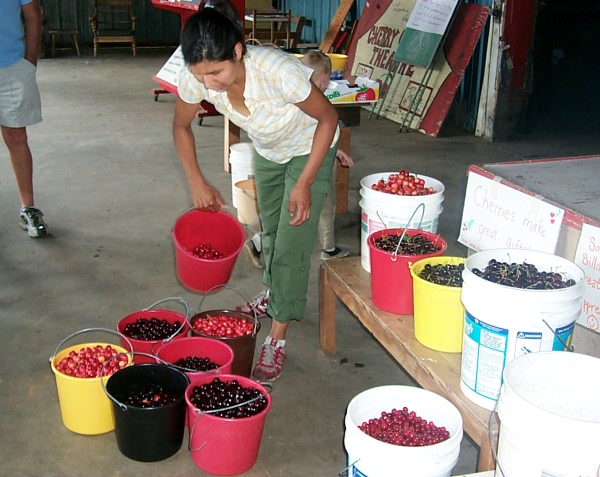
Fresh-picked cherries at Levering Orchard are brought to the shed to be sold.
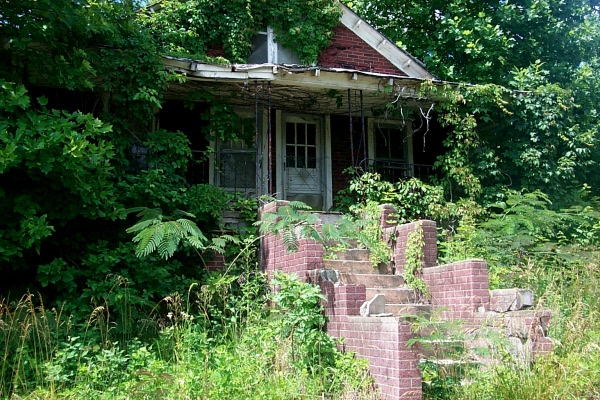
Nature reclaims an old house in orchard country near Cana, Virginia. Gavin, do you recognize this place?
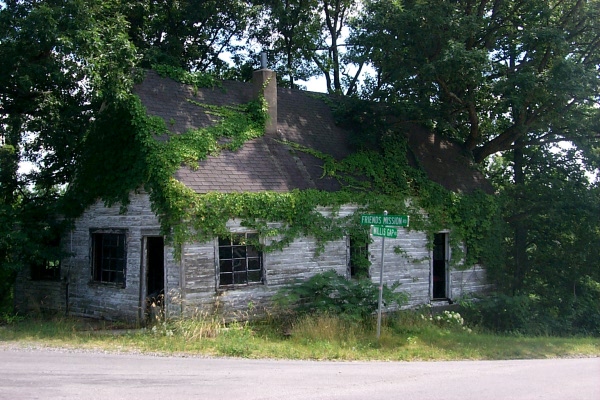
Another building goes back to nature near Cana, Virginia. I love things like this because it is the essence of art nouveau. It may take me a few years to get enough overgrowth, but I hope to get this overgrown look at my little place at the edge of the woods.
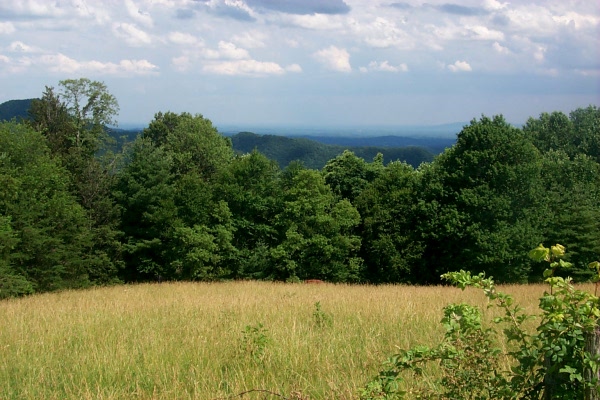
Now we have climbed the Blue Ridge around Bell Spur, Virginia, altitude around 2500 feet. We are looking down, and south, toward Stokes and Surry counties, North Carolina.
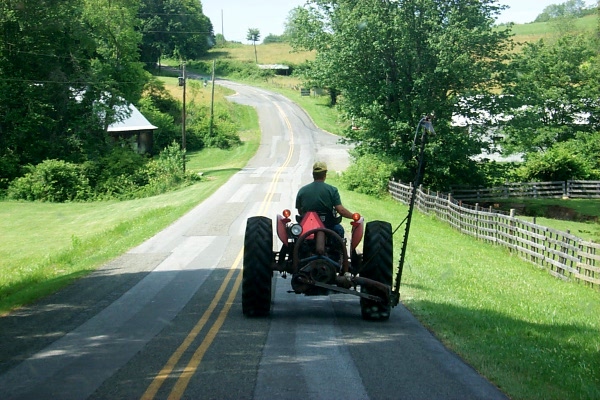
Tractor and sickle near Laurel Fork, Virginia
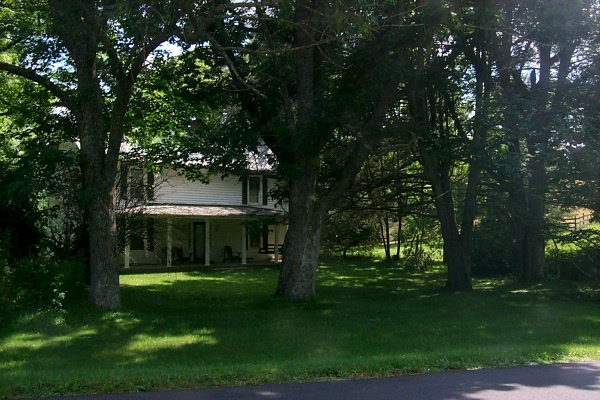
The Marshall home place at Laurel Fork, Virginia. This was one of the closest neighbors to my great uncle Barney Dalton.
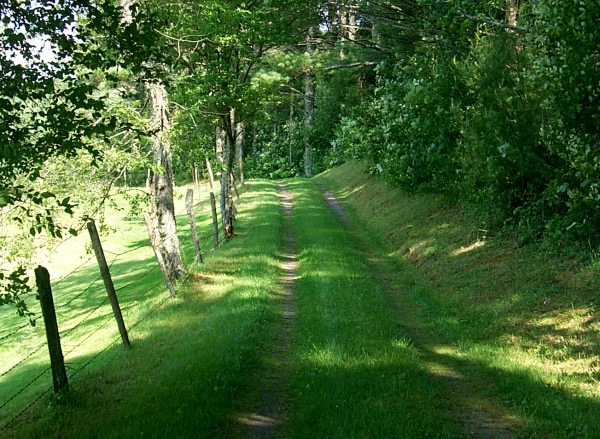
The road to Uncle Barney’s. My great uncle Barney Dalton’s place has always seemed magical to my siblings and me. Children often don’t like visiting relatives, but we loved to visit Uncle Barney. He had a farm of about a hundred acres, as self-sufficient as it was possible to be. Barney was an old man when I was a child. He was born in 1876 and died in 1972. When I think about relocalization and living close to the land, it’s Uncle Barney’s place I always think of. They had everything — cows, a huge barn, pigs, a trout pond, pasture, grain fields, gardens, and places to store what they produced. There was even a water-wheel-driven mill owned, I think, by the Marshalls on land adjoining Barney’s. Barney’s place has stayed in the family. His grandson continues to maintain the place, though he doesn’t live there and the place is unoccupied. The place is almost a family shrine, a testament to the enduring high esteem in which we all held Uncle Barney. The land is worth a fortune now and is surrounded by a resort, but the Dalton heirs, bless them, refuse to sell because of promises they made to the older generations. Above is the road to Uncle Barney’s. It’s almost a mile long. When I was a child, it crossed several pastures, and one had to stop and open several pasture gates on the way in. Uncle Barney’s place is near Laurel Fork, Virginia.
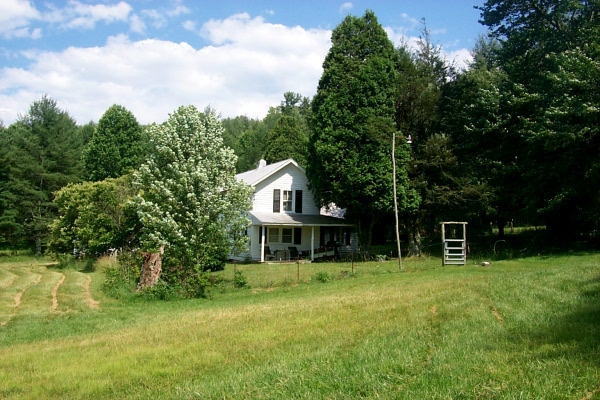
Uncle Barney’s. It has changed, but not drastically.
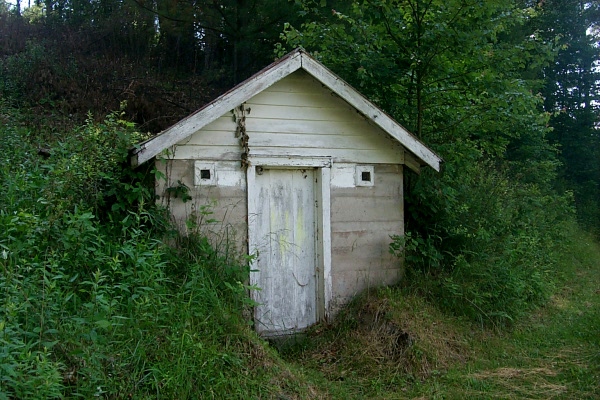
Aunt Rosie’s food cellar
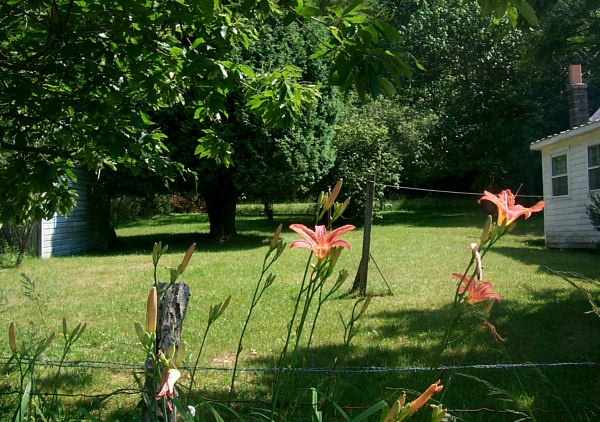
Uncle Barney’s backyard. When I was a child, I walked with Uncle Barney and my father to the upper pasture to get the cow, which Barney brought to the backyard here for his daughter to milk.
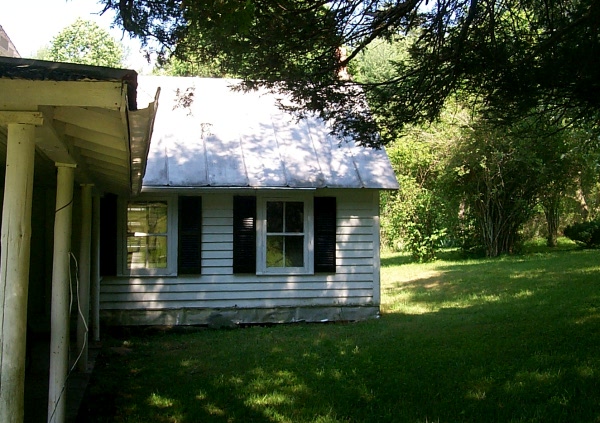
Uncle Barney’s kitchen window. What I would give to sit down to a meal in that kitchen again!
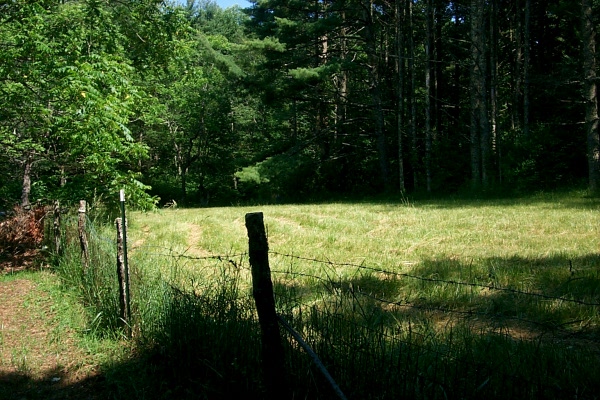
This is just a little field now, but 50 years ago it was the kitchen garden.

An upstairs window at Uncle Barney’s
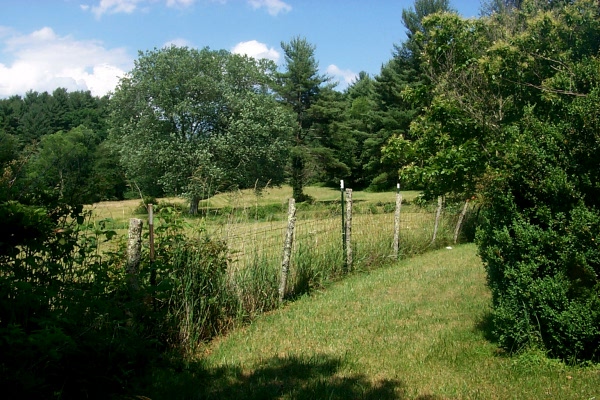
The side yard at Uncle Barney’s, looking toward one of the pastures. When I say that, when contemplating relocalization, my reference is how my older relatives lived, Uncle Barney’s place is of course one of the places I think of. Yet most of my older relatives lived like this, on largish, self-sufficient farms. I was very lucky to have witnessed this when I was boy. I had no idea how practical such references would be for a retiring, relocalizing, boomer like me.
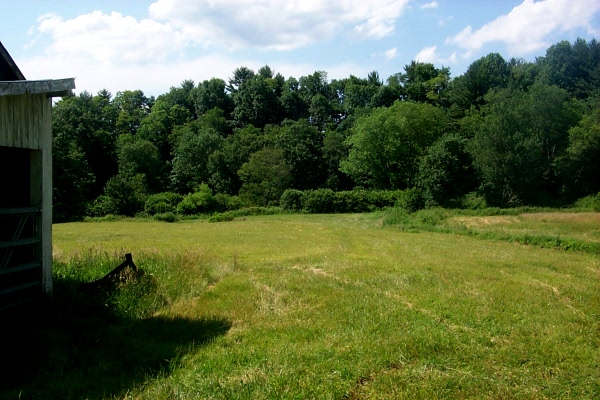
Uncle Barney’s barn is gone now, but it used to stand at the far end of this meadow.
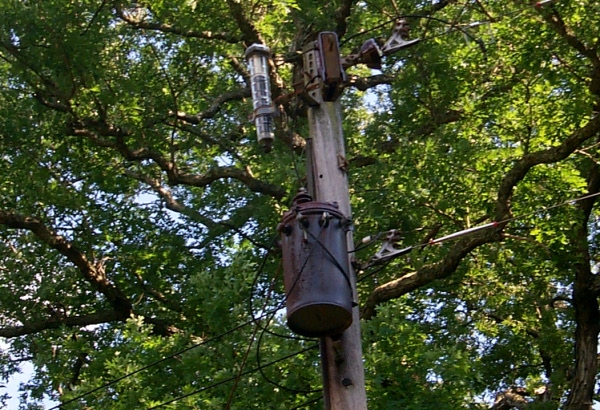
Very old electrical apparatus still feeds Uncle Barney’s place.
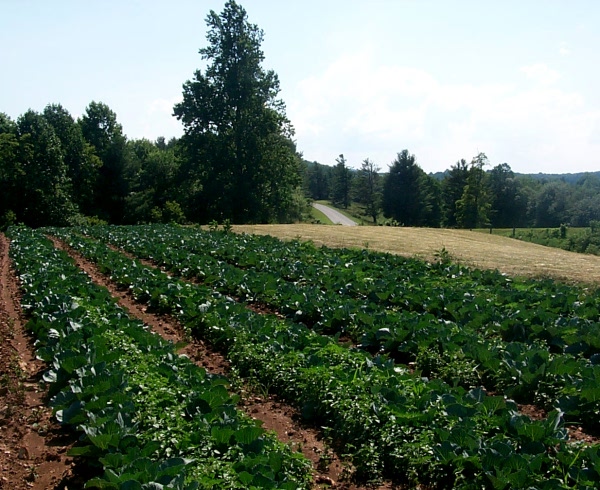
A while back I promised that I would look in on the cabbage crop in Carroll County, Virginia. It’s coming along! I’ll be eating it in a month or two. The road at the top right is the Blue Ridge Parkway.
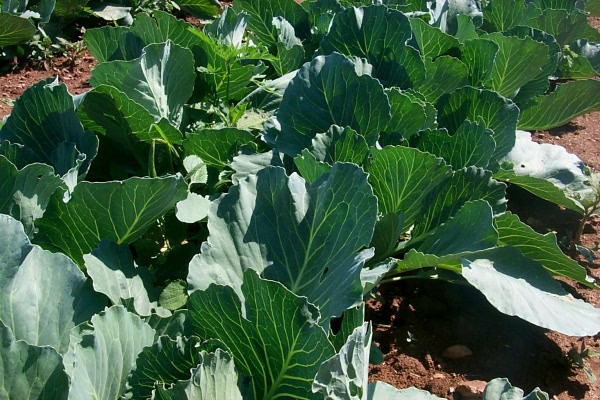
Cabbage!
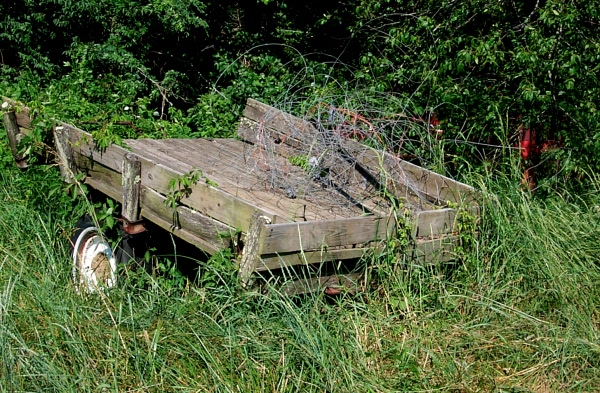
Nature reclaims an old trailer near Meadows of Dan, Virginia.
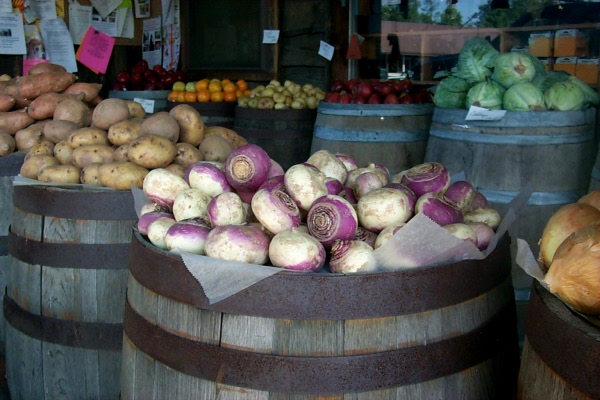
Turnips at a roadside produce stand near Meadows of Dan, Virginia. Once upon a time I was served turnips at a fancy restaurant in San Francisco. I said to the waiter, “Man, it takes confidence to serve turnips.”
Ready to be turned into supper…
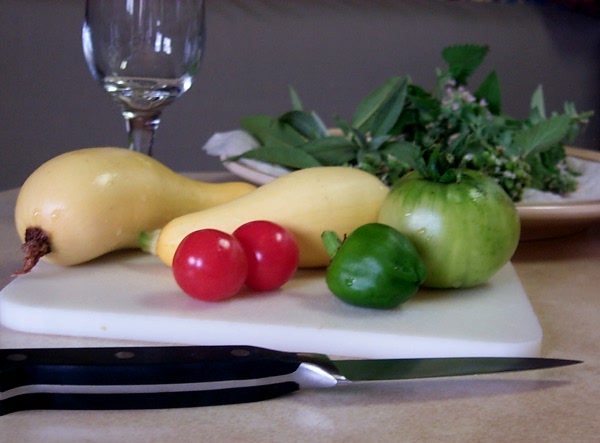
I’m so excited you’d think I was the first person to ever have a little garden. By the way, when green tomatoes have some sort of blemish that makes them look like they won’t survive until they ripen, just pick ’em and cook ’em. I’m still waiting for my first fully ripe, fully proper summer tomato. The two tomatoes here are just cherry tomatoes. When I get that first tomato, I know exactly what I’m going to do with it. Photo to come in a week or so, I hope. Hey, it’s not fancy San Francisco Chronicle food photography, but it makes you hungry, doesn’t it?
Herbses
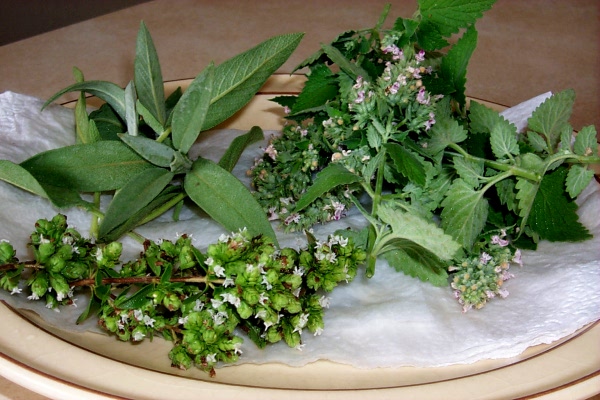
A friend tells me that I should clip my herbs before they bloom. Oh well. I’m learning. Here are oregano, sage, and catnip. I’ll dry the catnip and give it to some cats I know. I have a good stand of basil, and from that I had my first fresh pesto a few days ago.
At least the garden likes the hot weather
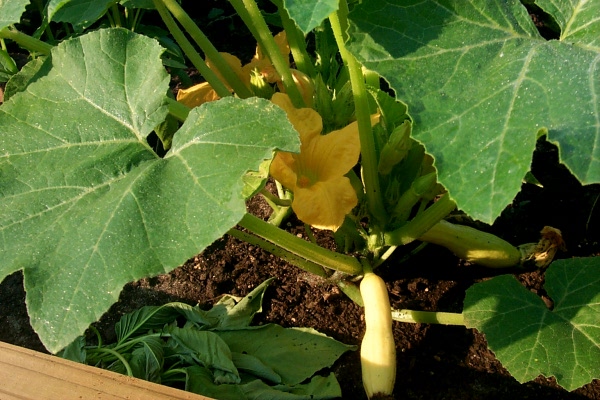
Baby squash
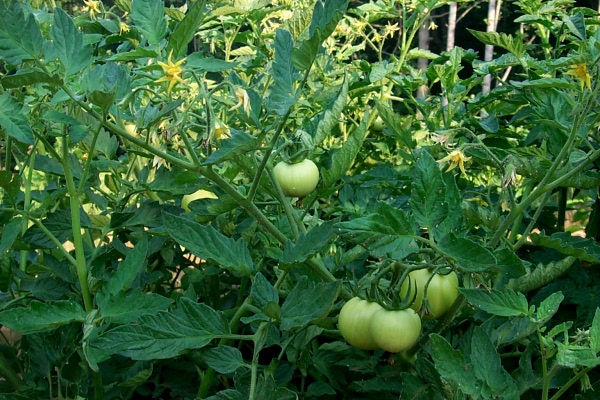
Baby tomatoes
Vidalia onions
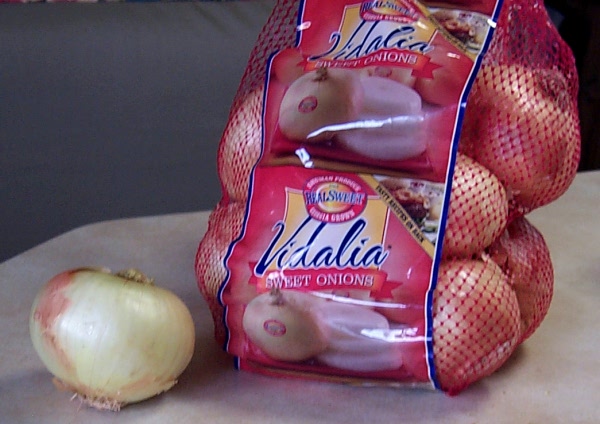
The real thing
I would continue to testify that, awesome though California’s produce is, there are three things grown in the Southeast that California can’t duplicate: Vidalia onions (from Georgia, of course), proper summer tomatoes, and mountain cabbage.
Vidalia onions are showing up in all the stores here. The large ones can be expensive. The medium-size onions are very reasonably priced. I don’t know why it took me so long to figure it out, but I now understand the source of the soggy onions we had during the winter, both in California and here in the Southeast. The onions are imported from Central America and Peru. I’m guessing that they must be transported on ships with no ventilation, so the outers layers have already started to rot by the time they get here.
I’ll have plenty more on tomatoes this summer. I hope to visit a cabbage patch in Carroll County, Virginia, before too much longer.
Michael Pollan on having a garden
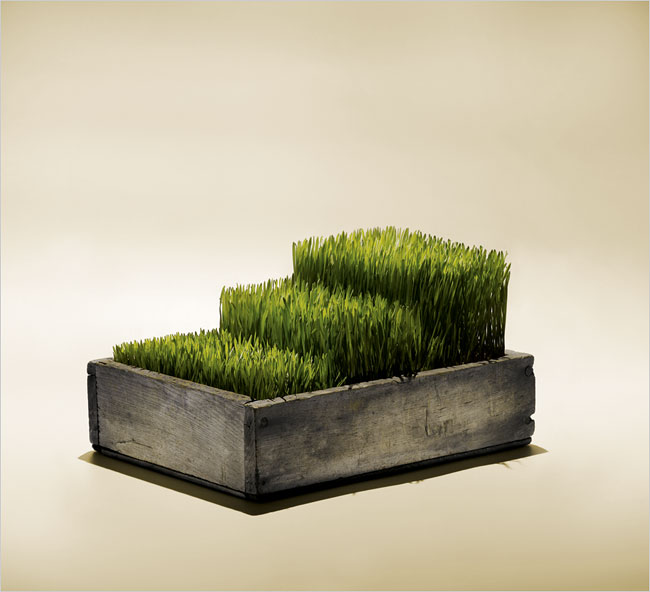
New York Times
It’s always a good Sunday if Michael Pollan has a piece in the New York Times Magazine:
You quickly learn that you need not be dependent on specialists to provide for yourself — that your body is still good for something and may actually be enlisted in its own support. If the experts are right, if both oil and time are running out, these are skills and habits of mind we’re all very soon going to need. We may also need the food. Could gardens provide it? Well, during World War II, victory gardens supplied as much as 40 percent of the produce Americans ate.
Creecy greens (and roadside produce stands)
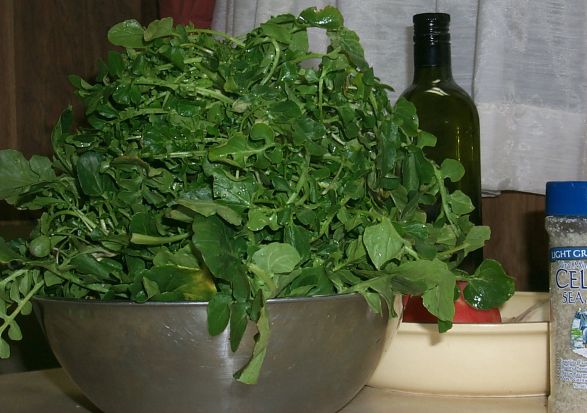
A mess of creecy greens, probably from South Carolina
Creecy greens have a long history in America. They grew wild, and they appeared in late winter, often when there was still snow on the ground. My dad, who grew up in the Blue Ridge Mountains, used to say that after a long winter the mountain people developed a strong hunger for something fresh and green. So when the first creecies appeared, they were a feast.
Around here creecy greens can be bought this time of year from roadside markets. I bought these from a roadside produce stand on U.S. 601 near Mocksville. They were relatively pricey — $1.29 a pound. For comparison, cabbage was 39 cents a pound at the same market. The woman who runs the produce stand said she thinks the creecies came from South Carolina. Creecy greens are of the order brassicales, so they are related to cabbage and mustard.
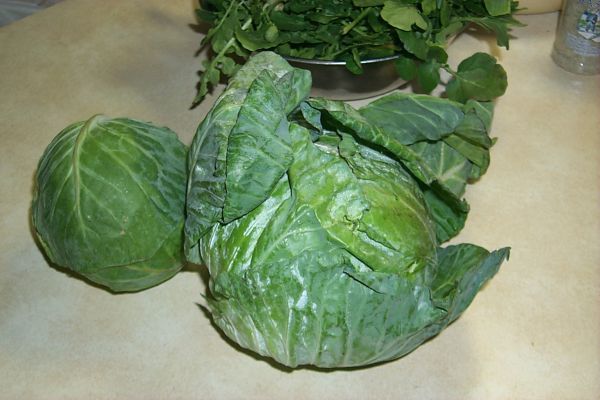
Wintered-over cabbage, 39 cents a pound
Speaking of cabbage, the mountains just to the north of here are cabbage country. Carroll County, Virginia, long known for its cabbage, is diversifying into broccoli as well. I have not yet had a chance to try Carroll County broccoli. Though I have had excellent cabbage in California, there is a tendency in California for cabbage to be pale and fluffy. Proper cabbage should have dark green outer leaves, and it should be as dense and hard as a piece of marble (attention, San Francisco Chronicle food department: you need to do a piece on the dignity, selection, and use of cabbage).
There is only one device I’ve ever seen that chops cabbage quickly and easily for coleslaw, and I’ve tried everything, from blenders to food processors to chopping knives to mandolins. The device is the Wear-Ever salad maker. We had one when I was young. Last month my sister found one in the Goodwill Store at Mocksville, and she was kind enough to let me buy it (I think she wanted it, too). It makes fine slaw, fast, without making a mess and without a lot of waste. It’s a very handy thing to have, because the winter diet here calls for cabbage in some form almost every day.
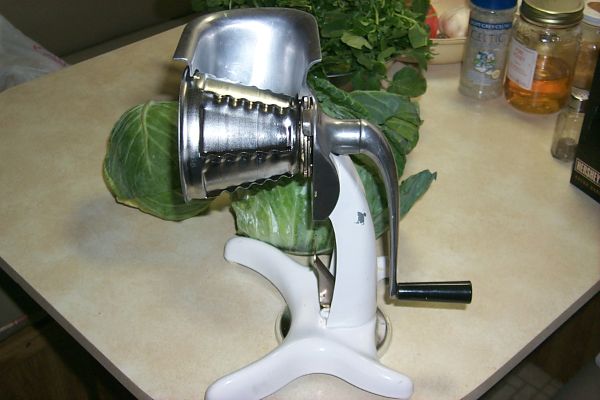
A Wear-Ever salad maker. They were made in Oakland, California, in the 1950s and 1960s, and maybe earlier for all I know. You might be able to find one on eBay.
The 50-mile rule for local eating is a nice goal (and it might even be possible in a lot of places at some times of year), but for many Americans it’s not workable. I propose as an alternative the 50-year rule: if people in the same place had it 50 years ago, it probably makes economic sense to have it now. I’m no expert on the history of this, but having lived in these parts 50 years ago, it’s clear that the winter foods that were available then are the cheapest and best winter foods available now. This includes Florida oranges, cabbage (from Virginia?), pintos beans (South Carolina? Georgia? Texas?), onions, and potatoes. Fifty years ago, of course, was before the Interstate highway system. I suspect much of this produce came up U.S. Route 1 and went onward to New York and New England. Locally, it probably came by U.S. 601, which is a spur of U.S. Route 1.
Update, 5:50 p.m.:
The finished winter supper: creecy greens with a sweet-and-sour treatment (vinegar, olive oil, and a touch of turbinado sugar); warmed-over pinto beans (with sliced onion); fresh hot flaxseed pone; and salmon cakes. The salmon cakes certainly violate the 50-mile rule, but they don’t violate the 50-year rule. My mother used to make salmon cakes fairly often from canned salmon. This was a premium brand of wild red sockeye salmon from Whole Foods in a 7.5 ounce can. If you’re shipping food from Alaska, canned is the cheapest, which probably means it takes less energy than fresh or frozen salmon. And I admit it. I like fish burgers. This is a low-carb, high-protein, healthy country supper.
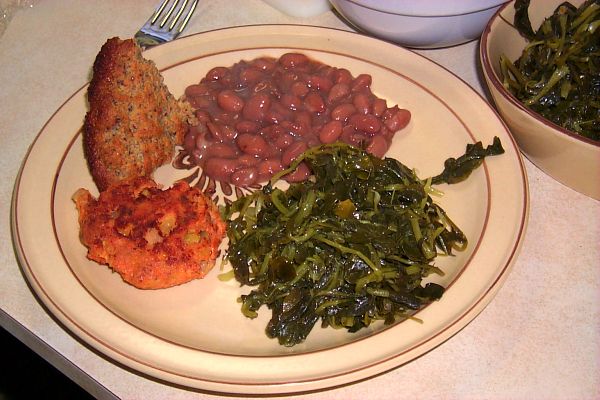
Creecy greens, pinto beans, flaxseed pone, and salmon cakes from wild sockeye salmon
More on flaxseed pones…
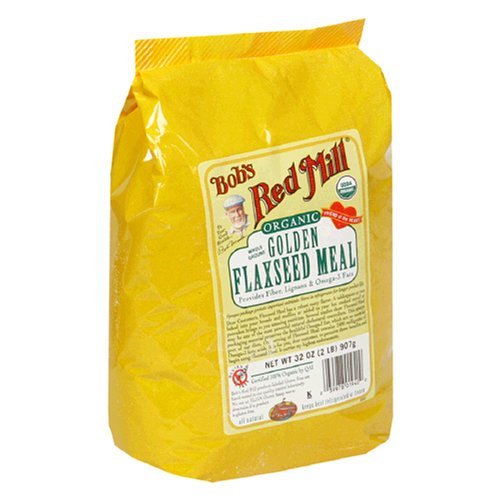
I’ve made a lot of flaxseed pones in the last couple of weeks, and I’ve learned from my mistakes. Most important: Don’t put too much liquid into the batter. If the batter is too wet and runny, the pone will never finish baking, and the texture will be gooey and disgusting. Keep the batter thick, so that it stands up when you put it into the baking pan. If the batter is so thin that it runs out to the edges of the pan, then the batter is too thin. Don’t worry if the batter mounds up in the baking pan. It will fill out once it starts to rise in the oven. I don’t quite understand the chemistry of this, because the opposite is true of biscuits. For a proper texture, biscuit dough needs to be as moist as possible. But flaxseed pone batter needs to be thick, thick, thick.
A second hint: Though I think there is no nutritional difference between golden flaxseed and brown flaxseed, the golden flaxseed makes a much prettier pone, the same color as corn bread. In fact, if you get your batter recipe right, many casual eaters of flaxseed pone would think they’re eating cornbread. It’s that good, and the texture of the bread is totally agreeable, in spite of the fact that flaxseed meal is much more like psyllium seed meal than corn meal.
Experienced makers of cornbread already know this, but for the newbies: Well-seasoned cast iron skillets are best for making pones. Get the skillet hot in the oven before adding the batter. If you’re making a supper pone, add some finely chopped onions to the skillet when you put the skillet into the oven to preheat. Half butter and half olive oil in the bottom of the skillet, with the onions sizzling during the preheating of the skillet, will make a fine crust for a supper pone. For a breakfast pone, omit the onions. Onions or not, the batter should sizzle when you pour it into the hot skillet.
The late-winter diet here in North Carolina is starting to change a bit. The Florida oranges seem to be getting more expensive and a bit more dry. But some fine turnip greens are showing up in the stores, cheap and fresh. And I still can’t get over how much better the onions are here than they are in California.
Here’s my earlier post on flaxseed pones.
Also, some Californians don’t seem to know what a skillet is (Hi, Clint and Joshua).
Flaxseed: A healthy, low-carb quick bread
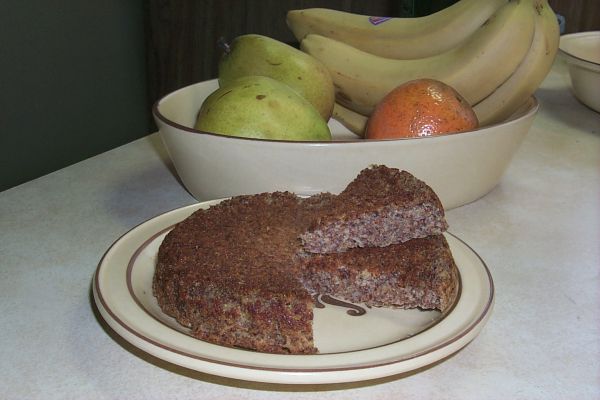
This morning’s flaxseed pone.
I frequently say that, after a certain age, we all should eat like diabetics even if we’re not. Bread is the hardest thing to cut down on. On the glycemic index, whole grain bread is no better than white bread. Cornbread also is no better than white bread. But hot bread is essential with the local winter diet, which revolves around (or revolved around, 50 years ago, but it’s still the best and cheapest winter food) pinto beans, cabbage in some form, and onions.
For a while I’d meant to experiment with flaxseed meal, having heard of its many virtues. But I had assumed that it would be difficult to work with. One Internet recipe I came across, for example, used five eggs. Why in the world (I thought) would someone put five eggs in a quickbread unless it was nearly impossible to get it to rise. It turns out that the five-egg recipe was just a stupid recipe.
Flaxseed meal will do anything cornmeal will do. A well-beaten egg definitely helps the batter and texture of the bread, but if you leave the egg out and use a bit of unbleached white flour, the flaxseed bread will rise just fine. I don’t use recipes for quickbreads, nor do you need one if you’re accustomed to making cornbread. The basic ingredients for flaxseed bread are flaxseed meal, a small amount of unbleached white flour, baking powder, and buttermilk. If you substitute flaxseed meal one-for-one for cornmeal in your favorite cornbread recipe, you’ll probably be fine.
The virtues of flaxseed meal are incredible. It’s low carb, high-protein, and low on the glycemic index. Plus, flaxseed is the richest vegetable source of omega-3 oil, almost as rich as fish oil. Flaxseed meal also has the same virtue as psyllium seed.
I’m getting rid of cornmeal and switching to flaxseed meal.
This link is for the Californians who don’t know what a pone is. And by the way, East Coast onions are better than California onions. I haven’t yet figured out why. Georgia?