Ramp Hollow: The Ordeal of Appalachia


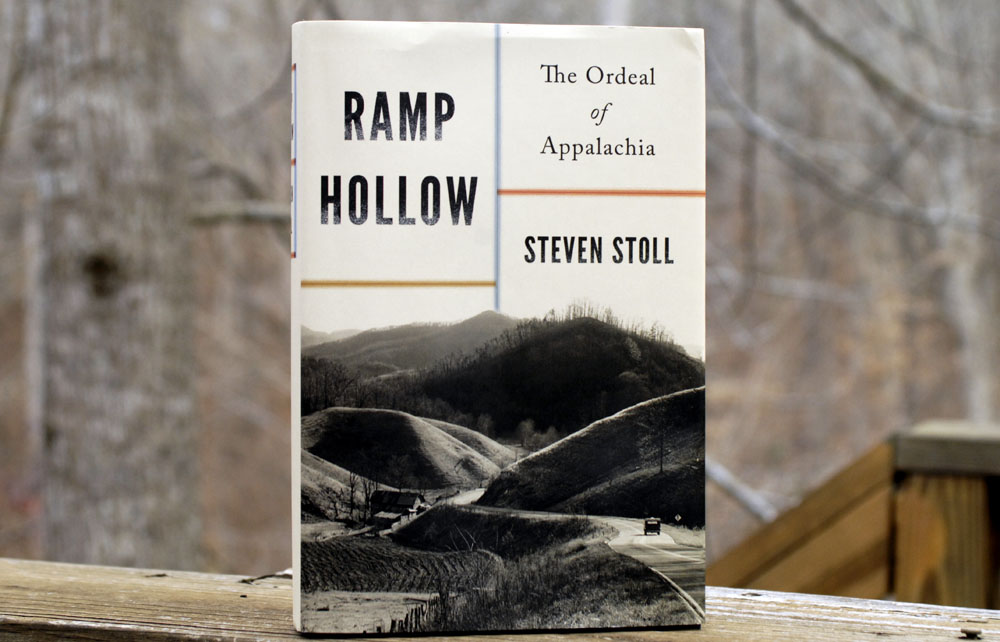
Ramp Hollow: The Ordeal of Appalachia, by Steven Stoll. Hill and Wang, 2017. 412 pages. ★★★★★


During the past couple of years, an extraordinary series of books have brought to our attention just what a sorry state the world is in. Ramp Hollow is the latest. Some of the others (many of which I have reviewed here) are:

Thomas Piketty: Capital in the Twenty-First Century

Anthony Atkinson: Inequality: What Can Be Done?

Kyle Harper: The Fate of Rome: Climate, Disease, and the End of an Empire

James C. Scott: Against the Grain: A Deep History of the Earliest States

Nancy MacLean: Democracy in Chains: The Deep History of the Radical Right’s Stealth Plan for America.

Jason Stanley: How Propaganda Works.

Sebastian Junger: Tribe: On Homecoming and Belonging

Jason Brennan: Against Democracy

Volker Ullrich: Hitler: Ascent, 1889-1939

Jack Rakove: Revolutionaries: A New History of the Invention of America

This is by no means a complete list. There are others that I still urgently need to read, including books by George Monbiot and Jonathan Haidt.

Stoll is a professor of history at Fordham University.

As for Ramp Hollow, I used the word “angrifying” in an email to a friend. I subsequently came across a review that used the word “enraging.” This book is a history of how the self-sufficient subsistence farmers of Appalachia were dispossessed of their land by the timber and coal industries and forced to work in coal camps and mill towns for starvation wages. Their forests and swidden fields, which they depended upon for their living, which were a kind of commons, were enclosed and decimated to feed the industrial revolution.

Stoll has much to say about dispossession and enclosure in general, starting in England in the 17th Century when Parliament dispossessed the rural English of their common lands, gave the land to the lords, enclosed the land, and forced the people to become peasants who worked the land for others. Earlier in American history, the native Americans had been dispossessed by the colonists. After the Civil War, every possible effort was made to keep emancipated blacks dispossessed, landless, and forced to work like slaves for others. All this was seen as economic and social progress. The poverty and misery this so-called progress caused was hardly noticed.

All around us today, we see the consequences. The poor people who now spend much of their sorry wages buying health-destroying foods at Dollar Generals are descendants of people who once lived off the land with no need of wages. The old subsistence farmers liked money when they could get it, but they could live without money. They traded with each other for what they could not make or grow themselves. Their descendants are dependent on money and sorry wages. They buy their sorry food from corporations.

We have forgotten how forests provided a living. The abundance produced by forests goes far beyond hunting or gathering nuts. One burned a little piece of forest and planted one’s crops amid the stumps. Pigs could live in the woods without being fed. Chickens did fine with a little bit of woods, a little bit of clearing, and a little stream from which to drink. With some pasture, you could keep a cow. Capitalism, on the other hand, saw the forests only as a source of timber to be clear-cut and shipped out by train. Beneath the West Virginia forests lay coal. Capitalism could not tolerate people living without money. Dispossession was a win-win for capitalism. The timber could be sold, and the people who were forced off the land were now a source of cheap labor and taxes, dependent on money for a living rather than on their environment.

Stoll’s book is an unapologetic indictment of capitalism. He ends the book with a stunning proposal — he calls it a thought experiment, but it would be doable if we had the political will — for reversing the centuries-old process of dispossession and the poverty and inequality it has caused. He calls it “The Commons Communities Act.” I’m all for it.

This book is enraging because it tells the story of cruelties and injustices that history did not record:

Those who hung on in the hills had their misfortunes thrown back at them. The basis of their autonomy gutted or sold, they pecked and scrimped. The words of the engineer who condemned them in 1904 echo here: “forlorn and miserable … never having known anything better than the wretched surroundings of their everyday life.” Though they often insisted that they could make a living on remnants of the old commons, they had become poor. They had become the horrifying hillbillies that lowlanders had always thought them to be.

The story is an old one: The intentional creation of poverty by the rich, in order to exploit the labor of the poor. Today’s rich have become so sophisticated at this exploitation that their propaganda has turned its dispossessed victims into active agitators for their own greater exploitation. The very idea of taxing the rich for the relief of the poor is rejected with a religious fervor. How long can this go on?

Are we all Buttercup now?


Buttercup

A couple of days ago, I finally got around to watching “The Hunger Games: Mockingjay Part 2.” It was good psychotherapy for trying to psychologically survive this week’s terrifying Republican train wreck in Washington.

I have been doing my best to avoid political posts. Partly this is because the mainstream media and the reality-based commentariat are now fully aware of what Donald Trump is and just how much danger the Republic is in. There is nothing I can add. But I do want to link to a piece by Dahlia Lithwick in which she writes about a question that I also have been gnawing on — that is, are we so far gone that the rule of law can no longer save us? The piece is at Slate with the headline Is It Too Late for Robert Mueller to Save Us? I also should mention a column by Andrew Sullivan at New York Magazine: America Is Trapped in Donald Trump’s Delusional World. Sullivan has a gift for describing the kind of criminal depravity with which we are surrounded.

I’ve also been painfully aware of the fact that sane and decent Americans no longer have a leader. Trump voters have their Hitler, but we have no one. We’re on our own.

All we’ve got to keep us sane and functioning is story and metaphor. “The Hunger Games” is a beautiful story for our times. But the characters of that story, unlike us, had their heroine to pull them through — Katniss.

The scene with Katniss and Buttercup near the end of “Mockingjay Part 2” is one of the most effective film scenes I’ve ever seen. It is the emotional fulcrum around which the entire story finally shifts from horror to relief. In the real world, we’re still waiting on tenterhooks, cringing like Buttercup, clinging to hope that the law will see us through.

Let’s just talk about the truck


The flag on the back is the Christian flag, which is commonly flown in King, North Carolina. Also note the bumper stickers in the lower photo.


We could talk about why a surplus military vehicle belonging to the Pfafftown (North Carolina) militia, a right-wing paramilitary group, showed up at the polling place for the Nov. 7 municipal elections in King. We could talk about how, in the previous two elections in King, assault charges have been filed because of encounters between members of the conservative majority and the liberal minority. We could talk about how Republicans and churchgoers are upset because an atheist is running for the King town council. We could talk about how it’s part of my duty, as a local political operative, to be concerned about what happens at the polls on election days. But let’s don’t talk about any of that. I’m burned out on tomfool right-wing drama. Let’s talk about the truck instead.

Because I’m a nerd with a Y chromosome, I find these trucks fascinating, just as cool machines. It happens that, only a couple of months ago, in writing book 3 of the Ursa Major series, I needed a truck like this for a fictional military operation. I had never seen such a truck, so I had to do some research on military vehicles. I never just make stuff up, when stuff must correspond to reality! I do whatever research is necessary. I found the army’s operator’s manual for the truck, which is 452 pages long. I admit without shame that it was fascinating reading, and that the truck almost becomes a character in the novel, the way Jake’s Jeep did in book 1, Fugue in Ursa Major.

I believe the truck in the photo is an M923A2 dropside cargo truck. These trucks come in about 30 different configurations, including dump trucks, wreckers, and vans. It has a Cummins diesel engine, all-wheel drive, and all sorts of cool features that harden it for military use. If you like fine machines (from aircraft to communications apparatus), you’ve got to love military specs.

The driver said he bought this truck for $10,000 a few years ago. I’m sure he drives it to church and to watch people vote. But I shudder to imagine where else.


Crickets. What’s going on?


This photo was in Google images and was sourced to Twitter. The photo was marked as having been taken at 11:43 a.m. on Sept. 16. The “Mother of all rallies” started at 11 a.m.


Have you noticed how dull and unfocused the media have been of late? At first I thought that hurricanes Harvey and Irma were crowding out other agendas. But now that the hurricanes have aged out of the news, the media are still drifting and befuddled about what story to lead with. What’s going on?

Normally there is a keen competition for setting the agenda, and someone somewhere is staging a big show to direct the media’s attention to where they want it. That’s what we saw when the Congress was mucking around with health care bills a few weeks ago. And there was Charlottesville. But for most of September, it’s been crickets. Back in August, we were told that September would feature mighty battles in Congress over the debt ceiling and tax “reform.” I believe that warfare in Congress was scheduled to lead the media agenda this month. But it fell apart.

At the moment, there’s just nothing going on keep us peasants angry and at each other’s throats. That’s pretty strange, given that whipping up political rage has been at the top of the agenda for more than a year now. We’re told that Trump invited the congressional Democratic leadership to the table. What’s that about?

Yesterday, some of the leadership of Trump’s so-called base scheduled “the mother of all rallies” (MOAR) on the Mall in Washington. They hoped for a million people. They wrote on the rally’s web site: “MOAR will send a message to the world that the voices of mainstream Americans must be heard. We are coming together to send a direct message to Congress, the media and the world that we stand united not divided to protect and preserve American Culture.”

Barely a thousand people came. A clown group outnumbered the MOAR attendees. The right-wing media seem to be as becalmed and befuddled as the mainstream media. At this moment, Drudge Report is leading with an acid attack in France.

Trump is said to be holed up at one of his resorts in New Jersey, and the White House wasn’t releasing any information about what Trump was doing. The media were isolated in a media container 18 miles away with nothing to do.

All this makes me nervous. To a dot-connector like me, it appears that something has disrupted the agenda and media scripts of the powerful, as though there is some kind of stalemate. It’s as though something new — and big — has derailed the September schedule for agenda-setting and media management.

Obviously I know nothing. All I can do is speculate and try to connect dots. Wishful thinking is always a trap to be avoided. But it’s almost as though Donald Trump has been fatally nailed by Mueller, and the lords of Washington are in retreat to write the script on how it will all play out. We know from a little Associated Press piece, mostly ignored by the media, that Mueller had a bipartisan meeting on Thursday with the leaders of the House judiciary committee. That’s the committee that is responsible for initiating impeachment proceedings.

Have I fallen into the trap of wishful thinking? Sure, I want Trump and his entire criminal syndicate gone and in prison, the sooner the better. Trump is clearly mentally ill, and in a dangerous way. But I also know that, when impeachment happens, the collateral damage to this country is going to be a terrible thing. When it happens, whether soon or next year, we the peasants won’t know about it until the powers that be have gone into hiding and worked out a reasonably responsible plan for managing the American people as the trauma unfolds.

Massive media failure, now documented


“Attempts by the Clinton campaign to define her campaign on competence, experience, and policy positions were drowned out by coverage of alleged improprieties associated with the Clinton Foundation and emails. Coverage of Trump associated with immigrations, jobs and trade was greater than that on his personal scandals.”Berkman Klein Center for Internet & Society at Harvard University


Media watchers and exhausted members of the reality community already knew that media coverage of the 2016 Clinton-Trump campaign was a media disaster, which led to a political disaster, which is now leading to a disaster of democracy. This week a Harvard study has quantified and documented the media disaster.

Here is a link to the study. It can be downloaded in PDF format.

Those who don’t have time to read the entire study should at least read the conclusion, which starts on page 128. Do look at the charts and graphs, though. Some of them are terrifying. Also note (page 107) how the right-wing media were successful at using propaganda to turn Sanders supporters against Clinton. (We all know Bernie supporters who believed the lies about Hillary Clinton and who bleated that Clinton was as bad as Trump. We must never stop rubbing their noses in it.)

It is no secret that the right-wing media are a filthy swamp of lies and propaganda. There’s not much we can do about that. But the study makes it clear that, if mainstream outlets such as the New York Times had not been sucked in by right-wing agenda-setting on fake scandals such as the Clinton Foundation and Hillary Clinton’s emails, Trump could not have won the electoral college.

I spent my life in the newspaper business. After the rise of Fox News in 1996, I watched, aghast, as most of my journalist colleagues were deceived by right-wing media strategies that turned the principle of “objectivity” into a utensil for corrupting mainstream newsrooms into agents of right-wing lies.

Editors and reporters are a herd, and few of them are geniuses. Within ten years after the start of Fox News, false equivalence had become an unchallenged standard in American newsrooms. They were tricked into treating the right-wing narrative seriously, even though it was transparent malarkey. Journalists became completely incapable of calling a lie a lie. I have lost friends over this when I tried to call them out for it. Not until a year ago, during the Clinton-Trump campaign, did an old colleague (one with a top-of-the-industry résumé, I might add) apologize to me and acknowledge that I was right. When newsrooms finally saw through the false equivalence trap, they turned as a herd, as they always do. Media scholars and media intellectuals have understood the problem all along. But you would be surprised how slowly this insight trickles down into newsrooms. When suddenly they saw Breitbart in the White House and a perilously deluded, disinformed, and enraged American public, even the slowest-witted mainstream journalists started figuring out that they had been used by malevolent (and outrageously rich) players who had outsmarted them.

Though I am not very hopeful, there are signs that the 2016 election taught a valuable lesson to the people in America’s newsrooms — that for 20 years they republished lies, tricked by their own principles, a little too dumb to perceive the trick. With luck, and with the chastening we have seen at the New York Times and the Washington Post (which slowly trickles down to lesser newspapers), maybe it is less likely now that it will happen again.

Postscript: I have not mentioned the broadcast media or cable news industry here because I completely disdain what they do and don’t regard it as journalism. As for Russian interference, as the Harvard study mentions, we don’t yet have all the information we need on that. I trust we will, eventually.

Preserving culture


Foxfire students interviewing Aunt Arie — photo by Foxfire Fund, Inc.

There are some strange ideas kicking around these days about what it means to preserve culture. But preserving culture is hard work and a labor of love.

Many, many people are doing this work. It involves books, books, and more books. It is being done with film and photography, with museums, with special events such as fiddlers’ conventions and food festivals, with archeology, and by scholars from many departments of the universities including linguists, historians, anthropologists, and even the music department.

Nor is white trash culture, or Southern culture, or Appalachian culture, being neglected. Far from it! It isn’t culture that white supremicists such as Peter Cvjetanovic seek to preserve. It’s privilege, injustice, and some sort of perverse notion of purity.

We might call the people who do the real work culture workers. And though preserving culture is a labor of love, there is so much demand for the products of culture workers that many people can make a living at it — scholars and writers, for example.

As I have argued in other posts, there is much that is sick in the conservative mind. They look to the past, but they look only to an arbitrary and falsely glorified moment in the past when their ilk were dominant. They selectively ignore the rest of the past. In doing so the conservative mind is blind to privilege and injustice and to the factors that rotted their moment of glory. I have no problem with statues, but the intention behind most statues is not to preserve culture. Rather, it’s to preserve glory.

Sic transit gloria mundi.

One of the things that bothers the dickens out of me is how disinterested many people are in preserving their own personal histories and their own family histories. Some may go so far as to sign up for Ancestry.com and try to build lists of their ancestors, working on line. But how many people bother to get to know great-aunt Matilda before she dies, ask her about what life was like eighty years ago, and then write it down? In most families, collective memory rarely extends beyond two or three generations.

If the white racist Peter Cvjetanovic actually knew any history, he would know that cultures have been melding together throughout human history. As for the moment he glorifies, he also would be sensitive to African-American history, to how African-Americans helped to build this country, and to how African-Americans still have not achieved their full and fair share of justice and equality. But conservatives don’t care about justice unless it involves punishing people they don’t like.

Preserving culture is work that all of us can and should do. Now that I’m retired and don’t have to work for a living, culture work really is my life’s work from now on.

Those who have read my novels know how concerned I am about the loss of pagan Celtic culture to Rome and to Rome’s predatory religion. The damage to Celtic culture was so severe that it was a genocide, actually. Our only means of reconstructing that culture is to absorb what exists in the written records, look at what archeologists have learned, and then use one’s imagination. Where lost Celtic culture is concerned, many writers are doing that.

I don’t plan to publish my memoir for many years, but 150,000 words of it is written. We all should write our memoirs. I was very flattered when Ken asked me if he could interview me and videotape it as an oral history. He did the same thing with his parents. He ended up with so much video that he wasn’t sure where to store it. That is the kind of work it takes to preserve history and culture. All kids have that capability now. All that’s needed is a smart phone that shoots video.

While open-minded people are actually doing this work, small minds are mistaking the preservation of hatred and privilege for the preservation of culture.

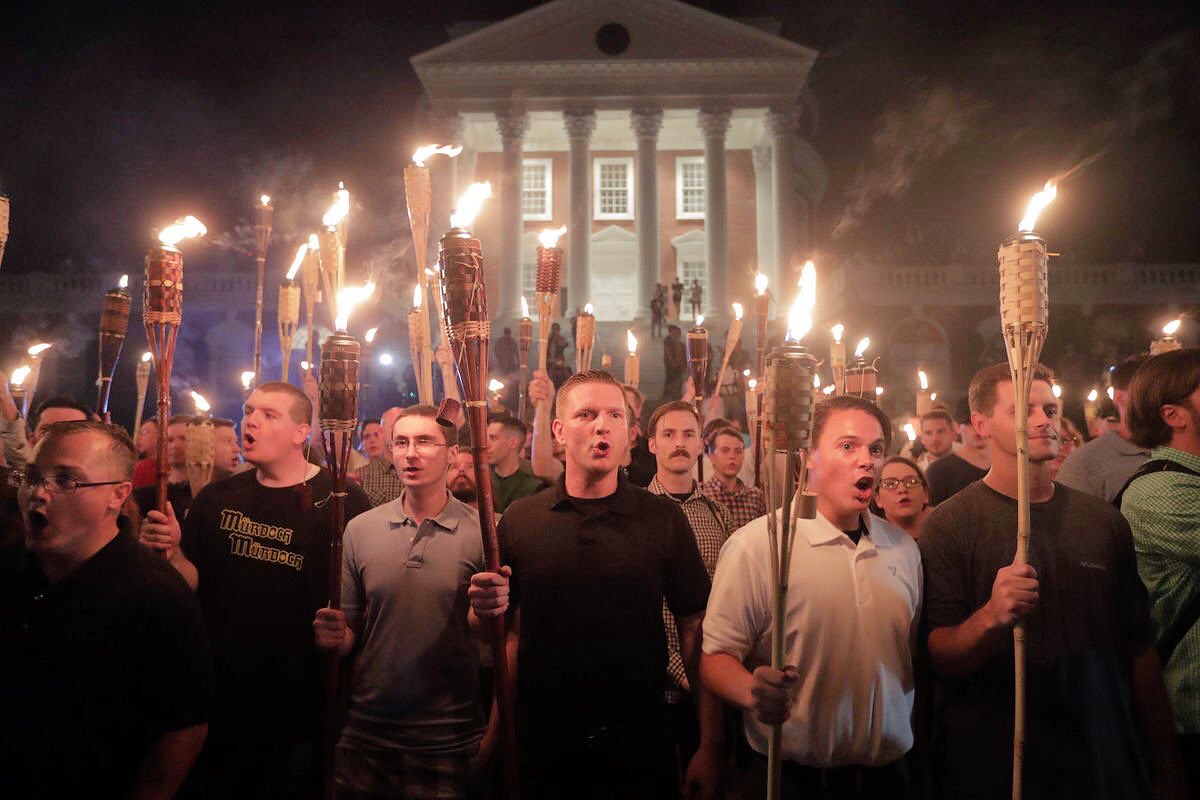
That photograph of Peter Cvjetanovic — holding a torch, his face contorted with hatred — has quickly become a cultural icon. It’s a photograph that will still give people the creeps a hundred years from now. Cvjetanovic has contributed to the cultural record, that’s for sure. But in the exact opposite of the way he intended.

A big backfire of right-wing propaganda


I try to limit my posts on politics to the times when I have something to say that others aren’t saying. The commentary in the mainstream media on Saturday’s events in Charlottesville has mostly been very good.

But I do want to point out here how a propaganda stunt by an ugly minority has backfired on its organizers, even though their web sites are claiming that it was a great success and just a beginning. They were greatly outnumbered. Some of those who were photographed with torches were embarrassed to be seen there, faces contorted with hatred. They tried to backpedal after their photos went viral in social media. If you read some of the comments in social media this weekend, then you know that this right-wing extremism, hatred, and gullibility extend far beyond the losers who carried torches in Charlottesville on Saturday. As long as the Republican Party stokes, or tolerates, this rage in its base, more white terrorism is inevitable.

The theatrics of their propaganda intentionally evoke the Nazis. I’m not sure how they think it will help them, unless they suppose that it makes them look powerful and that it evokes fear. Their most conspicuous web site, I believe, is the Daily Stormer, if you can stomach it. It appears to have been hacked by Anonymous during the weekend. Clearly they see Trump as their Hitler. I do, too.

Why is this happening?

All trails lead to the Republican Party, to the Republican media including Fox News, to professional provocateurs for the Republican Party including Rush Limbaugh and Sean Hannity, and to Donald Trump and the White House.

It is not enough to condemn white supremacists and neo-Nazis. It is the Republican Party that brought us this.


Update:

The backfire has kept growing such that, two days later, Trump was finally compelled to condemn the Nazis: Trump denounces KKK, neo-Nazis as Justice Department launches civil rights probe into Charlottesville death

Republican politicians start coming around, though Mitch McConnell is still being a coward: ‘Vile bigotry’: Politicians respond to violent protests in Charlottesville


The enlightened past


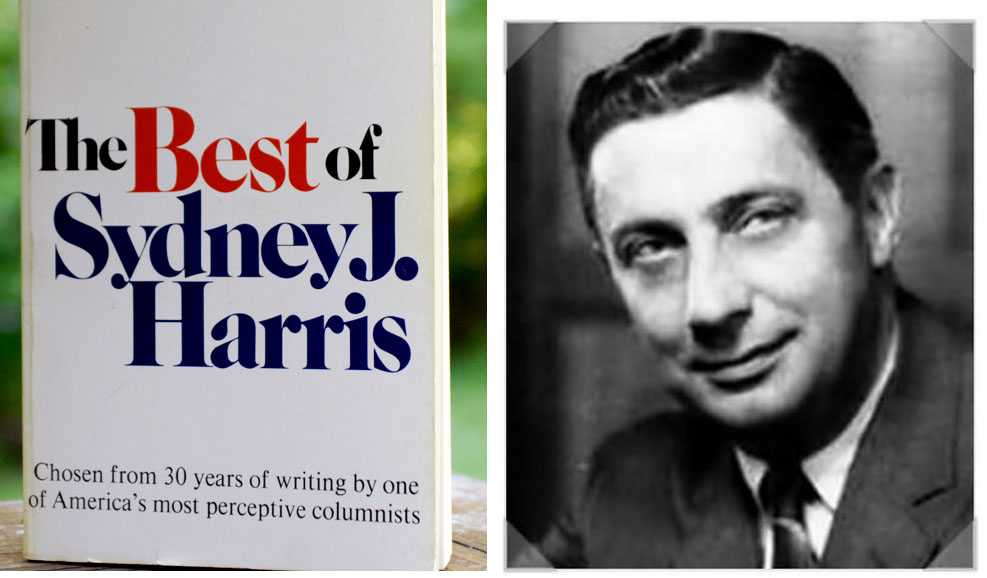
Once upon a time, philosophers could find work with newspapers. There are no such people now. But, back then, Sydney J. Harris was such a person.

Harris (1917-1986) worked for the Chicago Daily News, and, later, the Chicago Sun-Times. For years, he wrote a column called “Strictly Personal,” which was syndicated in 200 newspapers. One of those papers was the Winston-Salem Journal, where I got my first job. When I was college age, not as much was said about liberals vs. conservatives. I only knew that I loved Harris’ columns. He was, of course, a liberal. I should mention that the insufferable William F. Buckley also had a newspaper column in those days, “On the Right,” which was syndicated in even more newspapers — 300. No doubt I read, or tried to read, some of Buckley’s columns, but I have no recollection of it. Buckley would have made no sense to me. His pomposity, and the turgidity of his prose, would have offended me, I’m sure, though Buckley left no lasting impression.

Harris’ columns, I now realize, were formative for me and helped me sort out the political turbulence of the late 1960s and the early 1970s. I think about Harris from time to time, as though he was a mentor. In a way, he was.

Unfortunately, Harris’ books are out of print. His reputation has not carried forward very well into the Internet era. As a kind of memorial, I would like to reproduce here two columns. Both of the columns are taken from the book The Best of Sydney J. Harris, which was published in 1975. Some of the columns, I believe, may go back as far as the 1950s.


We are not fit to colonize space

By Sydney J. Harris

A few days after our successful orbiting of the moon, a friend expressed the hope that this venture would teach people humility in the face of the universe.

“If this helps us realize how vast outer space is, and how small our globe is,” he said, “then it might make us all feel more united as inhabitants of this tiny speck of dust whirling in space.”

This would be a commendable lesson to learn, I agree, but I doubt that we would draw so philosophical an inference from the moon project. Rather, I suggested bleakly, it might lead us in the opposite direction.

Instead of regarding space exploration as a common effort binding mankind together, it is far more likely that we will simply extend our competitiveness from inner to outer space, and look upon the solar system as competing nations once regarded explorations on earth — as places to plant flags, to colonize, to use as economic resources and military outposts.

Unless we make some unexpected quantum jump in our thinking and feeling, we will simply extrapolate to other worlds the same greed and vanity, the same lust for possession and domination, the same conflict over boundaries and priorities throughout the solar system.

What is even more dire, we might also export the contamination of our planet, not merely in terms of wars and prejudices and injustices, but quite physically, in terms of bacteria and viruses and all the assorted pollutions of earth, air and water that are rapidly making our own globe nearly uninhabitable.

Nothing in our history, early or recent, indicates that we are not prepared to despoil other planets as carelessly and contemptuously as we have turned ours from green to gray, from fair to foul, from sweet to sour, in the countryside as well as in the cities — so that even sunny, snowy Switzerland has shown a 90 percent increase in smoke content and turbidity of the air in the last two decades.

We are no more morally or spiritually equipped to colonize other parts of the solar system — given our past level of behavior on earth — than a hog is fit to march in an Easter parade. Our technical genius so far outstrips our ethical and emotional idiocy that we are no more to be trusted to deal lovingly and creatively with another planet than a rhesus monkey can be allowed to run free in a nuclear power plant.

The astronauts are bold men, and the scientists who sent them up are bright men, but they are not the ones who will decide what is done once we get there. The same old schemers will be running the show.


Radical righters are fascists

By Sydney J. Harris

It’s an interesting peculiarity of our social order that while the term “communist” is flung around frequently and often carelessly, its opposite number, “fascist,” is hardly used at all.

In Europe, this is not the case. People have no hesitancy in speaking of the right-wing radicals as “fascists,” for this is what they are. To speak of them as “extreme conservatives” is a foolish contradiction in terms.

And it seems quite plain to me that there are many more fascists and fascist sympathizers in the United States than there are communists and their sympathizers — unless, of course, you care to adopt the fascist line and suggest that everyone who favors staying in the U.N. and retaining Social Security is a Red fellow-traveler.

We seem to be so exercised about communist influence in this country, which is negligible, both in numbers and in appeal to the American temper. Yet, year by year, one sees a fascist spirit rising among the people, although it is called by many other and softer names, and has even achieved a certain dubious respectability in some circles.

There is no reason why there shouldn’t be a fascist movement in this country; nearly every nation has one. But it should be called by its right name, and it should be willing to accept the consequences of its position, as the fascist parties do elsewhere.

It has no business masquerading as “Americanism” or “conservatism” or “patriotism,” when its whole philosophy of man is based on a hate-filled exclusiveness that would shock and affront the conservative American patriots who founded this country.

What is distressing about this movement is the tacit or open support given it by men who genuinely think of themselves as “conservatives,” and who do not understand the implications of right-wing radicalism any more than the German industrialists understood what would happen to them when Hitler swept into power with their support.

Just as Communism always begins with an appeal to “humanity” and “equality” and always ends with inhuman despotism, so does fascism always begin with an appeal to “nationalism” and “individualism,” and ends with a military collectivism far worse than the disease it purports to cure.

These twin evils are the mirror-image of one another. It would be the supreme irony if, in rejecting the blandishments of communism, we fell hysterically into the arms of fascism disguised (as always) as Defender of the Faith.


Not on the agenda: Caring and justice


One of the most useful concepts I’ve come across in a long time is the idea of moral foundations theory, which I wrote about back in February. The theory posits six “moral foundations,” some of which predominate in liberals and some in conservatives. They are:

Caring
Fairness (which we can equate with justice)
Loyalty
Authority
Purity
Liberty

In liberals, caring and fairness are prevalent. In conservatives, it is loyalty, authority, purity, and liberty. There is some overlap, of course. Conservatives care about family, and to some degree they care about people who are just like them. But if you’re not just like them, then mostly they see little basis for caring about you, and you’re on your own. And liberals have strong feelings for liberty, though we liberals would never tolerate injustice in the name of liberty, whereas conservatives have a high tolerance for that.

ProPublica posted an article this week with the headline “Has the moment for environmental justice been lost?” The article says that Donald Trump has put the Environmental Protection Agency’s Office of Environmental Justice on the chopping block. It’s not that the Office of Environmental Justice is expensive. It costs only $2 million a year. It’s because the words “environmental justice” stick in the conservative craw, combining two thing that don’t fit with conservative (or libertarian) ideas about liberty.

Trump, of late, has been ranting about loyalty. To normal people, loyalty is reciprocal — I’ll look out for you because I care about you, and because reciprocity is fair, knowing that you’ll look out for me. But to a deranged man like Trump, as an article in Vox points out today, loyalty is a one-way thing owed to the big man. And the big man retains the arbitrary and unreciprocal authority to throw those loyal to him under the bus.

During the last year, through the horror of the Trump campaign and Trump’s first six months in office, we have learned much about how the supposedly moral foundations of conservatism lead conservatives to think, speak, and act during our era — a globalized era in which their thinking, speaking, and acting are amplified by globalization and their prowess in using technology. For example:

— Inequality doesn’t matter. In fact, they want more inequality. George Lakoff has described the conservative moral hierarchy thus: God above man, man above nature, rich above poor, employers above employees, adults above children, Western culture above other cultures, America above other countries, men above women, whites above non-whites, Christians above non-Christians, and straights above gays. Inequality is both good and godly, because they believe that this also is the hierarchy that is in the mind of God.

— It is better that the rich should have tax cuts than that 30 million people should have health insurance.

— Racism and a threat of violence can be tolerated and even encouraged, since it’s a basis of their righteous power.

— Corrupt Russian plutocrats are our friends. Democrats are the true enemy.

— Screw the earth. It’s our liberty to exploit it.

— If you’re poor, it’s your own fault, and we’ll do our best to keep you from voting because all you want is to take from the rich.

— No one is owed an education. If you can’t afford it, tough. (Though training labor for corporations at public expense may be OK. Real educations are actually dangerous in the lower classes and are to be discouraged.)

— Health care is not a right. If you can’t afford it, tough.

— The market can do no wrong. Government can do no right.

— To the maximum degree it can be gotten away with politically, profits should be private and costs legally transferred to the public.

— Thank God for scapegoats such as transgender people.

— Ethics? What ethics?

— If it’s not in accord with what we believe, it’s a lie. If we believe it, it’s true.

I would argue that there is something inherently crazy-making about over-esteeming both liberty and authority. Others have pointed out how authoritarians actually crave to submit — to the big man, at least. Liberals have no such problem, because we are highly skeptical of authority.

If white, conservative Trump supporters were a majority even in their own country, then a kind of repressed political stability might be possible. But Trump is in office even though he did not get a majority of the votes, and only because of meddling in the election to an extent not yet known. Six or so percent of the people who voted for him already have turned against him. In other words, the situation is extremely unstable and unsustainable. The iron heel becomes more necessary each day. It remains to be seen whether the damage done to our governing institutions can be restored after Trump is thrown down. But turmoil is guaranteed from here on out.

Moral foundations theory is presented as an objective, values-free way of categorizing people, which is as it should be with a pragmatic theory. To be a conservative, according to the theory, is just as normal for some people as being a liberal is for others.

But now that we have seen 63 million white, angry, ill-informed, ill-educated, heavily propagandized Americans rise up and elect a new kind of leader, and now that we see what kind of leader that is, and now that we see what the Republican Party has at last become, let us please stop deceiving ourselves. Conservatism is not just a normal and alternative way of being. Though ugly in all times, in our times conservatism is deeply pathological and very dangerous. Conservatism is hostile to every virtue and every value that will be needed if humanity (and the planet we live on) is to survive for another hundred years.

John Rawls:

The unjust man seeks dominion for the sake of aims such as wealth and security…. The bad man desires arbitrary power because he enjoys the sense of mastery which its exercise gives to him…. By contrast, the evil man aspires to unjust rule precisely because it violates what independent persons would consent to in an original position of equality, and therefore its possession and display manifest his superiority and affront the self-respect of others…. What moves the evil man is the love of injustice: he delights in the impotence and humiliation of those subject to him and relishes being recognized by them as the author of their degradation.

Which kind of man is Trump? He might once have been merely an unjust man. I would argue that, when he was running for president, he had become a bad man. And now, week by week, he becomes more evil. We also have seen Trump’s conservative moral depravity echoed in the kind of people he has surrounded himself with. Conservatives cannot conceive of themselves as morally depraved. After all, they go to church; they go around saying God, God, God; they make a great show of praying; and they would like to paint “In God We Trust” on every government building in America. But they are proving themselves to be actively depraved. They are acting it out.

To direct our resistance only at the big man and the Republican government is insufficient. There remains the problem of the 63 million people who voted for this and how their conservatism has damaged them and is damaging the rest of us. What is a solution to that, a solution compatible with caring and fairness? What does caring and fairness owe to the morally depraved? I don’t know, though cleaning up their messes and comforting those they are afflicting is part of it. Their big man acts like a child, a child with vast powers, and they’re OK with that. What they all have done cannot be overlooked or forgotten.

This Land Is Our Land


Ken has completed his next book, and it is due at the publisher this week. The book is This Land Is Our Land: How we lost the right to roam and how to take it back. It will be released next April.

The book came about after Ken published a piece in the New York Times last year, “This Is Our Country. Let’s Walk It.”

Ken calls the book radical. But having read the manuscript two or three times, I would say that it’s radical only to those who hold, as Ken says, a despotic view of property rights. The book is scholarly but very readable (as Ken always is). It’s brilliantly researched and documented, with 575 footnotes. It is, in many ways, a book about the law. But it also imagines a future that I’m pretty sure the readers of this blog would like.