The Jewish Enemy: Nazi Propaganda During World War II and the Holocaust, Jeffrey Herf, Harvard University Press, 2006.
I finally got around to reading a book on Nazi propaganda. As I’ve mentioned before, I have long been interested in the black art and dark science of propaganda. Nazi propaganda is an important — if not terribly interesting — part of the history of propaganda. Why is it not interesting? Because of its sameness and dullness. I’ll get to that in a moment.
I was born three years after World War II ended. Cold War propaganda, however, is not so mysterious to me. I grew up during the Cold War. I was 11 years old when Nikita Krushchev, on Oct. 12, 1960, angrily banged his shoe on the podium at a meeting of the United Nations. Americans were shown that film over and over. We also were often reminded that Krushchev had said, “We will bury you,” and we were encouraged to believe that Krushchev had something murderous in mind. Actually, that was a line that Krushchev used regularly with Westerners, and he took care to explain what he meant (though American television never bothered, as I recall, to explain what Krushchev meant). In a speech in Yugoslavia in 1963, Krushchev said: “I once said, ‘We will bury you,’ and I got into trouble with it. Of course we will not bury you with a shovel. Your own working class will bury you.”
I also used to do a lot of shortwave radio listening — the Voice of America, Radio Moscow, Radio Havana, the BBC, and so on. The English broadcasts of Radio Moscow in the 1970s were anything but threatening. The broadcasts largely were concerned with building on the prestige of Russian literature and Russian music. Radio Havana, as I recall, was extremely dull, with tedious and detailed reports on the number of tons of this and that being harvested. It didn’t make for good radio, but, given the long embargo against Cuba and the importance of local agriculture in Cuba, the priorities make sense.
It is extremely difficult to see Nazi propaganda as sophisticated. It was crude. It really had only one theme, a violent anti-semitism. There was no evolution of this propaganda before or during the war. There was only the repetition of that central theme, as though Nazi propagandists feared that straying too far from their central theme would cloud the message. As the war turned against Germany, and as Germany began carrying out “the final solution,” they doubled down on the anti-semitic theme, but the propaganda did not evolve or change.
This, in essence, is the storyline behind Nazi propaganda from the late 1930s through 1945: The Nazis want peace, but war was necessary to stop the Jewish plot to destroy German culture and murder the German people. The Jews are criminals, and they manipulate the puppet strings that control the West. The plutocrats of the United States and Britain, and the Bolsheviks of Russia, are really no different, because what they have in common is control by the Jewish string pullers. Both Churchill and Roosevelt are Jew-lovers surrounded by Jewish advisers who force the United States and Britain into a war to annihilate Germany and kill all Germans. The Jews are guilty. Only Germany has awakened to the Jewish plot, and Germany is justified in war and the annihilation of the Jews because Germany is only doing to the Jews what the Jews are trying to do to Germany.
That storyline never really changed, though, after 1943, Hitler in his speeches more often used German words for “annihilate” (Vernichtung) and “exterminate” (Ausrottung) in talking about the Jews, though the Nazi elite never spoke openly about “the final solution.”
There were two key players in Nazi propaganda, though Hitler himself was in control of the propaganda message until the very end. The key player, of course, was Joseph Goebbels, the Reich minister of propaganda. Herf, in this book, emphasizes the importance of Otto Dietrich, the Reich press chief who, unlike Goebbels, had an office near Hitler’s and spoke daily with Hitler.
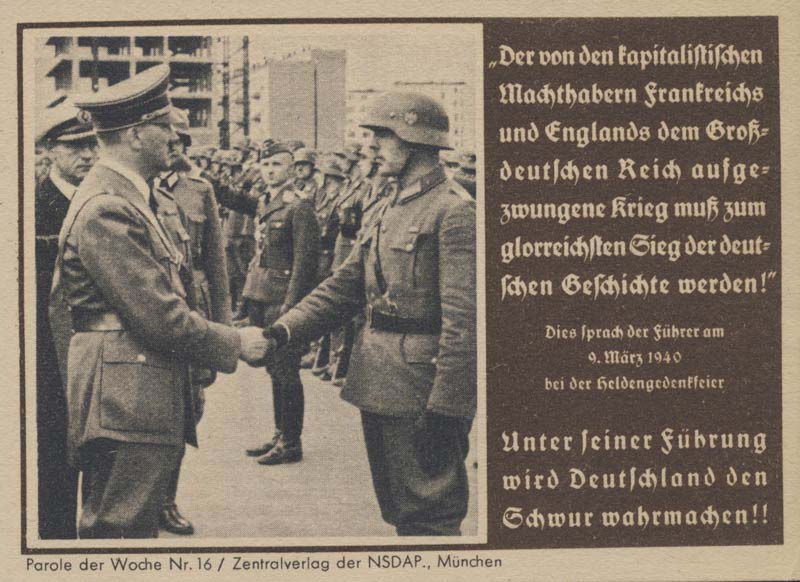
Though the Nazis’ propaganda delivery systems seem primitive now, they were state-of-the-art for the time, and they never skimped on the propaganda budget. There was no free press in Germany under the Nazis. Unfriendly editors and newspapers were purged, and the assets were sold cheap to members of the party. Uncooperative journalists were harassed and arrested, and party members were put in their place. Confidential weekly press directives from Dietrich were distributed to all newspaper publishers, listing the talking points and telling editors how to frame events. The Reich produced a weekly newsreel that was seen by millions. Radio was used extensively. Herf, in this book, puts a lot of emphasis on an important form of propaganda that everyone in Germany saw and read but which were poorly known at the time outside Germany. This was a weekly “wall newspaper,” a kind of poster that was posted all over Germany so that almost the entire population had a chance to read these posters as they went about their daily lives. You can find a lot of these posters online by searching for “Word of the Week,” or “Parole der Woche.” Goebbels’ order was that these posters should be simple and emotional: “Form and color must correspond to the primitive emotions of the masses.”
Herf lists some of the guiding principles of propaganda as given by Friedrich Madebach in 1941:
Madebach drew on Mein Kampf to arrive at “basic laws” of mass influence: intellectual simplification, limitation to a few key points, repetition of those points, focus on one subjective standpoint to the exclusion of others, and appeal to the emotions and to stark contrasts between good and bad or truth and lies, rather than to nuance and shades of gray.
Herf briefly alludes to an interesting question. Did the Nazis believe their own propaganda? Apparently there is no consensus on the answer. Before I read this book, I think I would have assumed that the Nazi’s did not believe their own propaganda, because the propaganda is so crude, and the Nazi leaders were elite (Goebbel’s had a Ph.D.). But after reading this book, and some of the entries in Geobbel’s diary and accounts of private conversations with Hitler, I now find it plausible that the Nazis did believe their own propaganda.
This book discusses one chilling set of facts that I was completely unaware of. That is that Nazi propaganda had a measurable effect on Americans. Polls by the Opinion Research Corporation attempted to measure anti-semitic sentiment in the United States. The polling question was, “Do you think the Jews have too much power in the United States?” Here is a table of the number of Americans who said yes:
1938: 41 %
1940: 42 %
1942: 47 %
1944: 56 %
1945: 58 %
In other words, anti-Jewish sentiment was growing in the United States even as we fought a war with Germany. Here’s another one. The polling question is, “What nationality, religious, or racial groups in this country are a menace to America?” In eight polls between August 1940 and June 1945, Jews always polled as the greatest menace, except for a poll right after the bombing of Pearl Harbor, when the Japanese were seen as the greatest threat, and a poll in February 1942, when German submarines were sinking ships off the United States’ Atlantic coast, when Germans were perceived as the greatest menace.
Just how these anti-semitic attitudes in the United States came to be intensified during World War II would be an interesting historical study in itself. Mostly this is a mystery to me. Fortune magazine, in February 1936, devoted an entire issue to the subject of Jews in American business. Henry Ford financed the publication of the infamous forgery The Protocols of the Elders of Zion. Ford also wrote articles in the Dearborn Independent that, according to Herf, “fanned the fires of anti-Semitism in American life.” Charles Lindbergh in the late 1930s and his ideological allies kept saying that it was Jews who were driving the United States to intervene in Europe. In 1939, Look magazine reported that there was 62 organizations in America distributing material that came from Hitler’s propaganda ministry.
This is a piece of history that is no fun to read. Now I need a good science fiction adventure to clear my mind. No wonder we dream of other worlds.