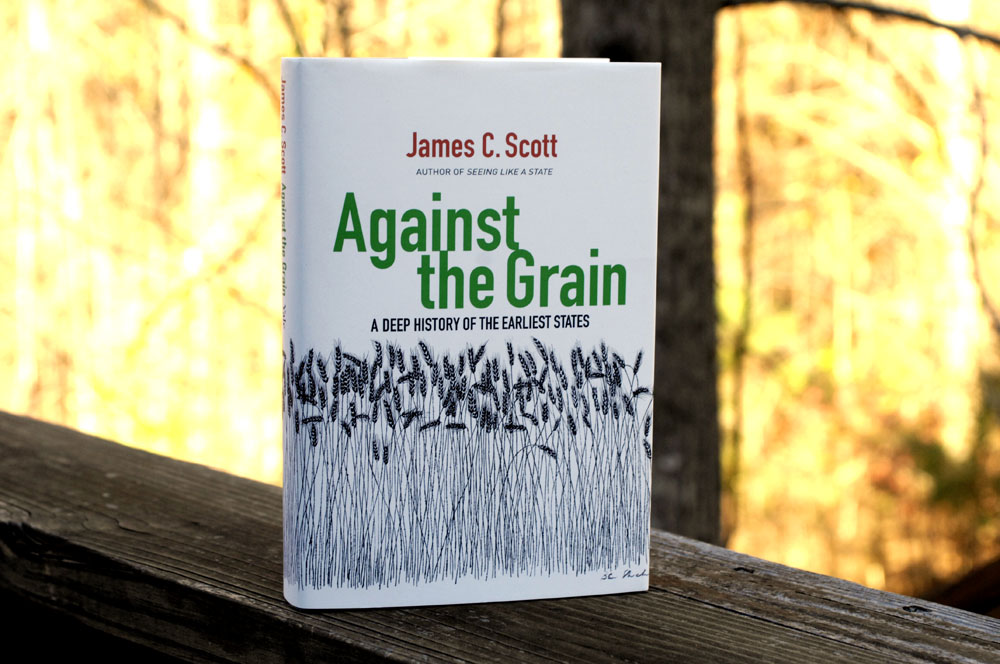
Against the Grain: A Deep History of the Earliest States, by James C. Scott. Yale University Press, 2017. 312 pages.
Why did human beings abandon their hunter-gatherer livelihoods, build the first towns and cities — and therefore create the first governments? This book uses new findings from archeology, epidemiology and climatology that may radically change our views on this radical period in human history that completely upset how we live as human beings.
The long-prevailing view was that farming and sedentary human communities were a great advance in human wellbeing and comfort that led to rapid advances in human cultures. But maybe not. Farming and pasturing actually were harder work than hunting and gathering and took more time and labor. Crop failure and famine were frequent. Sedentary people were sitting ducks for raiding. The greater density of people and domesticated animals, not to mention their wastes, brought all sorts of new diseases and epidemics. The diets of sedentary people were far less varied. Settled people weren’t nearly as healthy as hunter-gatherers. Grain was easily taxed. Elites arose to lord it over the peasants. Walls were built not just to keep raiders out but also to keep the peasants in. People actually liked their hunter-gatherer lifestyles and did not necessarily take up farming eagerly. Slavery was already well known, but slave labor was especially needed to keep the towns and cities running. If a town went bust (as frequently happened), the survivors would return to hunting and gathering. The move from wild to domesticated living was not a sudden and permanent switch. There was a lot of back and forth for centuries.
The only environments that were rich enough to support the early towns and cities were the mouths of rivers where the rivers slowed and spread into alluvial plains where the soil was enriched by siltation. Water was plentiful and provided transportation as well as irrigation. But all sorts of things could go wrong — floods, droughts, war, epidemics, environmental degradation and soil exhaustion, and natural changes in the climate. It was a risky, dangerous life. Child mortality was easily 50 percent.
The author has so much to say about taxation and the oppression of states that I was afraid I was being set up for a libertarian message. That did not happen. Scott, who is at Yale, is too good a scholar for that.
Part of the beauty of this book is that it sheds so much new light on how our Paleolitic and Neolithic ancestors lived. Their lives were not unappealing! They were free, they were bigger and healthier than city people, and most of them preferred a wild life to a life as a domesticated human, which was not all that different from the life of a domesticated animal. When cities and their governments squeezed the people too hard, people would often flee back into the wild. Returning to the frontier, Scott points out, was easier than revolution.
The sad thing is that, today, we have run out of wildness and frontiers. We are all domesticated now. We all are subjects of states. Though it’s terrain that this book is not concerned with, nevertheless these two opposites — wild vs. domesticated — beg some thought experiments. How can we do as much for ourselves as possible and disengage as much as possible from domestication and corporatization? To our overlords — who are now stronger and richer than they have been in a hundred years — we are just livestock. They exploit our surplus. They abhor us, but they also are afraid of us because we outnumber them and we are the source of their wealth and power. In that sense, nothing has changed in 10,000 years.