
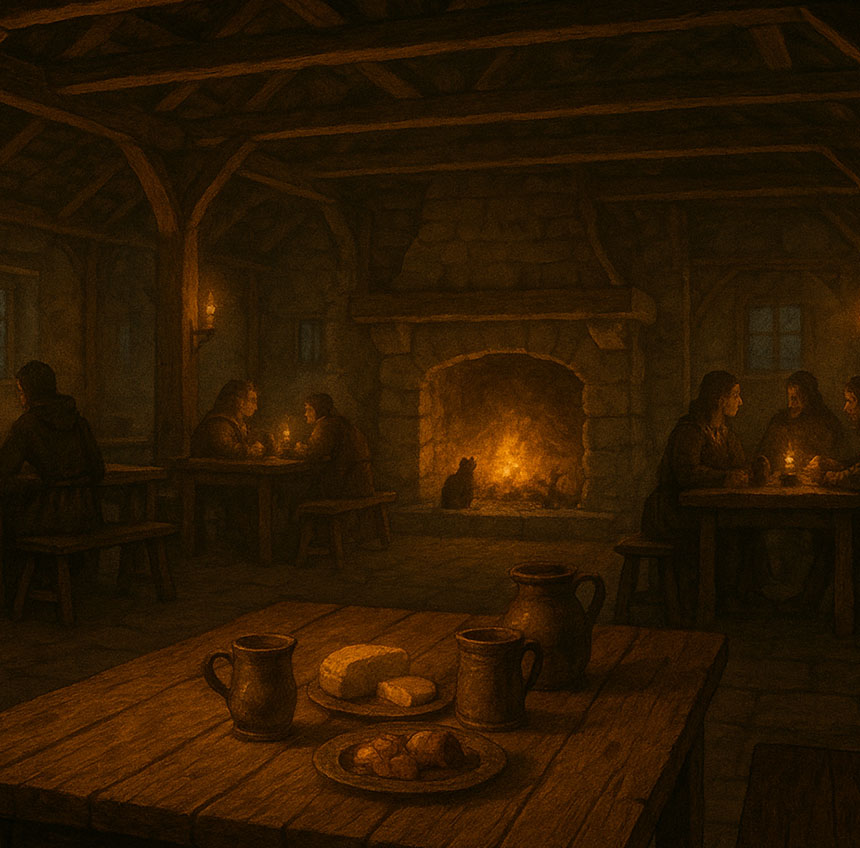
A medieval inn. Source: ChatGPT 5.1. Click here for high-resolution version.
It’s an odd paradox — to very much want to know what’s happening in the world, but very much not to want to be in that world. When you’re both introverted and old, like me, then all the more does one want to be away from the world. It’s why I live in the woods now. This almost certainly has something to do with why I no longer read stories set in the here and now.
It wasn’t always that way. Back in the 1970s, Armistead Maupin’s series of Tales of the City novels changed my life. They were very much set in the here and now, in San Francisco. Those novels were a big factor in my deciding to move to San Francisco back in the late 1980s. And by the way, by an unplanned stroke of fortune, I ended up at the San Francisco Chronicle, where Maupin wrote those novels in serial form in the Chronicle. I even, at last, met Maupin at an office Christmas party. By that time Maupin was rich enough from the novels that he no longer had to work at the Chronicle.
Still, the urge to travel has never completely left me, and I hope it never does. I’ve seen most of the places that I ever wanted to see, so it’s Scotland now that best suits my anything-but-the-here-and-now attitude. In Scotland, especially in certain places, the realities of today’s world can easily be imagined away — pubs, little villages, farmland that probably looked very little different 400 years ago, moors and bogs, castles, and the sea crashing against rocky cliffs. San Francisco suited me well when I was younger, but not anymore.
But: one has to get there from here. From where I am in the Appalachian foothills, that’s 24 hours or more of the most miserable sort of immersion in the here and now — the noise and discomforts of airports, being packed into airplanes, paying through the nose for a taxi or Uber ride, and sometimes an ugly and time-wasting layover in an airport hotel. No doubt this is inevitable in an era when people travel by the millions, requiring great efficiency. The economics of travel today, it seems, have been fine-tuned to keep the level of misery just short of the level at which people will refuse to bear it. The misery is twice as great on the way home, because everything that one was looking forward to is now behind rather than ahead. Though, to be sure, being home at last is awfully nice, too.
I was unable to find any new fiction that interests me, so once again I’m re-reading The Lord of the Rings. My favorite parts, really, are the traveling parts, especially in Book 1 when Frodo and friends set out from Hobbiton and travel cross-country to Bree and to the inn named the Prancing Pony.
I’ve often been curious about what travel was like in medieval times. There were Roman roads, of course, going in all directions from Italy into the heart of Europe as well as into Britain. There were a good many people on those roads, which means that there had to be a support system for travelers. For what reasons did people travel? How safe was it? Were there a great many inns, or too few? Who walked, and who rode? What kind of wagons and other conveyances did they use? Did they travel much during the winter?
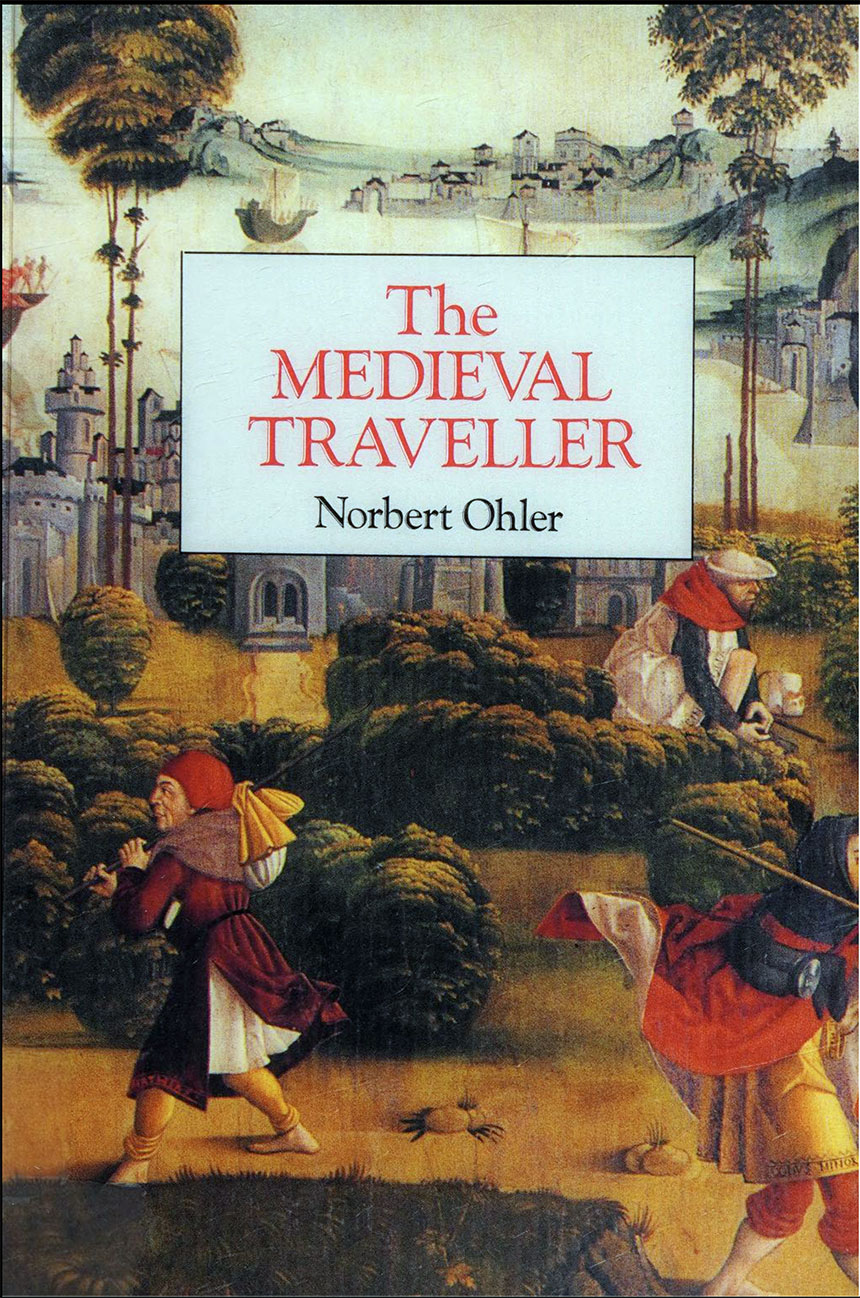
It seemed very likely to me that scholars have a great deal of information about medieval travel, so I asked ChatGPT for suggestions. I’ve ordered a 1997 reprint of Norbert Ohler’s The Medieval Traveller. It’s an English translation of the original German, Reisen im Mittelalter.
I’m hoping the book will provide some fuel for my imagination — staying right here in the woods while traveling in my imagination, and not in the here and now.
Love it. Speaking of fiction, I just received a copy of Fugue in Ursa Major; I can’t wait to get going on it!
Hi Eric: How nice of you to get a copy of Fugue. Though I wrote several practice novels, Fugue was still in many ways a practice novel. Oratorio, I think, is more polished.
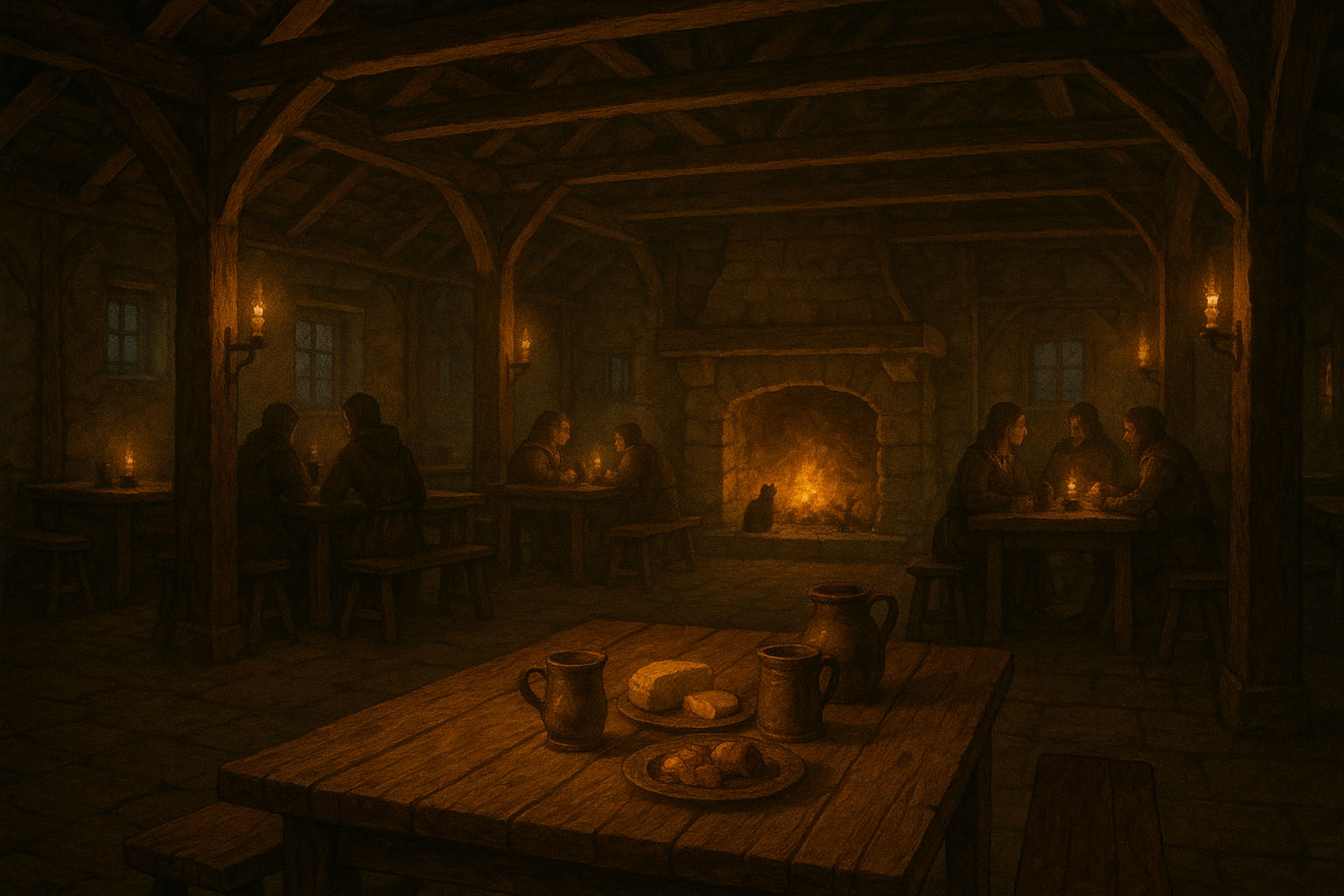
I love that image David, how long did it take to generate ? I have been using the free version of chatgpt for images but it takes a long time.
You can always tell you are driving on a Roman road when it suddenly becomes uncharacteristically straight. Sometimes the modern road will veer off in a different direction and the Roman route will continue onwards as a track or pathway. There is a you tube channel called Paul Whitewick which has a lot of interesting stuff on landscape history and ancient travel routes.
Hi Chenda: It took about 2 minutes per image. After the original image, I asked for revisions three times until I got something suitable. I have the $20 a month subscription to ChatGPT, and I do get my money’s worth. It’s a fantastic research tool. When reading difficult texts, such as something in physics or something academic that goes over my head, ChatGPT can really help clarify things that are murky to me. I’ve used it to write computer code, and it’s very good at that. I use it often to summarize long transcripts. It seems the media increasingly want to do “conversations,” and I just don’t have time to read through them. The ChatGPT summaries are very good. When I encounter particularly bad writing at an online site, I ask ChatGPT to tell me what the point of the piece is. Because it’s so good with languages, I often ask it to review that day’s main themes in foreign media — Russia, Germany, Polish, Swedish, etc. It saves a lot of time for an information junky like me.
Thanks for mentioning Paul Whitewick. I will look into that.
Thanks David, yes its excellent for research.