Smart car: A one-year re-review

I’ve had my 2013 Smart car for just over a year. It has exceeded all my expectations, and I stand by my original review from July 2012. There are a few things I can add after a year with the car.

As I expected, the Smart car’s gas mileage has gradually increased as the engine has gotten broken in. I now average about 51.5 miles per gallon. My mileage is greater than the Smart car’s EPA rating, and it’s greater than what most Smart car owners report. In fact, I hold the gas mileage record of all the 2013 Smart cars listed at Fuelly.com. I believe this is because I do a minimum of city driving (though a tank of gas will always include a couple of trips to shop in Winston-Salem); my lifestyle doesn’t require that I drive on freeways at criminal, gas-guzzling speeds; I have learned how to use (and like) the odd transmission in the Smart car; and I know how to drive.

When the time came for the 1-year service, I was afraid the cost would be high, since the Smart car is made by Mercedes. But actually the 1-year service cost only $220, about half of what I feared. Also, I find Mercedes dealerships much easier to deal with than other car dealerships, because there is much less of a sleaze factor. The salesmen and service managers seem to be overqualified, overeducated guys who ended up at a car dealership in a rotten economy.

In the last year, I have had no problems with the Smart car. I’ve had some fuel problems, but that’s not the car’s fault. Nothing on the car has broken. There was not a single thing, even a little thing, that needed to be fixed at the 1-year service.

About the fuel problem. It first occurred after I’d had the car for a few weeks. Shortly after I started it up one morning, the car started misfiring, and eventually the check-engine light came on. I drove straight to the Mercedes dealership. They could find no problem with the car, but diagnostics saved by the car’s computer was consistent, they said, with water in the fuel. The checked my fuel tank and filter and found no water. The problem cleared up on its own. I assume this is because the water had settled in the bottom of the fuel tank, and the car had ingested it all. This has happened about three more times in the last year.

My belief is that water in gasoline is more common than we think. Larger engines probably aren’t much affected by small amounts of water, but the Smart car’s engine is small and sensitive. The ethanol alcohol that is added to gasoline attracts water from the atmosphere. The Smart car’s fuel tank, like the fuel tanks on all modern cars, is designed to prevent this. But it probably happens at the service station, from condensation in the underground storage tanks. I have learned to never buy gas from country gas stations and to always go to the busiest, most modern service station available. The longer gasoline is stored, the longer it has a chance to attract water.

The anti-lock brakes have engaged only once in the last year, when a deer ran out in front of me. I wrote about that in a previous post. The stability control system has engaged only once. That was a couple of weeks ago, when I hit some standing water in the roadway at about 50 m.p.h. The stability control system indicator flashed for a couple of seconds, but I felt nothing, and the car kept going straight ahead, feeling perfectly under control.

I love this little car, and it’s actually highly convenient to drive a car that is no bigger than necessary. I just wish that more Americans could appreciate the sensible concepts and excellent German engineering that went into it.

Grrr…


Click on image for high-resolution version

I thought my day lilies weren’t looking as lush this year as they ought to look. This afternoon, I caught this doe eating the blooms right off the stalk like they were popcorn.

2 major TV appearances by Ken

Ken has two major television appearances coming up in the next week. On Thursday, June 20, he’ll be on CBS This Morning. On Monday, June 24, he’ll be on the Tonight Show with Jay Leno. The scheduling of the Tonight Show appearance may change because of the NBA playoffs, so check the Tonight Show web site if need be. He’ll be talking, of course, about his new book, Walden on Wheels: On the Open Road From Debt to Freedom. Ken wrote this book here at Acorn Abbey, and I helped with the editing.

Needless to say, I am very proud of Ken and very excited about the career push he’ll get from this. I’m also proud of his connection with Acorn Abbey and the interesting work that has gotten done here — much to my surprise, really, because I never imagined that my retirement would be so busy and so rich.

If you enjoy Ken’s television appearances, you’ll get some idea of how much I enjoy Ken’s conversation at breakfast and dinner each day.


Ken Ilgunas

More bread portraits


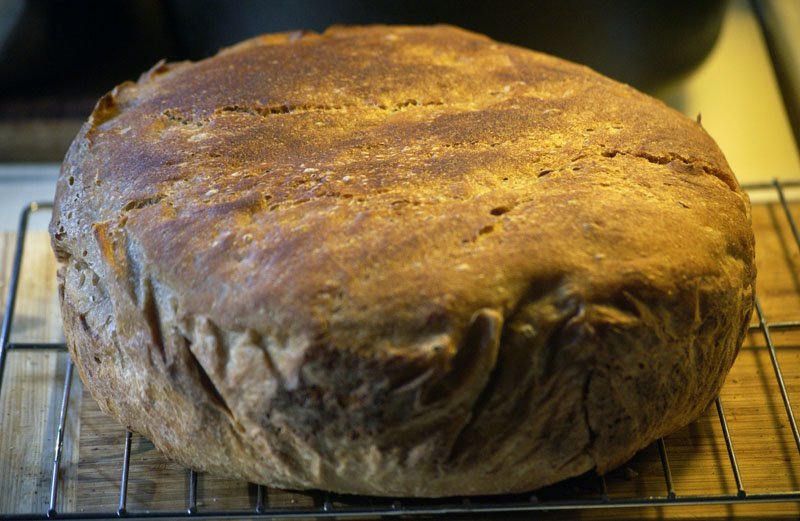
75% whole wheat, 25 percent unbleached bread flour

The sourdough testing continues, using the Tartine method described by Michael Pollan in his book Cooked. I have been very excited by the results and continue to try to refine my sourdough boule technique.

Another virtue of sourdough bread: It keeps longer. Yeast bread normally molds on the third day. I have three-day-old sourdough bread with no sign of mold. I suppose this has to do with the lactic acid in sourdough bread, acting as a natural preserve.


50% whole wheat, 50% unbleached bread flour

Whose hobbit hole is this?

Today while mowing the grass, I found the home of a new neighbor. The burrow is only about 20 feet from the side door of the abbey, in a steep bank above a newly planted deciduous magnolia tree. It looks just like a rabbit hole. But my understanding is that the eastern cottontail rabbit, which is the common rabbit here, does not burrow. Rather, they commonly live in brush piles or other homes that they find rather than build themselves.

I’ve seen many groundhog holes, but this hole is too small for groundhogs. So now I am puzzled. I don’t know if there are burrowing rabbits in these parts. There are rabbits here, that’s for sure, because I see them in the yard every day. But I’ve always assumed that they’re cottontail rabbits that live in the brush pile down in the thicket.

Whoever made the hole is very tidy. The landing is very neat, and they’ve spread dry glass on the floor into the burrow.

Taking bread up a level


First test: not too shabby, especially for 75% whole wheat

A week ago, I would have said that no hope existed that I would ever be able to make bread that could begin to compare with the bread one can buy from the excellent bakers of sourdough bread in the San Francisco Bay Area. Now I think it is possible. Michael Pollan’s new book, Cooked, has shown the way.

Part of my problem is that recipes are useless. No recipe can tell you, or teach how, how to make proper bread. Measuring (for example) has nothing to do with it. Rather, the ability to bake good bread can arise only from a deep understanding of how the process works. Pollan’s book has helped me figure out what knowledge I was missing that was holding me back. Don’t get me wrong — I can make delicious breads. But I had no idea how to get to the next level.

Pollan’s main source on bread for this book was Chad Robertson, who runs a bakery in San Francisco and who has a book out named Tartine Bread. When Pollan revealed that Robertson’s instructions for sourdough bread are more than 40 pages long but never quite gives a recipe, I knew that I had finally found my way to the next level. Those 40 pages are about the concepts behind the bread — exactly what I needed.

Here is a summary of some of the new knowledge I’ve gained that has helped fill some of my blind spots and misconceptions:

1. Sourdough is superior to yeast for many reasons. Sourdough bread is actually fermented, and some components of the flour are partially digested, releasing more nutrients and lowering the glycemic index of the bread. The lactic acid generated during the fermentation helps to strengthen the gluten. And gluten, of course, is what makes bread rise. I’ve started a new sourdough culture, which should be ready to use in about a week. My previous sourdough culture died out more than a year ago from neglect.

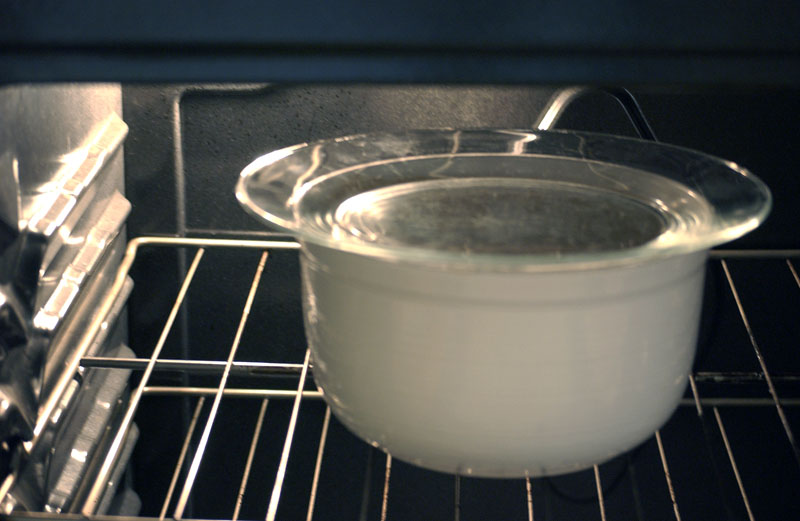
2. The reasons that whole wheat makes heavier bread can be explained, and there are ways of dealing with it. For one, the bran is sharp, and it cuts and weakens the strands of gluten. Overnight soaking of the flour softens the bran and helps reduce this sharpness. The shaping of the loaf is critical. Steam during the first part of baking is critical.

3. Random kneading of dough is useless. I have come to understand that the point is not just to form the gluten into strands, but to align those strands in such a way that they define the way you want the loaf to go when it rises. That is, the gluten strands form a kind of skeleton for the loaf. The point is to manipulate the dough in such a way that the gluten strands are formed into a skeleton.

4. The main reason steam is critical is that the formation of the crust must be postponed. If the crust forms too soon, it prevents the bread from rising. Throwing water into the oven is one way of dealing with this. But a better way is to bake in a covered Dutch oven. You remove the lid when the bread is about half done, after the loaf has already finished its “oven spring” — the inflation of the loaf when the heat hits it.

5. Maximizing oven spring is critical. The Dutch oven method works nicely. But another factor that is important to good oven spring is building up a proper gluten skeleton by manipulating the dough and to start baking at the right time. Bake too soon and there isn’t enough air in the loaf. Wait too long and the gluten becomes tired. Good oven spring is probably the single most important indicator of good bread and a good baker.

6. The dough must be wet. This probably has been my biggest failing as a baker over the years. Wet dough is difficult to work with. But it must be done.

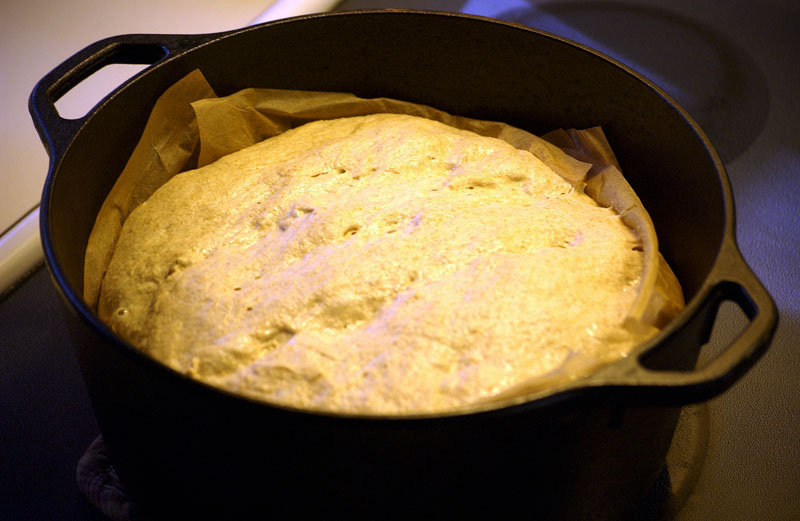
It will be at least a week before I can attempt my first sourdough loaf. But I did make a loaf of bread with yeast this morning to practice manipulating the dough into a proper boule and to test the Dutch oven method. The loaf was 75 percent whole wheat and 25 percent unbleached white flour. It worked beautifully, and I got excellent “oven spring.” The top of the loaf broke open even though I forgot to slash it with a razor blade before baking.

Michael Pollan’s Cooked is not just about baking. He divides all cookery into four categories — fire (roasting, of meat in particular), water (cooking in pots), air (bread), and earth (fermentation). For each category, he seeks out experts and gets them to reveal their secrets. Though I have some experience with making sauerkraut, Cooked has motivated me to expand my food fermentation skills. And though the abbey’s kitchen is far from a slouchy kitchen, it’s exciting to have new, and higher, goals to aim for.

French toast from low carb banana bread

Low carb quick breads are as easy to make as low carb yeast breads. This morning I made low carb banana bread and used it to make French toast. Instead of regular wheat flour, I used a mixture of 2 parts gluten flour, 2 parts barley flour, 2 parts almond meal, and 1 part soybean flour. Other than that, I followed my usual procedure for making banana bread.

French toast loves to be served with whipped cream. I put a pinch of nutmeg into the cream before whipping it.

This makes a very high protein bread, combining seed (wheat gluten and barley), legume (soy), nuts (almond), and egg.