
Watership Down


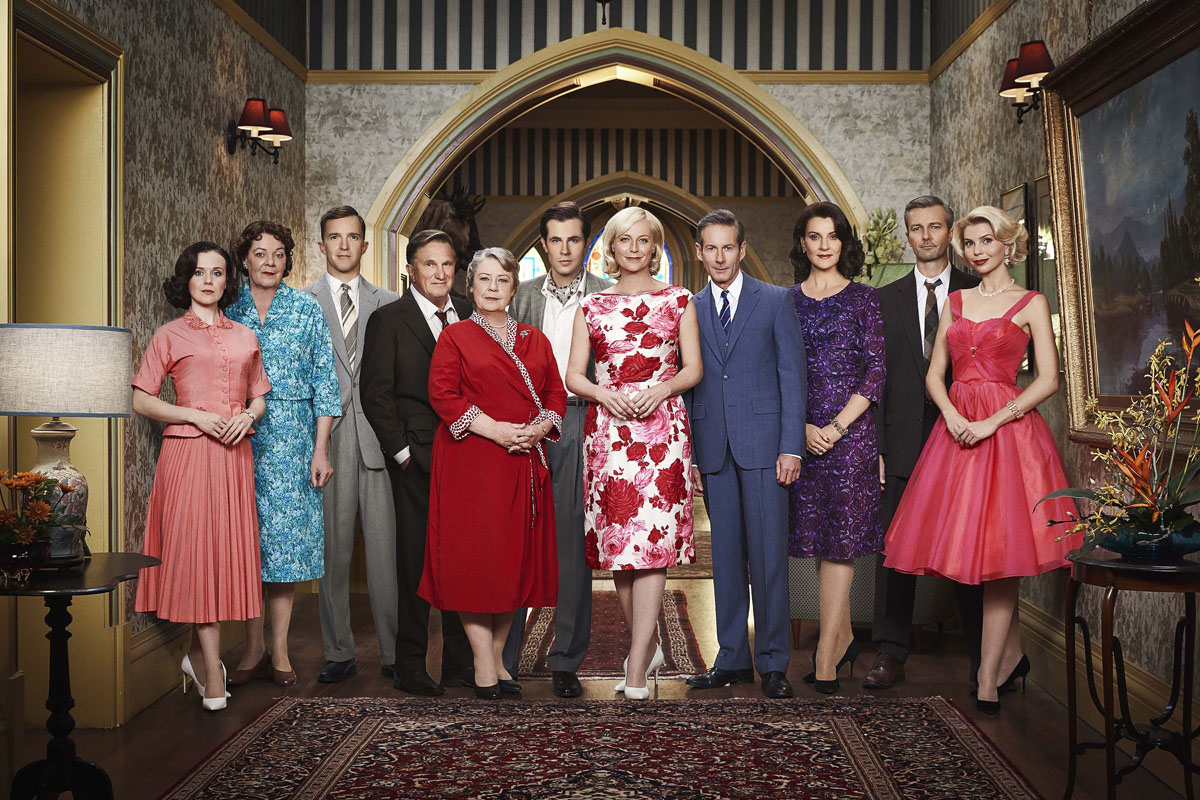
I watched the first episode of Watership Down last night on Netflix. It’s the best thing I’ve watched in a long time.

This is a new production of the Richard Adams novel by the BBC. There are four episodes.

Watership Down was originally published in the United Kingdom in 1972. The American edition was published in 1974. I read the book soon after it was published in the U.S., and I have reread it at least twice since then. I know the story, but whether you know the story or not, this BBC production is thrilling — and terrifying.

I don’t think that Richard Adams really meant Watership Down as an eco-parable. But it is that, though the story also is much more. The decimation of farmland to turn it into suburbs has been going on for a long time. I see Richard Adams as a kind of empath. I have to imagine that he loved the countryside and that, like Tolkien, it greatly disturbed him to see countryside lost. A writer’s imagination would then have a very natural way of lingering on what the loss of farmland would feel like to a rabbit. He felt their needs, their vulnerability, their contentedness (when they had it), and most of all he felt their fear and their panic. This is not a story for young children.

According to the Wikipedia article, Watership Down was rejected by publishers seven times before it was accepted, with no advance, by a one-man London publishing house, Rex Collings. Collings died in 1996. I hope he died rich.

Richard Adams died on Christmas Eve in 2016, at Oxford, at age 96.

Meow


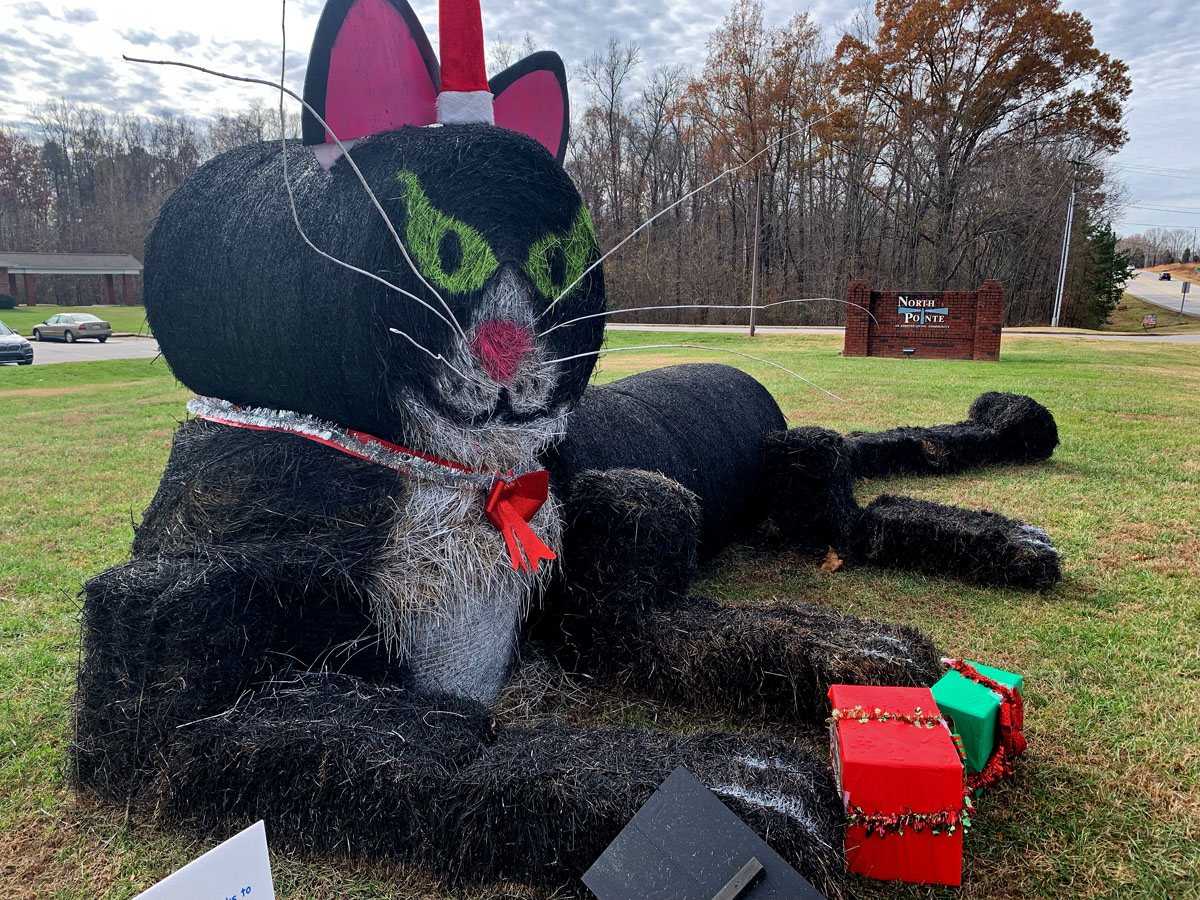
Hay bale sculptures are a thing around here (we grow lots of hay). Obviously there are even competitions, because there was a sign beside this sculpture saying that it had won first prize in something. It’s in Mayodan, North Carolina.

Those of you who are not up to date on agricultural machinery may not know that hay from large fields is often baled into large, very heavy rolls these days. These rolls are too heavy to be moved by one human being. But the smaller, rectangular bales are still produced, too. This cat sculpture combines both types of bales. And a lot of black paint.

Let’s hear it for the P.O.


Many things have vanished in rural America. Jobs and people (particularly young people) are at the top of the list. One institution that remains is the U.S. Postal Service, which has shown a remarkable ability to change with the times.

Though I lived in San Francisco for 17 years, much of my life has been spent in rural America, with a rural mailbox. I feel sorry for people who open their mailbox and mostly find bills. I get some of those, too. Still, after all these years, opening the mailbox each day and seeing what’s inside is like a tiny Christmas that comes every day.

When I was a boy, I eagerly awaited the little packages that brought fresh chemicals or glassware that I’d ordered for my chemistry set. I often ordered little doodads that were advertised in comic books. For years, I received regular catalogs from the U.S. Government Printing Office, and I ordered little books and pamphlets on all sorts of subjects. Everyone received a Sears catalog. As a teenage nerd, I got lots of electronics catalogs such as Allied Radio and Electronics. When I was older and had friends, and when those friends began to scatter, it was the post office that kept us in touch — letters typed on manual typewriters and mailed in legal-size envelopes, always with commemorative stamps for better presentation. Many of those old letters from friends still survive in trunks in the attic, which I refer to as the archives.

Everyone has email these days, so letters in the mailbox are, sadly, a thing of the past. But opening the mailbox is still a tiny Christmas. Amazon Prime, of course, is the new Sears catalog. All those boxes bother me (though of course I recycle them). But Amazon Prime does greatly reduce the amount of driving one has to do. Since the mail carrier drives through every day anyway, there are efficiencies there in maintaining rural supply lines.

What started me thinking about the reliability of the post office was the unreliability of UPS and Fedex in rural areas. Fedex can hardly ever find me. (The truth is that Fedex drivers don’t try very hard, because they obviously detest rural deliveries.) UPS does a better job here, but not much better. UPS and Fedex are just not efficient for rural delivery. Whereas the U.S. Postal Service knows its rural customers because they deliver every day.

Rural Free Delivery has been the rule in the U.S. since about 1900. Before that, people had to go to a post office to pick up their mail. Still — and this is just as true today — mail carriers don’t deliver mail to every rural door or driveway. Mailboxes are often clustered to make delivery easier. If your home is remote (as mine is), then your mailbox may be some distance away. My mailbox is half a mile away. I can stop and pick up the mail if I’m in the car, or I can walk a nice woodland trail to pick up the mail, just over a mile round trip.

The use of First Class mail continues to decline. But, since 2014, Postal Service revenue from online retailers has been steadily increasing and is making money for the Postal Service.

Not too long ago, I was saying to a friend that rural living today is a privilege. Obviously people need jobs, and they need reasonable commutes. Rural living is not very efficient for most working people. For retired people like me, rural living is efficient, if one stays off the roads as much as possible and especially if one grows at least some of one’s food, as many rural people used to do. It’s shocking to reflect on the fact that the world’s population is now twice what it was when I was born. That is just too many people, so it is a great gift — if you like peace and quiet and nature — to live in a place where the population actually is declining rather than growing. The U.S. Postal Service is as necessary to rural life today as it was in 1902.

1953 lunch counter deliciousness


Egg and bacon sandwich. Photo with iPhone XR.

I have written here before about the Red Rooster, a drug store lunch counter in Walnut Cove, North Carolina, which not only is thriving but is beating the fast food competition. The Red Rooster happens to be only about 200 steps from the county headquarters of the Democratic Party, so it has been part of my compensation as a political operative to have breakfast or lunch there for the past few weeks. If the food is in any way different from the diner food of 1953, I can’t detect it.

The breakfast menu includes egg sandwiches for $2. Dress the sandwich however you wish, says the menu. This morning I added — sinfully — bacon, along with lettuce, tomato, and mayonnaise.

In 1953, lunch counters in the American South would have been segregated. Today the Red Rooster is anything but. Walnut Cove has an African-American mayor, and two members of the town board are African-Americans.

The authoritarian lust for scapegoats


Transgender teenager Ally Steinfield, who was murdered last year in Missouri. Her body was mutilated and set on fire.


We live in a strange society in which a rather sad, vulnerable, harmless teenager like Ally Steinfield is seen as sick and dangerous. Whereas the people who have a mysterious need to scapegoat people like Ally Steinfield are considered normal.

It blows my mind how effectively this society programs most of its young to think so rigidly about gender and sex. After she was murdered, Ally Steinfield’s body was butchered. Her eyes were gouged out. Her genitals were stabbed. The body was set on fire. Then the remains were put into a garbage bag and hidden in a chicken coop. Four people were charged. One of them was 25, one was 24, and two were 18. And this is just one example of violence against transgender people that occurred last year. By high school age, most of our young people will have acquired thoroughly crummy educations in most things. But they will have acquired the equivalent of Ph.D.’s in this society’s notions about gender and sex.

Once again, the difference between liberal and conservative minds makes all the difference. Liberals don’t feel threatened by harmless differences. Liberals don’t feel a need to police other people’s private lives. Whereas authoritarian minds are terrified that the sky will fall if their fetishes for authority, obedience, and conformity can’t be policed, and if their scapegoating of out-groups isn’t sanctioned. This terror is so prevalent that our dominant religion is desperate to be permitted to legally discriminate. The terror is so prevalent that billionaires will put big money into lobbying for the legal authority to discriminate. For more on that, see this piece in yesterday’s New York Times, ‘Transgender’ Could Be Defined Out of Existence Under Trump Administration.

The Republican Party, allied with fundamentalists, has retailed this sky-is-falling sex panic all the way down to the local level.

Last month at the county fair here, the Democrats’ tent was, as usual, close to the Republicans’ tent. A Republican candidate for county commissioner, accompanied by the Republican Party’s county chairwoman, were haranguing me about transgender people and bathrooms. They brought it up, not me. They are inflamed by the issue. The Republican Party has made authoritarian scapegoating into a key political wedge issue, and their preachers have made it into an urgent religious issue. I have had similar encounters many times. Nothing I’ve ever said has gotten through. A person’s sex, they will soon say, is “God given.” I ask if they’ve ever known a transgender person. They haven’t, of course. Even though they’re not aware of ever having met a transgender person, nevertheless they believe the threat is imminent, personal, and severe — the sky is falling.

There is no mistaking one’s God-given gender, authoritarians say. Apparently they have never heard of the list of birth conditions that blur physical gender. Those conditions include ambiguous genitalia and gender indicators that don’t match up (external parts, internal parts, or chromosomes). In such cases, gender is often “assigned” at birth, based on a guess. But we have learned that children — and certainly adolescents — will let us know how they experience themselves from within, regardless of how they came to be that way. Who would argue with that? Authoritarians, of course. Mere argument wouldn’t be a big deal. But authoritarians are compelled to go much farther than that — policing, scapegoating, persecution, and sometimes violence — because for some mysterious reason they feel threatened, and because their politics requires scapegoats.

Even in discussions with other liberals whose lives and identities fit comfortably inside the range regarded as normal, it’s difficult to get them to see just how strange and rigid our training in gender and sex is. It isn’t difficult to compare that training with other human societies or even with our own society’s history. We didn’t have to be this way. And there are better ways to be.

One of the things that I found striking in in Ronald Hutton’s Pagan Britain (which I recently reviewed here), is that our prehistoric ancestors in western Europe seemed to see very little difference between the sexes. To a considerable degree, this attitude can be reconstructed archeologically, from images such as cave paintings, carvings, stoneware, and metalware, and also from burial rites. Writing about relatively recent (728 to 352 B.C.) statues found in the British Isles, Hutton writes, “The one from Scotland is of alder wood, and may be female, although the sex is hardly emphasized, while that from Devon has been called male and is of oak; sexual ambiguity seems the case at Roos Carr.” Writing about much older images, from the Paleolithic, Hutton writes, “Modern Western culture has long drawn a sharp distinction between human and animal, and female and male but, in pictures at least, the Paleolithic did not.”

Historian Miranda Aldhouse-Green, Hutton writes, “… has shown how the blurring of lines between species was accompanied by an equivalent ambiguity in representing gender, and a disinclination to distinguish clearly between the human and divine. When human and animal were combined, special types of beast were chosen, namely horses, dogs, stags, and bulls, and the stag above all: indeed, its antlers were sometimes given to female human-like figures as well as male. At the least, all this plausibly suggests a spirituality which depended on a regular sense of crossing ‘natural’ boundaries and of fluidity of identity.”

Sociologists have found a similar fluidity around sex and gender in Native American (and other) societies. Sex and gender weren’t a big deal. Those who were different actually were valued for their differences, and those who were different often took on special roles that were helpful to the community. Not only that, but those who were different were often consulted for their different perspective on tribal or personal issues. It could work that way today, if only we’d listen.

Instead, our society continues to insist on stark gender boundaries, though much (such as who can wear pants, or earrings) has been renegotiated. But where renegotiation is not complete, those who are different are somehow threatening and, through some strange psychological mechanism that is somehow trained into us, arouse fear. Then there is identity, which, we are learning, is a double-edged sword that can both liberate and obstruct. The authority of authoritarians is worth a whole lot less than it used to be, as people come out of the shadows to demand fairness and to defend their right to self-respect — and to not be scapegoats. Authoritarians aren’t used to that, and they don’t like it. It used to be that gay men and lesbians were the scapegoats. But unless Trump’s new Supreme Court can overturn gay marriage and Lawrence v. Texas (authoritarians will surely try), gay men and lesbians are not nearly as vulnerable as they once were, thanks to the law. Transgender people remain vulnerable. This move by the Trump administration is an attempt to make transgender people even more vulnerable and thus to increase their value as scapegoats. Republicans don’t want another good set of scapegoats to slip away by giving them — gasp! — basic civil rights.

When authoritarians choose a scapegoat, it has to be someone vulnerable. That vulnerability needs to be not just vulnerability under the law, but also vulnerability like Ally Steinfield’s vulnerability, the vulnerability generated by social training that set her up for violence by marking her as disgusting, threatening, deserving of punishment, and weak. Just one thing alone — the fact that authoritarians rely on their lust for scapegoats to keep the sky from falling — reveals how wrong, and how wicked, they are.

Buffalo: Who knew?


Quorn cutlets in Buffalo sauce with mozzarella

I was Googling for ideas for what to do with Quorn faux-chicken cutlets. I came across chicken breasts in Buffalo sauce with mozzarella. Hmmm. But what the heck is Buffalo sauce?

A little Googling revealed Buffalo sauce to be a zesty sauce served with chicken wings. It originated in Buffalo, New York. I put two and two together and also surmised that “Buffalo wings” must have gotten their name from Buffalo, New York. Googling showed that to be true.

The Quorn faux-chicken cutlets are the most difficult form of Quorn to deal with, I’ve found. It’s hard to overcome Quorn’s dryness and mealy texture. The faux chicken nuggets, and the faux ground beef, are easier to deal with — if nicely sauced.

Except for the Quorn, the supper above is very local. The greens and peppers came from a neighbor’s garden. The sweet potato came from a sweet-potato farm just up the road.

That’s Buffalo china in the photo, in addition to the Buffalo sauce. Buffalo china was made in Buffalo, New York. My post on Buffalo china is the most Googled post I’ve written here in more than ten years of blogging. Buffalo china is simply the best commercial china ever made. The abbey’s everyday dishes, bought piece by piece on eBay, are Buffalo china.

Way to go, Buffalo.

Chicken pot pie, Quorn version


Click here for high-resolution version.

The Quorn chicken nuggets make a very fine chicken pot pie. I previously wrote about Quorn here, and Scottish meat pies here.

I am acquiring the opinion that crusts for pot pies and meat pies don’t need to be flaky, and that lower-fat hot-water crusts work just fine. The 4-inch non-stick spring-form pans work great. The pies come out of the pan free standing and intact.

Seasoning for the chicken pot pie needs a good bit of celery, some peas, and maybe a bit of carrot. I used a white gravy made with olive oil.

I bought the sweet potato this very morning from a local farmer. In fact, I bought five pounds of them. He was selling potatoes at a local fall festival. The Brunswick stew was free. Consequently they made the biggest pot of stew I have ever seen. I used the word “pot,” but “cauldron” would be equally valid. I also wrote recently about what archeology tells us about the prehistoric Celts of the British Isles. We know that cauldrons were a status item, and we know that cauldrons were used for feasts. I strongly suspect that the local tradition of serving chicken stew and Brunswick stew to one’s neighbors at harvest festivals is a very old tradition. That tradition is still very much alive here.


The Democrats’ table at the local harvest festival

Heathen enchantment … and Alexander Borodin


Don’t click to listen yet!


Maybe we could use a little music right now to take our minds off of politics. A few days ago, I was writing here about the project of the re-enchantment of the land. And then tonight, while YouTubing to hear the voice of a Russian mezzo-soprano recently mentioned in a New Yorker article (Anita Rachvelishvili), I ended up listening to parts of Alexander Borodin’s opera “Prince Igor,” which Rachvelishvili has sung at the Metropolitan.

Those of you who are my age will be familiar with the song “Stranger in Paradise,” which was very popular in the 1950s. The song came from the Broadway hit “Kismet.” The song’s words are from the Broadway musical. The music is from Borodin’s opera. “Stranger in Paradise” has long been on my list of favorite songs. When I was a child, first hearing Broadway harmonies and Broadway melodies put a spell on me and ruined me forever as a normal Southern boy. Church just didn’t have anything like that. From there it was a slippery slope to Mozart and other heathenry. (The word heathen, an insult word which is found 140 times in the King James Bible, is of course related to the word heath. Heaths are enchanted places. Do you suppose there might be clues there to how disenchantment happened?)

Here are the words to the opening lines of “Stranger in Paradise.” These words occur in the song’s introduction before the main theme of the song begins:

Oh why do the leaves of that mulberry tree
Whisper differently now?
And why is the nightingale singing at noon
On a mulberry bough?
For some most mysterious reason,
This isn’t the garden I know;
No, it’s paradise now that was only a garden
A moment ago!

The answer to these questions, of course, for why a mere garden has turned into a paradise, is that the garden has suddenly become enchanted. Borodin somehow captures that change.

I listened to many versions of “Stranger in Paradise,” including the original cast version, the movie version, and versions done by many popular singers. But Borodin’s melody is just too sublime to be sung by singers who don’t have operatic training. One needs to stick as closely as possible to the original Borodin. I came across the undiscovered gem above on YouTube. And who knows. Maybe only Russians can sing this song. I settled on the version above. Why don’t you listen now and see what you think…

For extra credit, here is an orchestral version by the Berlin Philharmonic. Oh, if only Borodin had been born a little later, the films he could have scored …


For extra-extra credit, here below, excerpted from the oboe score, is the introduction of the “Stranger in Paradise” main theme by the oboe, accompanied by the harp. The theme is then picked up by the clarinets and bassoons and, at last (and of course), by the strings. Of particular interest, as the oboe introduces the theme, are the ornamental notes. I’ve circled those notes in red to help you follow them in the oboe score as you listen. Also listen for the repeating triangle tings after the strings pick up the theme at 2:07. In orchestration, triangle tings almost always invite enchantment.

Start at point “A” in the score at 0:58 in the video:


More extra credit: Look up the meaning of the word “kismet,” from which the Broadway show got its name.


Privilege and humiliation


The American people are getting some excellent — and I suspect lasting — new insights into the ugliness of unearned privilege. But unearned privilege is only half of the problem that requires fixing. The flip side of that coin is undeserved humiliation. The two things together — the increasing humiliation of the many and the also-increasing privilege of the few — are tearing the country apart.

Paul Krugman’s column today shines a light on privilege: “The Angry White Male Caucus: Trumpism is all about the fear of losing traditional privilege.” Krugman writes: “And nothing makes a man accustomed to privilege angrier than the prospect of losing some of that privilege, especially if it comes with the suggestion that people like him are subject to the same rules as the rest of us.”

In thinking about this issue, I need to return once again to the “moral foundations” theory of Jonathan Haidt and how the world looks very different to liberals than it does to conservatives. The high value that conservatives place on authority, hierarchy and in-group values blinds conservatives to the humiliation of others while inflaming conservative rage when their privilege, their authority, and their place in the hierarchy are challenged. Whereas, to liberals, with their emphasis on fairness and caring, undeserved humiliation begs for succor, and unearned privilege cries out to be taken down a notch.

Twenty million people, I believe, watched Brett Kavanaugh’s horrifying performance on television last week. Conservatives saw a dangerous assault on their highest values of in-group power, authority, and hierarchy by a threatening rabble of inferior out-group people such as Democrats. Liberals saw how privilege responds with rage and disbelief at the notion that fairness, caring, and justice matter enough to stand in the way of entitled elite power.

It has been sickening to watch the mainstream media, because of the notion of “balance,” trapped into reporting on this spectacle as though what conservatives see is somehow just as legitimate as what liberals see. The real story is the increasing depravity of a conservative minority driven to the last ditch, struggling to use entrenched power to preserve the status quo. The Supreme Court is their last hope to preserve their world a little longer, as the political backlash against right-wing overreach — and an increasing awareness of the ugliness of right-wing intentions — builds.

If you do a little reading on the psychology of humiliation, you’ll soon come across the word revenge. When people are humiliated, they long for revenge.

But there are two kinds of humiliation. There is undeserved humiliation, such as being made to sit at the back of the bus. And there is deserved humiliation (which unfortunately is much more rare), such as the Trumpian thrashing of Brett Kavanaugh’s humiliation as he discovered that there are limits to his entitlements and that questions relating to justice (as with Trump) are questions that (at least in a nation of laws) must be answered. Kavanaugh has earned humiliation, not the revenge he wants. Justice does not contribute to the happiness of the unjust.

Once upon a time in America, humiliation was for the most part a minority experience. Humiliation was reserved for those with dark skin, and for those on the lowest rungs of the economic and social ladder, and for those who would not or could not play their assigned “normal” roles. But, as far as I can tell, humiliation in the workplace is now the rule, almost regardless of the type of work or the level of income. Friends with Ph.D.’s in high-paying jobs sometimes tell me shocking stories of humiliation, powerlessness, and abuse by employers. This workplace humiliation, of course, started with those with more modest educations in more modest jobs. But the culture of humiliation has steadily worked its way upward and outward. Merely being white and playing by the rules is no longer enough to guarantee meaningful work and a life of dignity.

But the humiliation of the newly humiliated — many of them white people who supported Trump — contains an element of justice. If you tolerate (or, worse, participated in) the humiliation of those whom you consider beneath you, then don’t be surprised if the rising tide of humiliation spreads and eventually sucks you in, too. As the truly elite know, there’s not a thing in the world that’s special about white church people, though a great many white church people are having a hard time figuring that out. If the arc of justice does not bend toward justice, then it will bend toward injustice. Or the arc may stall, blocked by those who feel threatened by anything other than the status quo, or by those who believe that any improvement in the lives of out-groups necessarily comes at the expense of in-groups.

Therein is a lesson that conservative minds just can’t seem to learn. The conservative mind always wants to assume that anything threatening comes from beneath them in the hierarchy, or from an out-group. The idea that the very in-group authority they glorify is the source of the threat is unthinkable. The right-wing propaganda machine — always demonizing them and always glorifying us — works constantly to reinforce these ideas. This pattern of delusion in the conservative mind is the key to the power of the Republican Party.

I confess that watching Brett Kavanaugh squirm last week was a beautiful thing, insofar as I could bear to watch it. It felt as good as revenge, but it actually was fairness and justice at work. Still, bringing down the Trumps and Kavanaughs of the world is only a small part of the job, and probably even the easy part. That’s because the wholesale humiliation of the American people will continue — until we have a politics that can do something about it. Look at how long black people have been waiting. If white people insist on clinging to a world view that is exactly ass-backwards, then they may have to wait even longer.

The obliteration of the pagan past


Pagan Britain, by Ronald Hutton. Yale University Press, 2013. 480 pages.


If you plucked this book down off a bookstore shelf to have a closer book, you probably would assume from the cover and the title that the book is a romanticized effort to find magic in Britain’s past. That assumption would be wrong. If anything, the book is the opposite of that. Instead, the book is a thorough analysis, based primarily on archeology, of how any genuine understanding of Britain’s pre-Christian past is impossible.

The author is a professor of history at the University of Bristol. The blurb on the cover of the paperback edition sounds promising, quoting Times Higher Education: “A magisterial synthesis of archeology, history, anthropology, and folklore.” Unfortunately, that is misleading. The book is magisterial, but the book is 99.9 percent archeology, simply because where history and folklore are concerned, almost nothing remains, whereas the archeology is extensive. The author refers to textual classical sources where such sources exist (for example, Caesar’s account of the Gallic wars). But all those classical sources must be taken with a grain of salt because they were often second- or third-hand or were written long after events occurred. Later sources, such as the Venerable Bede’s An Ecclesiastical History of the English People, was written hundreds of years after events occurred and must be read as hopelessly biased by Bede’s religion. In short, such written records as exist are extremely unhelpful.

It has often been supposed that, during the Middle Ages, the Christian religion was a thin veneer over still-pagan rural cultures in which the old ways were remembered and still practiced. The author tears that idea to shreds. This study begins with the earliest signs of Paleolithic human cultures in the British isles well over 10,000 years ago and continues through the Mesolithic and Neolithic into the Bronze Age and Iron Age. The Romans arrive with their religion. Rome falls, but the Roman religion remains, and the “Dark Ages” begin. The study continues all the way forward to what we would call modernity. Again and again, no matter what the era, the author finds that there is simply no way to reconstruct a picture of how pre-Christian peoples lived and how they saw the world. Instead, the available evidence is much like a Rorschach test: The existing evidence can be interpreted in many different ways, and no particular attempt at reconstruction can be proved, or disproved.

Still, is it useful to know as much as possible about what the archeology can tell us about pagan peoples? Absolutely, though we are left with little but our imaginations to try to make sense of it. The author actually is quite respectful of the use of imagination in interpreting the archeological evidence:

“Since the 1990s, it has been feasible to propose a mutual understanding between them [scholars and the imaginations of neo-Pagans], based on the more or less undoubted fact, strongly argued in the present book, that it is impossible to determine with any precision the nature of the religious beliefs and rites of the prehistoric British. It may fairly be argued, therefore, that present-day groups have a perfect right to re-create their own representations of those, and enact them as a personal religious practice — of the sort now generally given the name Pagan — provided that they remain within the rather broad limits of the material evidence (or, if they choose not to remain there, honestly to acknowledge the fact).”

Personally, I am not interested in religious practice. But I am very interested in the project of “re-enchantment.” There actually is a scholarship of re-enchantment. That scholarship starts with the sociology of disenchantment set out many decades ago by Max Weber, who borrowed the term disenchantment from the philosopher Friedrich Schiller. If you Google for it, you will find YouTube videos of re-enchantment scholars talking to each other at retreats. They’re smart, though to me they come across as gasbags who fell off the earth into an unhelpful New Agey sky of words, abstraction, and conferences. Re-enchantment, it seems to me, is a project that is not so much about words. Rather, re-enchantment wants fresh air, rock, ruins, green things, running water, and a bit of starlight.

Writing about Patrick, who helped to drive the enchantment (if not the snakes) out of Ireland, Hutton writes: “Indeed, he explicitly considered paganism to be dead in his society, its memorials consisting only of the icons of Romano-British deities, still visible within and without the ruined cities. He recalled that his compatriots had once worshipped divine powers inherent in the natural world, but stated proudly that in his time they regarded that world merely as created for the use of humans.” Regular readers of this blog know that, to me, Patrick is one of the worst villains in history, and that I see Patrick’s Augustinian theology as one of the worst inventions, ever, of the human mind.

This book was my reading material for a recent hiking trip in Scotland (photos here). I carried the book on my back for many a mile, and it has taken me almost three weeks since coming home to finish it. The book has been invaluable for giving me a greater appreciation of the mysterious oldness that is so apparent in Scottish landscapes.

But I’m an American, so what about America? Will it ever be possible to enchant, or re-enchant, the American landscape? As I see it, recovering, through re-enchantment, what was destroyed by the Roman religion — a tragedy that played out largely in Gaul and the British Isles — is essential to saving the earth. There are those who blame the Enlightenment — reason and science — for our predicament. But I don’t see it that way at all. The Enlightenment leaves us open to redemption by progress in philosophy, whereas the Roman religion poisoned the world with an ossified theology.

Hutton writes:

“The appearance of the faith of Christ required and produced just such a seismic change, by breaking most of the conventions of religious culture as they had existed in Europe and the Mediterranean basin since history began. It claimed the existence of a single, all-powerful, all-knowing, universally present and totally good deity, who had created the world and directed its fate. It also preached the existence of a force of cosmic evil in the universe, inferior by far to the single god but powerful in worldly affairs and set on subverting the divine plan for the universe. All creation was therefore polarized between those two forces, and human beings were offered the stark choice of salvation, by embracing the worship of the true deity and obeying his rules and commands, or damnation, by ignoring or opposing them and choosing other religious loyalties. The divine beings of other religions were regarded as nonexistent, having the status of lies, deceptions or allegories, or of personifications and servants of the forces of evil: effectively, as demons. The divine will was expressed through sacred writings, which true believers had to understand and expound correctly, creating the new discipline of theology, which replaced philosophy as the main means of understanding the universe and the human place in it.”

We seem to be stranded in a damaged and disenchanted world, but I’d rather not end on a pessimistic note. So I’ll try to hang on to my memories of what persists, in spite of modernity, in parts of the British isles and even in parts of America: fresh air, rock, ruins, green things, running water, and a bit of starlight.


Update: Here is a related review of another book, on how Christianity destroyed classical, as well as pagan, culture.

The Darkening Age: The Christian Destruction of the Classical World