
Most people call these skinks, but after a bit of Wikipedia-ing, I wonder if they aren’t lizards rather than skinks. In any case, I call them the porch lizards, because they’re often seen on all three of the porches at Acorn Abbey.
Watching a bewildering world from the middle of nowhere

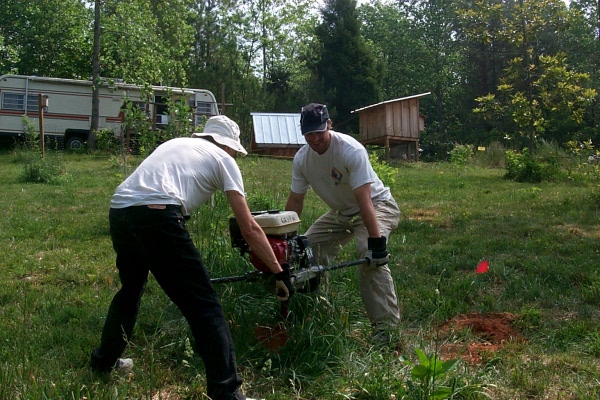
David and Ken use a rented machine to drill post-holes for the garden fence. The trailer is gone now, by the way. I sold it the same afternoon this photo was taken. The trailer was my home while Acorn Abbey was under construction.
Now that the house is built, much outdoor work remains to be done. The first priority is a deer fence. There is an overpopulation of white-tail deer here, and they can destroy a garden overnight. There also is a great deal of planting and landscaping work to be done. I was despairing of how all this work would get done, so that my vision for Acorn Abbey can continue to unfold. Much of this work — especially the fence-building — requires two people. It’s hard work, and I am not a young’un anymore. It would be possible to pay someone to do this work, but that wouldn’t be frugal, would it, if alternatives can be found?
The alternative turns out to be Ken Ilgunas. Ken, you may recall, visited Acorn Abbey during the winter. Part scholar and part adventurer, Ken was looking for a frugal summer situation that combined peace and quiet for reading with old-fashioned outdoor physical labor. Am I lucky or what? As I mentioned when Ken first visited Acorn Abbey, he has become quite a celebrity after he wrote a piece in Salon Magazine about how he lives in his van while attending graduate school at Duke University. Here’s a link to the Salon article. Many media outlets picked up Ken’s story and interviewed him. Here’s a link to an ABC News video. A literary agent recruited Ken, and they’re working on a book proposal about Ken’s experience living in the van while going to Duke. Ken brought 50 books for summer reading from the Duke library.
On Monday, we picked three gallons of strawberries at Mabe’s Berry Farm and put up 17 pints of strawberry preserves. Photos of the preserve-making will follow soon. We also started building the garden fence. It’s an ambitious fence project. The fence is to be 365 feet long and almost 8 feet high. It will surround the garden area, the chicken house, and my small orchard of 11 trees. After several dawn-to-dusk workdays, the fence posts are all planted. Next week we’ll work on the wire. I’m planning to save the fence-building photos and post them all at once, hoping that our fence-building experience and methods may be useful to someone else who needs to build a deer fence.
I’m exhausted from a week of hard work (though Ken doesn’t seem to be). I’ve declared that we’re going to take the weekend off from hard labor outdoors.
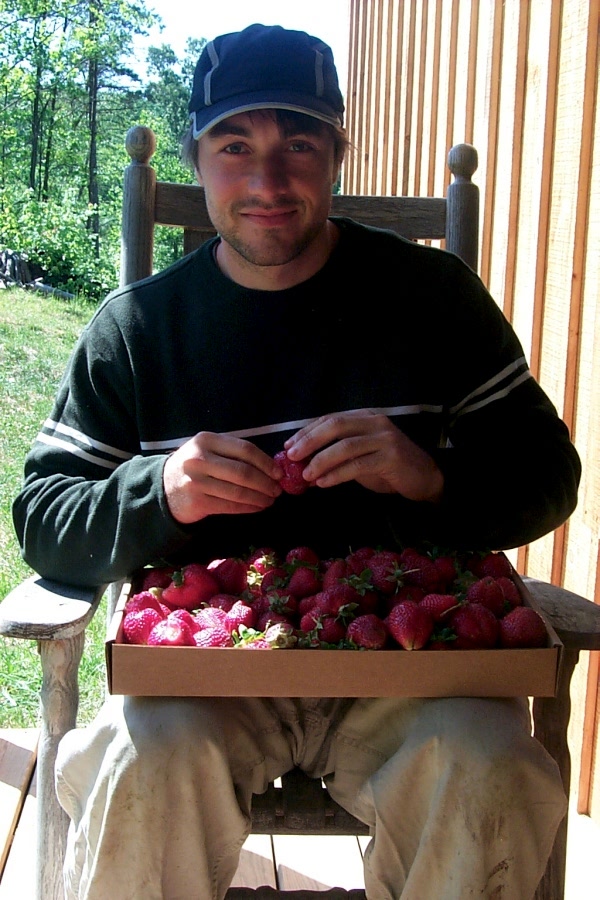
Ken caps strawberries.

The mystery buds have bloomed. However, I still don’t know what they are. Can anyone identify them?
Update: My sister has identified them: coreopsis.

Much of the South’s old rural housing stock is falling into ruin. This is the case with the Yadkin Valley house that my mother was born in. It was built by her grandfather. The house, and most of the land the house sits on, is no longer in the family.
I’m considering salvaging a tiny bit of tradition by duplicating the trim on the front porch posts of my mother’s childhood home. My brother did this. He copied the pattern and used it for the front porch of his house, which is about 25 years old.
Though the pattern is not exactly Gothic revival, I’m thinking that tradition may trump strict adherence to the Gothic revival style of Acorn Abbey.
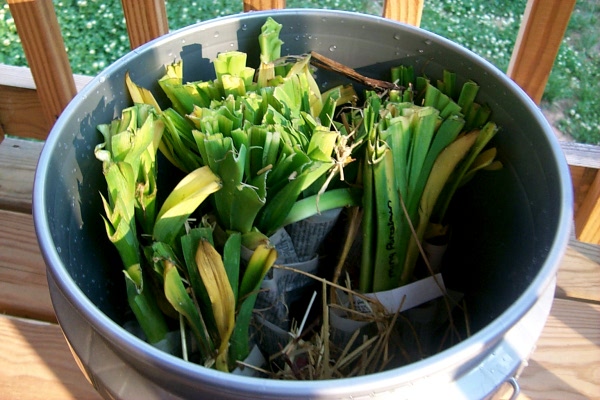
Waiting to be planted
In July of 2008, I planted 300 day lily sets on the bank above my driveway. They’re thriving, and they should start blooming later this month. All these day lilies are the humble orange “railroad” lilies like the ones that grow wild.
And now an old friend (who happens to be the best gardener I’ve ever known) has sent me six varieties of exotic day lilies. They came from Stout Gardens.
I think the most interesting of the lot is the “Joan Senior,” a white day lily that I assume is named for Joan of Arc, one of whose symbols is the fleur de lys.

The sourdough crock, after a good washing
I am ashamed to report that my sourdough starter is dead. It molded. I suppose I put too much faith in advice gleaned searching the web that a sourdough starter could safely live outside the refrigerator for up to a week. So I have a new rule: The sourdough starter will stay in the fridge except when it’s being fed.
My sister dispatched a jar of her sourdough starter to Stokes County with my brother, who had to make the trip to Stokes to bring a new bathroom cabinet he built for me. My sister’s starter also is fairly new and homemade. She’s had very good luck with it and has made several loaves of good bread.
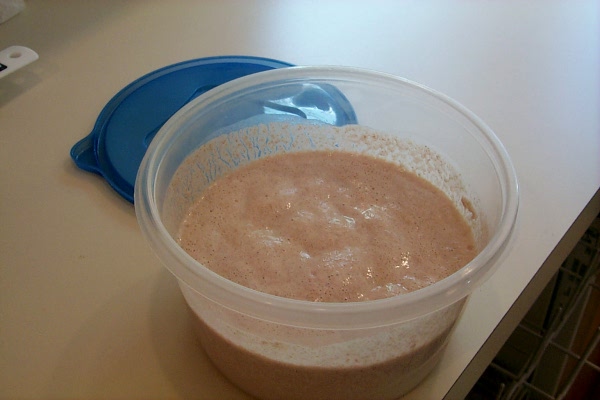
My sister’s sourdough starter, recently fed for making bread tomorrow
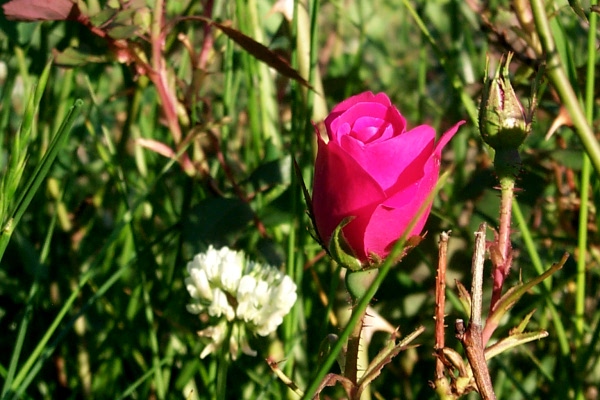
Here’s one of the first roses of summer. These are low maintenance, low-growing “knockout” roses. I planted them beside the ditch along the road.
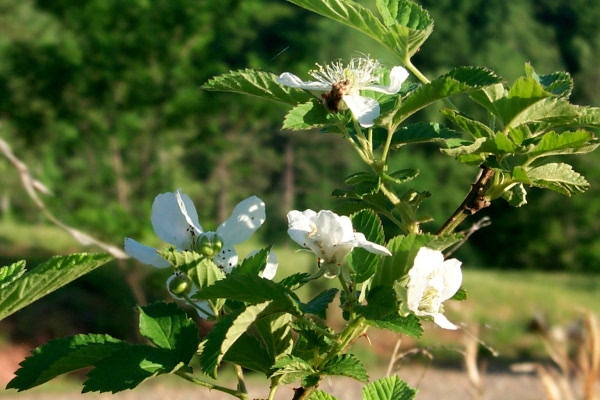
Blackberries volunteer everywhere. This one is in the ditch beside the road, but the edge of the woods is lined with young blackberry bushes.
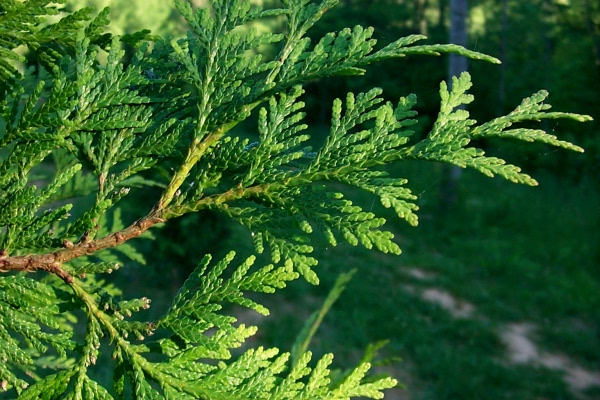
I’ve planted a number of arbor vitae trees. They’ve become one of my favorite evergreens. They’re growing well. If you look closely, you can see the lighter-colored new growth on the edges of the leaves.
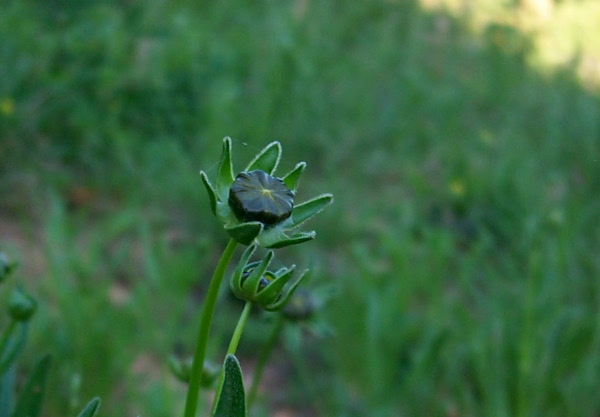
Mystery bud: Last spring I planted several pounds of bulk wildflower seeds. Most of them were perennials and didn’t bloom the first year. This year they should bloom. Here’s an example. I have no idea what it is, but any day now the bud should open, and we’ll see what the mystery buds are.
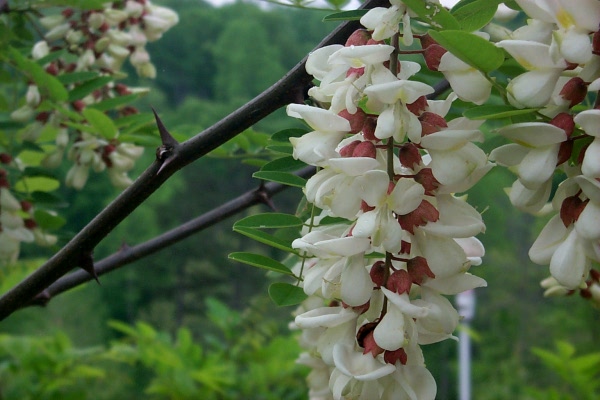
Of all the native species that like to grow here, I think I dislike black locust the most. This is because the young trees sprout everywhere, they grow fast, and they have vicious thorns. The stems are tough, so they’re hard to get rid of.
However, in the spring, the locust trees redeem themselves with dripping pods of flowers that have a really pleasant, springy scent.
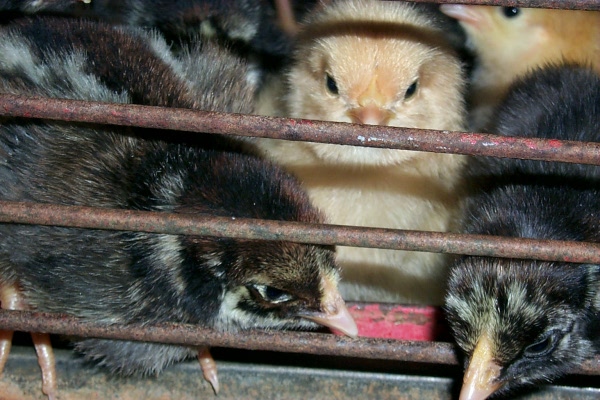
I took my camera to the mill today when I went to buy chicken feed, hoping to get a portrait of one of the mill cats. The mill cats were not to be seen, but the spring chickens were still there. This was at the Monitor Roller Mill at Walnut Cove.

My local newspaper, the Stokes News
While big newspapers are foundering and shrinking, small local newspapers are holding their own, or even thriving. Is there a useful economic lesson in this for relocalization?
Oceans of ink have been spilled in attempts to analyze why larger newspapers are dying. It boils down to two things: both readers and advertising are leaving the larger newspapers at a fast rate.
Since local newspapers are holding on, then clearly local newspapers are holding on both to readers and advertisers. I understand that my local newspaper, the Stokes News, is doing well and making money. Let’s take a look at the Stokes News and see if we can make some guesses about why.
On the front of this week’s issue are profiles of the race for county sheriff. Each candidate gets about 20 column inches — a lot of space. There is a story on a new campaign to market Stokes County as a country-music destination. That story is 42 column inches long — huge. Inside is a lot of community news, including columnists from different communities who write about who is sick and who is visiting whom. The cooking column, “Cat’s Kitchen” by Cathy Long, is far more solid and enlightened than the quirky-trendy food writing I see in the larger Winston-Salem Journal. And besides those quirky trends are stale by the time they arrive in Winston-Salem. The Stokes News has a huge sports section, with detailed coverage of high school sports and lots of stuff on hunting, fishing, and golfing.
In short, the Stokes News contains hyper-local information that people want, and there isn’t anywhere else to get that information in one place.
Let’s take a look at the advertising. Inside the paper are ads for local merchants and services. For example, lawn mower ads from local hardware stores. Even small businesses like pet-grooming and handyman services can afford the small ads.
But I’m sure the real money-makers are the preprinted inserts. These include inserts from three grocery store chains: Lowe’s, Food Lion, and Ingles. There’s also an insert for CVS pharmacies, and Wal-Mart. Those are the stores that capture most of the routine weekly spending by people in Stokes County (though you have to go outside Stokes County to find a Wal-Mart).
People spend a big chunk of their money close to home, at places within driving distance. That, I believe, is the key to why small newspapers are doing well.
With a population of about 44,000 people and a per capita income of about $18,000, total Stokes County household income is something over $800 million a year. That’s a lot of money, enough to support a lot of businesses, and much of that money is spent close to home.
Corporations are capturing most of that money — grocery and drug store chains, Wal-Mart, etc. How long did it take corporations to figure out how to capture so much local income?
The number of family farms in the United States peaked in 1935. I think it’s safe to say that corporations didn’t get a big percentage of local income in 1935. But probably the year of the turning point was 1945, the end of World War II. That was when the trends began that turned the United States from an agrarian economy to what it is today — corporatized and suburbanized. In less than 65 years, corporations ultimately responsible to Wall Street have come to soak up most of the spending of people even in small, rural counties such as Stokes County.
Relocalization is about reversing that process. If more of that $800 million a year stayed in Stokes County, just think of the jobs it would produce. Many of those jobs, to be sure, would be agrarian jobs similar to what people here did in 1935. Do people still want to do those kinds of jobs? I don’t know. But one thing is clear, as local newspapers prove: There’s a lot of money in local economies, so much money that Wall Street wants it. Grocery stores get the biggest chunk of it.
Local folks who figure out how to reverse those postwar trends and sell (particularly food) into the local market will find that the money is there. And every dollar that stays inside the county makes the county better off.

