Citizens of the galaxy


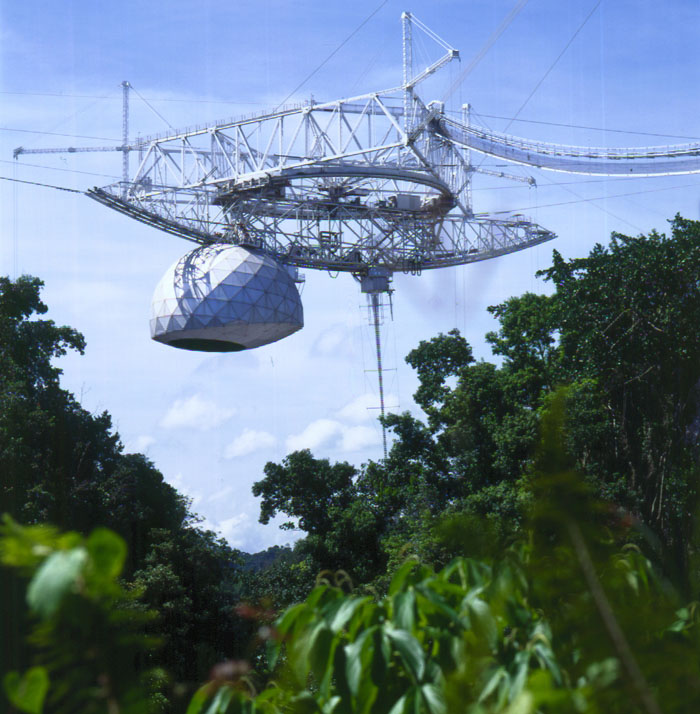
Radio telescope, Arecibo, Puerto Rico

“We do not have to visit a madhouse to find disordered minds; our planet is the mental institution of the universe.”

— Johann Wolfgang von Goethe, 1749-1832

It is no big secret that, for years, the government has been paying academics to try to predict — and presumably prepare for — contact with intelligent life from outer space. Back in 1992, when I was in San Francisco, a friend from Boston was staying with me temporarily. One day his dad came to town unexpectedly. My friend’s dad was an economist, on the faculty at MIT. When my friend asked his dad what had brought him to San Francisco, his dad said that actually he was on his way down to Stanford for a government-sponsored meeting of academics from many fields. They were to brainstorm the consequences of encountering intelligent extraterrestrial life.

This week, another such study was released to the public, this one done mostly by Pennsylvania State University and NASA. You can download a PDF of this report at this link.

There was some mention of this report in the popular press, with the usual spin — silly photos of aliens, with stories focused on the most extreme scenario. Examples here.

The report divides its scenarios into three categories — beneficial contact, neutral contract, and harmful contact. In the category of harmful contact, the report describes a scenario in which extraterrestrials come to earth to destroy us because humans are so destructive. Humans must be prevented from destroying their own planet and from venturing out into space and destroying other planets. That’s the scenario that got all the attention in the popular press.

Since the early 1970s, I have been fascinated with the question of intelligent extraterrestrials and why they would come to earth. This is because I saw a UFO in 1972. No, this wasn’t just a blinky light in the sky, the kind of thing that leads to most UFO reports. This was much bigger and much clearer than that. I was with a friend. We both saw the same thing. This was in eastern North Carolina, around sunset but well before dark. We saw a huge object just over the treetops, less than 300 yards away. This object was as long as a football field and appeared to have the shape of a cigar-shaped tube. It was hovering, moving very slowly, and making no sound at all. There were no exterior lights, but there were what I might call portholes along the side, with interior light showing through the portholes. As we watched, the object made a kind of rotating maneuver just above the treetop level, and then it took off into the sky at an impossible, breathtaking speed, making no sound.

It was as though this object’s gravity was suddenly reversed and it fell into the sky, falling upward, accelerating at a geometric rate as it fell. Nothing built by humans could possibly accelerate like that. And it did it silently.

“Rational” types always say something like, “Oh surely you just saw Venus rising.” That is silly, because I did not see a small light in the sky. I saw a huge object, quite close. It would make just as much sense to say that that Boeing 747 parked and loading over there on the tarmac, its interior lights glowing through the windows, is Venus rising. I believe my own eyes.

I do, of course, recognize that, though what I saw is sufficient to convince me that we have extraterrestrial visitors, to everyone else it’s just another UFO report, proving nothing. But I am not on a mission to convince anyone of anything. I only long to understand what I saw, and what it means.

It amuses me that reports such as the one from Penn State and NASA have to say things like this:

“Humanity has not yet encountered or even detected any form of extraterrestrial intelligence (ETI), but our efforts to search for ETI (SETI) and to send messages to ETI (METI) remain in early stages. At this time we cannot rule out the possibility that one or more ETI exist in the Milky Way, nor can we dismiss the possibility that we may detect, communicate, or in other ways have contact with them in the future. Contact with ETI would be one of the most important events in the history of humanity, so the possibility of contact merits our ongoing attention, even if we believe the probability of contact to be low.”

They have to say, I guess, that we have not detected any form of extraterrestrial intelligence. But having seen what I saw, I skip past the question “Are they out there?” to “Why are they here?” Let’s do some reasoning. This reasoning won’t apply to those who have never seen a UFO and who have not seen what a UFO can do. I only claim that this reasoning is valid, then, for myself, because I have seen a UFO and am satisfied that, not only do they exist and possess stunning technology, they’ve been here for some time.

The question then is, why are they here? And what are they doing? Since it has been almost 40 years since I saw this UFO, I think I can safely rule out the possibility that they are here to cause harm. If they were here to cause harm, surely they would already have taken action. So two broad scenarios remain: They are here to be beneficial, or their presence is neutral. Since they have not revealed themselves (at least to the masses), it is possible that they never will. But it is also possible that they are following some kind of protocol to gradually make themselves known and to give the people of earth time to adjust to the biggest culture shock that mankind will ever know.

If I have seen a UFO, then it seems very likely to me that other people have seen them as well and that thus some UFO reports are true. If I and others have seen them, it seems reasonable to assume that governments know about them. I can only speculate about how many people in the government actually know what’s going on and why they keep it secret. Perhaps they are following a protocol, and perhaps the development of reports such as the Penn State / NASA report are part of that protocol, work that must be done on the earthling side to prepare the population.

Since there is intelligent life on earth, and since there is at least one intelligent species capable of traveling to earth, it seems reasonable that there are probably many intelligent species out there. If there are multiple civilizations, and if we have evidence that they have protocols for the induction of new planets such as earth, then it seems likely that there is some sort of galactic government. If there is a galactic government, then there are galactic laws, and earth is subject to those laws. I can just hear the libertarians moaning!

That, I think, is where we are. Earth, for decades, has been going through a process of being studied and prepared for induction into some kind of galactic federation.

Can it be legal under galactic law to destroy a planet’s ecosystem? I doubt it. Can it be legal under galactic law for earthlings to build spaceships and venture out into our own solar system and beyond and do whatever we please out there? I doubt it. It seems reasonable to suppose that, when a civilization attains a level of technology that permit it to violate galactic law — such as destroying planets, our own or someone else’s — then that civilization must be made aware of galactic law, and galactic law must be enforced. I am not by any means the first to imagine such a scenario. I am only doing my best to reason sensibly from a few facts that I am convinced are true.

Having thus reasoned, I am now going to speculate, to dream a little.

It amazes me that human beings have such different dreams. Some libertarians, for example, have a dream of a libertarian utopia. Peter Thiel, who founded PayPal, recently donated $1.25 million dollars to start developing artificial islands in the ocean where libertarians can have their utopia — with no minimum wage laws, no building codes, and all the weapons they want. I see this as sheer madness, a dream of a more primitive state in which poor excuses for human beings are free to exercise their predatory instincts without restraint. What further proof do we need that earth is the mental institution of the universe? Don’t like government? Don’t like laws? Here you are, then: Check out these new volumes of galactic law!

I have a different dream. That is that our incredibly ignorant, violent, backward species will, in my lifetime, get some sense knocked into it. We will learn to see our planet in perspective — a fragile oasis of life in a galaxy that is mostly empty, cold, and dark. We will learn that we can’t get away with exploitation — exploitation of our planet and the other life on it or exploitation of our own species. Ignorance and deceit will no longer succeed as a political strategy.

The power structures of earth will be turned upside down. Religions will be widely recognized as obsolete and tossed into the dustbin of history where they belong. Earth’s economy will be completely transformed — I can guarantee that that huge spaceship that I saw in 1972 was not burning fossil fuel. All the benighted political forces that want to drag us backward, to gain power and satisfy their greed by lies, by appealing to ignorance and to black-hearted religions, will be neutralized. To some people, it will be the worst thing they can imagine, the worst thing that ever happened. Their strategy for exploiting this planet, for increasing their power, for pursuing their greed, for spreading their ignorance, will be defeated, overnight.

That’s my dream. I hope I live to see it.
Surveying the battlefield


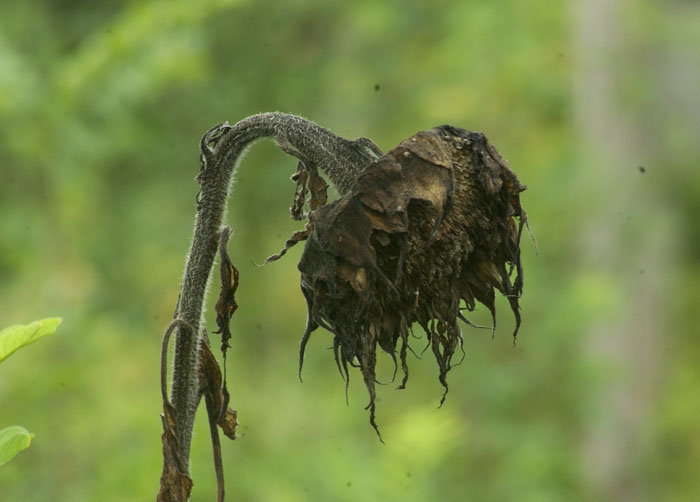
A pathetic sunflower. My flock of finches moved on. I don’t blame them. There wasn’t much for them to eat after the heat wiped out the annuals.

The brutal, killing weather of summer makes me clinically insane. I can’t explain this, though other gardeners might understand. The most I can manage is to stay indoors, cooled by a system powered by the burning of strip-mined Appalachian coal, and read, or practice new organ pieces. It’s not safe to be around me, because I get all snarly, constantly angry. I’m probably a danger to myself and others. I have been completely unsuccessful at finding an attitude from which I can remain philosophically detached from the misery and destruction that surrounds me. That’s why I’ve posted very little lately. I’m just trying to survive the summer, and no one should be subjected to what goes through my mind. I can accept the heat. That’s inevitable. But it ought to rain, and instead the rain perversely stops when the heat is at its worst.

There was a book in the 1970s that popularized the idea that plants can scream. I believe it. These past two months, I have been in the middle of a battlefield, surrounded by the screams of the dead and dying. I will generally water new perennials during their first year, especially if I was foolish enough to set them out in the spring. But if a plant isn’t hardy enough to survive its second summer, then I have to let it go. I worry constantly about my young fruit trees, planted in 2008. Luckily, they have survived, though they’ve grown very little, or not at all, since May. Starting an orchard is hard, risky work. Those who are lucky enough to have an established orchard are lucky indeed.

We’ve had a break in the weather, and finally I bucked up and found the fortitude to go outside and survey the damage. Half the grass is brown, but recovering. The annual flowers are baked to a crisp. The roses look pathetic. I lost a dogwood tree. The garden is gone except for a few scrawny tomatoes and peppers. I’ll probably lose a small arbor vitae that was planted this spring. Some of the native species have been miserably stressed, but they’ll make it fine. The bigger arbor vitaes that I planted in 2008 have flourished and must have deep roots. During the hot, dry weather of late summer, leaves on the native poplar trees start to turn yellow and drop, but that’s probably normal for poplars, because it seems to happen every year. The grapes handled the hot weather amazingly well. That’s probably because they’re native grapes — muscadine and scuppernong.

The forecast is for a few days of unusually cool weather. It’s not quite noon, and it’s only 74 degrees outside. I’ve had 1.6 inches of rain during the last two days, and there’s a good chance of more rain today and tonight. Most of the screaming outside has stopped, and instead I hear sighs of relief, and quiet weeping for the fallen. I even saw two little frogs frolicking in the rain last night when I went out to shut up the chickens. Where those poor frogs went during that long, hot, dry spell is a total mystery to me.

Here are some photos of the survivors. I’ll spare you photos of the corpses of the dead.


Muscadine grapes, very much holding their own


One of the last tomatoes


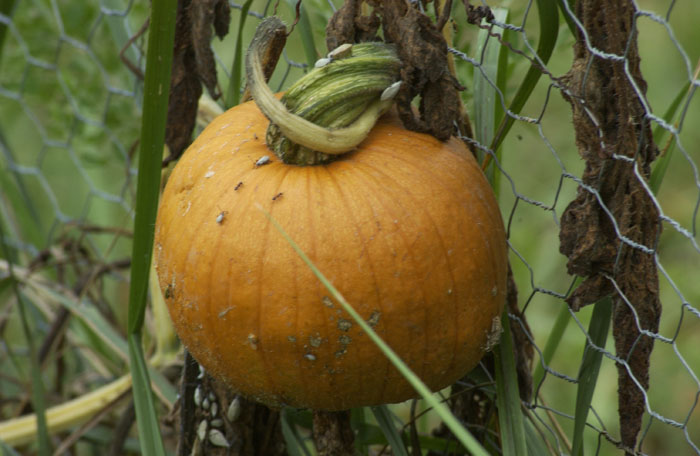
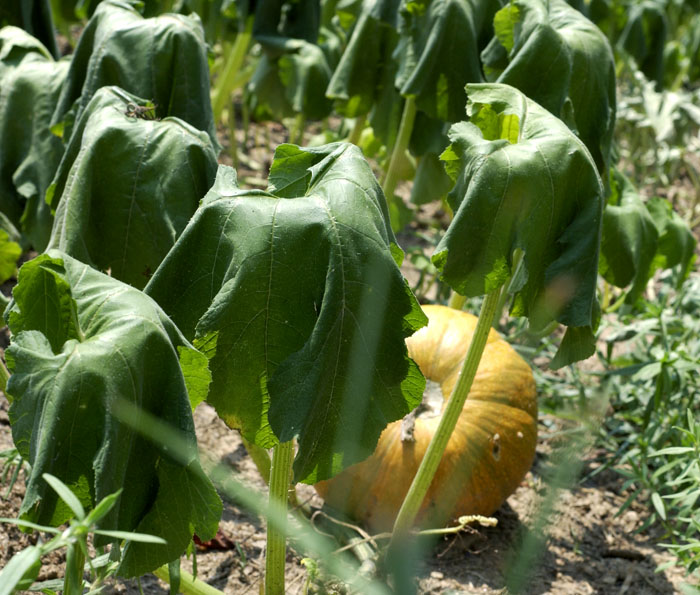
The last pumpkin, attacked by the last squash bugs. By the way, I had very little problem with squash bugs this year. I scratched their eggs off the squash leaves every couple of days and squished the adults bugs when I found them. They’re pretty easy to control that way.


Shabby black-eyed Susans


A wild persimmon, of which I’ll have a bumper crop


The poplars grow fiercely during a wet spring, but they hate the hot, dry weather of late summer.


I don’t know what this is. It’s growing right beside the chicken house. No doubt its seed came in with some chicken straw.


Poke is a very hardy native species. I never cut it down, even in the yard.

Book review: German propaganda in WWII


The Jewish Enemy: Nazi Propaganda During World War II and the Holocaust, Jeffrey Herf, Harvard University Press, 2006.


I finally got around to reading a book on Nazi propaganda. As I’ve mentioned before, I have long been interested in the black art and dark science of propaganda. Nazi propaganda is an important — if not terribly interesting — part of the history of propaganda. Why is it not interesting? Because of its sameness and dullness. I’ll get to that in a moment.

I was born three years after World War II ended. Cold War propaganda, however, is not so mysterious to me. I grew up during the Cold War. I was 11 years old when Nikita Krushchev, on Oct. 12, 1960, angrily banged his shoe on the podium at a meeting of the United Nations. Americans were shown that film over and over. We also were often reminded that Krushchev had said, “We will bury you,” and we were encouraged to believe that Krushchev had something murderous in mind. Actually, that was a line that Krushchev used regularly with Westerners, and he took care to explain what he meant (though American television never bothered, as I recall, to explain what Krushchev meant). In a speech in Yugoslavia in 1963, Krushchev said: “I once said, ‘We will bury you,’ and I got into trouble with it. Of course we will not bury you with a shovel. Your own working class will bury you.”

I also used to do a lot of shortwave radio listening — the Voice of America, Radio Moscow, Radio Havana, the BBC, and so on. The English broadcasts of Radio Moscow in the 1970s were anything but threatening. The broadcasts largely were concerned with building on the prestige of Russian literature and Russian music. Radio Havana, as I recall, was extremely dull, with tedious and detailed reports on the number of tons of this and that being harvested. It didn’t make for good radio, but, given the long embargo against Cuba and the importance of local agriculture in Cuba, the priorities make sense.

It is extremely difficult to see Nazi propaganda as sophisticated. It was crude. It really had only one theme, a violent anti-semitism. There was no evolution of this propaganda before or during the war. There was only the repetition of that central theme, as though Nazi propagandists feared that straying too far from their central theme would cloud the message. As the war turned against Germany, and as Germany began carrying out “the final solution,” they doubled down on the anti-semitic theme, but the propaganda did not evolve or change.

This, in essence, is the storyline behind Nazi propaganda from the late 1930s through 1945: The Nazis want peace, but war was necessary to stop the Jewish plot to destroy German culture and murder the German people. The Jews are criminals, and they manipulate the puppet strings that control the West. The plutocrats of the United States and Britain, and the Bolsheviks of Russia, are really no different, because what they have in common is control by the Jewish string pullers. Both Churchill and Roosevelt are Jew-lovers surrounded by Jewish advisers who force the United States and Britain into a war to annihilate Germany and kill all Germans. The Jews are guilty. Only Germany has awakened to the Jewish plot, and Germany is justified in war and the annihilation of the Jews because Germany is only doing to the Jews what the Jews are trying to do to Germany.

That storyline never really changed, though, after 1943, Hitler in his speeches more often used German words for “annihilate” (Vernichtung) and “exterminate” (Ausrottung) in talking about the Jews, though the Nazi elite never spoke openly about “the final solution.”

There were two key players in Nazi propaganda, though Hitler himself was in control of the propaganda message until the very end. The key player, of course, was Joseph Goebbels, the Reich minister of propaganda. Herf, in this book, emphasizes the importance of Otto Dietrich, the Reich press chief who, unlike Goebbels, had an office near Hitler’s and spoke daily with Hitler.

Though the Nazis’ propaganda delivery systems seem primitive now, they were state-of-the-art for the time, and they never skimped on the propaganda budget. There was no free press in Germany under the Nazis. Unfriendly editors and newspapers were purged, and the assets were sold cheap to members of the party. Uncooperative journalists were harassed and arrested, and party members were put in their place. Confidential weekly press directives from Dietrich were distributed to all newspaper publishers, listing the talking points and telling editors how to frame events. The Reich produced a weekly newsreel that was seen by millions. Radio was used extensively. Herf, in this book, puts a lot of emphasis on an important form of propaganda that everyone in Germany saw and read but which were poorly known at the time outside Germany. This was a weekly “wall newspaper,” a kind of poster that was posted all over Germany so that almost the entire population had a chance to read these posters as they went about their daily lives. You can find a lot of these posters online by searching for “Word of the Week,” or “Parole der Woche.” Goebbels’ order was that these posters should be simple and emotional: “Form and color must correspond to the primitive emotions of the masses.”

Herf lists some of the guiding principles of propaganda as given by Friedrich Madebach in 1941:

Madebach drew on Mein Kampf to arrive at “basic laws” of mass influence: intellectual simplification, limitation to a few key points, repetition of those points, focus on one subjective standpoint to the exclusion of others, and appeal to the emotions and to stark contrasts between good and bad or truth and lies, rather than to nuance and shades of gray.

Herf briefly alludes to an interesting question. Did the Nazis believe their own propaganda? Apparently there is no consensus on the answer. Before I read this book, I think I would have assumed that the Nazi’s did not believe their own propaganda, because the propaganda is so crude, and the Nazi leaders were elite (Goebbel’s had a Ph.D.). But after reading this book, and some of the entries in Geobbel’s diary and accounts of private conversations with Hitler, I now find it plausible that the Nazis did believe their own propaganda.

This book discusses one chilling set of facts that I was completely unaware of. That is that Nazi propaganda had a measurable effect on Americans. Polls by the Opinion Research Corporation attempted to measure anti-semitic sentiment in the United States. The polling question was, “Do you think the Jews have too much power in the United States?” Here is a table of the number of Americans who said yes:

1938: 41 %
1940: 42 %
1942: 47 %
1944: 56 %
1945: 58 %

In other words, anti-Jewish sentiment was growing in the United States even as we fought a war with Germany. Here’s another one. The polling question is, “What nationality, religious, or racial groups in this country are a menace to America?” In eight polls between August 1940 and June 1945, Jews always polled as the greatest menace, except for a poll right after the bombing of Pearl Harbor, when the Japanese were seen as the greatest threat, and a poll in February 1942, when German submarines were sinking ships off the United States’ Atlantic coast, when Germans were perceived as the greatest menace.

Just how these anti-semitic attitudes in the United States came to be intensified during World War II would be an interesting historical study in itself. Mostly this is a mystery to me. Fortune magazine, in February 1936, devoted an entire issue to the subject of Jews in American business. Henry Ford financed the publication of the infamous forgery The Protocols of the Elders of Zion. Ford also wrote articles in the Dearborn Independent that, according to Herf, “fanned the fires of anti-Semitism in American life.” Charles Lindbergh in the late 1930s and his ideological allies kept saying that it was Jews who were driving the United States to intervene in Europe. In 1939, Look magazine reported that there was 62 organizations in America distributing material that came from Hitler’s propaganda ministry.

This is a piece of history that is no fun to read. Now I need a good science fiction adventure to clear my mind. No wonder we dream of other worlds.

A raccoon did it, I believe


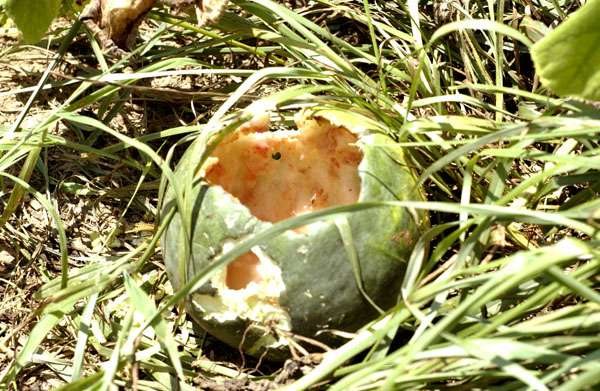
A hollowed-out watermelon

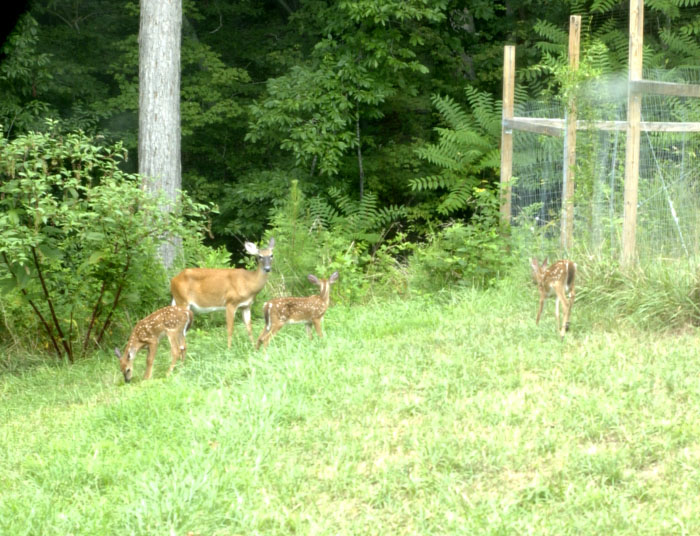
Of all the varmints around here, it’s now the raccoon, I think, that does the most harm. Before the fence was installed last year, it was the deer that did the most damage. But now, with most of the high-value stuff inside the fence, the deer can’t wipe me out. But the raccoons know all sorts of tricks.

I’m pretty sure it was a raccoon that killed my young chickens. Most of my watermelons have been destroyed (I had only a small crop of watermelons), and it appears to be raccoons’ work. Only raccoons, I think, would have the dexterity to open a watermelon and scoop out the goody. Luckily, I had harvested most of the corn, but the raccoons got the rest. They pulled the stalks to ground, then ripped the ears off the stalks.

I can certainly see why the old-timers had a zero-tolerance policy toward thievin’ varmints. I can’t let the raccoons get away with this next year. Maybe a bit of electric fence would teach them a lesson.

The miracle of rain

Four days ago, .4 inch of rain fell. The day after that, there was another .4 inch. That was enough rain to greatly revive the garden. Tomatoes ripened on the vine that otherwise would have rotted on the vine. The corn freshened. The pumpkins and melons resumed their growth. There may even be more peppers if the rain continues.

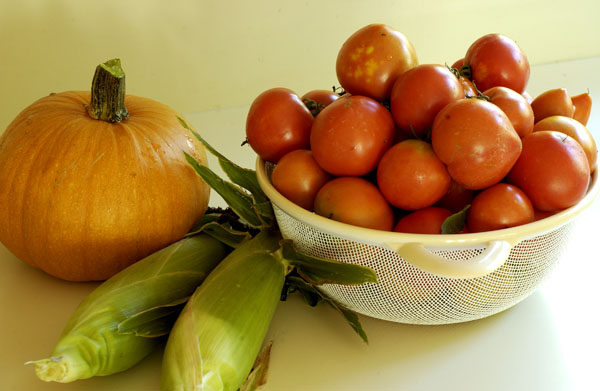
I’ll probably scald the tomatoes to remove the skins, then freeze them. As for the pumpkin, I couldn’t possibly eat a whole pumpkin pie. Even though it’s a shame not to use the pumpkin fresh, I’ll probably cook it and freeze it and use it later when I have company. I have at least two more pumpkins that I left on the vine, plus a couple of watermelons and canteloupes. I planted only two watermelon plants and two canteloupe plants, as an experiment. They’ve done amazingly well, so next year I’ll plant more than two.

Book review: Sovereign's Son


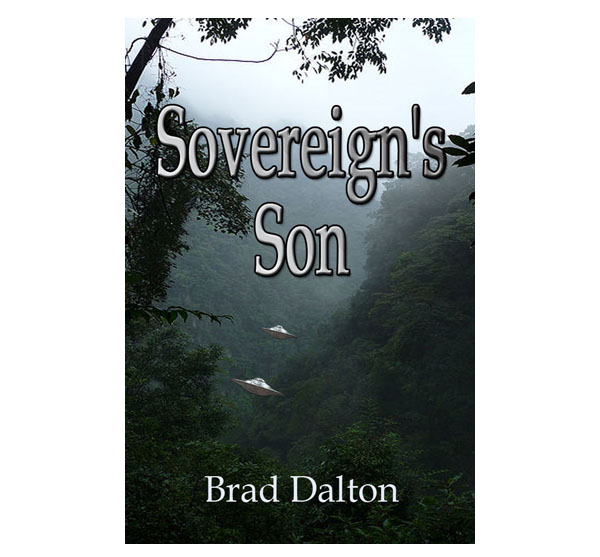
Don’t judge the book by its cheesy cover!

In the old model of publishing that is now dying, it’s tragic to think about how many books never got published. Deserving authors simply couldn’t get the attention of agents and publishers. They weren’t deemed worth the financial risk. In the old model, only so many books could be published, and at least some of them had to have big sales. In the new model of publishing, in which anyone can cheaply self publish, it was inevitable that many authors would release their books into the wild just so that they would be read, not caring whether the book ever made money.

That seems to be the case with Sovereign’s Son, by Brad Dalton, which was released in March 2011 and is available free in many digital formats. To my knowledge, there is no print version of this book. It is available only in digital formats. I got my copy from iTunes. I was intrigued to find a dystopian science fiction novel that was not only free, but also from an author with the same last name as mine. I believe he’s also a Southerner who lives in Virginia. I’ve been making a survey of dystopian novels — old and new — so of course I had to check this one out when I came across it on iTunes. The book is full of typos, as though it was never edited. But I was hooked right from the start, and I kept reading. It was such a hot read that I finished the book in two days.

The story takes place in a world that has been seriously screwed up by war, climate change, nuclear accidents, and a shift in the earth’s poles. Most of the population of the earth has died. And not only that, but aliens from elsewhere in the galaxy have arrived and set up a base in the mountains of California. The story gets off to a ripping good start when a 19-year-old boy is awakened by his mother in the middle of the night and told that he must leave home immediately and run for his life. The plot is beautifully constructed, and we even have strong characterization and character development, often missing in science fiction. The author also reveals himself to be one of those people — like John Twelve Hawks, who I have written about in the past — who is able to see through the fog of distortion and propaganda and grasp the essence of what is really going on in the world today. I believe that is largely what motivates people like Brad Dalton and John Twelve Hawks. They want to wake people up to what is all too likely to happen if we don’t come to our senses, if it’s not too late.

In a strange way, I have to say that I find dystopian novels comforting. This is because I feel less alone and less isolated in rejecting the false picture of the world that is constantly reinforced by the corporate media and all the other water carriers for the elites who hold almost all the power and all the money. It is comforting to know that other people get it and that they are as alarmed as I am about where it all appears to be leading. It’s shocking, though, how our culture can absorb the insights of brilliant writers, and yet nothing changes. The insights of Orwell’s 1984 and his warnings about power and propaganda have been part of our culture for decades, and yet no one calls out Fox News (for example … there are many other forms of propaganda) or sees it for what it is. Tolkien’s warnings about industrialization and the crushing of fragile local cultures by centralization and homogenization likewise are part of our culture. And yet nothing has held back industrialization and centralization.

In any case, the messages contained within a novel are secondary. What matters is that a good novel is a good read. I couldn’t put this one down.

Note to Brad Dalton: If you happen to Google across this, I’d appreciate it if you could drop me an email. I couldn’t find contact information for sending you a note.

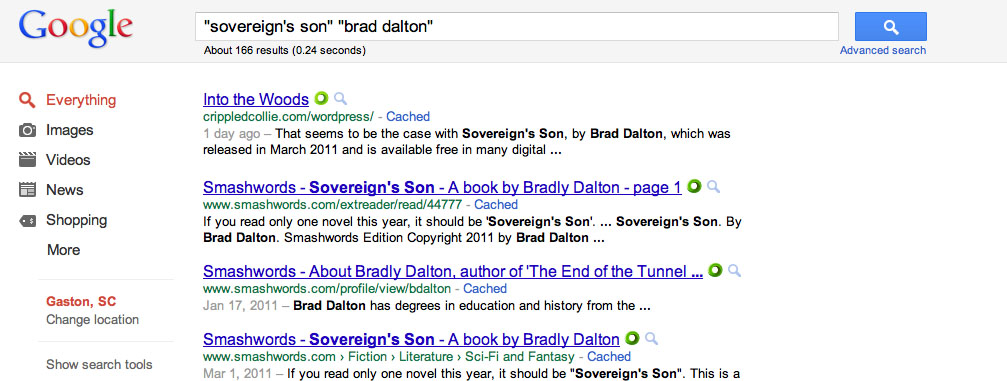
Update: I’m glad to have been able to bring some much-deserved attention to this book. A Google search for the title and author now brings up this review as the first listing.

2011 garden, R.I.P.


Pumpkin vines in 99-degree heat

I haven’t posted lately because I’ve constantly been in a foul and angry mood. I’m afraid my mood is not going to get any better until it rains and the weather turns cooler. And of course it’s not just me made miserable by the weather. This heat wave is affecting something like two-thirds of the country. Thousands and thousands of acres of crops and growing things are being scorched.

Every summer has been like this since I moved here from California in 2008. I’ve been going over the nearest local data from the National Weather Service. In June, July and August, daily high temperatures have been substantially above normal almost 75 percent of the time. I don’t even know how normal is defined anymore, since we’re almost always above normal. Scorching summers are the new normal. That’s clear.

With a practical, data-hungry and reality-modeling mind like mine, what can I make of this? For one, I’ve had to consider the possibility that I simply bought land in the wrong place. I was years behind the curve in understanding just how much the climate has changed. I’ve realized that, not only am I not living in the North Carolina of my childhood, I’m not even living in the North Carolina that I left when I moved to California 20 years ago. This land, which fed generations of people including my ancestors, is now no longer capable of supporting a summer garden without irrigation. I can’t explain how awful it is to face that fact. Sir Walter Raleigh’s men, surveying inland North Carolina in 1585, called it “the goodliest soile under the cope of heaven.” Now it would be dangerous to live here (as in most places) without the cheap energy that makes modern agriculture and long-distance food-hauling possible. If people were smart enough to understand this and let it sink in, I’m sure they would panic. Most people assume that the grocery stores will always be there for them, and that food will always be cheap. My practical, data-hungry, reality-modeling mind knows better than that.

But where could one go where a tiny farm can still operate the way they used to operate? I took a trip last week up to the mountains, westward toward the Tennessee line, where temperatures are lower and there is a bit more summer rainfall. The altitude varies from about 2,400 to 3,500 feet. They do indeed have thriving gardens and beautiful fields of cabbage up there. But to move now is not practical for me, and there are many downsides. There are even some compensations. For example, the growing season is longer here. Less energy is required to get through winter. And the hillbilly culture in those places makes Stokes County seem sophisticated. No, I’ve got to rethink some things and make some changes at Acorn Abbey.

As part of that thinking process, I read Bill McKibben’s book Eaarth, hoping that the book might contain some specific, practical ideas for adapting. But I was disappointed. This is not necessarily a criticism of the book, because the book does make it quite clear that there is no single answer and no single strategy for adaptation. As we relocalize and adapt to climate change, we must each relocalize according to our own locations, our local resources and our local problems.

Before I made the decision to move back to North Carolina, I did check the climate models for this area. They showed (and still show) a slight increase of 2 to 3 inches in annual rainfall, in addition to higher temperatures. But what I failed to understand is that water evaporates from the soil much more quickly in high heat. The equations for water loss from the soil are differential equations that look as complicated as the equations for launching a spacecraft toward Mars. I don’t understand the equations, but one thing has become obvious: The soil dries up much more quickly in a run of 98-degree weather than in a run of 88-degree weather. It’s that fact more than any other that has made the summer garden so difficult. I think that’s why people in the mountains north and west of here can still garden in the summer. It’s cooler there, just as it used to be cooler here.

One thing that’s clear is that, next year, I must irrigate. As I’ve said before, I am opposed on principle to irrigating with well water. Well water is simply too precious to be pumped out and used for irrigation. That’s what rain is for. My steep roof is not suited to gutters. Snow avalanches would rip the gutters off. The most practical plan I can come up with is to buy one of those 275-gallon tanks in aluminum frames that are used for shipping industrial liquids. They sell for $100 or less. I’ll buy a gasoline powered water pump from Harbor Freight, about $150. The tank will fit on my utility trailer, and, using the Jeep, I can take the tank down to the stream and fill it up. Then I can park the tank and trailer above the garden and attach a hose to drip-type fixtures in the garden. I also plan to get a local grading guy over and see if there’s a spot where I could make a very small pond. However, I don’t think that’s likely to work.

In any case, this year’s garden is now in salvage mode. The tomato crop, which should have been extensive with more than 30 tomato plants, was very poor. The plants were constantly water stressed, which led to bottom rot. I got small, tasteless tomatoes instead of plump, juicy ones. The tomatoes were simply starved for water and for the nutrients that come up from the roots with the water. The squash dried up and died almost two weeks ago. The peppers barely produced. The corn did fairly well. I had some decent green beans. The cucumber crop was excellent. I may get a couple of pumpkins and one or two watermelons and canteloupes if there’s any rain within the next few days. I’ll have to say this, though. Even with the miserable, dry weather, I don’t think I’ve spent more than $15 on produce in the last three months — some garlic, two or three avocados, a couple of canteloupes. The garden has fed me well and saved me money. But there was not nearly enough of anything to freeze or can.

For those of you who may be reading this blog because you’re planning projects similar to my Acorn Abbey project, I’d urge you to put a lot of thought into your sources of water. It also takes a few years to get your gardening skill — and your soil — up to speed. Even if one had enough land and enough help, I think it would take years to learn what one needs to know to truly become self-supporting. But every little bit helps.

Downton Abbey

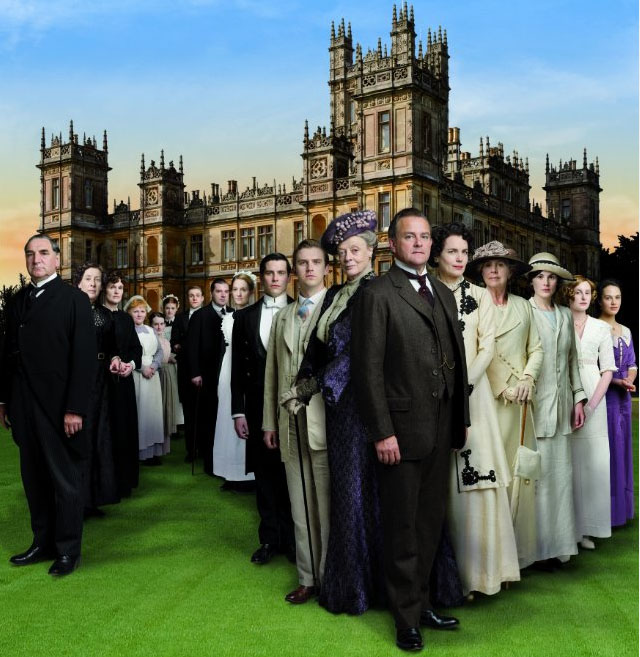
This is the best BBC mini-series to come along in years — amazing cast, including Maggie Smith, lavish budget, great scripts. It was shown on British television last year and is now available on DVD, and from Netflix. A second season is in production for broadcast this fall.

It’s set in Yorkshire starting in 1912. The plot and subplots involve the Crawley family as well as their servants. It’s awesome television, not to be missed.

My new dog substitute?


I’m not ashamed to say that all that overgrowth is in my front yard.

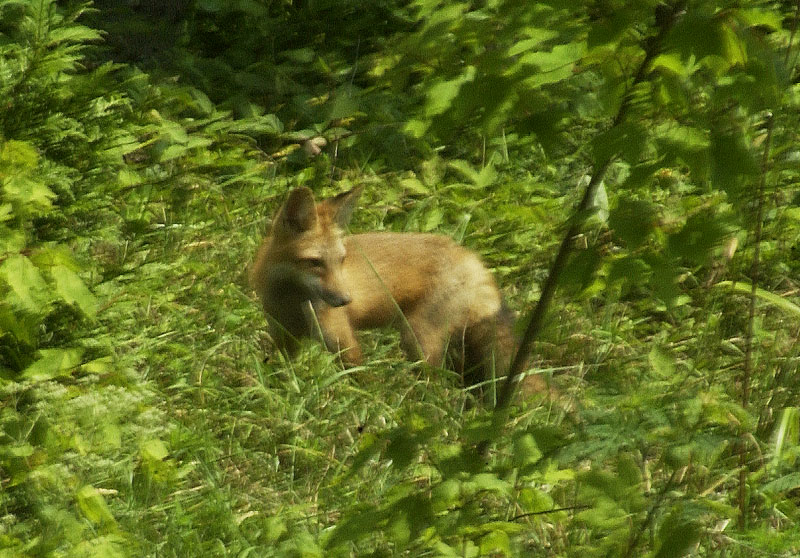
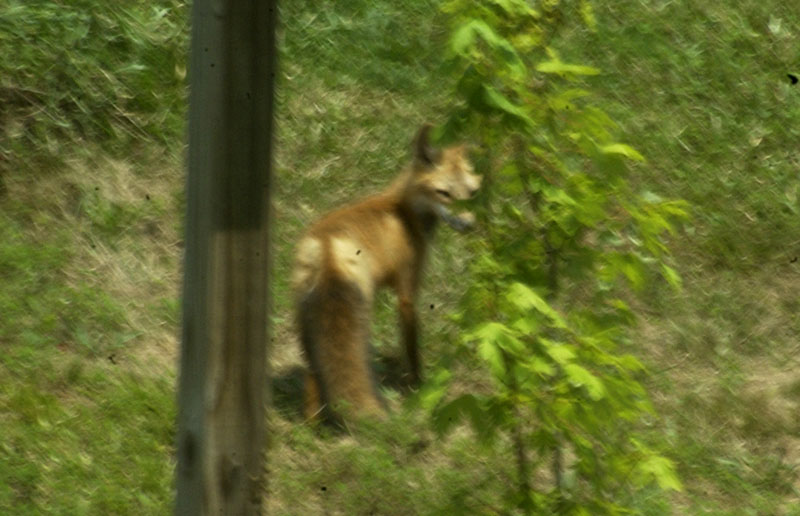
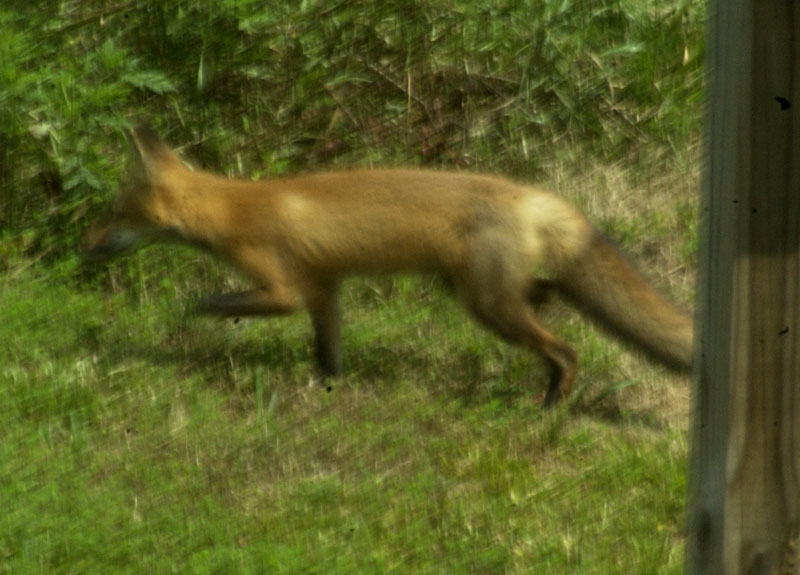
I was reading near the upstairs window with Lily curled up beside me when I saw that Lily had her eye on something out the window. She has stopped growling at the fox now. She just watches it, alert. Clearly the fox feels very much at home in the yard, and for some reason I’m seeing it more often in broad daylight. It lies in the sun. It moves to the shade and lies in the shade for a while. It yawns. It stretches. It patrols for voles. It’s just like having a little dog in the yard.

I rarely get an opportunity to photograph the fox, and something always seems to go wrong. This time not only did I have to change to the telephoto lens, the camera’s battery was dead and I had to snap in a fresh one. I was too afraid to miss a shot to fiddle with the adjustments. These photos were taken with too narrow an aperture, which forced a slow lens, which led to some blurring.

I’ve had no further incidents with the fox and chickens. I’m hoping the fox is eating enough voles to not get too hungry for chicken.

It’s nice having a dog — I mean a fox — in the yard. I don’t even have to feed it, and, unlike Lily, it’s not always demanding attention.