Book review: a biography of Theodore Parker

grodzins-3


American Heretic: Theodore Parker and Transcendentalism, by Dean Grodzins. University of North Carolina Press, 2002, 656 pages.


It’s surprising that Theodore Parker isn’t better known than he is. Parker (1810-1860), a transcendentalist, was a friend of Emerson. He inspired Thoreau. He was in the thick of things in the Boston-Concord area during his era. Abraham Lincoln and Martin Luther King Jr. picked up some famous rhetoric from Parker. For example, Parker’s words, talking about slavery, were:

I do not pretend to understand the moral universe; the arc is a long one, my eye reaches but little ways; I cannot calculate the curve and complete the figure by the experience of sight; I can divine it by conscience. And from what I see I am sure it bends towards justice.

This inspired Martin Luther King’s famous words:

The arc of the moral universe is long, but it bends toward justice.

In his Gettysburg address, Lincoln was paraphrasing words that Parker used in a speech in 1850: “A democracy — of all the people, by all the people, for all the people.”

Parker was a Unitarian. The Unitarians had more room for Parker than, say, the Methodists and the Presbyterians, but even some of Parker’s Unitarian friends shunned Parker as Parker became increasingly heretical.

What were some of Parker’s heresies? For one, Parker pretty much threw the entire Old Testament under the bus as primitive and unbelievable (not to mention lousy even as metaphor) and dominated by a cruel and immoral God. The question of miracles, and whether miracles were important or not, apparently was a big theological issue in Parker’s time. Parker came to believe that New Testament miracles were of no importance and probably didn’t really happen, that a revelation stood or fell on its own merit. Parker believed that some of the teachings of Jesus — not to mention the apostles — was wrong and morally flawed. Parker also rocked the boat. He became an outspoken abolitionist. Even Boston churchmen during this era who disapproved of slavery were careful not to preach too vehemently against slavery, because it got people too excited. Abolitionists were expected to be discreet in genteel society.

In many ways, this book is a theological history as much as a biography of Theodore Parker. These guys weren’t just preaching sermons to their congregations. They also were carrying on a theological debate with each other, a debate that also reached into the newspapers and the many church journals that were printed at the time.

I think it would be fair to say that Parker’s heresy boiled down to this: That ultimately, conscience, not scripture, is the only reliable guide. Note that in his statement about justice, it is conscience that allows Parker to divine the arc of the moral universe. I think it also would be fair to say (nor does Dean Grodzins say such a thing in this biography) that Parker left theology behind and became a moral philosopher instead. I think it also would be fair to say the same of Ralph Waldo Emerson, who actually gave up the ministry because it held him back. As for moral philosophy, Parker certainly was influenced by Kant. Parker also read in twenty languages, and he was particularly interested in German philosophy of that era. On a year-long trip to Europe, Parker tried to visit Goethe’s widow, but she was out.

It’s a shame to lose the thoughts of people like Theodore Parker who were so far ahead of their time. It’s amazing, really, how much progress was made in the 19th Century by the intellectual elite, though very little of that filtered down to incurious common folk. The white Protestant churches preach the same old fundamentalist, know-nothing stuff today, as though Emancipation and Civil Rights and all that thought and progress never happened. One of Parker’s complaints about social injustice, actually, was that working people had to work too hard and had little time for reading and study and bettering themselves intellectually. I wonder what Parker would think of television. Congregations at the time — at least Unitarian congregations — actually followed these debates and got intellectually involved. As Parker’s fame grew, people packed large halls in Boston to hear him speak. Who buys tickets to lecture series today? Are there even any lecture series to buy tickets to?

This biography ends around 1846, about 14 years before Parker’s death in 1860. Is Grodzins planning a second volume? Or was it that Grodzins was primarily interested in tracing the development of Parker’s heresy, and that was a done deal by 1846?

4 eggs down, 2 dozen to go

ice-cream

I had not made ice cream in well over a year. But the chickens have been laying well lately, so I start thinking about how to spend some eggs. Ice cream was a start. If you want to make ice cream, you have to crack some eggs. Proper ice cream has egg yolks in it.

Here’s a basic recipe for vanilla ice cream with a whiff of lemon. You could add whatever you like to this recipe to make different flavors.

Rich, old-fashioned ice cream

4 egg yolks
1/2 cup sugar
1 cup whipping cream
1 cup milk

2 teaspoons vanilla extract 
1/4 teaspoon lemon extract

In a double-boiler, whisk everything together except for the extracts. While whisking over steam, heat the mixture to about 175 degrees. Then pour the mixture into an ovenproof glass bowl, cover it, and chill it to refrigerator temperature. This will take several hours, or overnight.

When you’re ready to make the ice cream, add the extracts (or other flavorings) and pour the mixture into your ice cream freezer.

I don’t waste the egg whites. When I have leftover egg whites, if I can’t think of anything else to do with them, then I cook them and feed them back to the chickens. Chickens certainly should not eat chicken, but eggs are good for them if you cook the eggs and mix them with other scraps so that the chickens don’t know what it is.

Leftover grits

fried-grits-2

As long as you’re making grits, make too much. Bring the leftovers back the next day as fried grits.

Grits and polenta are notoriously hard to brown. But if you shape the grits into patties before they cool, wrap the patties in a paper towel to help remove excess moisture, and put them in the refrigerator until the next day, they’ll brown reasonably well.

As long as you’re firing up the grill to roast a winter tomato, why not grill everything but the egg? The grits above were grilled, as was the fake Morningstar sausage.

It’s actually kind of nice being out on the deck in January weather, cooking over a hot grill. It’s particularly nice to have a breakfast with a campfire flavor.

Putting up with pale: Winter tomatoes and winter eggs

broil-1
The tomatoes above were grilled on a gas grill. The sausage is Morning Star fake sausage.

Those winter tomatoes almost look real in the grocery store, don’t they? Then you get them home, and they’re tasteless and mealy. They’re barely fit for salads. I know of only one way to get some taste into them — grill them.

Yesterday I broiled the tomatoes in the oven, with some parmesan. This morning I grilled them, with nothing but salt and pepper. The grilled tomatoes, by far, were tastier. Luckily, the grill is on the deck just outside the kitchen door, so getting to the grill is convenient for small jobs like grilling tomatoes for breakfast.

It’s sad to see the eggs go pale in winter. It’s the grass and green things the chickens eat that make the yolks so deeply colored. It’s not that there isn’t some grass in the orchard in the winter. Rather, it’s that the turf is very vulnerable to damage in the winter if the chickens scratch too much. So in the winter the chickens stay mostly in the bare garden, where they can do no harm. Getting orchard time is a treat for the chickens during fine winter weather.

About those grits. I feel like a salesman because I’m always promoting the Cuisinart CSO-300 steam oven. But it’s the best way of cooking grits I’ve ever seen, by far. Just put the grits in an uncovered ovenproof bowl, 3 parts water to 1 part grits. Cook them on “super steam” at 300 degrees for 30 minutes. Then let the grits sit, covered, for about 10 minutes before serving. The grits come out perfectly cooked without any need for stirring and dealing with grit splatter.

broil-2
These tomatoes were broiled in the oven, with parmesan

broil-3

One food that is not pale in January: the New Year collards. December was warm and wet, perfect for collards. I got these collards at a local grocery store. They were grown in South Carolina.

The (distant) future of eggs

chickens-1
Home-laid abbey eggs

It has been nice to see a number of stories in the past month about major restaurant chains switching to cage-free eggs. But it’s a slow process. There’s an awful lot of industrial chicken infrastructure that has to be changed. And even hens that aren’t in cages are not exactly living in chicken heaven. The majority of cage-free hens will still be packed into big, crowded barns with no access to the outdoors.

Wendy’s restaurants announced yesterday that they will go cage-free by 2020. Starbucks and Panera also have promised to go cage-free by 2020. McDonald’s and Subway will take 10 years to go cage-free — 2025.

This is a start. Surely it was the market, or “consumer sentiment,” that demanded this change. People are becoming increasingly aware of our cruelty to animals kept on industrial farms. However, I suspect that, for psychological reasons, most people have less denial in thinking about chickens raised for eggs, because laying hens aren’t slaughtered (not, at least, when they’re still young). It’s easier to think about the lives of laying hens than about the short lives of broiler chickens.

Here’s a link to a nice Chicago Tribune story on cage-free egg farming. A farmer is quoted as saying that he keeps his hens for over seven years before they’re sent off to be made into soup. I’m a bit skeptical that hens are kept that long.

Though I love knowing that all my eggs are laid just up the hill, I’m very aware that having chickens is not for everybody. If I were buying eggs, I’d just pay extra for the most hen-friendly eggs I could find.

chickens-2
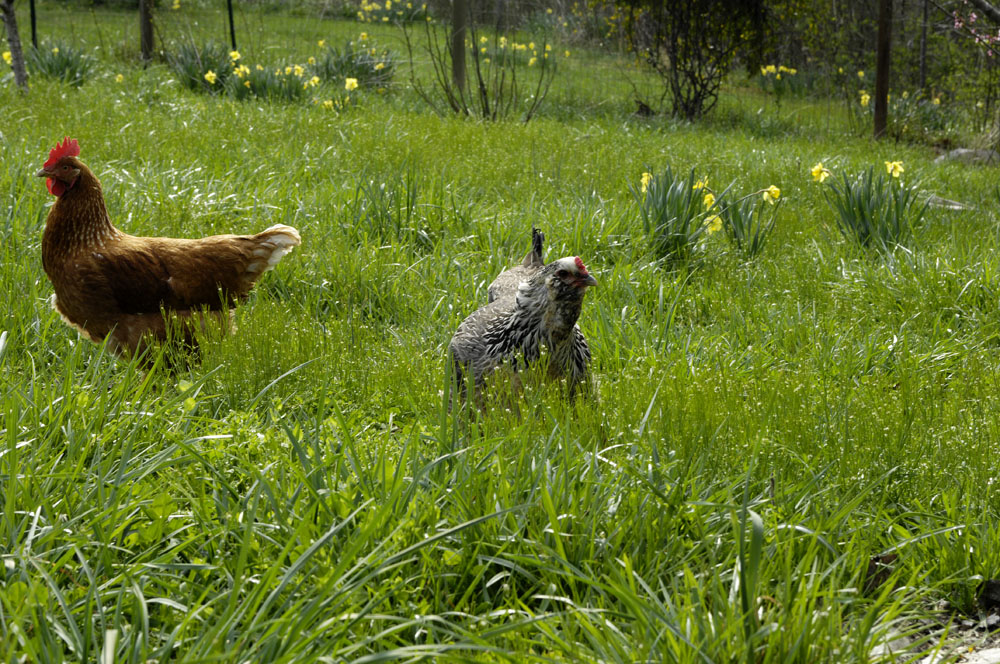
Given a choice on a January day between a grassy orchard and the woods, the girls prefer the woods, though they also spend time in the orchard to get the clover and chickweed.

chickens-3
Green grass and chickweed from a warm and wet December

chickens-4

Blue-filtering eyeglasses

blue-glasses

My eye doctor urged me to wear blue-filtering glasses while I’m in front of a computer screen or an iPad screen. Though I love the Retina display on my new 27-inch iMac, the screen does seem to be — at least subjectively — more intensely blue than the screen on my old iMac. So I’ve started wearing my blue-filtering reading glasses when sitting in front of the iMac.

The concern for ophthalmologists is high-energy visible light. There is evidence that it is a factor in age-related macular degeneration. Too much blue light also may affect the brain in a way that interferes with sleep.

Adding the blue-filtering feature to a pair of new glasses doesn’t add all that much to the cost of the glasses. Notice in the photo above that the computer screen looks slightly more orange when seen through the glasses, because the blue light is reduced.

If you’re in front of computer screens a lot, and especially if you’re older, this is something worth discussing with your eye doctor.

And, of course, keeping the brightness of the screen as low as is comfortable will help preserve the computer screen, use less energy, and reduce the strain on your eyes.

The ability (and inability) to judge character

You would think that after hundreds of thousands of years of evolution as social beings, we humans would be pretty good at judging the character and intentions of other humans. The sociobiologist E.O. Wilson has written, for example, that we humans constantly study other humans and that this explains our insatiable demand for stories, or why we love to gossip. Even our pets are very good at perceiving our intentions.

And yet a sizable chunk of the American population is dangerously bad at judging character. Not only that, this sizable chunk of the population all too often sees deranged and narcissistic people as political and religious leaders and sends them money by the millions and hundreds of millions of dollars. This is one of the most frightening and unpredictable facts of American politics. I am not terribly concerned about sexual peccadillos, except for the extreme hypocrisy of all-too-many preachers. Private sexual peccadillos don’t get us into wars or prey on the poor so that preachers and millionaires can ride around in jets and avoid paying taxes.

Can the ability to judge character be tested? Are there ways of impartially establishing who is good at judging character and who is not?

As early as 1929, MacMillan published Studies in the Nature of Character: General methods and Results by some academics from Columbia University. Since then, a good bit of research has been published on how good we are (or are not) at judging the character of others. How is this research done?

The basic method, as far as I can tell from my own admittedly limited research, is to go to a group of people who know each other and to ask those people to predict how others will perform on “personal inventory” tests. There are many such personality tests that clinicians use, for example the Minnesota Multiphasic Personality Inventory. Then you compare people’s predictions with other people’s actual performance on the tests and look for statistically significant correlations.

What are some of the factors that correlate with being a good judge, or a poor judge, of character? Here are some of the candidates, with a rough description of what researchers have found:

• Age: Though children improve in their ability to judge character between the ages of 3 and 14, there is no evidence that older people get better at judging character.

• Sex: There no convincing evidence that men or women are better at judging character.

• Family background: This area has not been well studied, but so far there is no evidence that family background matters much.

• Intelligence: Now we’re getting somewhere. Smart people are indeed better at judging the character of others. Smart people also, unsurprisingly, are better at judging the intelligence of others.

• Training in psychology: This is murky, but it may well be true that trained psychologists are no better than the rest of us at judging character.

• Sensitivity and artistic ability: There is pretty good evidence that artistic and sensitive people are better judges of character. People with literary abilities may be particularly good at judging character.

• Emotional stability: The evidence here is scant, though it is pretty clear that people who are excessively anxious, troubled by obsessions, etc., are poorer judges of character.

• Social skill and popularity: Though good social skills seem to help people judge character, those who are the best judges of character tend to be capable of a kind of scientific social detachment. For example, physicists may be better judges of character than psychologists. Poor judges of character are more socially oriented than better judges. It may follow (though I did not find any specific research) that introverts are better judges of character than extraverts.

And finally:

• Good character: People of good character are probably better equipped to judge the character of others. It’s important to keep in mind a famous statement by Gordon Allport:

As a rule, people cannot comprehend others who are more complex and subtle than they. The single-track mind has little feeling for the conflicts of a versatile mind. People who prefer simplicity of design and have no taste for the complex in their aesthetic judgments are not as good judges as those with a more complex cognitive style and tastes.

Unfortunately I could not easily find any research that looked for correlations between religiosity and the ability to judge character. But insofar as I myself am able to judge the character of others (feel free to judge me!), I would have to say that evangelical, salvation-oriented religious types are among the very worst judges of character. As for why people send millions of dollars to preachers like Jim Bakker or Jimmy Swaggart, it helps to remember that half the population have IQs of under 100 and live pretty hard lives. Getting money and votes out of people who are not so smart and not doing very well is now a think-tank science — the smart studying the not-so-smart so as to take political and economic advantage of them. Unfortunately, that may be the No. 1 key to American politics at present.

character-10

Pancakes: Problems and solutions

pancakes-1

There is no way to make pancakes into a truly healthy breakfast. But, sooner or later, we’re all going to give in to the temptation of eating them. I’m always looking for ways to make eating comfort foods more of a misdemeanor rather than a felony.

To be sure, it has been decades since I’ve eaten a pancake made of white flour. Yuck. My flour of choice at present is sprouted whole wheat flour. But it’s still just flour. How might we get the carb load down and the fiber and nutrition load up?

I’ve often used cooked apples as a topping for pancakes, but how might we do that with raw apples? This morning I grated two Granny Smith apples (the KitchenAid shredder made quick and easy work of it). I tossed the apples in maple syrup with some cinnamon.

That meant one pancake for breakfast instead of two, plus two fewer apples waiting in the refrigerator for me to figure out what to do with them. The apples were yummy prepared that way. There are worse crimes.

pancakes-2

pancakes-3