What are arc fault circuit breakers?

m-arc-fault-breakers.JPG
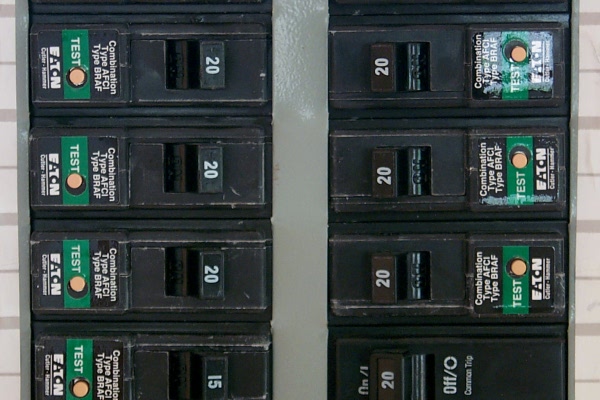
Some of the 17 arc fault breakers in my main electrical panel

Starting in 2008, the National Electrical Code included a new requirement: new homes must use arc fault circuit breakers. Like most people, I was unaware of this new requirement, nor did I know what purpose these breakers serve until my electrician explained it to me.

Many electrical fires are caused by arcs. Arcs can happen when a wire has been damaged, leaving a gap in the insulation, or when a connection has come loose. Ordinary circuit breakers don’t detect this problem. If enough current arcs for long enough, it will heat up and cause a fire. These new breakers are expensive (at least $45 each). They added more than $600 to the cost of my electrical system.

This added cost has caused many people to complain. In fact the North Carolina Building Code Council (under pressure from developers, as always) recently considered dropping this requirement. But they backed down and kept the requirement after wiser heads put some pressure on them.

If you’ve ever been around a house fire, as I have, you want all the protection you can get. There are 41,000 house fires each year, causing around 360 fire deaths each year and thousands of injuries. Children and the elderly are always at higher risk in house fires (and I’m not getting any younger). I gladly shelled out the money for these breakers. My electrician was able to negotiate a good price for me because my house has much more wiring than most houses this size (I’m a nerd). My 1250-square-foot house has more than 30 circuits.

So how does an arc fault breaker differ from a ground fault breaker? An arc fault breaker is for preventing fires. A ground fault breaker is to protect humans from electrical shock. The code still requires ground fault breakers in kitchens, bathrooms, laundry rooms, basements, etc. Typically the ground fault breakers are in the outlet boxes, so these circuits have both arc fault and ground fault protection.

Toward more frugal homes

g-washing-machine.JPG
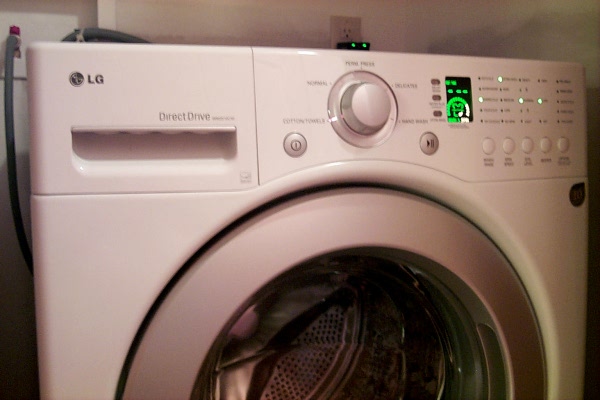
My new washer

—————————————–

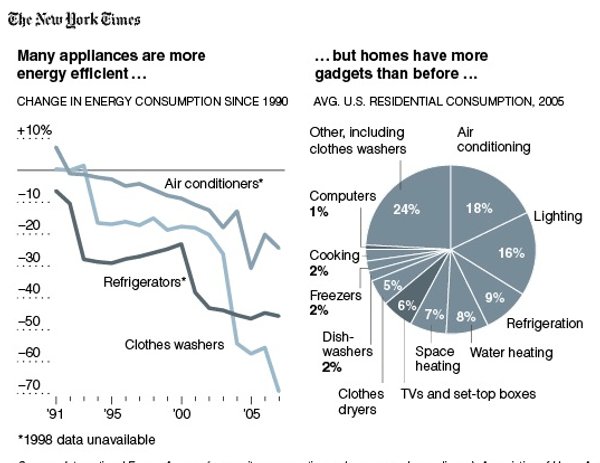
nyt-appliances.jpg

One of the nice things about new construction is that, largely because of tighter and smarter regulations, new homes and new appliances are more efficient and more frugal. My windows, with a U-factor of .31, are pretty darn snug, though no window is as efficient as a well-insulated wall. Local builders complain that Stokes County’s requirement for ceiling insulation is R-38, the same as in much of Canada, even though surrounding counties require only R-30. My Trane heat pump is far more efficient than heat pumps from the 1980s. Refrigerators have gotten much more efficient. Even my big iMac consumes far less energy than the computer it replaced.

For the month of July, with my cooling system running as needed all day and all night all month with thermostats set to 77 or 78, I used 604 kilowatt hours at a cost of $71.80. For September, with no heating and cooling needed, I’m expecting an electric bill of $35 to $40. My house is not a MacMansion. It’s 1250 square feet. [My electric company, Energy United, which is a rural electric cooperative, charges .0802 cents per kilowatt hour during the summer, meaning that my per-kilowatt charges were $48.44 for July. The rest of the bill is from taxes, fees, and fixed monthly charges.]

It has been fascinating to watch my new LG front-loading washing machine, which is Energy Star compliant. It’s astonishing how little water it uses. It’s very quiet. It spins at a very high speed to reduce dryer costs. Its behavior is very complex, controlled by a computer. Older washers with mechanical controllers were much more limited in how their wash cycles were set up.

The New York Times has a piece today on the patterns of energy consumption in the home and how they are changing.

A post for the nerds: Radioteletype

rtty-cuba-21.JPG
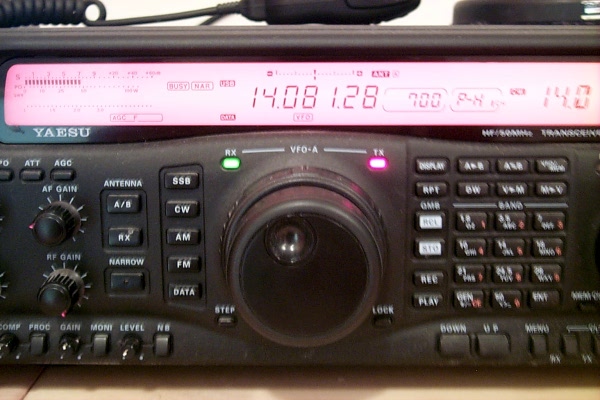
The radio is tuned to 14.08128 megahertz. This is in the 20 meter ham radio band in a frequency range normally reserved for radioteletype stations. Signals on the 20 meter band, by the way, travel farthest when the sun is overhead. During the day the earth’s ionosphere is energized by solar radiation, making the ionosphere reflective to 20-meter signals. The signals go up 200 miles or so, then bounce back down to earth, far from the point of origin.

rtty-cuba-1.JPG
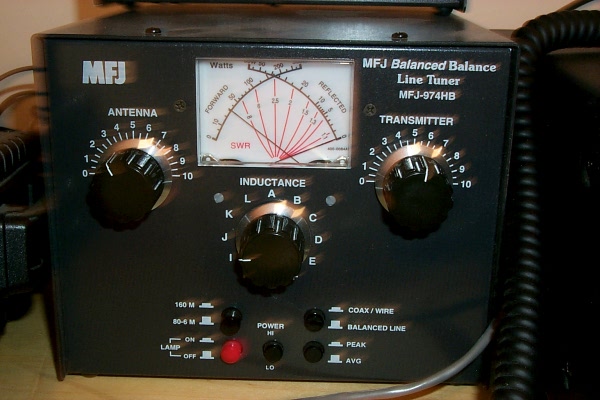
This photo was taken during a radioteletype transmission. The meter is saying that 30 watts of power is being sent to the antenna (left needle on 30). Because the antenna is tuned for this frequency, the antenna is not rejecting and thus reflecting any of the transmitter’s power (right needle on 0). In other words, there is no standing wave on the antenna feed line. The standing wave ratio (SWR) is 1:1.

rtty-cuba-3.jpg
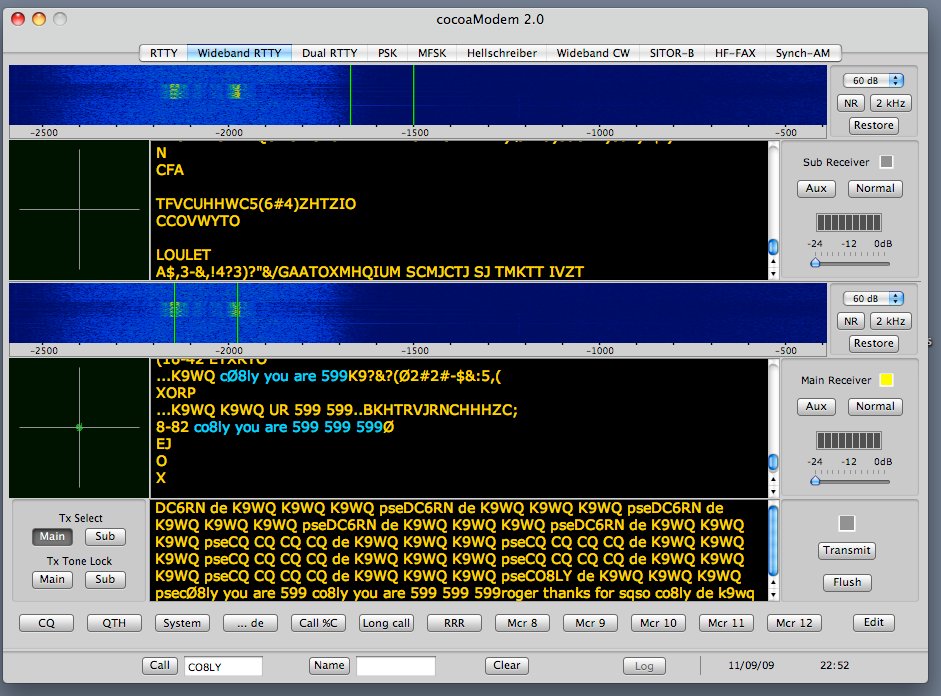
Instead of mechanical teletype machines, computers are now used to encode and decode radioteletype signals. This is a program for Macintosh named CocoaModem.

A few days ago I posted an item about Teletype machines and a mode of communications called radioteletype. Radioteletype is obsolete commercially, but it remains an excellent means of communication on the high-frequency (short wave) radio bands. When I posted last week, I had not yet got around to setting up radioteletype on my apparatus at home. As of today, it’s working.

Digital (as opposed to voice) signals were booming in from Europe today during the afternoon, when the sun was over both Europe and the United States. I was still working on setting things up and adjusting things, but I did talk with two stations in Cuba — CO8LY and CO2NO. I talked with CO2NO using 20 watts of power on a new digital mode that is a relative of radioteletype — PSK31. I talked with CO8LY via radioteletype using 30 watts of transmitter power.

You might wonder how 20 or 30 watts of transmitter power could travel from North Carolina to Cuba. Two reasons, basically. For one, the power is focused into a narrow beam of bandwidth, far too narrow to carry the human voice, but enough for a relatively slow digital signal such as radioteletype. For two, the earth’s atmosphere is very transparent to radio waves. Or, to say it a little differently: It would be more difficult to talk with someone in Cuba using a microphone and voice communications. “Narrow” digital modes such as radioteletype and Morse code carry less information per second, but the power used travels much farther.

I never use more than 100 watts.

Sony strikes back

h-new-sony-reader.jpg

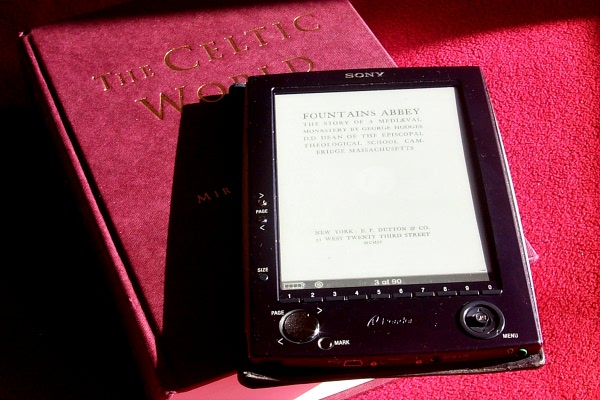
It is so exciting to see competition and innovation in the market for electronic readers. Sony has revealed a new Reader — its third model in the evolution of the Sony Reader. That should keep the Amazon Kindle developers on their toes.

Sony’s new reader includes the feature that put the Kindle miles ahead of Sony — electronic delivery of books and reading material over the cell phone network.

Sony says the new reader will be available in December.

Since Amazon and Sony are serious about the market for this technology, let’s hope Apple has something up its sleeve.

How you used to get your news…

ap-teletype.jpg

My previous post about the death of Fred Fragler, who hired me for my first job, got me all sentimental about analog communications technology. I mentioned the Associated Press Teletype machines and how it was the job of a newspaper copy boy to look after them. The Winston-Salem Journal had about, oh, eight of them. They made a lot of noise and were kept in their own room adjoining the newsroom.

Here’s a Google video that shows one running, and you can hear how it sounds.

The old Associated Press teletype network used a nationwide network of telephone lines leased from AT&T. Since this technology used telephone lines, it follows that its signal was something that could be carried over the telephone — sound. Sound, of course, can also be carried by radio. Ham radio operators still use this type of signal for communication. It’s radio teletype, which hams call RTTY. It, too, is sound. It sounds like this on the radio. Hams now use computers and computer sound cards to generate and decode this sound.

I’m still working on setting up my radio room here in the new house, and I don’t yet have a radio teletype system set up. When I was in San Francisco, though, I had confirmed (meaning the other side of the communication later sent an acknowledgement) radio teletype contacts with other RTTY operators New Zealand, Japan, the Galapagos, Spain, and Hawaii. Radio teletype actually is a very efficient mode of radio communications, almost as efficient as Morse code.

I’m amused by young’uns these days with their iPhones. “I can call New Zealand with my iPhone,” they might say. Sure they can. But the signal from their iPhone can carry at most for a few miles, then a corporate communication system picks up the data and hauls it to New Zealand. Whereas, in a radio teletype message from San Francisco to New Zealand, there is nothing between the two radios but the ionosphere.

Powering up the radio room

s-radio-room-2009070401.JPG

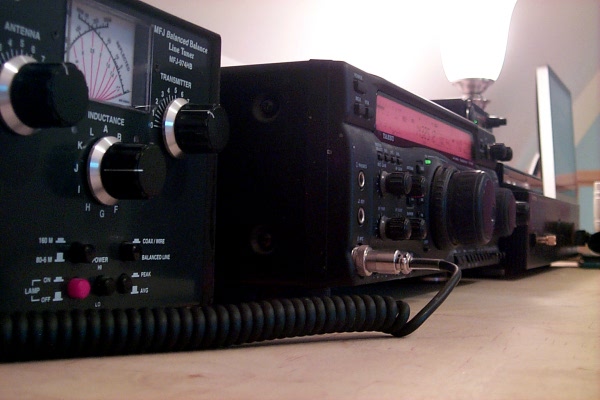
I’ve had very little access to the ham radio bands since I left San Francisco in February 2008. Though I have a VHF/UHF transceiver on the Jeep, and though I had a crummy VHF/UHF antenna installed outside the trailer, VHF and UHF serve only for local line-of-sight communication. For longer-haul communication, one needs longer antennas and the longer wavelength HF bands (1.8 Mhz to 30 Mhz or so, with wavelengths from 160 meters to 10 meters). Now that I have a house, I can bring my radios out of storage and put up longer antennas.

I installed a wire loop antenna of modest length in my attic yesterday (60 feet or so). The length of it makes it good for communications on the HF bands from around 14Mhz up. By golly it works. In no time, I’d made two-way voice contact with CO8TY in Cuba on the 21 Mhz band, YV1JGT in Venezuela on the 14 Mhz band, and LU8EOT in Argentina on the 14 Mhz band. I never use more than 100 watts to transmit. The antenna and its feed line still need some tweaking, but I’m encouraged that attic antennas here are going to work for me. Attic antennas are limited in length, but they aren’t out in the weather, they aren’t exposed to lightning, and no one can see them.

Propagation on the HF bands varies from minute to minute based on time of day, geomagnetic conditions, solar emissions, etc. Clearly propagation was good to South America this evening. I should be able to hear Europe earlier in the day when there’s daylight over Europe. Getting to Europe was tough from California. It should be much easier from here on the East Coast.

There are many who consider radio communications on the HF bands quaint and obsolete. But we’ll see about that if there’s ever a widespread power outage or widespread failure of the Internet pipes.

I installed wiring in my house so that I can power the HF radios, which are on the second floor, from a battery array (probably golf cart batteries) in the basement. But it will be a while before I can spend money on batteries and big chargers.

Update: rural internet access

s-internet-update-2009-04-20-1.JPG
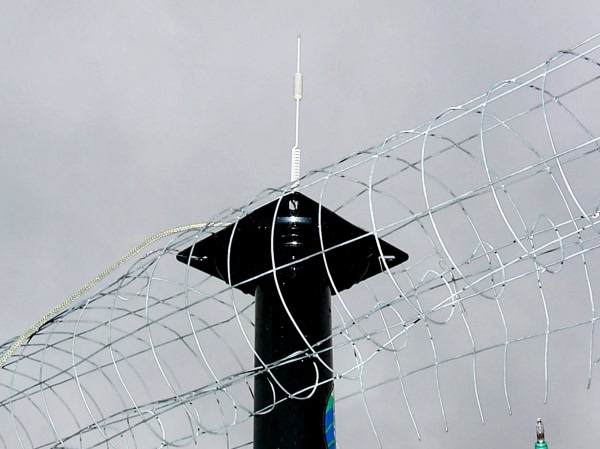
My internet antenna. It’s a 12-inch omnidirectional antenna. The fencing is a quick-and-dirty ground plane.

Last year I started using Alltel’s EVDO wireless system for internet access. I had a rough start with slow speeds, but after some nerdly noodling the system settled down and was pretty reliable, with typical download speeds of 500 kbps and typical upload speeds of about 90 kbps. This is not as fast as DSL, but here in rural America where we don’t have DSL, that was a pretty good speed.

Then, about a week ago, my speeds suddenly dropped from EVDO speeds to what is called “1x” speed — 130 kbps down and 40 or so kbps up. Very bad. When I called Alltel tech support, the tech told me that I had almost certainly been roaming to a Sprint tower for all those months, and that, because of the Verizon merger with Alltel, the roaming agreement with Sprint had ended. Now, he said, I would have to connect with an Alltel tower or a Verizon tower. All Alltel towers support 1x, but not all of them support EVDO.

On Sunday, tired of working on the new house, I decided to do some nerd work. I put a directional EVDO antenna on a portable mast and turned it in all directions, searching for a (possibly distant) tower that would give me EVDO speeds. I could get a 1x signal by pointing in almost any direction. In some directions I could detect a faint (-117 dBm) EVDO signal, but the signal was too faint to connect to. Disappointed, I reconnected the omnidirectional antenna that I’ve been using for months. I found that I could get a slightly stronger 1x signal if I improved the antenna’s ground plane by putting some metal fencing under the antenna. Slight improvements in antenna efficiency never do any harm.

To my surprise, about an hour later, I found that I was getting EVDO speeds again, better than the speeds I had all winter. I have no idea what changed.

Without accurate and up to date information on exactly where different carriers’ towers are located, and what data services are supported on those towers, making EVDO work out in the sticks is guesswork and voodoo. Plus I’ve never had an opportunity to talk with anyone who truly understands how cellular technology works. The employees of cell phone companies know nothing beyond “what PRL are you using.” At this point I have no idea whether I’m connected to an Alltel tower or a Verizon tower, or where that tower is. One of my nerdly rules is, if it’s working good, leave it alone. The high speed connection has been up for 14 hours. I hope I can hold on to it.

People think I’m weird because my cell phone (a Motorola M800 bag phone) weighs 10 pounds, and my data card (a Kyocera KPC680) has an outdoor antenna. But, here in the sticks, I would never consider buying a cell phone or a data device that can’t be connected to a proper outdoor antenna. The built-in antennas are pathetic and work well only when they’re close to a cellular tower.

internet-update-2009-04-20-2.jpg
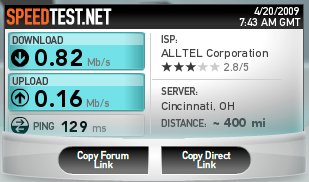
.82 Mb/s = 820 kbps. That would be a decent speed on DSL, and it’s a great speed for rural EVDO.

Kindle 2.0 on the way?

amazon-kindle-original.JPG
An older Kindle 1.0 (Amazon.com)

Rumors of an updated model of the Kindle, which everyone has been calling Kindle 2.0, have been kicking around for months. Amazon ran out of Kindles before the holidays.

Now a blogger at the Los Angeles Times is reporting that Amazon has scheduled a press event in New York for Feb. 9 that everyone assumes will be the rollout for Kindle 2.0. I’m hoping that Amazon also will reduce the price.

The neat thing about the Kindle is that it automatically downloads new content using the EVDO cellular network, and Amazon pays the bill for the EVDO. The Kindle comes with a basic Web browser, so that means it can be used to browse the Internet, or check your email, while out and about, with Amazon paying the network costs. Since I’m in the market for a way to check email while out and about, that makes the Kindle very tempting. Back in San Francisco I had a Blackberry, and yes, I miss it. I can’t justify the expense of a Blackberry here in the woods. My EVDO and cell phone bills are already high enough. But I’m hoping the Kindle would serve as a poor person’s Blackberry. You’d have to buy the Kindle, of course, but there’d be no monthly bill for Internet service.

Improvements in the 'Where's David' GPS system

a-aprs-track.jpg
The track I followed today to Walnut Cove, then to Sauratown Mountain (getting lost on the way), then back home past Hanging Rock State Park and through Danbury.

I’ve made some improvements in my “Where’s David” GPS system that make it practical for me to use the system any time the Jeep is on the road.

The old system used a Garmin eTrex Legend handheld GPS device. When I wanted to use it, I had to make sure the Garmin device’s batteries were charged, put it in the back window of the Jeep, and plug it into the VHF transceiver. I wanted a system permanently hooked to the Jeep and drawing the Jeep’s power, the same way the VHF transceiver is hooked up.

a-aprs-garmin.JPG
The GPS device I previously used, now retired — a Garmin eTrex Legend

a-aprs-placer.JPG
The new GPS device — a Trimble Placer 450

The new GPS device, a Trimble Placer 450, is made for permanent installation in vehicles. The devices are made for the commercial fleet-tracking market. I connected it to the Jeep’s wiring, and it’s safely mounted in the trunk of the Jeep along with my VHF transceiver. The Placer unit also has an exterior antenna, so it gets stronger signals from the GPS satellites

a-aprs-antenna.JPG
The Placer GPS unit’s satellite antenna, outside on the back of the Jeep

a-aprs-kenwood.JPG
The control panel for the VHF transceiver is mounted above the windshield

a-aprs-whip.JPG
The VHF transceiver’s antenna is on a short mast on the back of the Jeep

a-aprs-saura.JPG
Sauratown Mountain

How it works: The Placer GPS unit monitors the Jeep’s position, speed, heading, and altitude. The Placer GPS unit constantly sends this data to the VHF transceiver, a Kenwood TM-D700, through a wired serial connection. Every so many minutes, the TM-D700 transmits an AX.25 APRS packet on a ham frequency reserved for this purpose — 144.390 Mhz. These packets are almost always heard by a ham “digipeater” or internet gateway station which puts the location information into an Internet database operated by hams. Once this is in the database, anyone can look at, and map, the data. Amateur radio transmissions, by law, are open to all who want to listen. One must have an amateur radio license to operate the VHF transceiver and make the transmissions, though. That is, a license is required to transmit, but anyone can listen. The Kenwood TM-D700 is well suited to this GPS location mechanism, because it has built-in digital capabilities, with a device called a “terminal node controller.”

About Sauratown Mountain: Stokes County has its own little mountain range, the Sauratown Mountains. Two of these mountains, Hanging Rock and Pilot Mountain, are state parks. However, one of the mountains, Sauratown Mountain, has been used for decades as a site for radio and television antenna towers. On a clear day, one can see 60 miles or more. Since VHF radio frequencies follow a line of sight, from the top of Sauratown Mountain one can communicate nicely on VHF frequencies. While I was on Sauratown Mountain this morning testing the new system, I spoke with KG4IXS, who is 16 miles northeast of Danville, Virginia, almost 70 miles away. The Kenwood transceiver can, of course, handle both digital and voice communication.

How to find David: There are a couple of links to the right here on the blog under “Where’s David?”