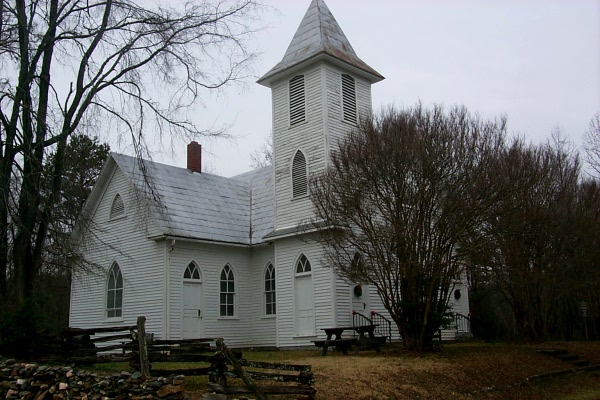
This is Rockford Methodist Church, built in 1913. It’s in the little town of Rockford, close to the Yadkin River. Note the chimney. Not all old wooden churches of this vintage have chimneys. I have not been inside this church, so I don’t know what kind of stove might be, or might have been, inside.
Category: Culture
Lady Windermere's Fan
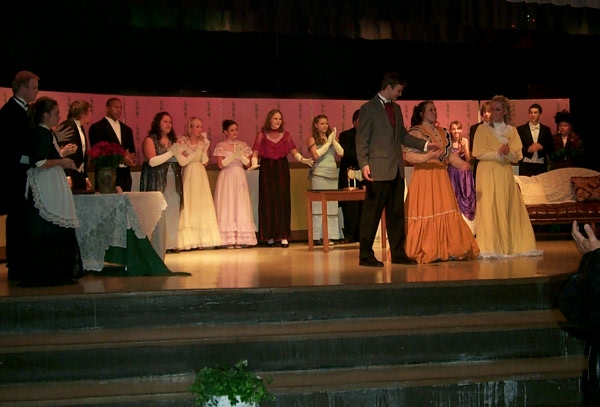
Have you ever been to a high school drama production that wasn’t fun? I thought not. What’s that? Some of you say you haven’t been to a high school drama production? Then you have missed an important piece of Americana.
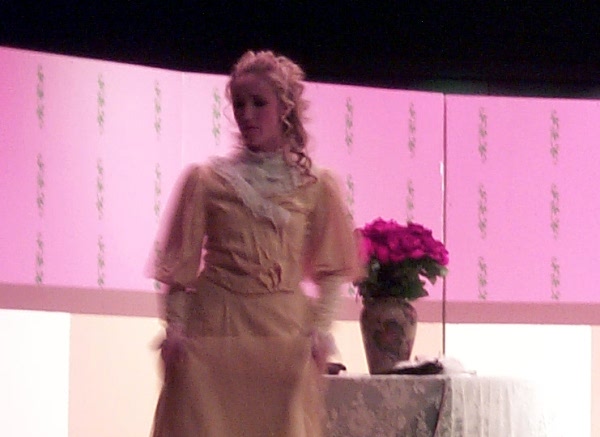
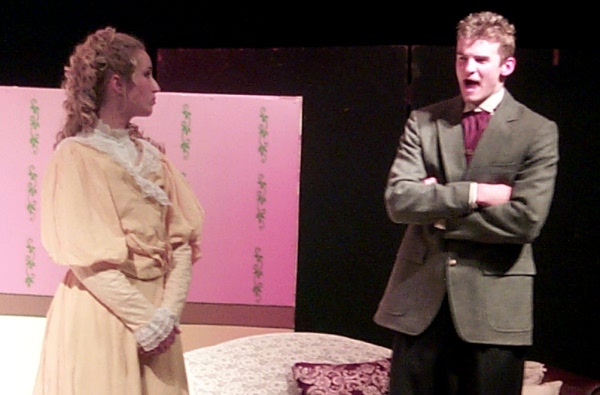
The local high school did “Lady Windermere’s Fan,” and a young neighbor who had the role of Lady Plymdale invited me to go.
What magic, to be so young, rather the the Wildean old curmudgeon that some of us are.
“We are all in the gutter, but some of us are looking at the stars.”
— Oscar Wilde, Lady Windermere’s Fan
Where late the sweet birds sang
Early fall has very quickly become middle fall. Though these pear trees up the road still have most of their leaves, the leaves on the trees in the woods are turning brown and falling. Summer’s lease hath all too short a date.
A bare, ruin’d choir of woods below my house
That time of year thou mayst behold thriving turnips and mustard.
Something black and wicked tiptoes through the turnips. A Lily cat?
My front door. I now have a shiny new doorkey to jingle in my pocket.
These two shots of the house show some of the angles that made the house so tricky to build.
The winter wind will whistle around these corners in a very gothic sort of way.
Sonnet 73
That time of year thou mayst in me behold
When yellow leaves, or none, or few, do hang
Upon those boughs which shake against the cold,
Bare ruin’d choirs, where late the sweet birds sang.
In me thou seest the twilight of such day
As after sunset fadeth in the west,
Which by and by black night doth take away,
Death’s second self, that seals up all in rest.
In me thou see’st the glowing of such fire
That on the ashes of his youth doth lie,
As the death-bed whereon it must expire
Consumed with that which it was nourish’d by.
This thou perceivest, which makes thy love more strong,
To love that well which thou must leave ere long.
— William Shakespeare
Carolina blue
Though the North Carolina elections board won’t release the final count until later this month, the Associated Press has called it — North Carolina is now a blue state.
As though to prove that this is a real phenomenon, yesterday Delta Airlines announced that it plans to start nonstop service from Raleigh-Durham to Paris. Last week, US Airways announced that it’s planning to start nonstop service from Charlotte to Paris.
This is not really something new. It’s a return to the norm. Lyndon Johnson, it is reported, said, “We have just lost the South for a generation” after he signed the Civil Rights Act of 1964.
It feels good to be connected to the coasts again, and to the world.
When the Frost is on the Punkin
My corn yield this year: exactly one ear.
What maple trees do in the fall.
I’ve never really forgotten this poem after we all were required to memorize it in the fifth grade.
When the Frost is on the Punkin
WHEN the frost is on the punkin and the fodder’s in the shock,
And you hear the kyouck and gobble of the struttin’ turkey-cock,
And the clackin’ of the guineys, and the cluckin’ of the hens,
And the rooster’s hallylooyer as he tiptoes on the fence;
O, it’s then the time a feller is a-feelin’ at his best,
With the risin’ sun to greet him from a night of peaceful rest,
As he leaves the house, bareheaded, and goes out to feed the stock,
When the frost is on the punkin and the fodder’s in the shock.
They’s something kindo’ harty-like about the atmusfere
When the heat of summer’s over and the coolin’ fall is here—
Of course we miss the flowers, and the blossoms on the trees,
And the mumble of the hummin’-birds and buzzin’ of the bees;
But the air’s so appetizin’; and the landscape through the haze
Of a crisp and sunny morning of the airly autumn days
Is a pictur’ that no painter has the colorin’ to mock—
When the frost is on the punkin and the fodder’s in the shock.
The husky, rusty russel of the tossels of the corn,
And the raspin’ of the tangled leaves as golden as the morn;
The stubble in the furries—kindo’ lonesome-like, but still
A-preachin’ sermuns to us of the barns they growed to fill;
The strawstack in the medder, and the reaper in the shed;
The hosses in theyr stalls below—the clover overhead!—
O, it sets my hart a-clickin’ like the tickin’ of a clock,
When the frost is on the punkin and the fodder’s in the shock.
Then your apples all is gethered, and the ones a feller keeps
Is poured around the cellar-floor in red and yaller heaps;
And your cider-makin’s over, and your wimmern-folks is through
With theyr mince and apple-butter, and theyr souse and sausage too!…
I don’t know how to tell it—but ef such a thing could be
As the angels wantin’ boardin’, and they’d call around on me—
I’d want to ‘commodate ’em—all the whole-indurin’ flock—
When the frost is on the punkin and the fodder’s in the shock.
— James Whitcomb Riley, 1853-1916
Pickin' at Priddy's, Oct. 4
Every Saturday in October, Priddy’s General Store near Danbury has “Pickin’ at Priddy’s.” There’s a bluegrass band, and there’s always something homemade in a black pot. Dogs welcome. It runs from 3 p.m. until 5:30 p.m. Priddy’s General Store is three miles from my place.
Today’s band was The Plank Road. Oct. 11, Hubert Lawson & the Country Bluegrass Boys. Oct. 18, Henry Mabe and Friends. Oct. 25, Blues Creek. Nov. 1, The Jug Busters.
Pepper and crackers for the Brunswick stew
On the porch at the front of the store
Above the front door of the store. Note the Web site! Also note the reference to Frank Duncan, a local artist. Frank is a neighbor of mine.
The Southern Highlanders: what they ate

This old family photograph was taken around 1921, around the same time the book below was published. It is a family reunion at the home of my great-great grandparents, William Ira Jackson and Martha Marshall Jackson, in Carroll County, Virginia. They are the old couple seated at the center of the table. My father, Sanford Clay Dalton, is the boy whose head is visible just to Grandpa Jackson’s right. The Jacksons were my paternal grandmother’s grandparents.
Here are a few paragraphs from The Southern Highlander and His Homeland (John C. Campbell, New York, The Russell Sage Foundation, 1921). A guest (no doubt the author) stops overnight while traveling through the Highlands. He does not give a specific location. Perhaps he intends this scene as a synthesis:
“One who has enjoyed for a night the hospitality of a more prosperous family in the remote Highlands, carries away with him a pleasing picture of the comfort and simplicity of such mountain life.
“Here, where the bottom land along the creek widens, he sees at the end of a day’s hard ride a cluster of low gray buildings flanked by gnarled and untrimmed apple trees and backed by an imposing row of bee-gums…
“The room they enter is plainly furnished — a bare floor, a few chairs, and two or three beds. On the walls hang large crayon portraits of father and mother, with their first-born in their arms, together with pictures of the older brother or the little sister who died (now twenty years ago) enlarged from some crude photograph or tintype take by a traveling photographer. Often there is an organ, and the guests are eagerly urged to play.
“‘Washing up’ is generally relegated to the porch, and fresh water is drawn from the well or brought from the spring for this purpose.
“By this time the fire has been lighted in the big fireplace, and all gather about ‘to warm.’ Our host, it seems, is getting out some of his timber, and after a time he appears, followed at intervals by the sawmill hands who slip in unostentatiously to join the group about the hearth.
“Desultory conversation as to season, crops, and timber is interrupted by the announcement of supper, and all file out to the long table set in a room near the kitchen. Places are taken without ceremony. The host sits at the head. One of the guests is generally asked to return thanks. The hostess and the women who are helping her wait upon the men and upon the guests. There is an abundance to eat — pork, usually fried, and if it be hog-killing time, the backbone is offered as a great delicacy; fried potatoes, cornbread, hot biscuits, honey, apple-butter and jellies of various sorts, canned peaches, sorghum, coffee, sweet milk and buttermilk, fried chicken, and fried eggs. The meal is not interrupted by much conversation, and there is no lingering afterward. Eating is a matter of business.
“Adjournment to the fireplace is prompt, and the women, after eating their supper, betake themselves to the kitchen to clean up after the meal.”
Some notes out of my own experience of the Highlands, which goes back to the early 1950s about 30 years after the above photo was taken:
Campbell does not specify the season, but clearly it is cold weather. Based on what was served for supper and the availability of eggs, this was probably early spring. In the summer and fall, there certainly would have been fresh vegetables from the garden. So Campbell has described the winter diet of a prosperous family.
The pig’s value in the early South, and the importance of lard, cannot be emphasized too much. Though there was butter, the availability of butter would have varied from season to season, and according to the health and condition of the cows, and according to how many cows one had. Lard was the primary fat for Southern cuisine.
Even when I was a child, it was common for the woman of the house, and maybe one of her daughters, to not sit down for the meal if there were guests. Instead they would bustle around the table, and back and forth from the stove. The men, depending on the season, would guiltlessly retire to another room, or to the porch, after the meal, leaving the womenfolk to clean up the kitchen. I’ve witnessed this cleanup, though. It involved huge quantities of boiling water, either from kettles or from a reservoir in the wood-fired stove.
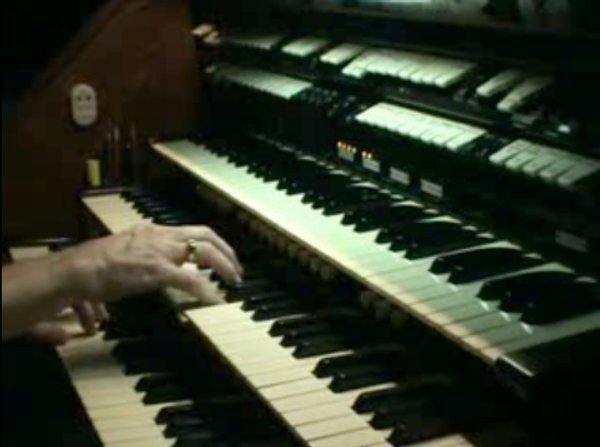
Technically, the musical instrument Campbell refers to is a harmonium, not an organ. The harmonium was a reed instrument driven by pedal-powered bellows. Harmoniums were quite common in the mountains. They were lighter than pianos, less expensive, easier to move and maintain.
Gothic weather
East Coast gothic weather and West Coast gothic weather are very different. The best West Coast gothic weather, to my taste anyway, comes with high wind and high waves off the Pacific, with waves crashing against the rocks and seagulls fighting the wind.
It’s very different here. East Coast gothic weather is about a chill wind in the trees, and clouds skudding across the moon, or the stars.
In late September, gothic weather returns. I got up during the night to read the president’s speech on the gothic economy, but the gothic weather is keeping me awake. The windows are all open. The wind is whooshing through the woods and making the curtains billow. Some noisy nocturnal creature blundering in the woods got the cat into a frenzy. She was growling and running from window to window to look out into the dark.
I wish I understood how the rich adjective “gothic” came to represent what it represents. According to a Wikipedia article, it was an insult to gothic architecture during a period of history in which people saw gothic buildings as barbaric. On the other hand, R.A. Lafferty, in The Fall of Rome, which I just finished reading, says that the descendents of the Goths helped to design and build the gothic cathedrals. Lafferty doesn’t give his sources, though I suspect he was relying on Gibbon. There’s some research to do there.
The tree above my trailer, in a gothic mood
Two Souths, two versions of pancakes
I’ve been having a discussion on-line with a friend in the south of France about the local in-season fruits and what to do with them. Lise sent a photo of a French version of apple pancakes with apples. Isn’t that so French, a tall stack of tiny pancakes with the edges perfectly browned? Whereas my American version takes time only for three middle-size pancakes, not so perfectly browned.
Lise was taunting me about the abundance of figs in the south of France. We don’t grow them here (as far as I know). Since my attempt to send by email a photo of an American persimmon tree failed, I’ll post it here and wonder whether they have persimmons in the south of France…
Humble Stokes County apples from the Danbury farmer’s market
And speaking of 19th century French literature…

Internet Archive — Around the World in 80 Days

Internet Archive — Around the World in 80 Days
Here in the sticks I’m clearly not surrounded by a population of readers. The Stokes County library at Danbury is tiny. There are bookstores in Winston-Salem, but they’re pretty terrible bookstores, not like the bookstores in the San Francisco Bay Area. But living in a travel trailer I don’t have room for books anyway. So I’ve been making my own books with free on-line texts and my Sony Reader.
I wanted to continue my tour of 19th century French literature, but after the bleakness of Notre-Dame de Paris, I needed a change of pace. I had never read Jules Verne, even in translation, so it seemed like a good time to check out one of the pioneers of science fiction.
Verne has not a lick of interest in philosophical ramblings. He is interested in characters, and places, and situations. So he just tells a tight, well-ordered story. He is, to tell the truth, just a tad shallow. In fact some people assume that his books are for young people.
Le Tour du Monde en Quatre-Vingts Jours — Around the World in 80 Days — is a romp. It reads like, well, a David Niven comedy.
I’m not sure what to read next. Probably George Sand, to see what kind of connection, if any, can be made between George Sand and my favorite 19th century English novelist, George Eliot.
These lines from nndb.com are intriguing. I’m not sure who wrote it: