An adult in the room


The New York Times said that King Charles’ rebuke of Donald Trump was “subtle.” I don’t think it was subtle at all. Rather, it was a historic example of how the English language, in the hands of those who know that language well, can beat the living daylights out of fools and be perfectly civil about it.

I think it was subtle, though, how Charles signaled in his opening joke that that’s what he intended to do. He referred to Oscar Wilde’s line, “We have really everything in common with America nowadays, except, of course, language.” I can’t decide whether the Republicans in the chamber realized that they were being horse-whipped or whether they figured out that the politeness of Charles’ diplomatic language gave them plausible deniability.

Democrats were quick to rise to their feet and applaud when Charles upbraided the Trump administration. Charles upbraided even the Republicans in Congress, for not restraining executive power. Republicans, though, stood and applauded slowly and reluctantly. They had no choice, politically. How could they, as mere tyrant-enabling boot-scraping lickspittles, stonewall Charles the Third, by the Grace of God of the United Kingdom of Great Britain and Northern Ireland and of His other Realms and Territories, King, Head of the Commonwealth, Defender of the Faith?

Charles took a lot of heat in Britain for even coming to Washington, out of concern that it could be interpreted as some degree of approval of Trump. But that’s not how it went.

I wonder who wrote that speech. Charles, no doubt, was very much involved in deciding what he would say, not least because of his emphasis on the environment. If you have not watched the speech, it’s very much worth the time. It’s on YouTube.


Here you can see what Charles really thinks of Trump’s coarseness, as Charles almost wrestles with Trump to try to pull his hand away.

https://x.com/AdamJSchwarz/status/2048860957993001251/video/1


Using technology to resist technology


I bought this old hotel phone on eBay. The light flashes when it rings. When it was still a hotel phone, the light was on when there was a message waiting. It’s an ITT phone made in the 1970s, but it has the classic AT&T / Bell Labs handset.


Some technologies are beautiful. Some are god-awful ugly. One god-awful ugly technology is the cell phone. As a small and portable computer screen, it certainly has its purposes. But as a device for handling voice calls, it would be difficult to imagine an uglier design. It’s like talking to a brick.

The perfect design for a telephone handset has existed for almost 100 years. It’s the E1A handset, which was introduced by AT&T in 1927. Bell Laboratories continued to refine the design, and it was perfected by the 1950s. Weight, balance, acoustics, and ergonomics were all part of the design factors.

One of the stunningly elegant parts of the design, which we all took for granted because it was so natural, is called the sidetone. This meant that one could hear one’s own voice in the earpiece, at a carefully engineered reduced level. This feedback allowed you to unconconsiously adjust how loud you talked into the phone. If the sidetone was too soft, you’d be inclined to talk too loud. If the sidetone was too loud, you’d be inclined to talk too softly. An ingenious circuit inside the telephone, involving a transformer and capacitor, controlled the sidetone. The capacitor served two purposes. It allowed the alternating ringing current to pass to the bell, while blocking direct current, so the central office would not see the phone as having gone off-hook.

In short, the telephone, as an instrument of communication, was perfected by the 1950s. As instruments of communication, today’s cell phones are monstrosities. Have you ever wondered why people are inclined to talk into a cell phone too loud? Now you know. Some cell phones, maybe most, do produce sidetones, but it is not nearly as elegantly done.

This is why I have said for many years that I would rather be beaten senseless than talk to someone on a cell phone.


This is my Western Electric 302, the best telephone ever made. It’s a very heavy telephone, for a reason. Inside are two brass bells, two very heavy ringing coils, a voice coil, a huge capacitor, electrical relays, and an elegant mechanical dialing mechanism.



The device on top of the WIFI router is a Cisco ATA191 analog telephone adapter.

How can other technologies help?

I actually had a 36-minute telephone call yesterday, on the old hotel phone in the photo above. Josh, who succeeded me as editorial systems director at the San Francisco Chronicle, called with some updates on San Francisco news. He was on a cell phone. Did it sound as good as a call might have sounded in 1970, on the Bell System copper-wire network? No, but it’s as good as it can get these days.

One can read that land lines are coming back. Parents are finding that it’s the safest way for teenagers and pre-teens to talk with their friends. The “Tin Can” telephone for kids has been selling so fast that they often are out of stock.

For those who want to go back to the best thing since land lines, VOIP (voice over internet protocol) is the only possibility. You need an adapter like the Cisco device in the photo, an internet connection, and a VOIP provider. I use CallCentric as my VOIP provider. I found CallCentric to be not only the cheapest option, but also the option with the nerdiest features, such as full fax support.
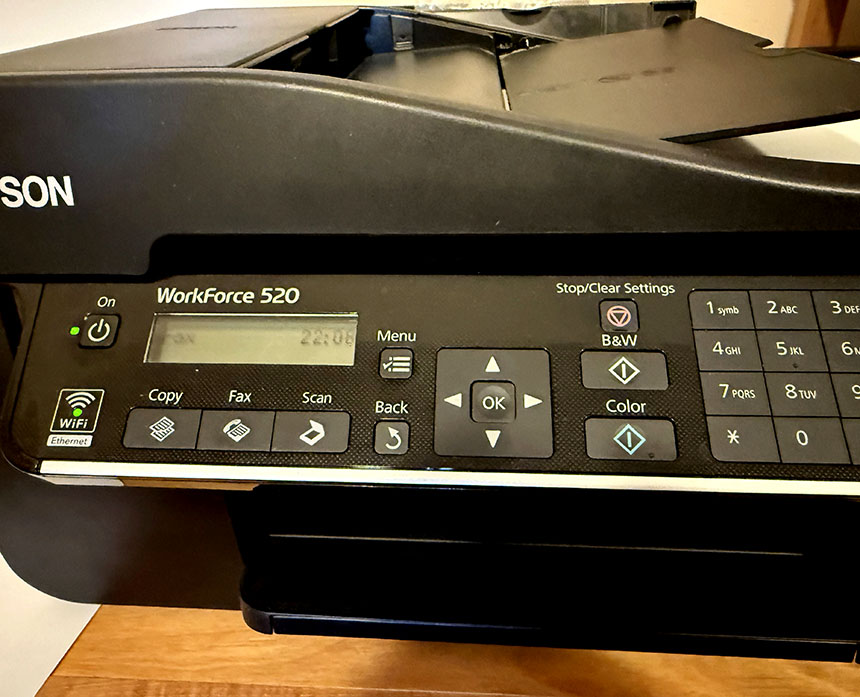

Yes, it can still send faxes, if there was anybody to send them to.

Using AI defensively

I am rapidly coming around to the conclusion that AI technology is the most magnificent — but also the most disruptive — technology of my lifetime (and I’m not young). Its potential for evil and its potential for good are probably roughly balanced. One of the things that Josh told me yesterday on the phone is that the Hearst Corporation, which owns the Chronicle, is aggressively looking at ways to use AI to cut costs. Cutting costs, of course, means eliminating jobs. Josh thinks it won’t be long before AI is editing newspaper stories, writing headlines, and even writing stories. That isn’t happening yet at responsible publications. But industries that generate propaganda, scams, and clickbait are already flooding us with AI slop.

To resist AI, I’m afraid, is futile. The best we can do, as decent human beings rather than corporate sharks or propaganda mongers, is to master AI ourselves and use it constructively, even defensively. AI is already being used to lie to us ever more efficiently. We can use it right back at them (as long as we know how) as a research tool to grapple for the truth. I have often said that having AI is like having a friend who has a Ph.D. in everything.



An 1823 novel that deserves a new edition. The cover of the new edition will look something like this. AI, of course, generated the cover image and helped recover the novel’s text.

Fighting slop by preserving excellence

My micro press, Acorn Abbey Books, has six books in print at present. Two of those are new editions of fairly recent books that had gone out of print (The Outnation and Denial by Jonathan Rauch). I have long wanted to republish a deserving 19th Century novel, but not until a year ago did I come across just the right novel. That’s Reginald Dalton, by John Gibson Lockhart, first published, in Edinburgh, in 1823.

Lockhart was Sir Walter Scott’s son-in-law. Lockhart wrote a vast seven-volume biography of Scott. Lockhart also wrote several novels, including Reginald Dalton. There are some facsimile versions of Reginald Dalton of very poor quality, but there has never been a true new edition. It’s certainly worth being done, which is why the Edinburgh University Press has an ongoing project to bring out academic versions of Lockhart’s work. I understand that that project will eventually include a new edition of Reginald Dalton, but it will be an annotated academic version that probably will cost two or three hundred dollars.

What I want to do is produce a reasonably affordable book meant for readers. I can already see that it will be about 550 pages as a 6×9 hardback — a lot of work to produce. A hardback book of that length, printed on demand by Ingram, probably will have to sell for between $40 and $50.

I own a copy of the 1823 first edition, which is in three volumes. But that gets me nowhere. Recovering old books means doing optical character recognition on scans of old books. Google Books has done this for Reginald Dalton, working from a copy of the book in the British Museum. Working from the Google scans, a year ago I use my nerd skills to extract the individual pages from Google’s PDF’s, do the OCR with a program named tesseract, and create a text file. But that text file, like all raw OCR, had many errors and a lot of extraneous material that has to be removed, such as the page number and titles at the top of each page. I started that process manually before I gave up after getting about a tenth of the way into the job. It was just too tedious and time consuming — editing a text file on one side of the screen while looking at an image of the 1823 page on the other side. There are about 1,000 pages in the three volumes of the first edition.

Recently I realized that AI could do this for me. Claude Code did the job. Even Claude Code worked on the job for at least six hours, and I had to buy extra time from Anthropic to get the job done. But I ended up with a text file that is about 99 percent clean. Google’s scans were imperfect. Some pages were missing in the scans, but I recovered those pages from my first edition. I have yet to give the text a full human read, but I won’t undertake to proof the text until I’ve gotten AI to do as much work on the text as an AI can do.

Some time within the next few months I expect to release a new edition of Reginald Dalton.



A Facebook meme

Day after day of pig circus

Even in times in which a bunch of medieval ayatollahs in Iran are far more real-world truthful and less corrupt than our own American government, we have no choice but to continue to read the news and continue to be appalled and exhausted and exasperated. When the tide turns, there must be payback, so we need to keep score. We also have to figure what can be done, collectively, to reverse the damage in the world than has been done by American stupidity.

The tragedy is that the pig circus distracts from so many things that actually matter. It also has set us back for years. Victor Orbán’s defeat in Hungary — or so we can hope — was a turning point. Deplorables have to learn the hard way, and some of them seem to be learning. I’m optimistic that American voters — enough of them, anyway — will exert their abundance of meanness in the right direction in the November election, though I doubt they’ll ever understand why it is that fascism requires scapegoats and how fascism exploited and inflamed their meanness, and even now is laughing all the way to the bank.

Dreaming of vegetables, but we’re in a drought


The water wagon delivers water to my rain tank. Click here for high-resolution version.


During the previous two years, I didn’t do any vegetable gardening. Instead I’ve been buying fantastic organic vegetables locally from Brittany and Richard, who make a nice living selling vegetables from their gardens.

But this year I was inspired to get back into gardening again, I hope in a way that won’t defeat me when high summer arrives with bugs, ticks, briars, heat, and humidity. I’m late to no-till gardening. I finally realized that, with a no-till garden, most of the work can be done early in the season, and summer maintenance should be greatly reduced. My ideal temperature for outdoor work is around 50F. That’s March weather.

It was reading about perennial leeks that inspired me. Leeks are one of my favorite vegetables, but I don’t live in leek country. Grocery stores usually have leeks, but they’re expensive and shopworn. Brittany and Richard say they can’t grow leeks profitably because the leeks take so long from seed to harvest. But Brittany and Richard happily started some leek seeds for me in their greenhouse while I made a no-till leek bed. I bought a big load of leaf compost for the job. I already had a lot of well-rotted chicken manure.

If it weren’t for the drought we’re in, I’d already have moved the baby leeks from the greenhouse into their new leek bed. But we’ve had hardly any rain for weeks, and there’s no real rain in the forecast. The entire southeast including Florida is under a high-pressure system that is keeping moisture away. Temperatures also are 10 to 20 degrees above normal. I think I’ve decided to go ahead and plant the leeks anyway, after the leek bed has had a good, long soaking from the rain tank.

I have a rain tank that Ken set up several years ago. When there’s rain, the roof of the shed catches it and spouts it into the rain tank. The tank is up the hill from the garden. A buried pipe carries water downhill to the garden. When there’s no rain, my nearest neighbor brings out his water wagon. He pulls it with his Jeep or with a tractor. There’s a gasoline-powered water pump on the back. Just down the road in the woods is a small stream that is always flowing. So water is always be available for the neighbors’ garden and for mine without having to use well water.


⬆︎ Filling the water wagon from the creek. Click here for high-resolution version.


⬆︎ The leek bed, with a drip hose. I’ve made a longer, narrower row with room for six tomato plants, four cucumber plants, and some basil. Click here for high-resolution version.


⬆︎ Doodle-bugs like the dry weather. Rain, I’m sure, messes up their traps. Click here for high-resolution version.

The wages of right-wingery


It has happened over and over. A population of fools falls for the lies and promises of a charismatic right-wing authoritarian. Slowly and painfully the slow learners realize that they’ve been had, but by then getting rid of a corrupted, criminalized government may not be an easy matter. Just ask Germany under Hitler, Italy under Mussolini, Spain under Franco, Portugal under Salazar and Caetano, Greece under the Colonels, Argentina under the military junta, Chile under Pinochet. Now Hungary under Orbán is history. Still to fully learn their lesson and throw off a criminal government: Russia under Putin and America under Trump.

It looks to me like an iron rule with no real exceptions: Right-wingery always leads to ruin, remorse, and revolution. Hungary is incredibly fortunate to be able to have their revolution with a lawful election. It remains to be seen whether the United States will be able to do that. Orbán was able to stay in power through institutional capture, patronage, propaganda, legal harassment, and intimidation. Orbán was not very violent. Trump, on the other hand (like Putin), is entirely willing to use violence to get what he wants.

The extreme right is often good at producing spectacle, enemies, and temporary, triumphal euphoria for those who are susceptible. But the extreme right cannot, anywhere under any circumstances, produce anything that is durable and decent.

Hungary’s Péter Magyar is troublingly conservative. But at least he promises to restore democracy, turn Hungary away from Putin, and rejoin Europe. If he doesn’t do that, I suspect that, given what they’ve so recently learned, the people of Hungary will catch on pretty quick.

At least we’re getting better and better laughs out of the blunders of the Trump regime. Their cluelessness in not comprehending that a visit by Vance would help Orbán lose the election was hilarious, as were the stories about Vance and Jared Kushner stomping out of Pakistan after the Iranians made fools of them. And then there was Melania’s press conference, which Saturday Night Live had a lot of fun with.

And then there’s this (⬇︎), apparently intended to keep evangelicals on board. I shudder to think what it must be like to be so stupid.

John Twelve Hawks has let us down


After I first discovered John Twelve Hawks in 2014, he became my favorite living science fiction author. He had not published a new novel (Spark) since 2014, so I was eager to read Certainty, which will be released by Doubleday on April 28.

In fact I was so eager that I requested an advance review copy from the publisher.

Certainty is not a pleasure to read. Its characters are not very interesting. The plot is confusingly complicated. The dialogue is ho-hum. The theme, I think, has something to do with the risks posed by artificial intelligence and virtual reality, though that never comes into focus.

Many of John Twelve Hawks’ fans will no doubt love this novel and will not see it as a failure. But I do see the novel as a failure, and I think that why the novel fails is very much connected with the failures of editors in the science fiction publishing industry for the past twenty years or so.

What are editors for? Once upon a time, I think the function of editors was to get good books into print and to work with writers to make books better. These days I think most editors see their jobs as serving some kind of social purpose — “to let other voices be heard” or something, or to make up for the past social sins of the publishing industry.

If a person has what it takes to get a job as an editor in a New York publishing house, then one certainly ought to have the confidence to assert some editorial judgment with writers. If I were such an editor, and if John Twelve Hawks had come to me with this novel, I’d ask him a polite but pointed question: “Is there anything else you’re working on?”

Certainty was doomed to fail the moment John Twelve Hawks finished his outline (if he works with an outline). The flaws are structural.

Certainty begins with three different sets of characters in three different settings. This is a terrible thing to do to a reader. Before the reader has any narrative investment in the story, before the author has generated any suspense or let the reader know what the stakes are, the reader must work through not one but three different sets of exposition.

Exposition is a framework in which readers can begin to follow the story. Who are these characters? What kind of place do they live in? How do the characters relate to each other? What is happening to them right now? What is at stake? Why should the reader care enough to keep going?

All stories of course require exposition, and one of the marks of a good writer is to make that exposition as transparent and interesting as possible. I’d wager that few writers are good enough to succeed at keeping a reader’s attention through three sets of exposition at the beginning of a story.

Not until somewhere near the middle of Certainty do we get an idea of how the three sets of characters are going to intersect. I found myself constantly looking back at previous chapters to remember characters’ names, or to remember where they were and what they were doing the last time we saw them. Reading fiction, to be sure, requires a reader’s attention and concentration. But a writer is on very thin ice indeed if he overloads a reader with exposition before the reader is interested in the story or cares about the characters.

Many stories, of course, involve simultaneous action. A good writer can build suspense by alternating between two or even three theaters of action. But I would argue that that can be done only after the reader has become well acquainted with the characters and deeply invested in the story. J.R.R. Tolkien and George R.R. Martin were masters of that technique, but only after they had secured the reader’s investment in their characters and the stakes of the story.

In short, Certainty is a story that gets off to a bad start and never recovers. Insofar as the story is about AI, the message is so vague and so weak that it doesn’t stir up anything worth continuing to think about.

John Twelve Hawks is still my favorite living science fiction writer, because of The Traveler, The Dark River, The Golden City, and Spark. But it’s a shame about Certainty.

AI as tech support


Cartoon by ChatGPT 5.4

Here’s a use for AI that everybody could use from time to time: tech support.

A few days ago, I noticed that anything I attached to an outgoing email was being converted to a proprietary Microsoft format. The person I sent the email to, unless they were using a Windows computer, would see a file named “winmail.dat,” and there’d be nothing they could do with it.

I Googled to try to figure out what was going on. Apparently this is something that a Microsoft mail server does when it encounters an email written in rich text (RTF) format. My email is hosted at GoDaddy. They use a Microsoft Exchange server for handling email. I’m on a Macintosh.

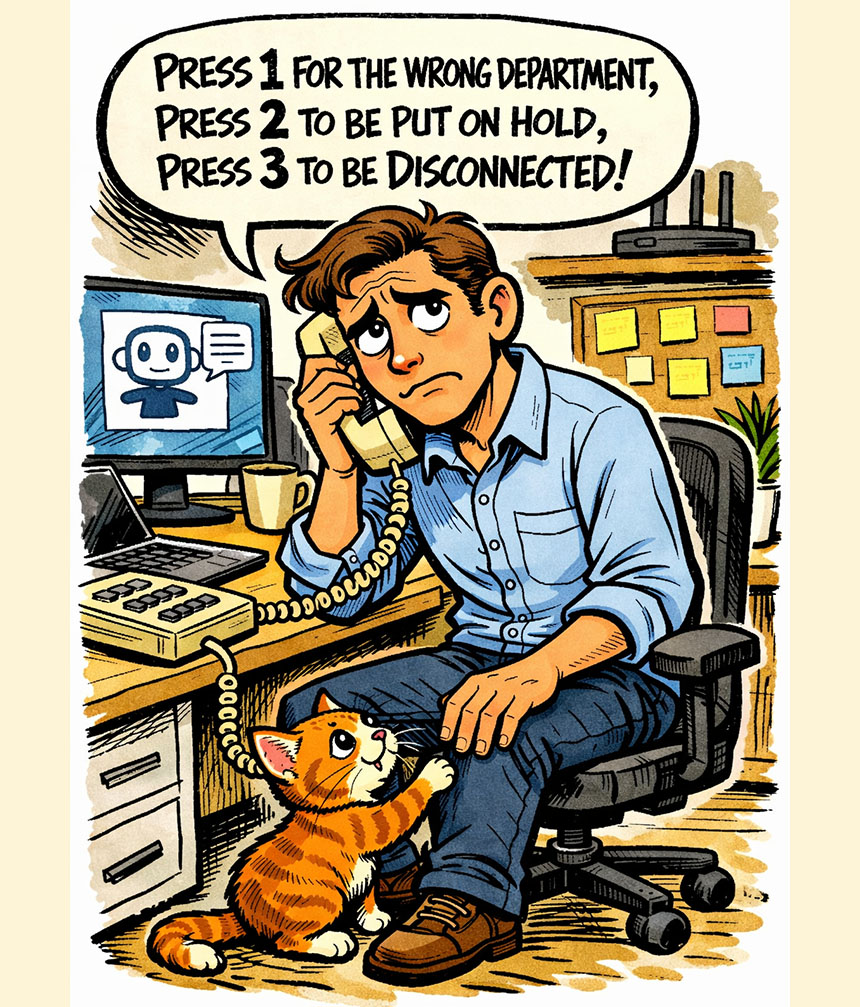
I called GoDaddy tech support.

I was on the phone with the first GoDaddy tech support person for 40 minutes. She said she’d never seen this issue before. Eventually, after putting me on hold for four times, she said she was escalating me to the next level of tech support.

While I was on hold waiting for the next person, it occurred to me to ask Claude what was going on. Claude immediately and accurately told me what was causing the problem and said that GoDaddy or Microsoft had clearly changed the defaults on their Exchange server. The fix, Claude said, is about 672 levels deep (I’m exaggerating) in my email configuration at GoDaddy. Many people had been affected by this GoDaddy (or Microsoft) mistake, Claude said, and GoDaddy had put out a memorandum on their support site.

This second person apparently understood the problem, but his English was poor. He couldn’t understand me very well, nor I him. After ten minutes of his trying to help me navigate 672 levels deep in GoDaddy menus, I finally gave up and said that I’d run out of time and would work on this later.

Then I turned to Claude. After five minutes the problem was solved.

I learned my lesson. Hereafter, if I need tech support, I’ll ask Claude first. Any time you have a problem with your computer or need to figure out how to do something new, an AI can probably help. I’ve been using Claude rather than ChatGPT for technical matters because I think Claude is a little better at that. Keep in mind that both Claude and ChatGPT can interpret screen shots if they need to see what’s happening on your computer screen. And it’s not just computers. Claude also answered some questions about a new Bosch dishwasher.

Delivering eternal damnation isn’t easy, you know


Pete Hegseth. Source: Wikimedia Commons

I had a nice email this morning asking if everything is OK since I haven’t posted for a couple of weeks. Yup… Here in the woods everything is fine. But some days it’s an effort to manage the rage at what’s happening in the world. Rage doesn’t make good commentary, nor is it good for mental health. So back to the garden with me, or the kitchen, or the computer.

Plus there’s not much I can add when I think that the media and our public intellectuals are getting things right. Heather Cox Richardson and Paul Krugman, in their daily Substack posts, are doing a fantastic job of writing the first draft of history. That should be the New York Times’ job. The Times, though, can’t just come right out and say plainly that what we are dealing with not only is fascism, but also complete idiots and psychopaths. Still, reading between the lines, it’s obvious that the New York Times staff now understand perfectly well what we’re up against, though they were a year or two (or more) late, and they continue to do a lot of sanewashing.

Part of the rage — you probably feel it too — is that we as civilized people have no choice but to stand back and watch as this pig circus of pluperfect idiots, who understand nothing other than domination and destruction, blunder around the world destroying things and killing people at enormous taxpayer expense. And because stupid people don’t know they’re stupid, they believe themselves chosen to instruct the rest of us on moral excellence. Just listen to this prayer by by the odious Pete Hegseth:

“Almighty God, who trains our hands for war and our fingers for battle, you who stirred the nations from the north against Babylon of old, making her land a desolation where none dwell, behold now the wicked who rise against your justice and the peace of the righteous. Snap the rod of the oppressor, frustrate the wicked plans, and break the teeth of the ungodly. By the blast of your anger, let the evil perish. Let their bulls go down to slaughter for their day has come, the time of their punishment. Pour out your wrath upon those who plot vain things and blow them away like chaff before the wind.

“Grant this task force clear and righteous targets for violence. Surround them as a shield, protect the innocent and blameless in their midst. Make their arrows like those of a skilled warrior who returned not empty-handed. Let every round find its mark against the enemies of righteousness and our great nation. Give them wisdom in every decision, endurance for the trial ahead, unbreakable unity, and overwhelming violence of action against those who deserve no mercy. Preserve their lives, sharpen their resolve, and let justice be executed swiftly and without remorse that evil may be driven back and wicked souls delivered to the eternal damnation prepared for them. For the wicked flee when no one pursues, but the righteous are as bold as a lion. We ask these things with bold confidence in the mighty and powerful name of Jesus Christ, King over all kings and amen.”

I have to believe that eventually we not only will remove these people from power, we’ll also hold them accountable. But it isn’t just them. It’s also the 77 million idiot Americans who voted for them. Fixing that kind of dumb will take generations.

What was it he said? I’m tempted to quote him, even at the risk of indulging my rage:

Pour out your wrath upon those who plot vain things and blow them away like chaff before the wind.

That level of depravity and the blind projection of what he is onto others is almost incomprehensible. But here we are.

How’s that cakewalk going?


Trump speaking at a Women’s History Month event. Source: the White House.


It’s remarkable — and exceedingly scary — how what we’re now reading about the world economy is so similar to what happened during the Covid pandemic. A virus caused the pandemic and the inflation that followed. Trump and his pack of righteous simpletons did it this time.

Apparently they thought that bombing Iran would be a quick and easy win — wham bam, kill the ayatollah, install a puppet, drown out Epstein, make fools of those who are unmanly and timid, and fill the airwaves with footage of smoke over Tehran and Republicans doing victory laps.

Instead:

• Oil and gas prices have jumped.

• It’s planting season, and farmers have to deal with fertilizer shortages, fertilizer prices, and higher costs of diesel fuel.

• Iran’s promise to keep the Strait of Hormuz closed is driving up the cost not just of oil, but of everything that is shipped by sea. As the New York Times writes this morning: “Beyond its effects on oil and gas, the unfolding war in the Middle East is roiling shipping and airfreight, threatening the availability of a vast range of goods.”

• Manufacturers, from electronics to textiles, are not getting the materials they need. We’re nowhere near Covid-level disruptions, but the longer the Middle East is in turmoil, the worse the situation will become.

• If the turmoil continues, grocery prices will start to go up. Grains and oils and everything that contains them will increasingly become a problem. Fresh produce shipped by air is already becoming a problem, as producers watch things rot and buyers either do without or pay more.

• We’re being reminded that we’re just as globalized as we were during Covid. Just-in-time supply chains are just as brittle. Manufacturers will have to deal not only with missing inputs but with falling demand.

• Trump wanted interest rate cuts. Instead he’s got more inflation pressure, more uncertainty, and less room for the Fed to cut.

• The stock market is nervous and is looking awfully toppy.

• The longer this keeps up, the more people will panic over gas and grocery prices.

• The best estimate is that about 2,000 people have been killed so far, including American soldiers and 160 people in an Iranian children’s school. In Lebanon, more than 800,000 people have been evacuated because of the bombing and are now refugees.

The MAGA warriors thought that their little excursion would look good on television, win them votes, and improve their ratings. Instead it is starting to look like Covid with drones and missiles and no Biden to blame. They’ve had their cakewalk. Now they have to eat it.


Note: ChatGPT 5.4 helped with the research for this post.


Ayatollahs bombing ayatollahs


Official White House photo via Wikimedia Commons. The photo was taken March 5, 2026, five days after Trump started bombing Iran. Click here for high-resolution uncropped version.


Everyone should see this photo. I’ve cropped it to fit the space, but if you click on the high-resolution link you’ll see the wide version.

The photo captures the total madness of American power under Trump. Not only are such people rafters-and-rabies crazy, they think so highly of themselves, and they are so delusional, that they think this kind of Jesus theater is somehow uplifting. Fools don’t know they’re fools. Religion in America has always been blind and dumb and foolish. But now it has merged with fascism.

I don’t know who the people in the photo are, other than Paula White, a millionaire who speaks in tongues and sells “blessings” for cash. It’s safe to assume that all of them are con men who fleece the ignorant.

From Pete Hegseth to Pam Bondi to Stephen Miller, this is what Trump has brought to Washington.

A bully who can easily reverse his 2-vote loss


Phil Berger, president pro tempore of the North Carolina Senate and the most wicked man in Raleigh. Source: Wikimedia Commons.


For fifteen years, Phil Berger has been doing the devil’s work in Raleigh. North Carolina is a purple state, with a Democratic governor but a legislature that Berger has turned into a right-wing instrument of terror. In yesterday’s Republican primary, the unofficial returns showed Berger two votes behind the Rockingham County sheriff, Sam Page, 13,075 to 13,077.

Provisional votes have not yet been processed. There surely will be a recount. Page declared victory, but the media are mostly saying that it’s too close to call.

OK. I’ll call it.

Unless it freezes over, there is no way in hell that Berger will allow a mere two votes to put an end to his power.

One of Berger’s projects was changing the law so that Republicans control the state and county boards of elections by taking away the Democratic governor’s power to appoint members of the state board. The puppet strings from which the state board of elections dangles, not to mention all one hundred Republican-dominated county boards of elections, go straight into Berger’s busy hands. Utter ugliness, Republican style, is guaranteed as Page and Berger continue to fight it out. I’d be very surprised if it doesn’t go to the N.C. Supreme Court, which is dominated by Republicans. One Republican member of that court is Berger’s son, nepo baby Phil Berger Jr.!

Where there is evil to be done, Berger has done it — the “bathroom” bill and the marriage amendment to inflame the culture wars, tax cuts for the corporations and the rich, interference with the state’s universities, the starving of the public school system and diversion of public money to religious schools and private schools, and obscene levels of gerrymandering to send right-wingers to Raleigh and to Washington.

Berger caused himself a lot of blowback with his maneuvers to try to cram casinos down North Carolina’s throat, including a proposed casino in his home county of Rockingham. The sheriff, Sam Page, didn’t like that idea because of all the crime and drunk drivers it would bring. The casino blunder was one of the few times that Berger didn’t get what he wanted, and he opened the door to be primaried. The sheriff is no saint. But if Sheriff Page was able to take Berger’s place in Raleigh, then the political machine that Berger built as the N.C. Senate Republican leader would come crashing down.

There is nothing that any Democrat can do as Berger goes to work to keep his power. The Democratic governor has no power to keep things legal and honest. Republicans own it all — the state and county boards of elections and the N.C. Supreme Court. Thanks to gerrymandering, the Democrat who will run against Berger in the fall doesn’t have a snowball’s chance.

Berger is a case study in Republican ruthlessness. Sheriff Page had better watch out for the payback. I hope he’s got good lawyers. Half the voters in Berger’s senate district want him out. That, too, is going to generate some ugly Republican-style politics in Rockingham County. But I doubt that Berger spends much time there.


Update, Saturday, March 7: The news from yesterday is that, after the provisional votes were counted, Page is now ahead by 23 votes. There probably will be a recount. But now the election is a bit harder for Berger to steal.