On coming straight to the point


John Williams comes straight to the point.


For 50 years, I have ranted (it has been futile) about anecdotal ledes and the abuse of readers with “good” writing that does nothing but delay and frustrate readers and put a writer’s hackitude on display.

Here’s a doozy from the November 2026 issue of the Atlantic. It’s a story about the tech oligarchy, particularly Jeff Bezos and Elon Musk. The headline is “Battle of the Galactic Overlords.”

“The Adriatic has been crossed by Odysseus and Caesar, by Venetian fleets and Napoleon’s navy, by countless men bent on dominating the world. It has seen its share of courage and folly. But one day in June 2025, off the island of Cres, it witnessed something genuinely new: a man worth $240 billion standing waist-deep in bubbles on the deck of a $500 million yacht, wearing a white bucket hat.”

It doesn’t get any better. Here’s the second paragraph:

“The man is Jeff Bezos, and the woman photographed in the string bikini next to him—hugging him, rubbing him with bubbles—is his fiancée, Lauren Sánchez. Bezos is shirtless, and it must be said: He is ripped. His hairless torso is so buff, his expression so amused, that he looks more like a louche cartoon character—a Club Med Ninja Turtle—than a 61-year-old corporate executive. In the foreground, an anonymous crew member, his face hidden from view and his thoughts forever unknown, mans a cannon blasting bubbles into the Croatian sky.”

There is, of course, not a clue so far as to what the piece is about. At least half of the readers who started the piece won’t get past the second paragraph. Whereas the writer will have thought that this was sublimely good and clever stuff that vigorously pulled the reader into the story. Apparently the editors of the Atlantic also think it’s good stuff, because they print that kind of stuff all the time.

There is an excellent analogy to music. John Williams’ Star Wars theme is a beautiful example of not wasting anyone’s time. He starts with a loud chord to establish the key and to wake us up — almost a jump scare, the first time we ever heard that music. Then there are eight quick beats of triplets that barrel straight to the main point, which begins on the last beat of the third measure. Williams conducts the last triplet with a slight retardando to create an instant of suspense before the music is off and running.


Click here for high-resolution version.

There are many forms of writing, of course. What works in novels does not work — never works, cannot ever work — in expository writing, in which we are reading for information, not to be entertained. Expository writing is not art. It’s science. But even art can come straight to the point.

Here’s another fine example from music — the first movement of Schubert’s Piano Sonata No. 21. It is as though Schubert wasted no time coming to the point. He probably knew he was dying. He died eight weeks after finishing this sonata.

Listening to the world, and to the propaganda


Source: Wikimedia Commons


In today’s world, why does it feel like we are fighting World War II all over again? I would argue that this isn’t just a feeling. We are fighting the same war, and much of the danger now is as great as the danger was then.

The stakes today are the same stakes as in the 1930s and 1940s: Democracy vs. authoritarianism. Equality vs. hierarchy. Human rights vs. nationalism and ethnic supremacy. Reason and knowledge vs. propaganda and fabricated mythologies. The rule of law vs. elite power. Social and economic justice vs. entrenched privilege. International cooperation vs. militarism and domination.

Even the theaters of this ongoing war are much the same. Once again, Europe, particularly Eastern Europe and Russia, is in the thick of it. America is in it, this time as a bad guy, not as a good guy — a shocking change. Asia is in it, more powerful than before. Israel has a new kind of role. The destabilizing effects of oil and oil money have brought the Middle East into the conflagration. New technologies have not only changed the battlefields, they’ve also enriched a new oligarchy of the tech elite, who have formed an alliance with the oil-and-kleptocracy oligarchy.

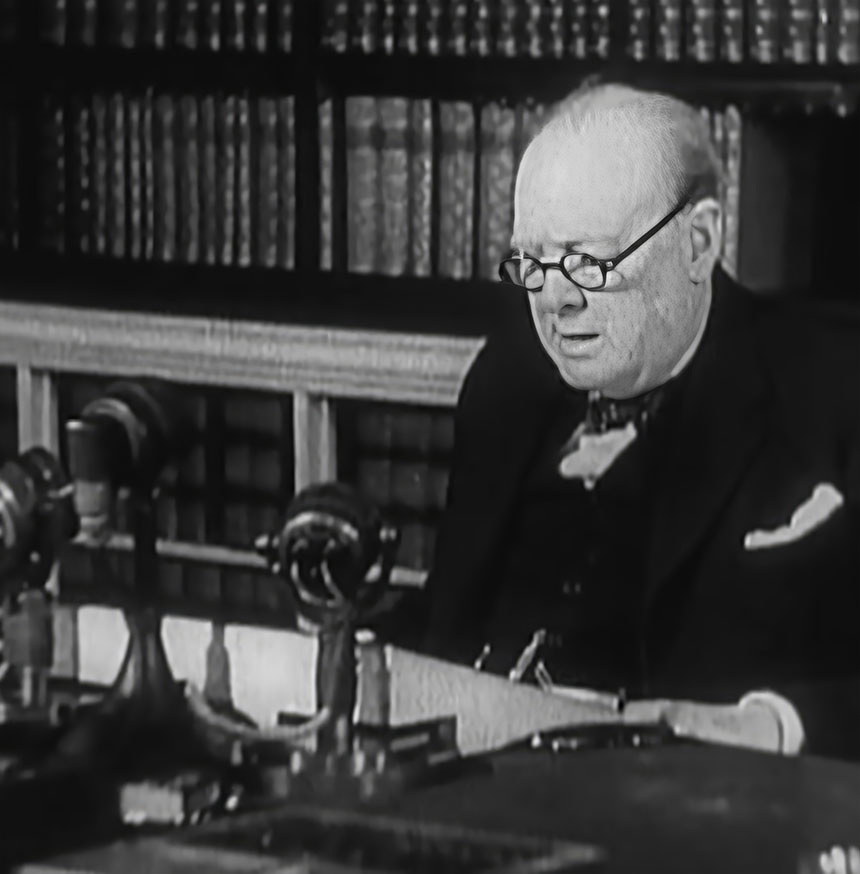
Where is our Churchill?

Today, do we have our Churchill and our Roosevelt?

We do not, and that is one of the most terrifying aspects of our problem. Instead we have Donald Trump and Vladimir Putin.

Most people, like me, are watching from the sidelines, feeling powerless and disoriented. Some good people choose to shut all this out to focus on their own families and their own struggles. I don’t blame them.

But some of us, like the worried people gathered around their radios in 1943, crave to know what is going on.

Though some of our media — the responsible media — do a remarkably good job, they cannot cover everything. The American media are under huge pressure not only from the Trump White House, but also from their corporate owners.

Our tools are better now

Fortunately, we ordinary people have access to technologies that were science fiction in 1943. We have a global network. We have powerful computers. We have AI. The enemies of democracy use all those things. We enemies of authoritarianism can use them, too.

Those technologies certainly include AI, though there is a trend — I think it is a prudish and misguided trend — to reject and disparage the use of AI. My attitude is that we should use AI for everything it’s good for, while being clear and up front about how we use it.

In 1943, radio was a new technology. Shortwave radio could reach across continents and oceans. The BBC, with its many transmitters, was heard round the world during World War II, translated into many languages. But Europeans weren’t limited to the BBC. Germany and Russia broadcast their propaganda in English during the war. Other countries also had radio stations — Italy, France, Switzerland, Sweden, Belgium, and even the Vatican.

Listening to propaganda, and paying attention to news from afar, is an important part of modeling the world, whether now or in 1943. With AI, translation is no longer a problem.

The Acorn Abbey global news digest

In that spirit, Acorn Abbey is going live with a new, automated system for monitoring propaganda and news from afar. There are links on the page for this.

How it works is complicated. But, today, Claude can write complicated programs for us. Acorn Abbey’s global news digest is built with more than 12,000 lines of Claude-written computer code, running on Acorn Abbey’s servers.

Acorn Abbey’s mainstream digest is built on data retrieved from GDELT, a sophisticated open-source system which constantly monitors thousands of news outlets in more than 100 languages, yielding about a quarter of a million articles a day. Acorn Abbey’s system retrieves updates from GDELT every 15 minutes.

Acorn Abbey’s unofficial digest comes from the Russia-centered Telegram network. GDELT does not monitor social media, so Acorn Abbey’s code monitors Telegram directly, typically 1,500 posts a day. Posts that are not English are machine-translated by Acorn Abbey’s code.

Both the mainstream digest and the unofficial digest are written by Claude AI, working from many megabytes of data handed to it by the programming that gathers, translates, sorts, and does preliminary analysis on the data, based on criteria determined by Acorn Abbey. A key part of the mainstream analysis is quantifying how much attention an event is getting in international media.

What to focus on

Acorn Abbey could as easily have built a system for monitoring global attention to cats, or taxation, or even the environment and climate change. But we are in the middle of a war for global democracy, so that is what Acorn Abbey’s system is designed to monitor at present.

This is not meant as a substitute for the sources of information that we already use. Rather, it’s meant to fill in the gaps. Most of us don’t have any means of monitoring newspapers in Ukraine, Lithuania, Poland, Iran, Denmark, Tel Aviv, Berlin, Rome, or Bogota. But GDELT monitors those countries and many more, and, through GDELT, Acorn Abbey’s programming has access to all that data.

Acorn Abbey’s global news digest has been operating in test mode since early October. Refinements will continue. The pages are automatically generated once a day, around 6:30 a.m. Eastern time, from data collected during the previous 24 hours.

My blog posts here reflect my own values and political views. Acorn Abbey’s global news digest, though, is designed to take no side. It reports only on what it finds.

We are living through a counter-Enlightenment. A tiny global elite with vast wealth and authoritarian power sees an opportunity to take over the world — or at least big parts of the world — and run that world for their own profit and power, without interference from the rest of us, and in opposition to every noble thing the Enlightenment stands for. Warfare has drastically changed in the last 80 years. But this is war. And technology has developed new forms of shortwave radio.

The exploitability of the deplorables


Jim Bakker died on October 5 at the age of 86.


It probably was Jim and Tammy Bakker who first showed the world that there are millions of suckers who are so simple and so morally vacant that con men in makeup can strut and crow and mug right in front of them and the suckers will believe they’ve seen a vision of godliness and leadership.

Though con men preachers had existed for ages, it was television that made it possible to reach the sucker population in numbers great enough to support corporatized exploitation. There is a straight line from the first Christian television stations to Fox News to Donald Trump in the White House.

Though anyone with normal cognitive ability could watch the Bakkers on TV and detect within 30 seconds that they were clowns on the take, the deplorables sent the Bakkers $1 million a week.

In 1985, as the law was catching up with the Bakkers, Rupert Murdoch was starting to put together his cable network, having recognized the economic and political possibilities of both monetizing and weaponizing the deplorable population. Fox News was born in 1996.

Changes in technology combined with diabolical development in the science of propaganda made mass deception not just costless, but profitable. Thanks to the political weaponization of the deplorables with these new technologies, it took only about twenty years for billionaires, backed by the deplorables, to take over America and start systematically looting the country. Compared to the right-wing elite now looting the country, Jim and Tammy Bakker were pathetic pikers, raking in mere millions rather than billions and trillions. But they were pioneers.

In 1989, we were still a country that could put someone like Jim Bakker in prison. Let’s hope we still are.

What percent of Americans are crazy as a betsy bug?


Source: Wikimedia Commons

A new poll by the Associated Press and NORC at the University of Chicago gives us a solid estimate of the size of two species of dangerously clueless Americans. Let’s do the math.

Species 1 contains the completely clueless betsy bug Americans who still think that Trump was sent by God. They’ll probably go to their graves thinking that Trump was sent by God.

Species 2 contains the Americans who are so dense and gullible that they fall for Republican deceptions, and vote for the likes of Trump, until something like the price of gasoline gets through to them.

Species 2 is just as dangerous as Species 1. They’re the reason why it will be hard for the United States to win back the trust of the civilized world after Trump is gone. The civilized world won’t forget that Americans voted for Trump not once, but twice. That’s reasonable grounds for concern that such a thing could happen again.

I think that a reasonable analysis of the poll shows that the size of Species 1 is about 15 percent of American adults. However, that 15 percent votes, and when they vote they make up about 24 percent of the vote in a presidential election.

As for Species 2, the highest percentage of the vote that Trump ever got (in 2024) was 49.8 percent. So the size of Species 2 is a whopping 26 percent of the voting population.

Each group is about a quarter of the voters. Together, they’re half the voters. They’ve never added up to more than 50 percent of the popular vote, but the 49.8 percent in 2024 translates to 312 vs 226 in the Electoral College, a horribly regressive quirk in the American system.

Here we should keep in mind that 36 percent of Americans eligible to vote did not vote in 2024.

So how do we get our democracy back?

Species 1 are the eternally damned. There is no way to reach them.

As for Species 2, we have to hope that they learned a lesson at the gas pumps that they’ll remember for a while.

As for those who didn’t vote in 2024, it’s a good thing that they didn’t. Polls by Pew Research have shown that non-voters in 2024 actually preferred Trump, 44 percent to 40 percent. Let’s call the Trumpy non-voters Species 3.

So if you add Species 1, Species 2, and Species 3, and if all of them had voted in 2024, then Trump would have won by an even bigger margin.

No wonder the civilized world no longer trusts Americans. Half of the American population are a loaded weapon with the Republican Party’s finger on the trigger.