Jefferson the foodie


Monticello

Salon magazine has a nice article about how Jefferson was America’s first foodie.

I sure would like to know what the sources are for all this information about Jefferson. My guess is that it’s scattered throughout Jefferson’s letters and diaries. I’ve read two biographies of Jefferson in the last year, and though there are passing references to Jefferson’s vegetable garden, there’s not much else.

Of the founding fathers, Jefferson is my favorite. He was a Southerner and proud of it, but he didn’t let that close his mind to the larger world. His values were Enlightenment values, not the Puritan values that stank up the political environment then, as now. He loved languages. He loved science and technology. And best of all, he never stopped being rebellious. He was as much a rebel when he died (at age 84) as when he wrote the Declaration of Independence.

Jefferson’s cuisine was a fusion cuisine: Southern comfort food fused with Mediterranean, and wine rather than whisky.

Oh what I would give if it were possible for Thomas Jefferson to write an op-ed in today’s New York Times, wielding his rhetorical light sabre against the Puritans, corporatists, Philistines and know-nothings who have bought the government.

Know your farmer? Not if she can help it…

There is no creature in the U.S. Congress more vile, more black-hearted, more ignorant, and more determined to horse-whip us all back to the Dark Ages than Virginia Foxx. I am ashamed to say that she represents my district, the 5th District of North Carolina.

She’s always up to no good, in service of corporate greed and pandering to the fears and prejudices of the ignorati. Her most recent deed was to introduce an amendment that would shut down a U.S. Department of Agriculture web site known as the “Know Your Farmer, Know Your Food” initiative. Though the web site has no real budget to take away, its purpose is to lend a little support to small farmers and local markets. Foxx thinks that’s a bad idea, you see, because she doesn’t want any competition for corporatized, industrialized agriculture. There’s nothing that free-marketers hate more than any attempt by groups of citizens to band together to supply their own needs. Consider, as an example, the right-wing North Carolina legislature’s recent approval of a new statute that would prevent rural communities from setting up their own broadband systems. When groups of citizens dare to “compete with the private sector,” these libertarian types elected with corporate money just pass a law against it.

Tom Philpott blogs about this at Mother Jones.

Foxx is from up near Wilkes County, which is one of the largest producers of factory chickens in the United States. It’s this proximity to factory chicken farms, apparently, which qualified Foxx to sit on the agriculture committee, including a poultry subcommittee.

Here’s a link to the web site Foxx wants to shut down. Foxx does not approve of its mission: Support local farmers, strengthen rural communities, promote healthy eating, protect natural resources.


Where corporate chicken comes from

A meteorologist's roundup of wretched weather


My ever-empty rain gauge

The high temperature here today was 94 degrees. The normal for this date is 86. In the last month, I’ve had half an inch of rain. Lots of things are turning brown. Even the squash are wilting. High temperatures alone wouldn’t be so frightening, if there was rain. It’s the combination of hot and dry that is life-threatening. Crops will grow in hot and wet. Crops won’t grow in hot and dry.

Under these circumstances it’s a depressing time to read this roundup of extreme weather by Jeff Masters at Weather Underground. These are not climate predictions that right-wingers can say are lies. It’s just real, measurable weather, compared with the weather we used to have. Last year, remember, tied with 2005 for the hottest year on record.

From Masters’ post:

“The pace of incredible extreme weather events in the U.S. over the past few months have kept me so busy that I’ve been unable to write-up a retrospective look at the weather events of 2010. But I’ve finally managed to finish, so fasten your seat belts for a tour through the top twenty most remarkable weather events of 2010. At the end, I’ll reflect on what the wild weather events of 2010 and 2011 imply for our future.”

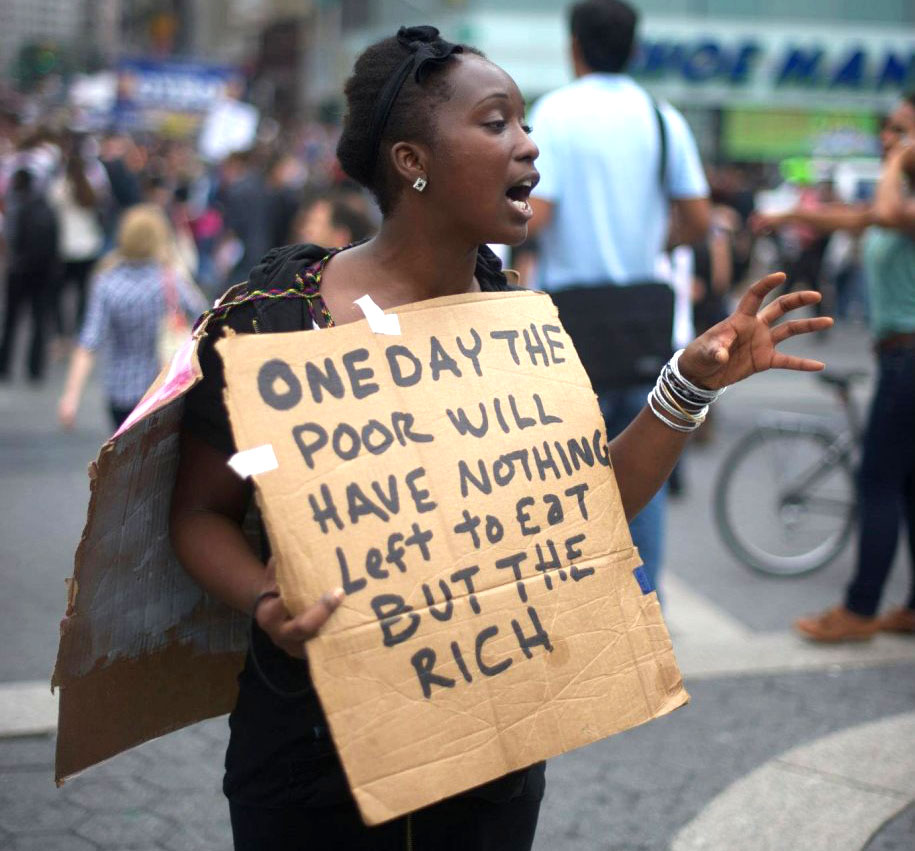
Mobs?


Greece, this week (Der Spiegel)

Yesterday, while browsing for books at Amazon, I came across the title of Ann Coulter’s newest book: Demonic: How the Liberal Mob Is Endangering America.

I have long been a student of propaganda, but reading an Ann Coulter book is farther than I’ll go. Besides, ideologues like Coulter are easy to model because their ideologies are always so black and white, so cut and dried, and so predictable. Look at what the title alone tells us. The authoritarian right-wing mind demonizes what it fears, literally. And it always, always sees a threat.

But insofar as I understand the point Coulter is trying to make from reading a few reviews, she’s actually right — if you’re on the side of authority, the status quo, and ruling elites who won’t allow justice without a fight. As Voltaire said, “The comfort of the rich depends upon an abundant supply of the poor.” Voltaire died in 1778 and so did not witness the French revolution, but he understood what the revolution was about. Coulter sees in the French revolution the roots of today’s “liberal mob.” What kind of knots of revisionism she ties herself in to make the American revolution sacred and the French revolution evil must be a thrilling and instructive piece of propaganda production, but I’m still not going to read the book.

In any case, Coulter reveals the deepest fears of the authoritarians who have now nearly completed their takeover of the American democracy. Having bought and captured the institutions of the American democracy, now all they have to fear is the mob.

I’m afraid they’re right.


Selma, Alabama, 1965


Berlin, 1989


Tianenmen Square, 1989


Poland, 1980


White Night, San Francisco, 1979


India, 1931


Kent State, 1970


Kent State

Unbearable weather


Panting chickens


Wilted beets


Dying cabbage

I try to honor a policy of never posting when I’m angry. Once again my anger has got the best of me.

After a cool, wet May, soon it will be three weeks since I’ve had any rain. During this time, day after day, the temperature has gone into the 90s. Today the high was 97F. A storm appeared out of nowhere up in Virginia yesterday evening, and it moved south and gave Surry County to the west of me a nice soaking, but I didn’t get a drop. That alone makes me angry — when I watch thunderstorms on radar that miss me by a few miles.

But it goes beyond that. Weather varies wildly from year to year and month to month, and always has. I know that. But this simply can’t be normal. When I was a child in the Yadkin Valley, I was around crops and gardens every summer. Sure there were dry spells and lost crops. But I don’t remember gardens drying up and dying every year, summer after summer. Because of the hit or miss nature of summer thunderstorms, some people will have good luck and others will have bad luck. But increasingly I’m afraid that no one will be able to garden consistently and successfully without some source of irrigation. I’d happily irrigate from a pond or a stream if I had one near enough. I don’t. I’ll use well water sparingly to revive the celery or keep a newly planted shrub alive, but well water is not the answer. It’s just wrong, and it’s unsustainable.

I expect next year’s weather in the U.S. will be just like this year’s: some places will flood, and others will parch. Some places will dry up, others will blow away.

My beets, cabbages, celery, and kale are done for. If I spritz them with water in the evening, they perk up enough to be harvested in the morning, so it won’t be a total loss. If it rains soon, most of my tomatoes and squash will survive, but the tomato leaves are starting to curl, and the squash is starting to wilt.

This morning Thomas Friedman — who as far as I’m concerned has devolved into a stopped clock when he writes about foreign affairs — has a pretty good column with the headline “The Earth Is Full.” He interviews Paul Gilding, an Australian who recently published a book, The Great Disruption: Why the Climate Crisis Will Bring On the End of Shopping and the Birth of a New World. Gilding gathers data on the brutally excessive demands we’re making on the earth’s natural systems.

Gilding is optismistic. He says, “We are heading for a crisis-driven choice,” he says. “We either allow collapse to overtake us or develop a new sustainable economic model. We will choose the latter. We may be slow, but we’re not stupid.”

Oh we’re not, are we? I beg to differ. Americans are incomprehensibly thoughtless and ignorant, and they show no signs of rethinking their lifestyles or levels of consumption. Just the other day I gritted my teeth as one ignoramus said to another ignoramus at the gas pump, “We’ve got enough oil for 2,000 years.” The other replied that all we needed to do was get the environmentalists off our backs so we could do more offshore drilling, and that would solve the problem. I know where they hear this stuff: from the shouting heads on television who are paid handsomely to retail corporate and right-wing propaganda. One good thing about the current recession is that consumption is down. But if we ever pull out of this recession, Americans will expect to go right back to their old levels of waste and consumption.

Ken recently quoted Lew Rockwell, a libertarian and chairman of the Ludwig von Mises Institute in Alabama, a right-wing propaganda tank. Rockwell said:

“I spritzed some hairspray at the sky (not having enough hair to justify pointing it at me), used up a whole roll of paper towels, turned the refrigerator thermostat down, mixed newspapers with my garbage, filled up my car at an Exxon station, turned on all the lights, and took my daughter to McDonald’s for cheeseburgers, since they still had those nice, clean styrofoam containers. Unfortunately, it wasn’t cold enough to wear my fur hat.”

And:

“Chicken or chicory, elephant or endive, the natural order is valuable only in so far as it serves human needs and purposes. Our very existence is based on our dominion over nature; it was created for that end, and it is to that end that it must be used — through a private-property, free-market order.”

That last idea, of course, is a religious idea, and it comes from America’s dominant religion. And his rabid anti-nature attitude isn’t just ignorant, it glories in its ignorance. The appeal this kind of talk has for the American ignorati and the blindly religious is enormous. And those masses of Americans, of course, are exactly the target the propaganda is designed to reach.

I wish there was some other planet for those people to go live on. Then we might have a chance at saving the Earth.

Our sorry species doesn’t deserve a beautiful water planet like Earth. If we left it to the chickens and the chicory, the elephants and the endive, they’d take care of the Earth. They’re not as stupid as we are.

Got a revolution?


Jefferson Airplane, Woodstock 1969: Got to Revolution

I am dumbfounded at the passivity of today’s young people, particularly recent college graduates. If they got any education at all for the money they spent on a college education, then they ought to be able to see that they are among the designated losers in an already almost-lost class war being waged by the corporate and political elite against the people of America.

My generation would never have put up with it. Even if we lost the struggle, we’d be in the streets raising raising hell and having a good time at it. To quote Jefferson Airplane from the song they sang at Woodstock in 1969:

Look what’s happening out in the streets
Got a revolution got to revolution
Hey I’m dancing down the streets
Got a revolution got to revolution
Ain’t it amazing all the people I meet
Got a revolution got to revolution
One generation got old
One generation got soul
This generation got no destination to hold
Pick up the cry
Hey now it’s time for you and me
Got a revolution got to revolution
Come on now we’re marching to the sea
got a revolution got to revolution
Who will take it from you
We will and who are we
We are volunteers of america

The statistics are appalling. Surveys show that 85 percent of this year’s college graduates will be forced to move back home with their parents. Their average student debt is $27,200. Data from the U.S. Bureau of Labor Statistics shows that at least half of college-educated people under age 25 are unemployed or working for low wages in dead-end jobs such as bartending. A survey showed that 71 percent of recent college graduates wish they’d done something differently while they were in school to better prepare for the job market. In other words, they’re blaming themselves.

I already detect that some young readers are about to click the comment button and say that this is a generational problem: That my generation, which grew up in the ’60s and ’70s, got all selfish and self-indulgent as we aged, in spite of our youthful idealism, and that we screwed up the world. Don’t bother, because that’s just right-wing propaganda. The vast majority of we Boomers who grew up in the ’60s and ’70s worked our butts off all our lives to raise the generation that’s now moving back home. The tax money we Boomers paid out was the greatest source of revenue this country ever had. This was not a generational failure, this was a right-wing project: To capture the government and regulatory agencies to serve corporate interests, to shift the tax burden down, to redistribute income up, to starve the schools and the social safety net, to shift government expenditures toward profitable business projects such as war, to privatize profits and socialize costs, and to saturate Americans with propaganda so that we blame the poor, the hard-working, and the weak for the country’s problems while building right-wing hero myths around weak-minded, sociopathic pipsqueaks like Ronald Reagan and George Bush.

Right-wingers say that the country is broke. Ha! The United States is richer than ever, so awash in cash that new speculative bubbles may again be forming. Corporate profits are at record highs. The rich are richer than ever, and paying far less in taxes than they used to. There is plenty of money, but all the gains are going to the top. In Reaganomics, you’ll remember, that was the excuse for reducing taxes on the rich and ending regulations on corporations and Wall Street — it would create jobs. How’s that working out for you, recent college graduates? And how do you like the new line that’s coming out of the corporate propaganda machine, that college degrees are a hoax? That’s the new propaganda line: It’s not that economic elites are capturing all the new wealth and productivity gains, it’s that college degrees are a hoax.

Each year, about 3.2 million young people graduate from American colleges and universities. There must now be millions of college-educated young people unemployed and/or living at home. What the devil are they doing with all that free time? If they organized themselves and took to the streets, they all by themselves would have the power to take back the American democracy from corporate control and to get this country’s wealth back into the hands of the people who produce it rather than the greedy, unproductive hands of those who skim, scam, exploit, and tax-avoid their way to the top.

How I wish that today’s young people would start raising a little hell and pushing back against the elites who’ve eaten their lunch and offshored their future. Taking to the streets and civil disobedience are very effective strategies. Right-wingers know this. That’s why rich oilmen like Charles and David Koch pay good money to organize those fake little made-for-TV Tea Party rallies.

If you’re looking for an organization to get started with, consider U.S. Uncut. They’re a sassy new disobedient but non-violent organization going after greedy corporations and the corporate capture of government. They need help starting local chapters.

You don’t even have to have a revolution. You only need to claw back the American democracy from the corporate forces that have bought it with their obscene profits, and shout down the lies of the right-wing propaganda machine.


Right-wing propaganda update: This is from a transcript of Rush Limbaugh’s radio show yesterday:

LIMBAUGH: Young people are moving back in with them. Their moms and dads! And some of these people moving back in are 35 and 40. How old are their moms and dads? 60 and 70, try. But they’re 60 and 70 and if they can afford their worthless offspring moving back in with them, just how poverty-stricken are they?


Another update: Ken Ilgunas has written a response to this post on his blog, “Why aren’t we revolutionaries?

In Wisconsin, the farmers join in


Milwaukee Journal Sentinel

The protests in Wisconsin are growing, and now the farmers have joined in. The Crooks and Liars blog mentions this telling commentary from a Fox News shouting head who thank goodness I’ve never heard of, Jay Townsend:

TOWNSEND: I take away this. Number one, elections have consequences. Number two, unions will never have any trouble renting a riot, and number three, when you gore that pig and wound it, it can make a lot of noise, and that’s the message I would take out of this.

So Townsend would have us believe that these 100,000 people, including the farmers, were rented, the way a few busloads of Tea Party protesters were rented by the Koch brothers. He also reveals that he believes that working people — or at least unionized working people — are pigs. He calls it a riot, which it wasn’t. And he reveals his hypocrisy about elections: Elections have consequences when Republicans win them, but elections are illegitimate when anyone else wins.

What I take away from this is that right-wing propagandists are angry, frustrated, and even a bit scared, because they’re forced to face the fact that their state-of-the-art propaganda doesn’t work on everyone. This must truly frighten the right wing, because they know that they can’t win elections without deceiving large numbers of voters. Having overplayed their hand in Wisconsin, they now face the possibility of recall elections and a massive, reality-driven backlash in which their propaganda has stopped working.

Decorporatizing your life


Fritz Lang’s “Metropolis”

One of the many puzzling things about today’s political environment is why so many of the people who distrust government think that corporations can do no wrong. My view is that out-of-control, anti-democracy corporations are far more dangerous than government.

Mind you, I don’t want to totally demonize corporations the way some people totally demonize government. Corporations, if they are reasonably regulated, can do lots of good things — make iPads, for example. But as corporations get richer and more powerful, they want a weak government. They will use their resources, if they can, to take over the government. They will use propaganda to demonize government and keep lots of people from seeing what they’re up to. That is what is happening in the United States today. Corporations are well along in their plan to weaken our government and our democracy and bring about their vision of a dog-eat-dog, corporatized, free-market utopia.

If corporations get their way — and increasingly they are getting their way — government will be powerless to stop them. Already our democracy is too weak to restrain corporations. The Congress regularly passes bills that the majority of Americans clearly don’t want. Instead, Congress passes the bills that corporate lobbyists and big-buck campaign donors want.

What can we do, on our own, to get back at corporations when our democracy fails us?

Here are some suggestions.

1. Get out of debt as quickly as possible, and stay out of debt. Not only will corporations bleed you dry on the costs of servicing your debt, debt limits your choices. It keeps you on the treadmill. It forces you to remain a slave indentured to corporate power. Your debt lets them treat you like a dog, while you are powerless as long as you owe them.

2. Don’t sign contracts. Contracts with corporations these days rarely benefit the little guy. They benefit the corporations. Consider your cell phone contract, for example. You got just a cheap phone out of the deal. The corporation locked you into a long money stream and prevented you from taking advantage of competition.

3. Build up your savings. We need savings to get through unexpected crises, such as loss of a job, or a costly illness. Many people lose their homes to foreclosure, for example, after losing their job or getting sick. With no savings, they are at the mercy of every corporation that has a claim on them. And corporations have no mercy.

4. Spend your money as close to home as possible. Corporations suck money out of our neighborhoods, where it ends up as profits for Wall Street to be invested abroad. If you eat at a chain restaurant, for example, the money goes to Wall Street. But if you eat in a neighborhood restaurant, the money stays in your neighborhood, with your neighbors. Support your local farmers and farmers markets!

5. Cut your consumption. Most Americans buy all kinds of junk that they don’t need. See the Story of Stuff. Buying useless stuff is a waste of your money. It ends up as just more trash in our landfills. And it makes corporations fatter.

6. Don’t let them snoop on you. Corporations see the Internet as a wonderful new way to snoop on, and brainwash, consumers. They’ll track everything you do on the Internet, if you let them. You’ll find articles here and elsewhere on what you can do to prevent this.

7. Don’t let them scam you. Increasingly, diluted regulations and lack of government oversight let corporations scam you, legally or not. There are all kinds of scams, particularly having to do with borrowing or investing money. Half of the junk mail I get has a whiff of scam about it. The housing bubble and bust came about largely because of scams, some of which are actually legal in our deregulated business environment.

8. Don’t let them push you around. Is your bank pushing you around with high fees? Did the dealer try to tack on hidden fees when you bought a car? In how many ways is your credit card lender abusing you? When they try to pull a fast one on you, be smart and push back. Don’t let them take you for even so much as a penny. It’s a matter of principle.

9. Don’t believe their advertising and public relations. Corporations spend billions of dollars to make us think they’re nice. Oil companies, for example, love to make commercials about how “green” they are. It’s all bunk.

10. Cut off the propaganda. Virtually everything on radio, television, and cable these days is propaganda. At the very best, it’s low-grade information or mere infotainment. Those people who get their “news” by watching television are guaranteed to be ill-informed and besotted with propaganda. Not only that, but people like Rupert Murdoch make billions of dollars selling propaganda to people on his cable networks. Americans actually pay for their propaganda! Cut off your cable or satellite TV. The only way to be well-informed is to read, not to watch.

11. Don’t outsource to corporate America what you can do for yourself. Every time you take a ready-made supper dish out of your freezer and pop it in your microwave, you’ve outsourced your cooking to a corporation. Your supper cost you five or ten times as much as it should have. You ate all kinds of chemicals and cheap ingredients. A corporation got the profit.

12. Remember co-ops? Back in the 1970s, when health food stores were less common and before chains such as Whole Foods existed, there were many food co-ops. People got together, bought foods in bulk, and distributed the food, at cost, to the members of the co-op. I would love to see a resurgence of co-ops. Meanwhile, remember that credit unions are co-ops and are an alternative to banks. The Farm Bureau is a non-profit co-op, and it sells insurance. Look around for co-ops and non-profits that you might be able to shift your business to.

13. Support regulation and fight the corporate agenda. Don’t believe the corporate propaganda about the evils of regulation. In the real world, as opposed to the imaginary free-market utopia imagined by idealogues, it’s obvious that, if unregulated, corporations rapidly move toward predation, monopoly, and, eventually, oligarchy — which is pretty much where we are already in the United States. Corporations will always do everything they can to privatize profits and socialize costs. They don’t want their profits and sky-high executive salaries messed with, but they love bailouts. In Ireland, corrupt, corporatized politicians actually shifted the entire cost of the Irish bank bailout to Irish taxpayers. In the U.S., at least we mostly lent the bailout money to the banks. In Ireland they actually gave it to the banks. Corporatists, emboldened and empowered by the 2010 election, are pushing a nasty agenda: Rolling back environmental regulations, weakening unions and pushing wages down, continuing the takeover of public assets, continuing to shift the tax burden away from corporations and the rich to working people, weakening and starving the public school system, and so on. They’re winning, even though the public don’t support these things.

14. Rethink your career plans. If you’re young, how you make your living for the next 20 or 30 years can make a huge difference. Can you start your own business? Might you be able to work for a non-profit? I learned that there were many benefits for working for a private corporation rather than a corporation owned by Wall Street. Private corporations often take better care of their employees, because they don’t have to play games every quarter to try to keep Wall Street happy. Where you make your money is as important as where you spend it. Granted, working people in today’s post-industrial economy don’t have a lot of choices. But if you do have choices, go for it.

15. Roll back the clock. I would never argue that corporations have not improved our lives. In some ways, they have. That, after all, is why corporations exist — to supply some human need, something that can be done only with the combined effort of lots of people and specialized knowledge (like building airplanes, for example). But the problems occur when we, without thinking, let things go too far. So spend some time thinking about how corporations have brought you benefits but how they’ve also caused you harm. Did you buy tobacco from them? I hope not. Are you overweight because you eat too much corporate food? Have you become so dependent on television that you no longer know how to entertain yourself or your children? Have you failed to learn basic human skills, skills that your parents and grandparents once had, because you’ve become too dependent on corporations? How can you, in your life, roll back the clock to the time before corporations were out of control?

I leave you with a famous quote by Robert A. Heinlein. It’s from Time Enough for Love:

“A human being should be able to change a diaper, plan an invasion, butcher a hog, conn a ship, design a building, write a sonnet, balance accounts, build a wall, set a bone, comfort the dying, take orders, give orders, cooperate, act alone, solve equations, analyze a new problem, pitch manure, program a computer, cook a tasty meal, fight efficiently, die gallantly. Specialization is for insects.”

Heinlein is considered to have been a libertarian. But it wasn’t just government that helped us lose all this knowledge and give up so many choices. It was corporations.

John Twelve Hawks and the Vast Machine

twelve-hawks-cover.jpg

It’s been a long time since I’ve kept up with what’s new in science fiction. In the early 1980s, I ran a very popular and very literate computer bulletin board (remember those?) called Science Fiction Writers Network. Some of the big names were regulars there, including most notably Orson Scott Card, who won both the Nebula and the Hugo awards for his 1985 classic, Ender’s Game. I even helped throw a congratulatory dinner for Card to celebrate. What a Golden Age that was.

And what an innocent age it was, when only nerds had computers and knew what to do with them. A friend of mine used to shake his head at me when he saw me in front of the computer, saying, “One of these days it’s going to tell you what to do.” It was a joke then, but he was right: Our computers have been turned against us.

That is the theme of John Twelve Hawks’ Fourth Realm Trilogy. The books are The Traveler (2005), The Dark River (2007), and The Golden City (2009). The Traveler was a New York Times bestseller. A little Googling reveals that 20th Century Fox is making a film version of The Traveler, for release, I believe, in 2012. I was too distracted by my job responsibilities in San Francisco to notice these books when they first came out. But the buzz about good books continues long after they’re released, and eventually you hear about them. Plus, if you wait, you get to read the whole trilogy straight through, instead of having to wait for the next book. I became aware of John Twelve Hawks’ books from a comment on my recent post about privacy on the Internet.

All summer, I’d been hankering for a fast-moving science fiction thriller, a hot read. John Twelve Hawks’ trilogy really hit the spot. I rushed through the three books in not much more than three weeks because I didn’t want to put them down.

The story is set in the here and now. The plot has to do with what Twelve Hawks calls “the Vast Machine” – the international system of surveillance and computer snooping that now spies on all our lives, in the name of security. The main character, Gabriel Corrigan, comes to understand who is spying on us and why, and he sets out to defeat “the Vast Machine” and organize resistance to it.

Twelve Hawks’ writing style is very cinematic, with the characters always on the move from city to city or in exotic places such as the underground rivers of London or the rocky skelligs off the west coast of Ireland.

John Twelve Hawks is a pseudonym. His identity is not known, and he lives off the grid. He communicates with his editor using the Internet or over an untraceable satellite phone with a voice scrambler.

There is a long history of fiction that draws our attention to the state of the real world. The most obvious example, of course, is George Orwell’s 1984. Much of Charles Dickens’ work is in this category. Dickens’ brought some reforms against the horrors of 19th century industrial England: its squalor, its filth, its debtors’ prisons, and its wretched working class. Visionary authors often see these things before the rest of us.

Cui bono?

If I have a complaint about John Twelve Hawk’s books, it’s that he limits his theme to issues of surveillance, Internet snooping, and the secret databanks that know who-knows-what about all of us. As I see it, the people who are bringing us the Vast Machine have a much larger agenda having to do with corporate exploitation of people and resources, corporate usurpation of government, and endless war. Twelve Hawks knows that the stuff on television is not news but is, rather, a pig circus of propaganda created to distract us, misinform us, and turn us into insatiable consumers.

What in the world is really happening today? Most people have no idea. The international intelligentsia are well aware of the fact that Americans are now the most propagandized people in the world. The people of the former Soviet Union at least knew that they were being fed propaganda, and some of them were quite skillful at working out whose interests the propaganda served. But in the United States today, Americans relish their propaganda and actually pay to get it (through their huge cable bills), and propagandists make enormous profits. The meat and potatoes of American propaganda is Rupert Murdoch’s Fox News. Though it’s run by Roger Ailes, a media consultant for three Republican presidents, and though Fox News actually has contributed to right-wing political campaigns, and though, to my lights, Fox has been wrong about everything that matters since it came into existence in 1996, a poll in January 2010 found that Fox is the most trusted of the television news networks (49 percent trust Fox). This blows my mind. I often think that the ignorance of the American ignorati is as incomprehensible to the intelligentsia as the intelligence of the intelligentsia is incomprehensible to the ignorati. But that is how propaganda works. It flatters ignorance, appeals to prejudice, stokes fear, makes everything simple and black and white, and is always going on about god. By the way, it was not Sinclair Lewis who said, “When fascism comes to America, it will be wrapped in the flag and carrying the cross.” But whoever said it (Harrison Salisbury?) was right.

I was amused a while back after I left a comment on a newspaper web site making fun of the spectacular wrongness of someone who was repeating Fox News talking points. He shot back at me an insult about what I “watch” to get my news – some loony left network like CNBC or MSNBC, no doubt, he said. What I found amusing was that he thinks I “watch” something on cable to get news. In fact I don’t watch anything at all. I read.

Most Americans have neither the time nor the skills to try to figure out what’s really going on in the world today. Even the Tea Party crowd, though they are blinded by propaganda, sense that something is terribly wrong. But because they watch so much corporate and right-wing propaganda on Fox they get everything exactly backward. Government is not the problem. Corporate power and corporate greed are the problem. Corporate propaganda constantly demonizes government, because government (including the judiciary) is the only entity that has a chance of restraining corporate corruption, corporate predation, corporate exploitation, and the corporate takeover of government.

This corporate takeover of government may be almost complete, as is clear from the difference between Barack Obama’s campaign rhetoric vs. the way he has actually governed. No backroom deals, said candidate Obama. And then one of the first things he does as president is meet secretly with the health insurance industry to make sure that health care reform is a bonanza for corporate interests. Candidate Obama talked about the importance of “net neutrality” to prevent corporate domination of the Internet, but recently we learned that President Obama’s FCC was meeting secretly with Google and Verizon to work out deals that would permit corporations to strangle the Internet to get obscene profits by turning the Internet into yet another delivery system (like cable) for corporate propaganda and brain-dead entertainment. All that subversive, independent stuff would be pushed aside, starved for bandwidth, and drowned out. The Washington establishment is always talking about “stakeholders.” The stakeholders are always corporate, and the important meetings are always secret.

Open source intelligence

How does one get past the propaganda? First of all, one turns off one’s television. And then one becomes a practitioner of open source intelligence. Ironically, the same Internet that permits corporate and government snooping on private citizens is the best tool we have for open source intelligence. That is one of the reasons that corporate interests want a corporate takeover of the Internet – we’d have to consume what they throw at us, while our ability to seek our own sources would be strangled. The kind of sources that can inform an open-source understanding of the state of the world are the kind of sources that Fox-watchers are usually completely ignorant of. When these open sources do get media attention (for example, WikiLeaks), the propaganda machinery will immediately step in to demonize it, marginalize it, and, if possible criminalize it. Because elites now work almost entirely in secret (while denying privacy to the rest of us, as John Twelve Hawks points out), leaks from whistleblowers are now our best hope for breaking through the razor wire of secrecy behind which elites hide.

Though the daily newspapers in the United States are now little more than zombies, there are still organizations and people with a commitment to truth. An important part of an open-source regimen are books and articles by authors who haven’t sold out or become lazy.

For example, Janine Wedel’s Shadow Elite: How the World’s New Power Brokers Undermine Democracy, Government, and the Free Market, helps us understand how, because of privatization and outsourcing, the public and private sectors have been blurred so much that corporations now write their own regulations. Wedel also showed us what the Neocon cabal which brought us the invasion of Iraq has in common with the elites who “privatized” public assets and seized money and power in the breakup of the old Soviet Union.

Naomi Klein, in a magisterial article in the September 2004 issue of Harper’s, “Baghdad year zero: Pillaging Iraq in Pursuit of a Neocon Utopia,” shows us how the invasion of Iraq was a business product, jointly created by government and corporate forces, in which the publicly owned wealth of Iraq (mostly oil) was to be divided up among corporate players, with the intention of turning Iraq into a utopia of deregulation and profit. The profits would be private, of course, and the costs were to be socialized and paid for by the American people. The fact that people would die (thousands of Americans and hundreds of thousands of Iraqis) meant nothing. Everything they said to sell the war was a lie.

The Washington Post is a zombie, but they got in a rare good lick with the recent series, “Top Secret America,” in which they show just how vast, secretive, and costly is the surveillance and snooping machinery put in place after 9/11. Nor is this mostly a government apparatus. Much of it is outsourced to private interests and corporations that reap huge profits while gathering, and abusing, data on private citizens.

In John Twelve Hawks’ plot, the elites who control the Vast Machine actually create crises to scare people and make people more willing to accept constant surveillance. There are, of course, all sorts of conspiracy theories about 9/11. But even if those 9/11 conspiracy theories are fevered and false, it is nevertheless true that elites have learned to use crises to gain more power, as Naomi Klein shows us in The Shock Doctrine.

Rolling Stone magazine, with reporter Matt Taibi’s “The Great American Bubble Machine,” brought us much new information about how Wall Street, with its allies in government, ripped us off first with the financial bubble and then again with the bailout.

In the Aug. 30 issue of The New Yorker, Jane Mayer unmasked the Koch brothers, whose combined wealth (oil) is exceeded only by Bill Gates and Warren Buffett. It is largely their millions and millions that pay the “think tanks” that develop the corporate propaganda that is then handed over to Fox News for dissemination. It is this propaganda that tricks hardworking Americans into not merely supporting, but actually agitating and demonstrating, à la tea party, for the corporate agenda. Why are Americans so blind that they don’t even understand their own economic interests? Partly it’s the propaganda, of course. And partly it’s self-delusion. Something like 20 percent of Americans think their earnings are in the top 1 percent, and something like 27 percent more Americans think their earnings will be in the top 1 percent someday. Americans are so eager to identify with the rich and consume like the rich that they support wealth transfers that have brought us back to 1928 levels of wealth and income distribution.

And yes, bloggers also contribute to the open source intelligence project. For example, there are bloggers who carefully pore over government data dumps that are usually buried and ignored. For example, have you become suspicious that Wall Street is now plotting with its bought-and-paid-for friends in government to find ways to suck up as much as possible of Boomers’ 401(k) savings? I’ll leave that as an exercise in open-source intelligence for you readers, though some of the story may come to light in hearings at the Department of Labor scheduled for Sept. 14 and 15. Start your search with the keywords “lifetime income options.” As is often the case, right-wing bloggers are onto this issue, but, as usual, blinded by anti-government ideology, they think that government is trying to confiscate 401(k) wealth. They wouldn’t have to dig too deeply into reality (say, reading some of the corporate comments submitted before the hearings) to see that it’s actually corporations who want to engineer this theft, though it would require help from the corporations’ bought-and-paid-for friends in government who would have to rubber-stamp the corporate-written regulations.

In mentioning bloggers, I mustn’t leave out Glenn Greenwald, a Constitutional lawyer and blogger for the online magazine Salon. Everything Greenwald writes is required reading. He is scrupulous in his adherence to reality and tenacious in his demands for accountability for our ruling elite, no matter which party is in the White House.

I already hear a chorus of complaints from those with right-wing tendencies who may have read this. I’m just repeating left-wing talking points, they say. I’m just citing left-wing sources, they say. OK. I identify as a leftist. This is because I identify with working people and I believe that income should be redistributed down, not up. Ruling elites always have and always will redistribute wealth up if they can get away with it. In the Middle Ages, peasants put up with it because they were powerless and were told that it was god’s will. The untouchables of India put up with it because they were powerless and were told that it was the cosmic order. Only in America have the exploited classes cheered for their own exploitation, thanks to state-of-the-art propaganda and the promise of more cheap stuff to consume. In the American democracy, we were not supposed to ever have a ruling class, but now we do, because our democracy has been bought off with corporate money. I willingly concede that, back in the 1980s especially, some people on the left became unmoored from reality and bought into almost nihilistic views of the world. The entrenchment of the impenetrable and fraudulent postmodernist Michel Foucault in academia is my favorite example, just because it’s so much fun to pick a quote at random from a Foucault book and then ask someone to read it aloud and then try to say what it means. It was a mere fad that petered out. If the Foucaultian airy-fairiness of the left caused any lasting damage, I’d love for someone to point that out to me. Facts only, please.

But that was then, and this is now. The right wing in the United States has long been enamored of self-serving ideas that are detached from reality. For example, even George H.W. Bush derided Reagan’s supply-side policies as “voodoo economics.” That would be the same voodoo economics that wrecked the economy under George W. Bush and made the rich much richer. These days, the right wing just makes stuff up. It lies and distorts, and they’re rarely called on it. Who’d have time, anyway, to set the record straight on a 24/7 stream of lies, distortion, propaganda, and angry shouting heads?

The mainstream media, which once upon a time did a pretty good job of keeping people honest in the marketplace of ideas (I spent my entire career with newspapers), is now broken and cowed. The mainstream media have retreated to one of the biggest lies of all: that, left or right, both are equally valid and it’s just a matter of perspectives to be “balanced.” Since about 1996, when Fox News entered the picture and helped bring us the train wreck of the Clinton impeachment, the right wing with its corporate backing has been in looney land. Then, under Bush a few years later, we had the lies and hysteria that sold us the Iraq war. Now there is no left to speak of as far as I can tell, no matter how often right-wingers fling the word “leftist” or “socialist” at any idea that isn’t corporate. If reality is one’s reference, one is immediately demonized as a leftist, as though any criticism of right-wing craziness is coming from a competing ideology rather than reality.

Notice that I have not used the word “conservative.” I adore conservatives, and they are sorely missed today. Conservatives are reality-based people whose voices need to be heard. They might help us get out of the mess we’re in. But conservatives have been purged and drowned out by right-wingers. The players we are dealing with today are not conservatives. They are right-wing radicals. And they’re crazy.

Back to John Twelve Hawks

John Twelve Hawks has laid a fantastic foundation for helping people understand that we’re all being had by the corporate, right-wing agenda. (I use corporate and right-wing almost interchangeably. They differ only slightly. For example, right-wing propaganda is overtly racist, and corporate propaganda is not.) Twelve Hawks makes it clear that we must resist. But the invasion of our privacy is only part of the corporate agenda. The corporate agenda goes much farther than just profiting off the invasion of our privacy. It includes greed, exploitation, and predation in every domain – housing, energy, health care, banking. Winning elections by voter intimidation, swift-boating, and judicial fiat is so 2000. Now elections are to be won by unrestrained corporate propaganda, with the blessings of the same Supreme Court that decided the 2000 election.

I don’t know what form the resistance should take. The democratic process may have enough life left in it to work, if somehow the lies, propaganda, and distortion could be countered by the voices of reality. From past movements that have succeeded, we know that it must be non-violent and that it must involve masses of people. These are projects whose urgency is critical: the project of figuring out, through open-source intelligence, what elites in their secrecy are trying to do; and figuring out how to resist, peacefully and lawfully, with truth on our side.

I end with a quote from the conclusion of John Twelve Hawks’ trilogy. Gabriel Corrigan is speaking. A hacker in the resistance movement has used a virus-like program to make the audio and video of Gabriel’s speech appear on millions of computer screens all around the world:

“Some of you have seen the future clearly. For these people, it feels as if we are trapped in a gigantic mall, frightened but hiding our fear, trudging from store to store carrying objects purchased for some reason – now forgotten….

“When people believe they have no real power, their only choice becomes what to consume. Our society’s constant emphasis on buying things has nothing to do with the loss of morality. We feel powerful when we buy something, so we are easily manipulated to buy more.

“I’ve spoken about freedom throughout this message, but for many of us the word has lost its meaning. The faces on the television use the word freedom as the justification for war and the expansion of the Vast Machine. The word ʻfreedom’ is used to sell airplane tickets and lawn mowers.

“The Vast Machine carries us toward a world where free thought and the expression of those thoughts becomes difficult – and, sometimes, impossible. And the politics of fear gives our leaders the justification for more control….

“Some of us have had enough of fear and manipulation. In the next few days, we will appear in the chambers of power and in the street. Join us. Stand with us. Who speaks for freedom?”

————-

Permalink to this essay: https://acornabbey.com/blog/?p=2103

Bookmarkable link to this blog: https://acornabbey.com/blog

Defending your privacy on the Web

1984-classes.jpg
The social and political classes in George Orwell’s novel 1984

We’ve all been told that there is no such thing as privacy on the Web. That is true. Still, we are not helpless. Recently I got quite angry after I learned about a whole new category of privacy threat on the Internet — shady private organizations that collect data on you and then give it, or sell it, to the government. Glenn Greenwald posted an article on this a couple of weeks ago.

This motivated me to put a little time and research into figuring out how to attain a reasonable level of privacy on the Web with a reasonable effort. I was not interested in what I’d call a paranoid level of privacy. That would take a great deal of effort and would make it much harder, and less fun, to use the Internet. But surely, I thought, there is a reasonable level of defense that anyone could achieve with a little study and some changes in how you set things up on your computer.

There are three broad categories of privacy and security risk on the Internet:

1. Illegal activity. This would include password “phishing” scams, spyware, viruses that take over your computer and turn it into a “bot” under the control of spammers, etc.

2. Activity that is legal but extremely intrusive. This includes efforts to track you and identify you on the Internet, the better to target ads to you or to sell you something. This is extremely common, and it’s getting worse.

3. Tracking aimed at the ability to build dossiers on millions of Americans, names and all, that can be sold to the government or otherwise used against you. It was this type of activity that Greenwald (Greenwald is a Constitutional lawyer) was writing about in the link I posted above.

For category 1, your best defense is to keep your computer up to date with security fixes of the type that are regularly released by Microsoft and Apple.

For categories 2 and 3, there is much you can do to defend yourself by making some changes in how your configure your computer.

I’m going to list some steps that I took — and that you can take — with a brief description of the privacy threat and how the threat can be reduced. Please appreciate that I can’t answer questions about how to make these changes on your computer. Instead, you should do your own research and learn about how to manage these things. Then you’re on your way to empowering your own self defense.

1. Use two browsers. One of the ways that snoops can figure out your identity is to snitch your identity from sites that you sign into. I am particularly wary of Yahoo, Facebook, and Google. If you are signed into them, they know who you are. Clever tracking cookies can then identity you by name on other sites. For example, recently the Washington Post’s web page started displaying a new feature that shows (among other things) what you and your friends on Facebook have been reading on the Washington Post web site. The Washington Post was quick to put out a disclaimer about why this is no threat to your privacy. You decide. As far as I’m concerned, it’s yet another reason to ignore the Washington Post, which (to my judgment) is no longer a real newspaper but merely a mouthpiece for the Washington establishment.

So here’s what I did. I use a Macintosh, and my regular browser is Safari. I downloaded Google Chrome to use as a second browser. One browser is my “identity” browser, and the other is my “no-identity” browser. When I sign in to Facebook, I do that in the “identity” browser, Google Chrome. But I don’t go anywhere else in that browser. Someone could glean my identity from Facebook and track me all day, but they’d only discover that I didn’t go anywhere but Facebook.

I do the rest of my browsing in Safari. But when browsing in Safari, I never sign in anywhere. The other important step is to delete all your cookies. Now, cookies may do a couple of things for you that you like, like enable a web site to remember that you’ve been there before. But it’s actually pretty easy to browse happily without those minor conveniences that cookies can give. Mostly, cookies are there to support the business models of the web sites you visit, whether legitimate or snoopy. But I don’t care about anyone’s business model on the web. I care much more about my privacy. Delete your cookies frequently, even once a day. If you haven’t looked at your cookies in a while, you may be stunned to find that you have thousands of them. Cookies are being used more and more, and mostly they are being used against you.

2. Use a DNS other than your internet service provider’s DNS. I cannot explain here what DNS is or tell you how to change your computer’s DNS settings. You must do your own research and understand it well enough to make this change for yourself. My ISP is Verizon. But that doesn’t mean I have to use Verizon’s DNS. I use Google’s free, public DNS. Though I am increasingly suspicious of Google’s commitment to privacy, their written privacy policy for their public DNS does explicitly say that they won’t match your DNS lookups with other data that Google may have about you. They also say that they destroy their DNS logs on a regular basis. Based on what I know at this time, I’d rather have my DNS data logged at Google rather than Verizon. And besides, Google’s DNS service is better than Verizon’s. Here is a link to information on Google’s public DNS.

3. Get Adobe Flash under control. I’ve mentioned previously how Adobe Flash has become one of the most obnoxious players on the web. It’s for good reason that Apple’s Steve Jobs is doing battle with Adobe over Flash. Flash eats your bandwidth with unwanted fancy ads. It eats up your computer’s processing power, and, if you’re on a laptop or a handheld, will run down your battery quickly. Even worse, Adobe Flash operates totally outside of your browser’s security features. Flash’s default security settings are wide open. By default, Flash can set its own “Flash cookies,” which are much harder to find and delete because your browser doesn’t know about them. Flash permits web sites to store data on your computer. Flash even may permit some web sites to use your internet bandwidth for “peer assisted networks.” My guess is that, 10 years ago, Flash already had everything that is of interest to you as a web user. Their development effort, clearly, is focused on giving advertisers and the operators of web sites the tools they want to track users, gather data on users, and focus advertising on users. I don’t care about any company’s revenue. I care more about my privacy. So I took these steps:

a. Get a Flash blocker plug-in. For Safari, I use ClickToFlash. There are different Flash blockers for other browsers. Do some Googling for “flash blocker” plus the name of your browser, and you’ll find a way to keep Flash from running in your browser unless you explicitly give it permission.

b. Delete your Flash cookies. You may have hundreds or thousands of them. On the Macintosh, you can find them in the file system at ~/Library/Preferences/Macromedia/Flash Player/#SharedObjects. Drag them all to the trash. They are not benefiting you in any way. They are only benefiting someone’s revenue model. If you use a computer other than a Mac, Google for “flash cookies” or “flash shared objects” and see if you can’t find some instructions. Remember, I can’t help you with this. I’m only suggesting that it’s something you might want to research for yourself.

c. Change the default settings of Flash on your computer. To do this, you must go to Adobe’s web site. Lock it up as tight as possible. None of those features benefit you in any way. They all benefit those who want to track you or make money off you. I believe that Adobe intentionally makes it difficult to change the privacy and security settings in Flash. Adobe is one of the meanest players on the web today. They do not deserve our support.

4. Use a proxy service. Using a proxy service full time, at least in my judgment based on what we know at this time, is probably more trouble than it’s worth. Still, if I wanted to do something on the web that might be considered suspicious or that I think might attract attention (for example, visiting the WikiLeaks web site), then I would use a proxy service temporarily. Again, you must do your own research, but proxify.com is a good place to start.

Good luck and happy browsing. And please remember, I can’t answer questions or help you make these changes on your computer. I’d rather see you empowered to handle your own self-defense on the Internet. It’s a jungle.