Do snakes drink water?

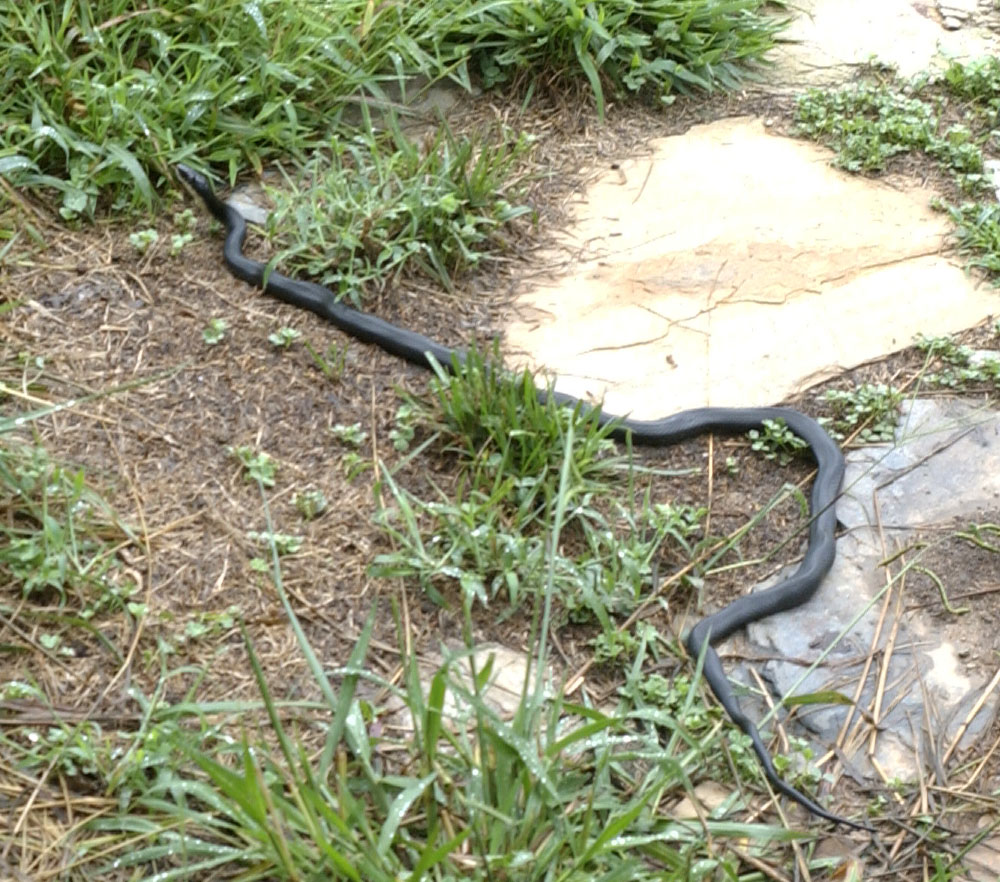
As I watched this snake, it appeared to me that it was lapping water droplets, like a cat, from the wet grass. It wasn’t just flicking its little red tongue. It was flicking it at the grass. I asked a friend who has kept snakes as pets if they lap water. He said no, that snakes get most of their water from their food.

I remain unsatisfied by that answer. It sure did look like it was lapping water like a cat.

Jewel weed


This jewel weed grows along the roadside downhill from me, in an area where my small stream passes through a culvert under the road.

In the previous post, I mentioned jewel weed as a plant that might grow well in the dark, moist area under my deck. As luck would have it, there is a stand of jewel weed along a branch downhill from me, so I can steal some seeds down there.

The native wild jewel weed grows in the shady undergrowth along small streams. It has dangling, horn-shaped flowers. In the fall, it forms elongated seed pods. When the pods are ripe, taut fibers along the seed pod are like springs. If you touch a ripe pod, it will explode with a surprising amount of force and fling seeds as far as 10 feet. It’s a magical little plant, even without the seed bombs.

Michael’s suggestion was that I gather some jewel weed plants when the pods are ripe and lay the plants under the deck. When the pods explode, they’ll seed the area under the deck.

A major shift in the weather

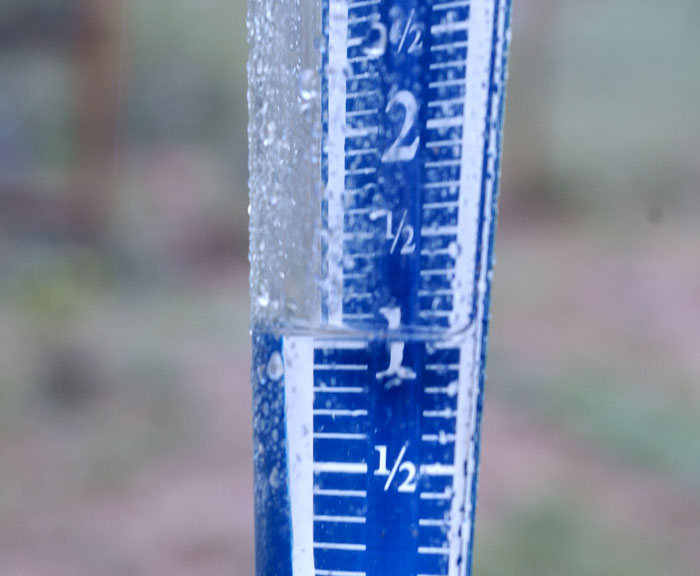
I wasn’t expecting rain today, but I heard thunder around 5:30 p.m. and discovered that a good-size storm was bearing down on me, moving out of Virginia headed north to south (not the typical summertime pattern). It left a bit more than an inch of rain.

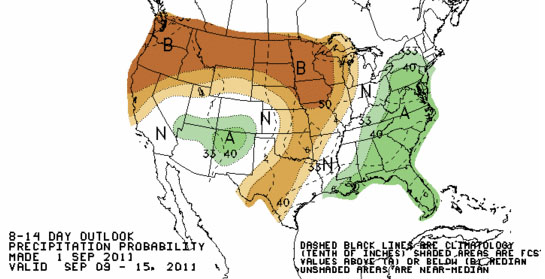
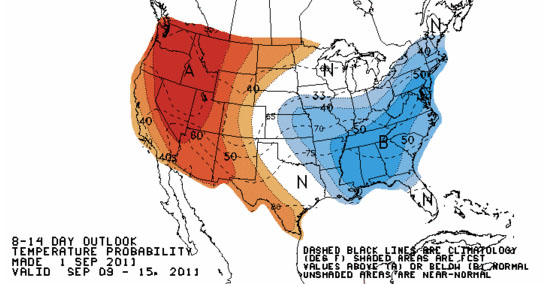
Not only that, but the 14-day forecast shows the entire eastern seaboard down for below-normal temperatures and above-normal precipitation. If that forecast holds true, then this miserable summer is over. The abbey will soon be green and lush again. I already feel myself transforming back into a human being from the snarling ogre I was during the summer.

By the way, I had a visit this week from Michael, who was Stokes County’s agricultural extension agent for the past five years until he resigned a month ago to work for himself. One of the things he’s now doing is consulting with organic farmers and gardeners like me. I was almost ashamed to have him here while the abbey grounds are looking so parched, but Michael saw right past all that — he lives only a few miles away and deals with the same weather patterns that I’m dealing with. The work that Ken and I have done here (thank you, Ken, wherever you are) got all kinds of gold stars from Michael (especially for the lawn, the orchard, the vegetable garden, the wildflower patches, and the animal habitat), and his message basically was keep up the good work. He did have some great ideas, though, and he solved some of my problems. Such as:

Q. Why did my blueberries die? A. Soil pH. Blueberries like a more acid soil and won’t do well in my orchard area, where I keep the soil well limed for the apple trees.

Q. Why did my fig trees die? A. Replant in an area with morning sun and more water. We picked a spot.

Q. Why did my dogwood die? A. It’s difficult to get dogwoods started under full sun without lots of babying for several years. Replant dogwoods in an area with less sun.

Q. Will anything grow in the darkness under my north-facing deck? A. Jewel weed! This is one of the most magical plants in the world. I’ll post later about jewel weed, with a photo.

Q. What’s the best way to solve my irrigation problem? A. Do some shoveling and enlarge an already-existing pool in my branch which just happens to be at the point where the branch is closest to the garden. Buy a low-cost pump from Harbor Freight. Buy flexible irrigation tubing to run up the hill to the garden and hook it to a soaker system. This will be a winter project.

Q. Can I grow pawpaw trees along my branch? A. Probably not, unless I’m willing to clear some trees over the branch to provide a little more dappled light. Though pawpaw trees might grow by my branch in the existing low light level, they probably would not bear fruit.

Michael also had some excellent ideas, such as planting muscadines on the upper side of the garden fence and raspberries on the woods side of the fence. Both will climb the fence without need for strapping. The other two sides of the fence already have roses, which are growing slowly, but Michael assured me that they would eventually cover the fence. He’s also going to help me find and plant a new shade tree for the south side of the house. I want a shade tree that’s as big as I can find, so that I’ll see some shade in my lifetime.

I doubt that a non-commercial type like me could get this much attention from a county agricultural extension agent, because they’re very busy. So I’m lucky that he’s now working for himself. But that’s something for everyone to keep in mind. I believe that just about every rural county in America has an agricultural extension agent. Expert help is a very good thing. And I’ve learned enough from my experience, and from reading, that I can well understand what a professional horticulturalist has to say.

Climate Prediction Center. These forecasts are updated every day. Your tax dollars at work. What would we do without a strong weather service, information to which every American is entitled, for free? “Entitled” is a beautiful word.

Free fiction, and an Ayn Rand rant

“Someday someone is going to do a psyche profile on you and discover what’s behind that switch that allows you to go from the personable Captain we all know to a cold tactician in an instant,” Oz said quietly.

“I don’t enjoy getting into one firefight after another, but when some corporate marionette tells me to surrender my crew and all their freedoms, I get a little irritated.”

— Randolph Lalonde, Spinward Fringe

The most mentally healthy way I could find to deal with the intolerable summer weather was to stay indoors and read. Though I read some non-fiction, mostly I read escape fiction. What’s escape fiction for, after all? I also did 99 percent of my summer reading on the iPad and Kindle. Because I’m cheap, and because I wanted to sample the quality of the many free, self-published books that are available, I’ve been reading a lot of free books. The appearance of a great many free books was something I expected with the cost of digital publishing approaching zero. What the business model is (if any) for giving away books, I don’t know. But I’ve found two or three excellent new authors from reading free e-books. To my disappointment, lately I have found no new authors that I like through the paid-for, legacy publishing system. I’ve spent $9.99 on several books that weren’t worth reading.

My newest discovery is Randolph Lalonde, a young Canadian writer who I believe is entirely self-published, and most of whose books are available for free. He’s also prolific. I’d love to know how he supports himself. His Spinward Fringe series is as fine a space opera as has ever been written. His plots are tight and thrilling, the characters are appealing, the villains are plausible, the technology is fascinating. His dialogue between the characters is brilliant and witty. His characters have depth, and mystery.

I believe I’ve also spotted a new trend in science fiction. Science fiction writers think more rigorously about the future and the human condition than they are usually given credit for. That is the real value of science fiction, and it’s a large part of what makes a classic. As for this new trend, there are no doubt those who would say that it’s only a lefty political bias of the authors, and that I share that bias. I would disagree. Science fiction — at least good science fiction — always is a profound reflection of reality. A good author has a good model of the present-day reality in which human beings live, and he uses his imagination to roll that model forward and project where it might lead in the future.

There has been a libertarian streak in science fiction for decades. Robert Heinlein certainly showed that streak. And then there is Ayn Rand, though she is not considered a science fiction writer. In any case, in this older libertarian vision (as in Ayn Rand’s Russian childhood 100 years ago), it was the government that threatened human liberty. In the new libertarian model that I detect in today’s science fiction, it is corporations that are correctly identified as the threat to human liberty. Only government, through law and regulation, can protect people from the power of corporations. In Lalonde’s Spinward Fringe, there is a legal officer on the flight deck. Corporations are the villain. The few remaining free peoples in Lalonde’s universe have governments and formidable weapons — to protect themselves from corporations.

Those who think more clearly, who see more clearly, whose models of reality are based on reality rather than some ideology or “faith based” system, clearly see the corporate threat. Others are stuck in the 1960s, still suckling their worn-out copies of Atlas Shrugged.

Speaking of Ayn Rand, I have never adequately defended my reasons for despising her. I was able to get through Anthem, because it is short and is more of a metaphor than a sermon. But I have never been able to get more than a few pages into Fountainhead or Atlas Shrugged without flinging them aside as unreadable. That is not a political reaction. It is purely a literary reaction. I don’t know why it is, but authors whose philosophies I despise reveal themselves very quickly, as though their complete philosophy is holographically contained in only a few paragraphs of text. The rhythms of their writing hurt my ears, like the rhythms of a fire-and-brimstone preacher, or the rhythms of a speech by Adolf Hitler, or the rhythms of a family quarrel heard through the thin walls of an apartment. I cannot read Ayn Rand simply because my ears cannot take the sound of her sermonizing rhythms. Consider this sample of text that I Googled up, from Atlas Shrugged:

“To trade by means of money is the code of the men of good will. Money rests on the axiom that every man is the owner of his mind and his effort. Money allows no power to prescribe the value of your effort except the voluntary choice of the man who is willing to trade you his effort in return. Money permits you to obtain for your goods and your labor that which they are worth to the men who buy them, but no more. Money permits no deals except those to mutual benefit by the unforced judgment of the traders. Money demands of you the recognition that men must work for their own benefit, not for their own injury, for their gain, not their loss–the recognition that they are not beasts of burden, born to carry the weight of your misery–that you must offer them values, not wounds–that the common bond among men is not the exchange of suffering, but the exchange of goods. Money demands that you sell, not your weakness to men’s stupidity, but your talent to their reason; it demands that you buy, not the shoddiest they offer, but the best that your money can find. And when men live by trade–with reason, not force, as their final arbiter–it is the best product that wins, the best performance, the man of best judgment and highest ability–and the degree of a man’s productiveness is the degree of his reward. This is the code of existence whose tool and symbol is money. Is this what you consider evil?”

My ears hurt!

In my view, bad ideas and bad thinking simply cannot be contained in the natural rhythms of the English language, of which iambic pentameter is the quintessence.

I sometimes forget that not everyone was an English major who is familiar with these terms. Iambic pentameter, also called “blank verse” when it is unrhymed, is the language of Shakespeare. It is considered to be the natural rhythm of the English language. You hear it in prose as well as in poetry. Native speakers of English commonly talk in blank verse — or at least in iambic rhythm — without realizing it, simply because they are speaking English. Good writers in English write in iambic rhythms most of the time, totally without thinking about it, because they have an ear for English. Bad writers use choppy, jarring rhythms that sound like bursts of machine-gun fire, or celery on a chopping block. It’s the rhythm you’d get if you killed a nest of snakes with a hoe.

This leads me to Dalton’s First Postulate of the English language, expressed here for the first time: To lie in iambic pentameter is almost impossible, but if a lie is forced into iambic pentameter, the lie will be transparent. Lies and iambic pentameter are like matter and anti-matter: If you put them together, they will explode. The language of lies is the language of hectoring and scolding and ax-grinding and belittling. And yes, I sometimes use those rhythms when I am tearing into liars and distorters on Internet forums. I hate the sound of my voice when I do it, but that is the purpose of those rhythms, to scold and hector. These hectoring rhythms, this ugly way of using language that liars must use, also make a simple and reliable propaganda detector. It is very difficult to express a lie in beautiful language. Right now I can’t even think of an example, but I will look for some.

Now look again at the quote from Ayn Rand above. Instead of saying the words, just substitute the sound “dah” for each syllable and read it aloud to hear only the rhythm. She has used some iambs (“Is this what you consider evil?”) — it’s almost impossible to not use iambs in English. But listen to her chop when she sermonizes: “Money allows no power to prescribe the value of your effort except the voluntary choice of the man who is willing to trade you his effort in return.” I fling books aside as soon as I hit a sentence like that. I don’t let people talk to me that way.

Read these Ayn Rand quotes in a sing-songy voice:

His effort in return!
Bang-bang! Bang-bang! Bang-bang!

The degree of his reward!
Rat-a-tat! Tat-tat! Tat-tat!

The best that your money can find!
Bang-bang! Rat-a-OOM-pah! Bang-bang!

It’s no accident that these rhythms sound like the in-your-face chants of a protest march, which happens to be one of the ugliest sounds that human beings can make, as far as I’m concerned, right up there with hell-fire sermons.

One of the things that mystifies me about why people like Ayn Rand is why they let someone talk to them like that, hectoringly and scoldingly. My only theory is that they crave authority, or someone to look up to, as Ayn Rand sneakily puts it.

Try this at home. Read aloud any longish paragraph randomly selected from Tolkien’s Lord of the Rings. Tolkien, in my opinion, was the greatest writer of English prose of the 20th century. Then after reading the Tolkien, read aloud the above paragraph from Ayn Rand. Did one of them hurt your ears? Was one easy to read, and the other hard? One of them is trying to sell you something. The other is on a quest for truth. Can you tell which is which, simply from the sound of their language?

A helicopter theory?

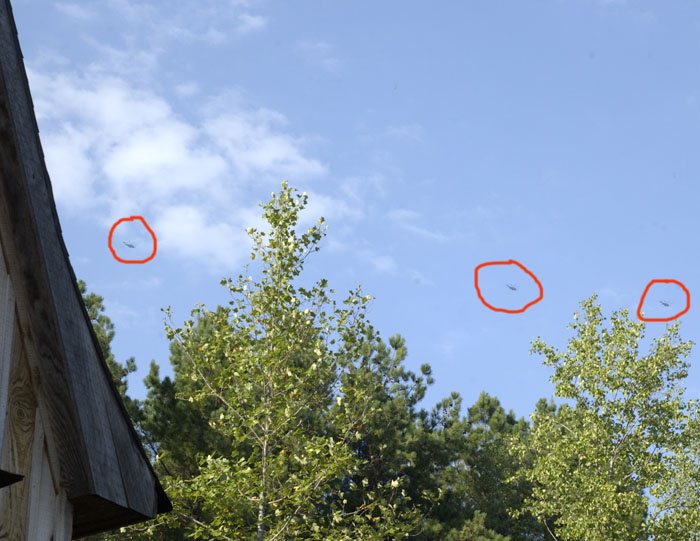
I’ve mentioned a number of times the unusual amount of military helicopter traffic over Acorn Abbey. I think I may have a clue. On Thursday, 36 hours or so before Hurricane Irene came ashore in North Carolina, there was a westward parade of helicopters, all following the same course (though at a higher altitude than usual, probably around 7,000 feet). Then today, after Hurricane Irene had safely passed by, there was a eastward parade of helicopters on the opposite course.

It seems very likely to me that the military was moving aircraft stationed in eastern North Carolina to another military base to keep them safe from the hurricane. Then they moved them back. As far as I can tell, if you draw straight lines between all the military bases to the east and west of me, none of the straight lines pass directly over Acorn Abbey. A straight line from Seymour Johnson Air Force Base in eastern North Carolina to Fort Campbell, Kentucky, looks like the best match. Maybe the aircraft alter their course to stay north of the much more densely populated Winston-Salem and Greensboro area.

What hurricane?


Miracle peppers. Do they have deep roots or something?

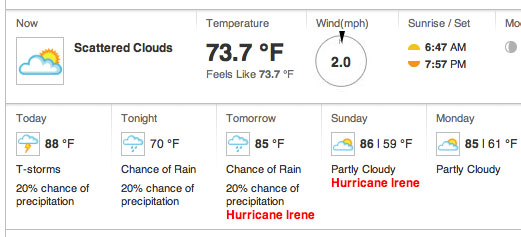
One would think that a major hurricane traveling along the North Carolina coastline would bring more rain to inland North Carolina. I am about 225 miles from the coast. My forecast shows a chance of rain of only 20 percent as the hurricane passes by tomorrow (Saturday).

A thunderstorm last night left .4 inch of rain, the only rain I’ve had in almost two weeks. This summer has proved to be more wretchedly dry than last summer, which was bad enough. In any case, last night’s rain will help things survive a few more days.

It surprised me, but the peppers took the hot, dry weather better than anything else in the garden. I have no idea why. I left the peppers standing when I pulled up all the dead stalks from the summer garden. I’ve also watered the pepper plants a bit during the last four or five days, because they had some blooms and they clearly they wanted to produce another round of peppers.

One more UFO post…


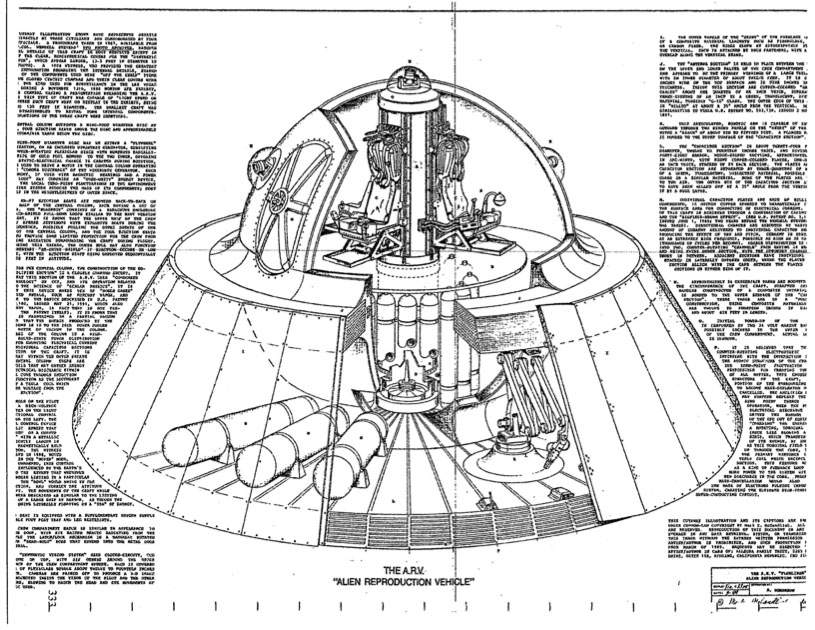
Some say that the U.S. captured a UFO like this, reverse-engineered it, and built a new one like it. [Image from The Disclosure Project Briefing Document]

One of the many wonderful things about being retired is that you don’t need a job, so you no longer have to care whether people think you’re crazy. Ridicule has been used for decades to prevent serious discussion about UFOs. Reports are that airline pilots see UFOs all the time, but they don’t talk about it, because it’s a quick way to end one’s career.

The official story about UFOs, of course, is that they don’t exist. The unofficial story is much more interesting than that. For those interested in the unofficial story, there is no better source than “The Disclosure Project Briefing Document.” It’s 500 pages long, and it rounds up all the best unofficial information that is available. When the document was compiled in 2001 by Steven Greer and Theodore Loder, their hope was that the document would lead to congressional hearings. That never happened, though there was a presentation for the National Press Club.

The briefing document contains interviews with, and in some cases sworn affidavits by, people who have knowledge of UFOs. Mostly these people are retired military types, or engineers or contractors who have been employed by the military or military contractors. The strength of this compilation is that it is based on the testimony of dozens of people who witnessed things that happened from the 1940s up until the early 1990s. Their testimony fits together extremely well and tells a clear, consistent story. Here are the key elements of that story:

Though UFOs have visited earth for a long time, there was a surge of UFO activity after World War II. This was because of the detonation of atomic weapons, which are of great concern to the extraterrestrials. UFO appearances became very frequent, and they were concentrated around military installations. The extraterrestrials corrected the problem pretty quickly, but, early on, the guidance systems of the UFOs were affected by our radar systems, and quite a few UFOs crashed. Crashed UFOs as well as dead ETs (and a few live ones) were captured by the military. Projects for reverse-engineering UFOs have been going on since the late 1940s.

Control of these “black operations” by the military was very quickly taken over by small, powerful groups of people who kept everything secret. Several people testified that President Dwight Eisenhower was very interested in and concerned about UFOs but that as early as Eisenhower’s presidency the elected government lost control to private interests. Many think that this was the basis of Eisenhower’s sharp warning about the military-industrial complex in his last speech as president. Since Eisenhower’s era, the elected government has been kept in the dark about UFOs and UFO technology. The military-industrial complex owns it all. Many presidents, including John Kennedy, Jimmy Carter, Ronald Reagan, and Bill Clinton, have been aware of the existence of UFOs and have tried but failed to break through the secrecy of military-industrial black operations.

UFO technology is based on anti-gravity propulsion powered by zero-point energy systems (basically, free, unlimited energy that permeates the universe). The military-industrial complex have reverse-engineered these technologies, but they are kept secret in the interest of power and profit. Some UFO technologies have been put to use, however, including miniaturized integrated circuit chips, lasers, fiber optics, and materials such as Kevlar.

UFOs are reported to have frequently interfered with the operation of atomic weapons and their delivery systems. UFOs have repeatedly shut down ICBMs. Some say that ETs ordered the U.S. and U.S.S.R. to stop nuclear testing and told both countries that no more detonations of nuclear weapons would be permitted.

There are very few areas in which the testimony of these multiple witnesses is contradictory. One such area is how ETs communicate. Then again, as many as 25 different species of ETs have been reported, so maybe this varies from species to species. Several witnesses say that ETs communicate only telepathically and that humans can “hear” them if the ETs want to be heard. One report says that ETs do talk, but that communication, especially on technical matters, is difficult and requires help from a linguist. Some witnesses say that they worked with ETs on duplicating ET technology. Reports of direct communication with ETs and engineering help from ETs peter out after the late 1950s. There is no testimony that would answer the question whether ETs stopped cooperating with humans, or whether the secrecy around that cooperation has been more successful. Reading between the lines, though, it seems to me that a fair assumption would be that cooperation between ETs and humans had broken down by the 1960s because the ETs did not like the direction in which earthling black operations were going.

No one has testified that ETs are hostile, though several witnesses have expressed concern over what could happen if the United States continues with the weaponization of space and continues to build systems that are intended to shoot down UFOs outside the earth’s atmosphere.

Multiple witnesses have testified that we earthlings have long possessed the technology to end our reliance on fossil fuels and clean up the earth but that we don’t, to protect the profits of the oil and coal industries.

Some witnesses speculate that there is growing pressure inside the black operation cartels to go public. Younger members of the cartels, it is said, tend to view matters differently than older cold-war types like Dick Cheney. These younger members, it is said, also are less sympathetic to the oil cartel and are more open to making the now-secret technologies available to benefit the earth’s ecosystem. These younger members understand that they are being complicit in the destruction of the earth’s ecosystem if something doesn’t change.

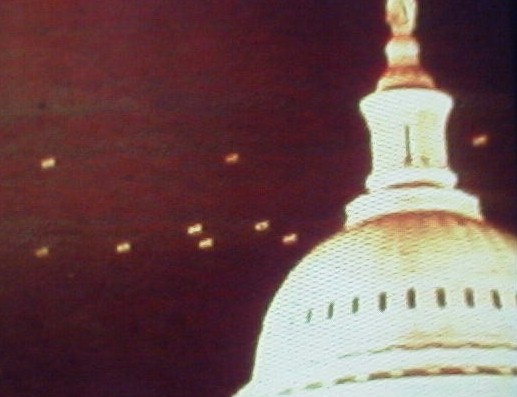
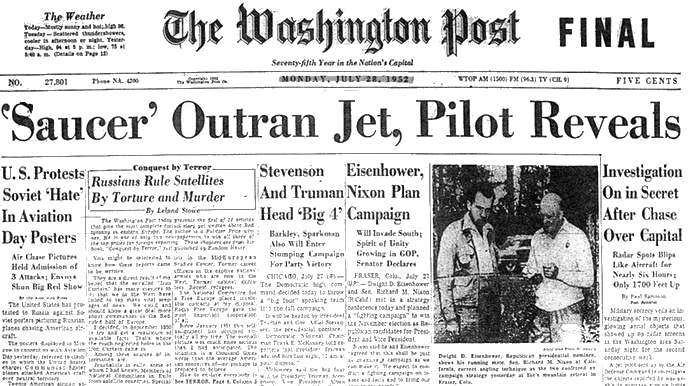
I personally am pretty satisfied with the story that emerges. It makes sense to me. But a few things still don’t make sense to me. If the ETs are displeased with the black cartels that have taken over in the name of humanity and kept everything secret, then why don’t the ETs bypass the cartels and take their case directly to the masses? In 1952, the ETs appear to have made such a threat, during a dispute with earthlings. They overflew the Capitol.

Multiple witnesses say that there are only about 40 people on earth who know the whole story. They have no right to keep this from us. Neither the truth, nor the technologies they are hoarding, belong to them.