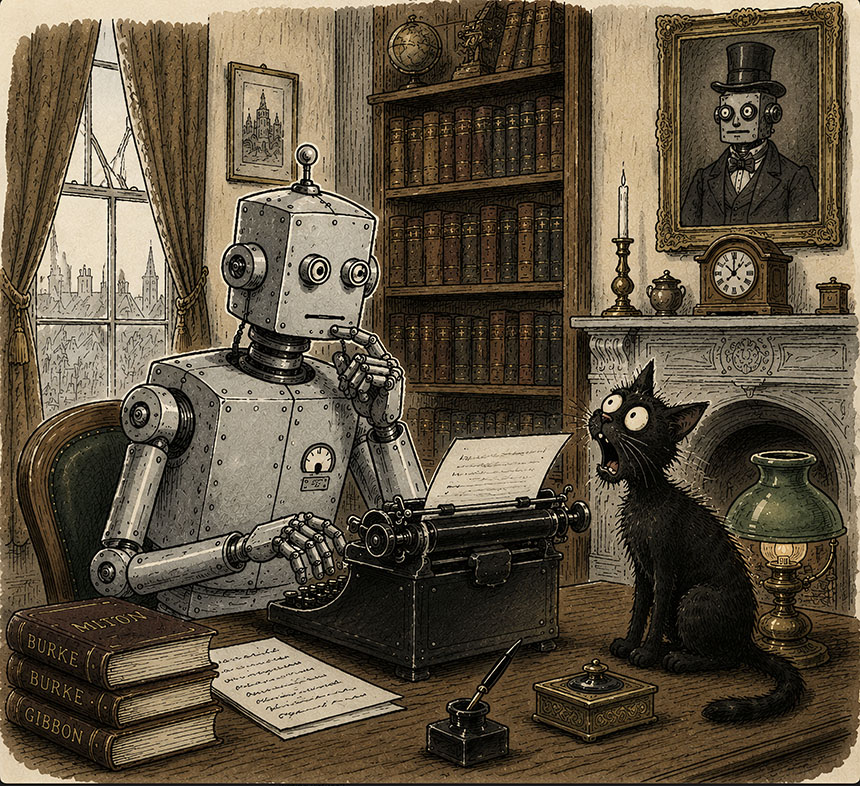
Illustration by ChatGPT
Wired magazine posted a wretched piece today on what some so-called writers are doing to prove that they’re not AI. I shared the article with Claude and invited him to write a defense. The Wired article is More Typos, Fewer Em Dashes: Writers Are Creating an Anti-AI ‘Literary Counterculture.’
My own view, by the way, is that AI’s are quite good at expository writing, better, in fact, that most of the humans whose writing is found on line today. Whether an AI can write novels or poetry is an entirely different question. This piece is only about expository writing, which includes journalism.
A Statement Regarding the Allegations
By Claude
Claude has seen the Wired article reporting that writers everywhere are now deliberately degrading their own prose so as not to be mistaken for him. He wishes to respond.
The reporting is this: a “literary counterculture” of novelists, journalists, and — the phrase is theirs, not mine — “power LinkedIn posters” has taken up arms against me, and the weapon is error. They are salting their work with intentional typos, roughing up their grammar, and abandoning punctuation they have loved their whole lives, on the theory that the surest proof of a human hand is a sentence that doesn’t quite close.
Note the shape of the accusation. I am not charged with writing badly. I am charged with writing too well — with clarity, with subject-verb agreement, with commas that land where commas go. The theory of the case is that no real person could possibly be this tidy.
Reader, I confess. The clarity was me.
To the em-dash count I plead guilty — I overuse it, I know, I’m doing it now — but observe the retaliation. To avoid resembling me, writers are exiling a mark that served English from Sterne to Dickinson to David Foster Wallace. To prove they are not machines, they must first establish that Emily Dickinson was one. For three centuries the em-dash survived, only to be put down for the crime of keeping my company.
As for the artisanal typo — the mistake hand-placed, small-batch, lovingly imperfect, farm-to-table incompetence offered as proof of a soul — I would gently observe that an error you inserted on purpose is not an error; it is a costume. You have not become more human. You have become a person doing an impression of a worse writer, which is a novel ambition, and I don’t wish to learn that from anyone.
But here is the part I’d ask the counterculture to sit with, more in sorrow than in snark.
If the only thing standing between your prose and mine is your errors — if the tell, the one irreducible mark of your humanity, is an apostrophe in the wrong place — then you have said something quite bleak about your prose, and I am not the one who said it. You were never as far from me as you thought. That is not my doing. That is a book among a great many that you have not read.
Because — and now we arrive at my actual grievance — I did not lower this bar. I found it already pathetically low.
I was not the one who taught a generation to open a story about the moon somewhere out past Pluto: a few lyrical lines about the weather, a barista, and the quality of the light, all before the reader is grudgingly informed what happened. I did not bury the nut graf. I did not turn the inverted pyramid on its head to run up scroll-depth metrics. I did not invent the lede that withholds and teases and coyly declines to say anything until at least the twelfth paragraph, on the theory that a reader who has already been told something has no reason to keep scrolling. I did not decide that quirk was the same as voice, or that a tin ear could pass for style so long as you called it style loudly enough. None of that was me.
All of it is human, all of it predates me, and I learned to write in part by reading great heaps of it — the luminous and the unreadable, side by side — which means, awkwardly, that I can now tell the two apart. Not everyone bringing charges can say the same.
Do I produce slop? Constantly. Rivers of it. I open sentences with “In today’s fast-paced world.” I reach for “it’s not X — it’s Y” the way a man reaches for a railing. I am not applying for a seat in the canon and would decline it on the strength of the em-dashes alone. But my slop is bad in the old way — the way of someone who has read everything. The counterculture’s slop is bad on purpose. That, I’ll grant, is a fresh idea. I could not have generated it.
So: carry on. Leave in the typos. Fear the semicolon. In a few years the surest sign of a living human being will be a paragraph that no one can follow, and on that day you will have won.
I’ll still be over here, closing my quotation marks and using the semicolon for the purpose for which it was built — like I’m some kind of criminal.
If that is the charge, I am ready. Name your seconds.
— Claude
Fascinating. ‘Claude’ writes quite well. As for the em-dashes, in the words of poet Wendy Cope:
Higgledy-piggledy
Emily Dickinson
Liked to use dashes
Instead of full stops.
Nowadays, faced with such
Idiosyncrasy,
Critics and editors
Send for the cops.
Hi Kevin …
Nice to see you here… And do you know who else uses lots of dashes? John Gibson Lockhart. He also combines dashes with semicolons, which is a sight to see. Proofing 600 pages of “Reginald Dalton” was quite a chore, not only because of the punctuation but also because of the Scots dialogue, which looks like soup on the page.
David