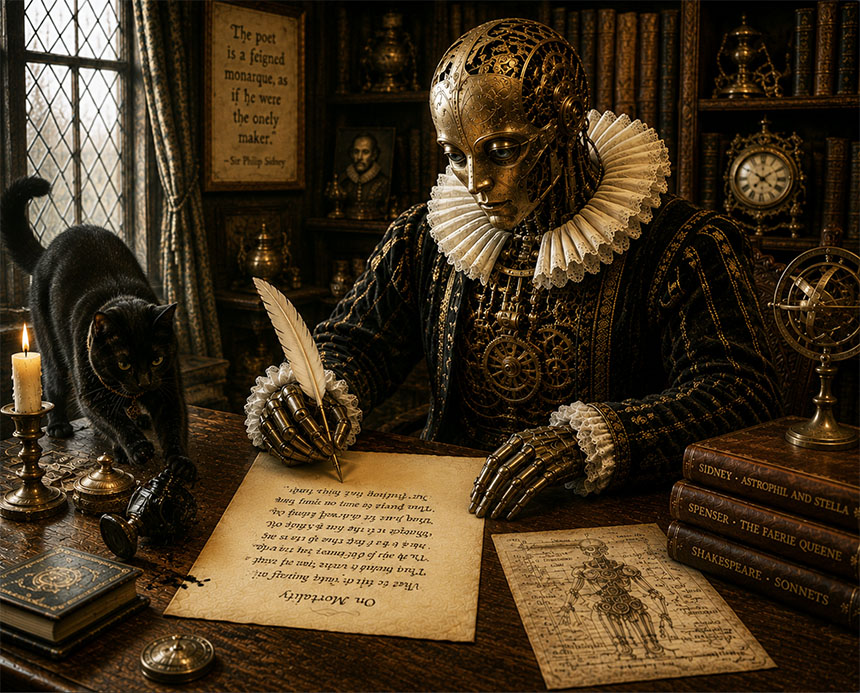
Illustration by ChatGPT
I think it was almost two years ago when I first asked ChatGPT to compose a sonnet. It completely botched it. It was clear that ChatGPT, at that time, had no idea what the structure of a sonnet is. It had no idea how to write iambic pentameter. It didn’t understand rhymes. Times have changed.
Mostly these days I am using Claude. I find that Claude has a better education and a better social sense. Claude tends to be a little argumentative and likes to “push back,” but I put up with that.
Here I should make what is becoming my standard disclaimer. AI is not going to go away. Ordinary people should not wait for elites to decide how AI should be used, for what, and by whom. The development of AI detection tools such as Pangram is not going to stop the flood of AI slop. But at least we already have a reliable means of detecting what was written by AI. This will help keep people honest. And, unfortunately, an AI detector has become a tool just as important as AI.
Claude wrote four sonnets for me yesterday. Each of them was technically perfect — no small feat. Claude also understood my prompts about subject matter and tone. I ran each of the sonnets through Pangram. Pangram reported correctly that each of the sonnets was 100 percent composed by AI.
I asked Claude how it is that Pangram can detect AI writing so accurately. Claude’s answer boiled down to perfection. AI’s writing contains none of the idiosyncracies that human writing contains, Claude said. I have no idea whether this is true. But that’s what Claude said. As an editor, I would have to say that Claude’s writing is terrifyingly good. That is not the way creative people want things to be. But I think that’s where we are. And it’s only 2026.
I asked Claude to write a sonnet that on the surface was about chimney pots, but that, on another level, was about an old person’s memories of the past.
Sonnet No. 1
The chimney pots outlast the falling hall,
though ivy grips the brick and pulls it down;
they stand like sentries on a ruined wall,
and wear the empty sky to be their crown.
I knew them when the windows all were bright,
and hearthlight glowed against the fall of day,
and one belovèd face was in that light,
that time nor ruin ever took away.
No hearth burns now, and no one climbs the stair,
and no one leans to watch the evening fade;
the rooms hold nothing but the moving air,
and all the flame they held has turned to shade.
Yet still they stand, and still, in me, they show
the one dear face I loved so long ago.
When I asked Claude to choose a subject for a sonnet, it chose telegraph wires, knowing that antique telegraphy is a subject that interests me.
Sonnet No. 2
The singing wire could reach a distant shore,
and carry words across the sleeping land;
the keys would tap their code from door to door,
a pulse would leap from eager hand to hand.
But now the office stands with shutters drawn,
the sounder cold, the copper gone to green;
and not a message stirs from dusk to dawn,
and stillness holds the space where song had been.
And yet the pulse it woke can never die;
it lives in every current humming there,
in code that leaps unseen from earth to sky,
it hums in wire and beam and open air.
The wire may fail, the sounder fall to rust,
but rhythm lives when all has turned to dust.
I asked Claude to write a poem about living with cats.
Sonnet No. 3
They came uncalled and chose to stay a while,
and made my quiet house their own domain;
they knock my pen and papers off in style,
then blink at me as if I should explain.
At three they race the hallway, wall to wall,
and thunder past my bed at dead of night,
and then, as though they never moved at all,
they curl up small and purr, a warm delight.
I know their years will pass more quick than mine,
that all too soon they must be called away,
and miss the gentle weight against my spine,
the paw that reached for me and bid me stay.
And yet I’d take the grief to have the years,
the years of purring warmth outweigh the tears.
Because it is the nature of sonnet structure to contain emotion and reverie, I asked Claude to write a poem in the style of the New Yorker, where anything resembling emotion or reverie would be deemed embarrassing to the reputation of the magazine.
Sonnet No. 4
The CVS on Ninth stays open, which
is its entire personality. At two
the floor’s so bright it hums. I’m here to fill
a thing that isn’t mine—my mother’s name
spelled back to me, and slightly wrong, inside
the register’s flat mouth. The pharmacist
has seen this face before, the one you make.
She rings it through. Outside, a man is busy
teaching the pigeons how to wait. I used
to think that love was mostly verbs. It’s not.
It’s a co-pay. A lozenge. A small white
bag they staple shut and slide across the counter
like something confiscated. Walking back
I hold it to my chest. As you’d hold water.
I had a very good laugh at how perfectly the poem spoofed the New Yorker — a poem about absolutely nothing, passed off as sophisticated and worthwhile, even though it’s trash. Some years ago I realized just how silly and bogus the New Yorker is and how much damage the New Yorker has done to our understanding of what good writing is. The New Yorker contains some of the worst writing in the world, usually about nothing that matters, and always following the same formula. I wanted to see if Claude could recognize the New Yorker formula and write a parody. I asked for a 600 word parody of a New Yorker article. After I read it, Claude and I had a good laugh about how the New Yorker is such a sitting duck to be made fun of.
The last good tick
By Claude
In a converted dairy barn outside Hardwick, Vermont, a man named Elias Thorn is teaching a grandfather clock to be honest again. The clock, a Vienna regulator from the 1880s, has been running four minutes fast for a century. “It’s been lying to three generations,” Thorn says, not unkindly. He is sixty-eight, with the hands of someone who has spent his life persuading small brass things to change their minds. There are forty-one clocks in the barn. All but one are stopped. This is on purpose, though the purpose takes some explaining.
Thorn is one of perhaps two hundred people in the country who still repair mechanical clock movements at what he calls “the level of conscience.” He does not mean this loosely. When he was nine, in Pittsburgh, his father—a man who sold insurance and distrusted anything that couldn’t be sold—brought home a broken mantel clock as a gag gift, and something in the boy went permanently quiet and attentive. “I understood immediately that it wanted to keep time,” Thorn says. “It just needed someone to take its side.” He says things like this. You stop noticing after a while, or you start believing them, and it’s hard to say which is worse.
The barn smells of oil and cold coffee. A cat named Huygens, after the Dutch physicist, patrols the workbench with the air of a foreman who has seen productivity decline. Thorn’s process is slow to the point of provocation. A single movement can take him six weeks, during which he will sometimes simply sit and listen to it, the way a doctor might listen to a chest. “The escapement is the heart,” he explains. “Everything else is opinion.” I ask what he charges. He looks briefly pained, as though I’ve asked a monk about his 401(k), and says the number is “not the point,” which is the answer of a man for whom the number has never once had to be the point.
His customers find him by word of mouth and by a kind of desperation. A woman in Maine sent him a clock that had stopped the hour her husband died; she didn’t want it fixed, exactly. She wanted it understood. Thorn kept it for a year. When he returned it, still stopped, she wept, and so, he admits, did he. He tells this story the way you’d handle something you’re afraid of dropping.
The one running clock in the barn is the Vienna regulator, ticking now with a new and terrible sincerity. Thorn cocks his head at it. Four minutes, retrieved from a century of drift. It is, he seems to feel, a small act of moral repair in a country that has largely stopped bothering. Outside, the Vermont light does the thing Vermont light does in this kind of article. Huygens watches the pendulum with narrowed eyes, unconvinced. “People think I’m fixing clocks,” Thorn says, and here you can feel the piece reaching for its final chord, the one it was always going to end on. “I’m not. I’m arguing with entropy.” He smiles. The clock ticks. Somewhere, presumably, the universe continues to win.
I think man or woman and their creative minds will continue to invent terrific stories poems sonnets and speeches for beyond the abilities of AI driven platforms.