Culture for lunch: $5.99

A-cafeteria-1

If Southerners still ate traditional Southern cuisine cooked at home, the statistics on our health wouldn’t be what they are. You only have to look at what people have in their carts at the grocery store to see that almost nobody cooks from scratch anymore. I have a lot of doubts about whether young people really learn to cook at all anymore. Often on Facebook I see pictures of dishes that I suspect pass for home cooking these days — concoctions of grated cheese, sausage, and biscuit mix, for example.

In this area, one of our cultural resources is the K&W Cafeteria, a regional chain that started in Winston-Salem in the 1930s, I believe. It’s been over 40 years since I first ate at a K&W, and almost nothing has changed. They do Southern cuisine pretty much from scratch, striking a pretty good balance between honesty of the cuisine and the low prices that people expect around here.

Many people look down on the K&W and wouldn’t want to be seen there. I am not among them. As a matter of fact, I’m a reverse snob when it comes to the K&W. When I have visitors from out of town (with the occasional exception of Californians), I almost always take them to the K&W to help acquaint them with traditional Southern cuisine. It was the favorite eating place of a friend from Europe (who made fun of restaurants that are considered fancy in these parts). And even those who look down on places popular with seniors and people of modest means have to grant that, at least, the K&W is not fast food.

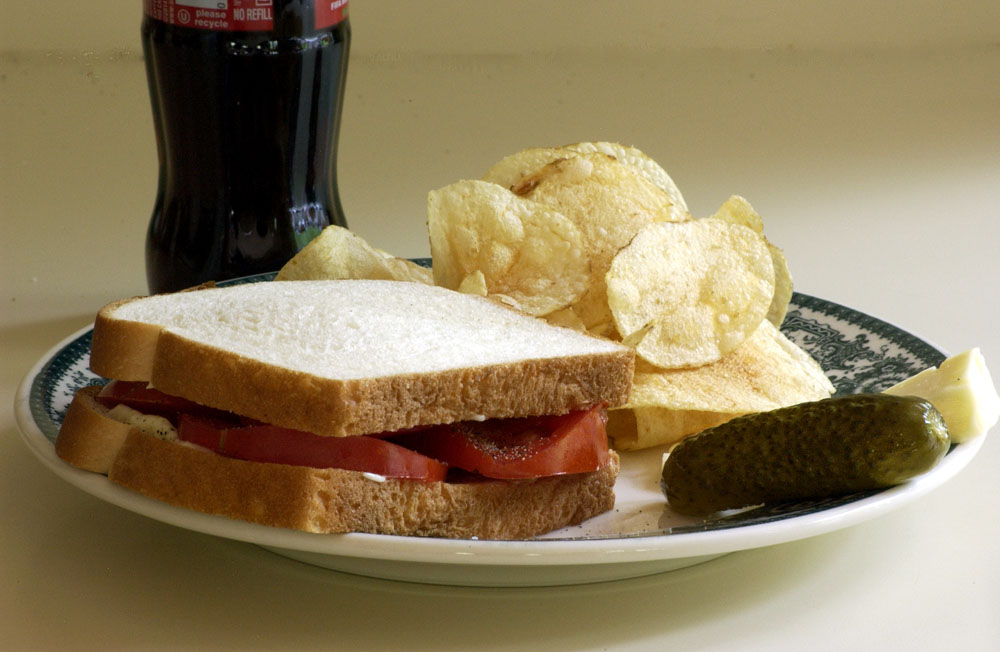
Recently they started having lunch specials. One of those specials is four vegetables, plus bread and a drink, for $5.99. Today for lunch I had pinto beans (with onions), mashed potatoes, green beans, broccoli, corn bread and iced tea. How could you go wrong?

A-cafeteria-2

New gate for the new chicken lot

A-new-gate-1

As of sunset today, the chickens’ new habitat is ready. They now have three grazing and scratching areas, each separated by gates: the garden, the orchard, and a section of woods. Six chickens can do a great deal of damage to grass, and we want the strongest possible turf in the orchard. When it became apparent by mid-winter that the turf in the orchard was not going to be able to withstand a full winter of scratching, we moved the chickens into the garden to protect the orchard turf. The chickens soon wiped out the winter rye that had been planted as a cover crop for the garden and made a big mess. But at least, in the garden, no permanent harm was done.

Ken made the decision to extend their scratching area into the woods. That will give the chickens a great deal more space and relieve the pressure on the orchard turf. It also will provide a cool, shady area for the girls to hang out during the heat of summer. It also will make it easier to justify two or three new hens this spring.

This project cost several hundred dollars and a lot of time, but after we saw eggs for more than $10 a dozen at Whole Foods, we had no doubt that it was worth it.

B-new-gate-2
The girls in the garden — now a muddy mess after lots of rain and snow and scratching

Birds, everywhere

vireo
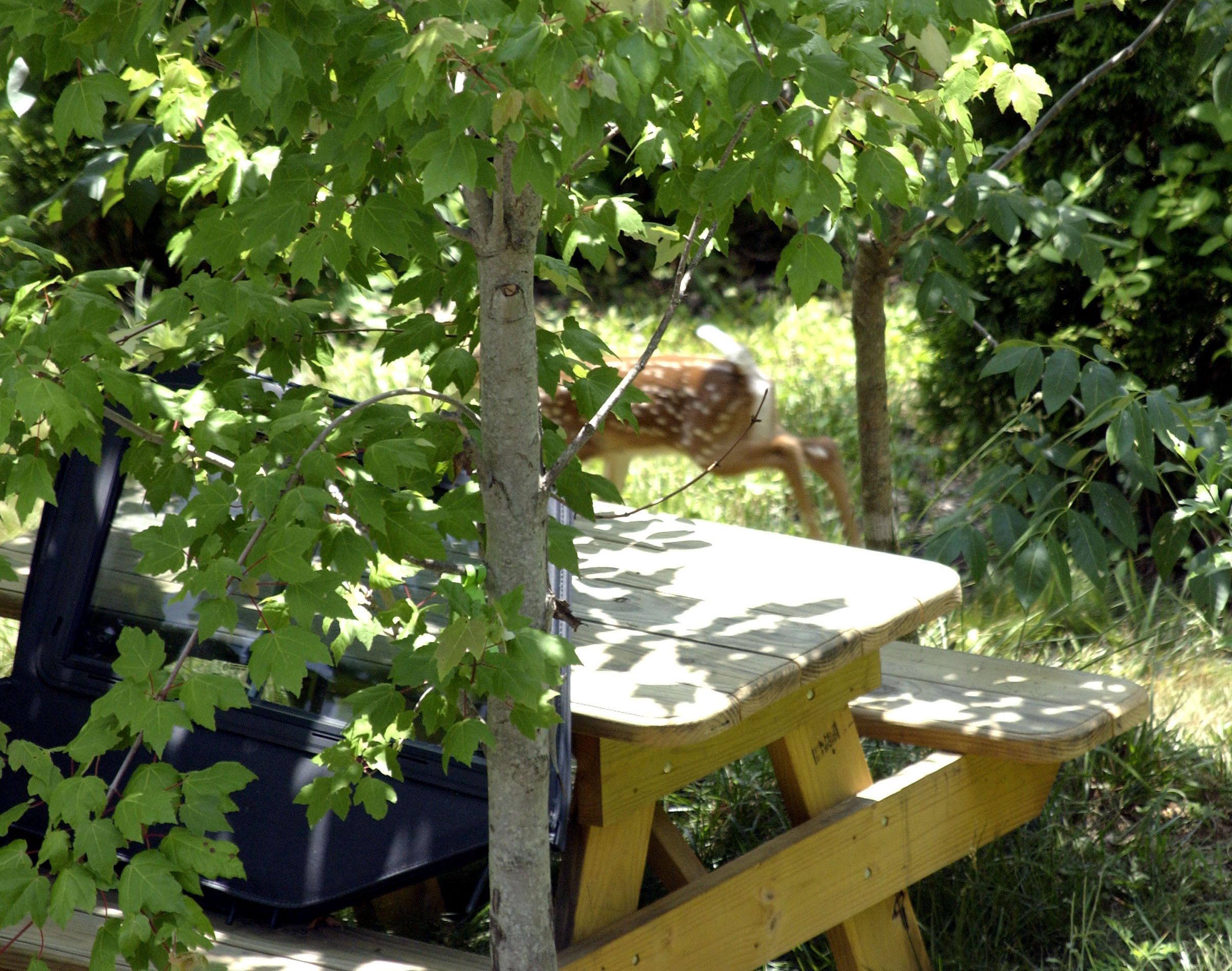
Who can identify this bird? Photo by Ken Ilgunas. Update: We think this bird is a pine warbler.

It’s amazing how many birds there are around the abbey right now. Partly, no doubt, it’s because we’ve been feeding them. Partly, no doubt, it’s because it’s spring. But the birds are not just near the feeders. They’re everywhere — in the trees, on the fences, working the orchard, raiding the chicken house, waiting in line for the feeding stations on the porches.

We would like to think that, each year, the abbey grounds are becoming better habitat for birds. Each year, we dump more compost and more organic fertilizer pretty much everywhere. We’ve planted more evergreens for cover and lots of wildflowers. Where there is food and water and shelter, the birds will come.

Wheat: Proceed with caution

organic-wheat

Previously in this blog I’ve expressed the opinion that the prevalence of gluten intolerance is exaggerated. Less than 1 percent of the population has coeliac disease. Still, gluten sensitivity seems to be increasing. Something must be going on. What could that be?

Recently I came across an article about a renegade MIT scientist who has a new theory about this. She thinks that the gluten problem is caused by glyphosate — that is, the herbicide Roundup, which is made by Monsanto and other companies.

I have no way of knowing whether this theory is valid. However, this scientist mentions a fact that is new to me, and it’s shocking. That is that wheat farmers are spraying Roundup on their crops just before harvest, to dry out the wheat and make the harvest process easier for the combine machine.

When I first read this, I was skeptical that farmers would do anything so obviously dangerous. But a little Googling shows that, not only is it true, Monsanto promotes this use of Roundup as a way of boosting combine output by up to 30 percent. How long Roundup persists on plants and soil after it is sprayed is highly variable. Under some conditions, it takes months for it to break down. When Roundup is sprayed on a field to clear weeds before planting, there probably is usually time for the Roundup to mostly break down before the crop reaches our kitchens.

However, if Roundup is sprayed on wheat three or four days before harvest, you can be very sure that it remains in the wheat, and therefore in the flour, until we eat it.

I take two lessons from this.

First is that our industrialized farmers cannot be trusted. If poisoning us yields them higher profits, then they’ll poison us. Unless we’re paying attention, we won’t know what they’re doing.

Second is that, from now on, I will use only organic wheat.

Changing domains: Not for the faint of heart

B-web-traffic

About four months ago, I moved out of the crippledcollie.com domain into this domain — acornabbey.com. Not only is a domain change a tedious and challenging process, even for a nerd. There also is the risk of losing readers.

Frankly, I didn’t do the best of all possible jobs. I went to quite a lot of trouble to move all the posts and photos (about 900 posts and more than 1,000 photos) from the old blog to the new blog. I assumed that Google would find, and index, all those posts at the new acornabbey.com domain. I was wrong. I recently figured out that Google would probably never find all the older material unless I submitted a “site map” to Google, using Google’s Webmaster Tools. That has now been done, and I’m waiting for Google to finish re-indexing everything.

Another step that I needed to take was to automatically redirect traffic from the old blog to the new blog. That was relatively easy, using an .htaccess file on the old server to map everything to the new domain and redirect everything to the new domain.

These changes are kicking in, and traffic to acornabbey.com has more than doubled. I expect it to increase even more once Google finishes indexing all the old posts, which go back to 2007. I’ve posted on many different subjects over the years and show up in a lot of Google searches on obscure subjects such as “Pleides,” “iambic pentameter,” or “biscuits and gravy.”

Nerd post: Hewlett Packard 3456a digital multimeter

B-hp-3456a-1

One of the tragedies of being a nerd is not being able to afford the toys one would like to have when those toys are new. But, thanks to eBay, we can go back in time and find bargains in some of the cool things we’d have liked to have many years ago.

A recent eBay acquisition is an HP 3456a digital multimeter. I believe the list price on these devices was $6,395 in 1982. They can still cost $600 to $700 on eBay if the seller can vouch for the history of the instrument and guarantee that it’s in good working order. If you watch the auctions carefully for a while, you can pick up an HP 3456a for less than $100 if you’re willing to accept some risk.

This instrument seems to be in great working order. The display in the photograph is showing the readout with a 100-ohm resistor across the terminals. The tolerance of the resistor is 5 percent, so at only 1.213 ohms off the rated value of the resistor, the odds are good that both the resistor and the HP 3456a are close to specification.

One of the cools things about the HP 3456a multimeter is that it can be controlled (using an HP-IB interface) by an early HP computer — the HP 85, one of which I also happen to have. Getting the two devices talking to each other will be a project for some other rainy day.

It’s a shame that Hewlett Packard is a mere shadow of its former self. Clearly, years ago, it was a company run by engineers, for engineers, selling to engineers. Cost was not a problem. It was all about the quality of design and the quality of the build. That’s why their stuff is still working today.

John Twelve Hawks is now on Facebook

jth-facebook

From time to time, I have written here about John Twelve Hawks, and so I get a fair number of visitors to this blog who have searched the Internet for “John Twelve Hawks.” Some of you fans of John Twelve Hawks may not be aware that he recently created an official, verified Facebook page. He posts photos periodically and offers snippets from his off-the-grid life.

For my previous posts on John Twelve Hawks, use the blog search box to search for his name. To find him on Facebook, type his name in the Facebook search box.

And though John doesn’t know it yet, I plan to send him a copy of Fugue in Ursa Major as soon as it’s released, hoping that he’ll like the book enough to write me a cover blurb.

Another drop in the compost bucket

A-compost-2014-1

It’s shocking how the abbey grounds soak up compost. I long ago lost count of the total number of truckloads of compost that have been delivered here. It’s used for mulch and to loosen the soil when trees and shrubs are planted, plus a large amount of compost is tilled into the garden each year. The soil eats it, and it seems to vanish. But surely it’s still around in some form, feeding the earthworms. This is leaf compost, which is not the most nourishing compost in the world. But the earthworms eat it and never complain.