
Population growth? Run for your life…

Sometimes I have survivor’s guilt. I got in my Jeep, I drove and drove and drove, and I escaped the corporate life. Not only that, but many people struggling to get closer to the troughs in the corporate feedlots tried to eat my lunch back then, but I beat them back. It was self-defense, but my hands are stained.

I even cleverly managed to keep Wall Street from tricking me out of the secret stash I’d hoarded while in the feedlots. With that stash I built my little refuge in the woods. I had gotten too old to fight anymore. I am as far as I can afford to be from everything that is corporate, where the top dogs rake it in and leave the rest of us to fight over the scraps.

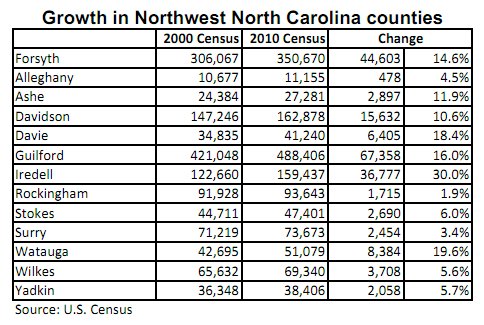
The U.S. Census bureau released numbers yesterday for population growth in North Carolina for the 10 years between the 2000 census and the 2010 census. The population of the Raleigh area grew by a horrifying 43.5 percent. Stokes County’s population grew by 6 percent.

Why do I use the word horrifying? Everything looks different when you’re no longer a poor hunk of pork getting the life rendered out of you in today’s pressure-cooker economy. Once upon a time when I was of working age, I too had to go somewhere where the money was, and I went to San Francisco. But that was then, and this is now. When you finally get to step off the corporate treadmill, you want to be as far from the corporate feedlots and kitchens as you can possibly get.

I have not been to Raleigh in decades, but I have been to Charlotte. What 43.5 percent growth has done to Raleigh can only be worse than what 32.2 percent growth has done to Charlotte. Charlotte is hideously ugly. It has no focus, no center, no charm, no style. It has sprawl, traffic jams, and people who, having gone where the growth is, are always in a hurry. Charlotte seems unaware of what has happened to it. The story in today’s Charlotte Observer is self-congratulatory and cheers this population growth, taking for granted that it’s a good thing. But to my eyes, what growth has done to America’s regional inland cities is as horrifying, ugly, and unhealthy as what steam-driven industrialization did to 19th-century England.

As I see it, the dog-eat-dog dynamic of today’s working environment is only going to get worse. There’s a story going around the blogosphere. It’s about David Koch, one of the billionaire oilmen who have financed the tea parties and the “think tanks” that produce the right-wing propaganda that Fox News disseminates. The story has many variations, but it goes like this:

David Koch and a tea partier are sitting at a table. On the table is a plate with a dozen cookies. Koch grabs 11 cookies, then looks at the tea partier and says, “Watch out for that union guy. He wants a piece of your cookie.”

Recent polls indicate that working Americans support Wisconsin’s unions more than they support Wisconsin’s union-busting governor, who takes money — and phone calls — from David Koch.

Maybe Americans are finally starting to figure out who it is who is eating their lunch (and their cookies). And does anyone (other than those who live in the fog of Fox News lies) think that corporate America cares any more about workers in general than it cares about unionized workers like teachers and firemen? The effectiveness of the propaganda on Fox News is really quite terrifying. It can cause Red State Americans of very modest means, and who would be hard up but for Social Security and Medicare, to vilify government and not only vote for, but also cheer for, the interests of the rich.

For those of you who are still working, I hope you’ve found one of those rare safe spots in this globalized Brave New World that Wall Street is creating.

And I hope that someday you too will be able to find a place where the growth is not.
Getting the garden ready


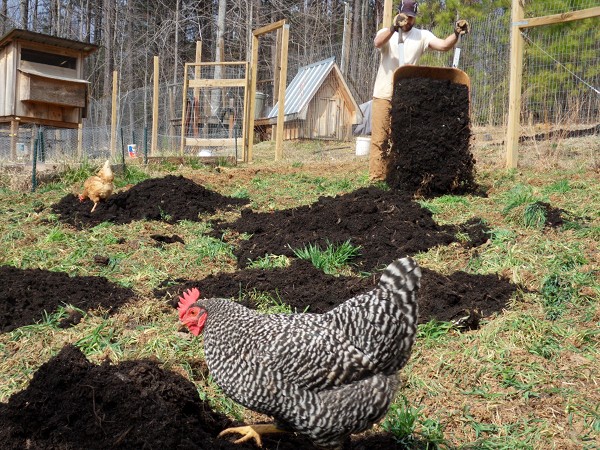
The chickens love anything that scratches the soil.

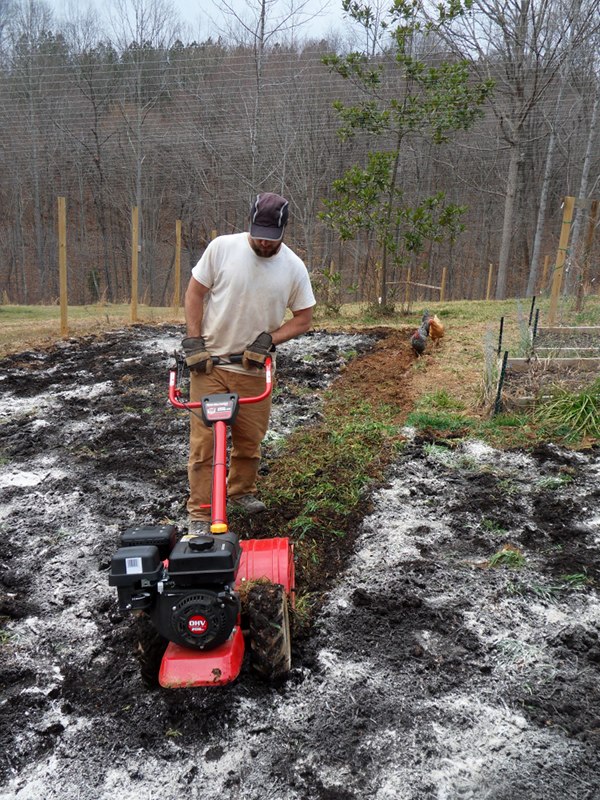
A lot of work got done in the garden today. It’s almost time to plant the cabbages, etc., one to two weeks from now.

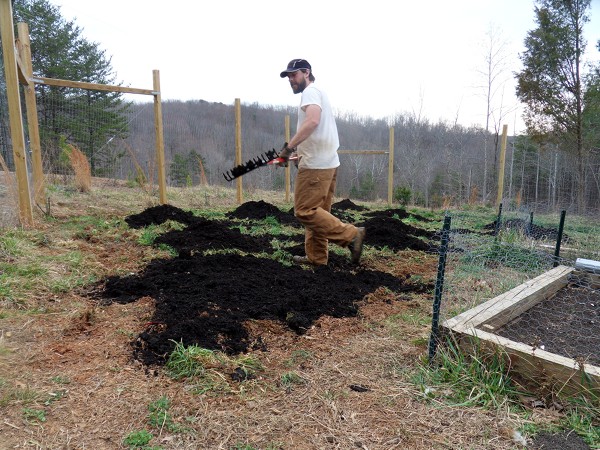
Ken spread 300 pounds of organic fertilizer, 50 pounds of lime, and many wheelbarrow loads of compost. All of that got nicely tilled into the soil. Now the soil needs to sit for a week or two so that the winter rye, which we tilled under today, can break down. The fertilizer also needs to wash in a bit. Rain is forecast for tomorrow.

We actually measured the pH of the garden today. It was 6.9 — just a tad on the acid side of neutral. This surprised me. Pine trees grew on the soil for years, and I expected it to be more acid. On the whole, the garden soil is looking much better than I expected. We’ll soon see how well things grow.


Ken spoils Patience.

Pith helmet


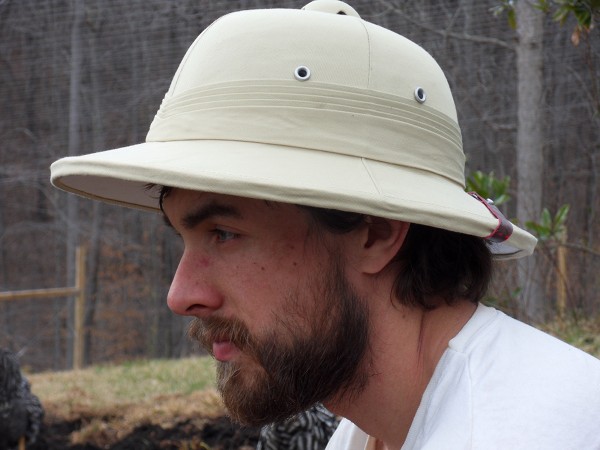
Ken models my new pith helmet.

I have several sun hats. The main problem with sun hats is that, vents notwithstanding, there’s not enough air circulation around the top of the head. I’m hoping that my new pith helmet, ordered from VillageHatShop.com, will solve the problem. It’s a helmet rather than a hat, so the hat is suspended from a band that fits around the head. There’s an air gap between the band and the hat. When there’s a breeze, you can feel cool air on top of your head. And when there’s a bigger puff of wind, it whistles through the hat.

Pith helmets get their name from the material they’re made from — a natural material like cork. The hat is light but sits firmly on the head. I forget that I’m wearing it.

The vegetable plants at 3 weeks old

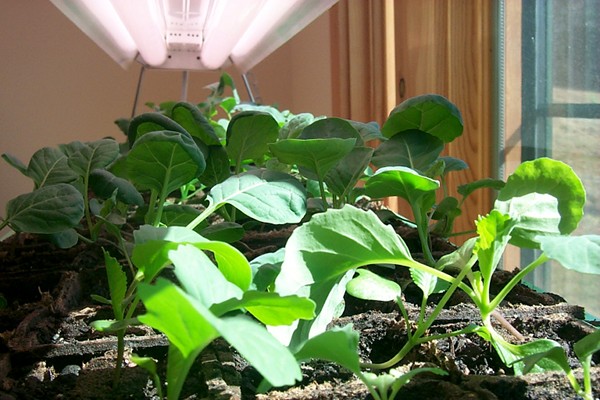
The vegetable plants that we started from seed are three weeks old today — cabbage, broccoli, brussels sprouts, cauliflower, and celery. When they were 16 days old, we transplanted the “sponges” from the starter dome into soil and peat moss cups. We ended up with 100 baby plants in peat moss cups, too many to fit under the grow light. We put our strongest plants under the grow light and moved the remainder to the south-facing bay window. All of them are doing fine. So far, I think the plants that have only window light are doing as well as the plants under the grow light.

When we move these plants outdoors will depend on the weather, but probably around March 15.

Next week we’ll start the seeds for the summer garden — tomatoes, squash, and so on.


These 30 plants were our culls. They’re now living in the bay window without a grow light.

Fake chicken and dumplings

For a while, I’ve wanted to experiment with imitation chicken and dumplings. Today was the perfect day — cold and rainy with a high of 44F.

I made fake chicken with seasoned wheat gluten, cut into strips. It was far from perfect, but I think it proved the concept. Wheat gluten alone is just a bit too chewy. About 10 to 20 percent ground nuts or soybeans would give a better texture. It’s also difficult to get enough flavor into the fake chicken. I used garlic powder and Vegit seasoning. Next time I’m at Whole Foods I’ll look for other seasonings that might help.

The dumplings were very good, though. I made them from unbleached King Arthur flour, an egg, and enough water to make a dough. The stock was made from onion, celery, and carrot sautéed in butter, thickened with a bit of flour.

I’d give today’s dish a B minus, but I think I can improve it next time I make it.


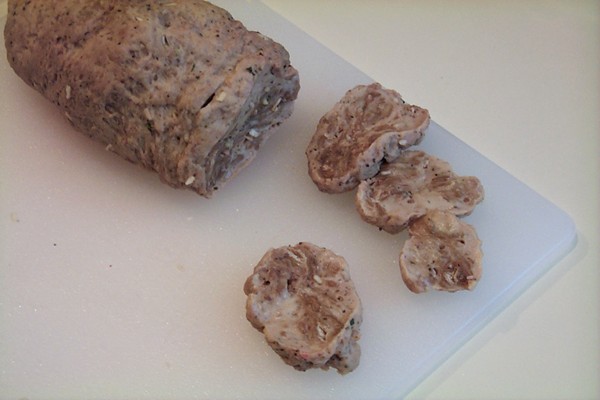
The fake chicken — made from wheat gluten and seasonings. This is the gluten dough before it was cooked.

Compost

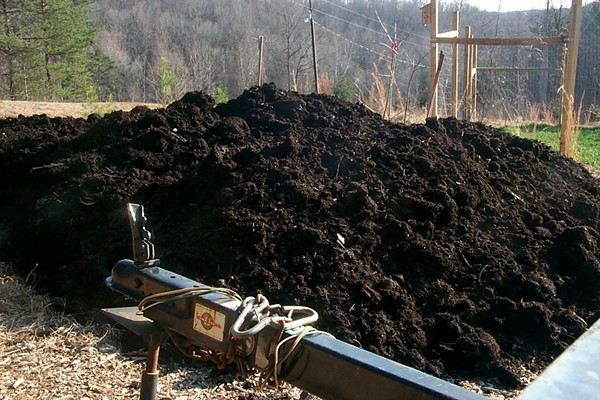
We had a nice, big load of compost delivered today. It looks like a lot of compost, but it’s amazing how much compost this place eats. You spread a bunch of compost and then wonder what happened to it all. This compost came from a local landscaping supply business. It’s made from leaves and brush chips.

Next chore: Using the tiller to turn under the winter rye grass that now covers the garden. Most of the new compost will then go into the garden. It’s a shame to till the rye under, but it has served its purpose — ground cover for the garden during the winter and providing winter greens for the chickens.

Gone to Chrome

I am constantly experimenting with Web browsers and better ways to prevent corporate snooping on the Web. This has led me — for now at least — to stop using Apple’s Safari browser and switch to Google’s Chrome browser.

For one, manual cookie management in Safari (or any browser) is just too tedious. To make matters worse, there apparently is a bug in the Safari browser that causes Safari to recreate cookies that have been deleted. At first I thought I was victim to an “Ever cookie,” but a bit of Googling indicates that this actually is a Safari bug that has been present for years, but Apple still hasn’t fixed it. I also suspect that Safari has memory leaks. What’s up with Apple? Are they neglecting development of the Safari browser for some reason? These bugs have been discussed in Apple user forums for years.

(Non-techies may be wondering, “What’s a memory leak?” A memory leak is a programming error in which a program requests an allocation of memory but fails to free that memory when the program is done with it. As a result, as the program continues to run, it starts to use more and more memory. To recover the “leaked” memory, the program must be stopped and started again. I periodically use “Activity Monitor” on my Mac to see how much memory, CPU time, and virtual memory a program is using. It is stunning that Apple’s own Safari is one of the worst offenders I’ve seen, though it’s possible that some of the problem is coming from Safari plug-ins rather than from Safari itself.)

Google Chrome, on the other hand, may have the richest set of available security plug-ins. The screen capture above shows the security plug-ins that I’m using at present with Chrome. Rather than having to find and delete tracking cookies, for example, two of these extensions (Ghostery and ChromeBlock) detect and deflect the action of tracking cookies on the fly. When you go to a Web page, both Ghostery and ChromeBlock will show you how many corporations are trying to use that page to track you — very interesting, and very scary. Also, by default, I disallow Adobe’s evil Flash with FlashBlock.

I continue to use Firefox, with the Tor extension, when I want super-secure (but slower) browsing.

Correction


A tiny celery plant, planted 11 days ago

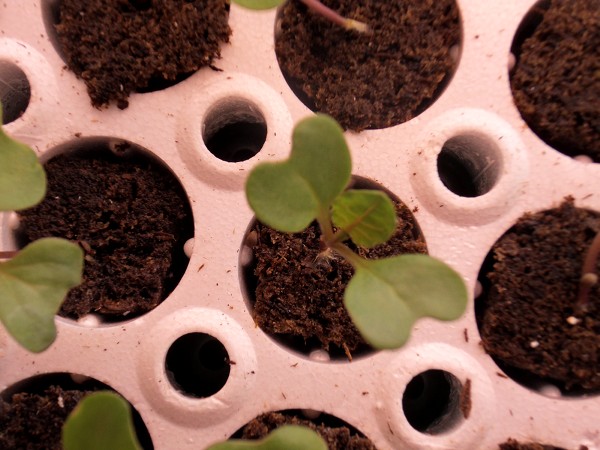
In a post yesterday, I said that my Wakefield cabbage plants didn’t germinate well. I was wrong. I had misread the chart on which I recorded what was planted where in the starter trays. It actually was celery that appeared to have a problem. But now I can see that the celery seeds actually are germinating. They’re just much smaller seeds and slower to appear. So far, six of the 10 celery seeds are up.

The plants are looking much better now that I’ve lowered the grow light closer to the plants. If all continues to go well, 95 percent of the seeds I planted will make it all the way to the garden.


For comparison, this is an 11-day-old brussels sprout

Pruning the apple trees

This photo was taken last week when the weather was colder. Most of the apple trees needed to be pruned. The trees don’t show up very well in the photo, but they’re there. I have 10 apple trees, semi-dwarf, planted in the fall of 2008. The tallest of these trees is now over eight feet. I’m hoping I might even get an apple or two this year.

Two of my apple trees — both Arkansas blacks — died last summer. I replaced them with two two-year-old Arkansas black trees from the same nursery — Century Farm Orchards. Because Arkansas blacks are my favorite apples, I requested full-size trees, rather than semi-dwarfs, for the new trees. In response, David Vernon, the orchardist, taught me something new. He said that I can make the semi-dwarf trees into full-size apple trees by planting the trees deeper, with the graft underground. Then, he says, roots will grow from the part of the tree above the graft onto the semi-dwarf root stock, thus producing a full-size tree.

Tuna-nut burgers


Burgers made with tuna, ground brazil nuts, ground pumpkin seeds, and an egg

I use quite a lot of canned salmon, tuna, and sardines in the abbey kitchen, but other than that I have never cooked meat here. The protein foods are fish, soy milk, soybeans and other legumes, grains, lots of nuts, some rice, and the eggs that Patience, Ruth and Chastity lay. I’m always looking for ways to work more nuts into my cooking. One new method is to combine nuts ground in the blender with something like tuna for burgers. Brazil nuts are particularly interesting when used in burgers and meat analogs. When ground, they have a kind of crab-like texture.

For the burgers in the photo, I used about three parts nuts and seeds to two parts tuna. The burgers tend to be a bit dry, though, and they crave some kind of savory sauce.

I always buy the nuts from the bulk section at Whole Foods. That’s much cheaper, and fresher, than buying packaged nuts. Walnuts and pine nuts are very expensive. The best bargains in nuts right now are brazil nuts, cashews, and raw macadamia nuts. Hazelnuts also are reasonably priced, but, in my opinion, the flavor of hazelnuts doesn’t combine well with other foods.